Natan’s Notes on Deuteronomy 28—What Is Torah’s Purpose?

Deuteronomy 28

Deuteronomy 28:1–68, Blessings and curses for Torah obedience. Are the curses for Torah disobedience and the blessings for obedience still applicable in the life of the redeemed believer today, or because “we’re now under grace” are these blessings and curses irrelevant to us? Or, as some preachers teach, do Christians now only receive the blessings, and not the curses of the law regardless of whether they violate the Torah or not, since Yeshua took away the curse of the law? What is the answer to this question? The short answer is this: Is the law of gravity still in effect if you jump off a cliff? For a further explanation, see my notes at 2 Cor 3:7.

Deuteronomy 28:1, Commandments. Most people with whom I have engaged in discussions about the Torah-law of Elohim have a limited understanding of the breadth, scope and purpose of Elohim’s law. If they were to understand the full ramifications of the Torah, they would likely be less inclined to dismiss its validity in their lives. When discussing the Torah with people who have a traditional Christian view of “the law,” it might be helpful to keep the following truths in mind; they help to “blow the lid” off of people’s theological boxes!

What Is the Purpose of the Torah?

(Excerpted from a larger work by Ya’acov Natan Lawrence entitled, YHVH’s Instructions In Righteousness—A Messianic Believer’s Introduction to the Torah available online at http://www.hoshanarabbah.org/pdfs/torahprimer.pdf)

The purpose of the Torah is to show man how to walk in right relationship (or righteousness) with his Creator. To do this, we must love YHVH with all our heart, soul, mind and strength (Deut 6:5; Mark 12:30) and love our neighbor as ourself (Lev 19:18; Mark 12:30). Once one is saved by grace through faith (See my teaching article entitled: The Abrahamic Covenant: The Covenant of Salvation, available at http://www.hoshanarabbah.org/pdfs/abracov.pdf.), Torah helps show man how to walk in the straight and narrow path that leads to blessings and life and avoids the curses of the law (Deut 30:15; 32:47). The Torah shows man how to avoid sin (which is the violation of YHVH’s Torah-commandments, 1 John 3:4), which is walking contrary to YHVH’s instructions in righteousness that are for our blessing and benefit.

The Torah does not set an impossible standard by which to live. We must ask ourselves, would a righteous and just Creator and a loving Heavenly Father give to his chosen people and children a set of standards that were humanly impossible to perform, and then curse them for their inability to meet these standards? Of course not! Rather, the Torah (including both the Abrahamic and Mosaic Covenants) sets a standard of faith, trusting in Elohim, and of following its system of repentance and sacrifice for obtaining forgiveness from Elohim and restoring a condition of being considered righteous in his sight. After all, Moses, the human instrument through whom YHVH revealed the Torah to the Children of Israel, states in Deuteronomy 30:11–14:

For this [Torah] commandment which I command you this day, it is not hidden from you, neither is it far off. It is not in heaven, that you should say, “Who shall go up for us to heaven, and bring it unto us, that we may hear it, and do it?” Neither is it beyond the sea, that you should say, “Who shall go over the sea for us, and bring it unto us, that we may hear it, and do it?” But the word is very near unto you, in your mouth, and in your heart, that you may do it.

Paul quotes this very passage in Romans 10:6–8 where he relates the written Torah to Yeshua, the Living Torah or Word of Elohim incarnate (in the flesh, see John 1:1, 14). He shows that they are one in the same and that Messiah Yeshua came to live and reveal to us the righteousness of the Torah-law (verse 4) that is available to us if we will but have a heartfelt faith in him (verses 4, 9–10) and allow him to live out his righteousness in us through the empowering work of the Spirit of Elohim. In verses 11 through 21, Paul goes on to relate this very truth to being the central message of the gospel that Isaiah prophesied (Isa 52:7) would be preached to redeem both houses of Israel to Yeshua their Messiah.

It might be said that in a sense that the Torah itself is neutral; neither positive nor negative, for it is like a mirror simply reflecting the image portrayed in it. Torah reacts according to human action. Those who obey it are blessed and those who disobey it are cursed. David Stern in his Jewish New Testament Commentary lists both some of the “negative” and some of the positive functions of the Torah. On the “negative” side:

  • 1) The Torah has the capacity to stir up sin in an individual. This capacity of the Torah to make us sin is not a fault in the Torah but a fault in ourselves. A healthy person thrives in an environment deadly to someone who is ill; likewise, the Torah, beneficial to a believer living by faith, is an instrument of death to these controlled by their sinful nature (p. 375).
  • 2) The Torah can still produce guilt feelings in a believer—as it rightly should whenever he contemplates how his behavior falls short of the standard Elohim sets in the Torah. But these feelings are not irremediable. The remedy is once-and-for-all trust in Yeshua the Messiah’s final atonement for sin (Rom 3:21–26), followed by ongoing confession of and repentance from sins (1 John 1:9) (Ibid.).
  • 3) The Torah also provides a framework of justice by which Elohim, the Just Judge of the universe, will judge the actions of men to determine both their level of punishment for its violation and their level of reward for obedience to it.
  • 4) Because of the righteous standards the Torah sets out, for the sinner it points out the fact that they have sinned and how far they have fallen short of the glory of YHVH (Rom 3:23) and hence their need for a Savior or Redeemer. The Torah actually points the way to Yeshua as Paul points out in the book of Galatians (3:25).

On the positive side:

  • 1) The Torah provides a framework of grace in which one can live. As David Stern points out, YHVH’s people are to live “within the framework of” Torah, but they are not to be “in subjection to” [or under] the Torah in a legalistic fashion. YHVH’s giving of the Torah was in itself an act of grace that the New Covenant (NT) compares with his sending Yeshua (John 1:17) (Ibid., p. 374). Ariel Berkowitz, in his book, Torah Rediscovered, states it this way, “[Torah] function[s] as a protective border for the people of [Elohim].” He goes on to show that there are two opposing spiritual realities in the universe: the kingdom of light (YHVH’s kingdom) and the kingdom of darkness (Satan’s kingdom). Torah acts as a protective border to keep those wanting to abide in the kingdom of light/life/blessing/relationship with YHVH safe and secure. The Torah tells us what is truth as opposed to error, light as opposed to darkness, clean as opposed to unclean, holy (kadosh or set-apart) as opposed to profane or polluted, life as opposed to death (pp. 26–27).
  • 2) The Torah, as understood and applied through the Spirit, thereby gives life in union with Messiah (Stern, p. 381).
  • 3) Obeying the Torah brings us eternal rewards (not eternal life, which is by grace through faith alone, see Eph 2:8) in the world to come (Matt 5:19).
  • 4) Obeying the Torah helps deepen a loving and intimate relationship with YHVH-Yeshua and helps us to abide in Yeshua (John 14:15; 1 John 2:3–6).
  • 5) Obeying the Torah helps us to stay spiritually pure (1 John 3:3–6).
  • 6) Obeying the Torah protects us from the influence of the devil (1 John 3:8).
  • 7) Obeying the Torah-Word of YHVH helps to perfect YHVH-Yeshua’s love in us (1 John 3:6).

Deuteronomy 28:4 and 5–12, The fruit of your womb.Please note that the blessings of children are mentioned before material blessings. What does this teach us about how YHVH views children and families? Is such a view reflected in the mores of our current society? Are those with large families more respected than those who have large homes, drive expensive cars and have high social positions?

Deuteronomy 28:15, To the voice of YHVH.What is the voice of YHVH? Is his voice that which was uttered the Torah at Mount Sinai? Is it the voice of his Spirit inside of a Spirit-led, redeemed believer? Is it the voice of Yeshua as largely recorded in the red letters of the Testimony of Yeshua, or is it the entire Word of YHVH Elohim called the Scriptures? If the answer to the question is “all of the above,” then should any parts or aspects of Elohim’s voice contradict with any other? If we have a Biblical view or theology where we believe that one aspect of YHVH’s voice contradicts with and another in that we believe a part of it has been “done away with,” then what does this imply about the mind and nature of YHVH? There is a psychological term for this. It is called schizophrenia. Now in our right mind, we would never dare label YHVH with such terms, for to do so would be blasphemy, right? Yet, in reality, many of our religious beliefs make YHVH into something that he is not, and we risk become an unwitting party to attaching this blasphemous labeling to the Almighty Creator if we subscribe to these false theologies that, in one way or another, tell us one part or another of the Word of Elohim is no longer for us today. One thing is certain. YHVH is not a liar, nor does he ever contradict himself. If there seems to be a problem with inconsistency in YHVH’s Word, the problem is with OUR ­misunderstanding or misinterpretation of it, and NOT with the actual Word or voice of YHVH!

Deuteronomy 28:15–68, Judgment on a nation and a saint’s responsibility. Read the punishment for Torah disobedience listed in chapter 28. Are these curses coming upon America as its political leaders enact legislation and its judicial leaders make legal rulings that help to turn us away from our historic Judaic-Christian heritage, while at the same time America’s religious leaders say little or nothing against this trend? You and I do not have a large voice in this nation, though we have a small voice. What can we do to help turn the spiritual tide? What are you doing to be the salt and light in this society that Yeshua has called you to be with regard to keeping YHVH’s Torah ­commands?

Deuteronomy 28:47, Ungratefulness versus thankfulness. YHVH states that ungratefulness for the blessings he has given us and failure to obey him out of a joyful and glad heart will bring curses on us. Reflect on this. How much time each day do you spend thanking him for his blessings in your life? When you get up in the morning? Every time you eat? At noonday do you stop to praise him, as David did? Before you go to sleep? Not only is doing so a form of worship, but such a heart attitude and orientation helps us to keep our focus continually upon him so that we will forget not all his benefits (Ps 103:2) and fall into a state of hardened heart and forgetfulness (Deut 29:2–4). Israel forgot what YHVH had done for them, which led to their disobedience, faithlessness and explains why the older generation was not allowed to enter the Promised Land. Will we learn from their examples (1 Cor 10:11)?


Natan’s Notes on Deuteronomy 27

Deuteronomy 27

Deuteronomy 27:2–10, Set up for yourselves. Immediately upon crossing the Jordan and upon entering the Promised Land, YHVH instructed the Israelites to set up a stone monument containing the Torah and to construct an altar for burnt sacrifices. What is the significance of these and why was it so important that this be Israel’s first order of business upon entering the Land of Promise? Matthew Henry states in his commentary that the Word of YHVH (the Torah) and prayer (the altar) must always accompany each other. Discuss this and relate it to Psalms 51:16–19 and Hosea 6:6 and the believer’s spiritual walk. Also, why did YHVH command the Israelites to construct the altar of uncut and whole stones? To whom does this prophetically point? (Read Dan 2:35, 45; Ps 118:22; Matt 21:42; Luke 20:17.) The stones of the altar were rough and uncut. To whom does this point who became our Living (spiritual) Altar and Sacrifice? (See Isa 53:2.)

Deuteronomy 27:2, 4, 8, Set up great stones. On Mount Ebal on whole, uncut stones, the Israelites were to write the Torah-law and then coat these stones with lime plaster. Elohim also told them to build an altar there where they were to make burnt and peace offerings. Why was the Torah written on stones on Mount Ebal—the mountain of the curses? Why not on Mount Gerizim, the mountain of blessing? Certainly this cannot mean that the Torah is a curse, for Paul calls it kadosh (holy), just and good in Romans 7:12. What could these stones represent symbolically? 

First, this symbology tells us that those who don’t follow the Torah will come under a curse, for to violate it is sin (1 John 3:4), and the wages of sin is death (Rom 6:23), and every person has sinned (Rom 3:23). 

Second, Who is the Chief Cornerstone, the Stone the builders rejected (Ps 118:22; Matt 21:42; Acts 4:11; Eph 2:20), and the stone cut without hands (Dan 2:34)? What was the purpose of these offerings and to whom do the burnt and peace offerings point? Could white lime plaster symbolically represent the saints, the bride of Messiah, being clothed in robes of righteousness (see Rev 19:7–8)? Who is the King of Righteousness through whom redeemed sinners become righteous? Who is clothed in robes of righteousness once their sins have been atoned for? (Read Heb 7:2, 20–28 cp. Rev 19:7–8 cp. 3:5, 18; Isa 61:10.) Who was wounded for our ­transgressions and bruised for our iniquities, had laid on him the iniquities of us all, and was made an offering for sin (Isa 53:5, 6, 10)? Who was the Living Torah, the Word of Elohim made flesh (John 1:1, 14)? Who redeemed us from the curses of the law (Gal 3:13), which came upon us as a result of our sinning (sin is the violation of YHVH’s law, 1 John 3:4), and thus bringing a death penalty upon us (the wages of sin is death, Rom 6:23)? 

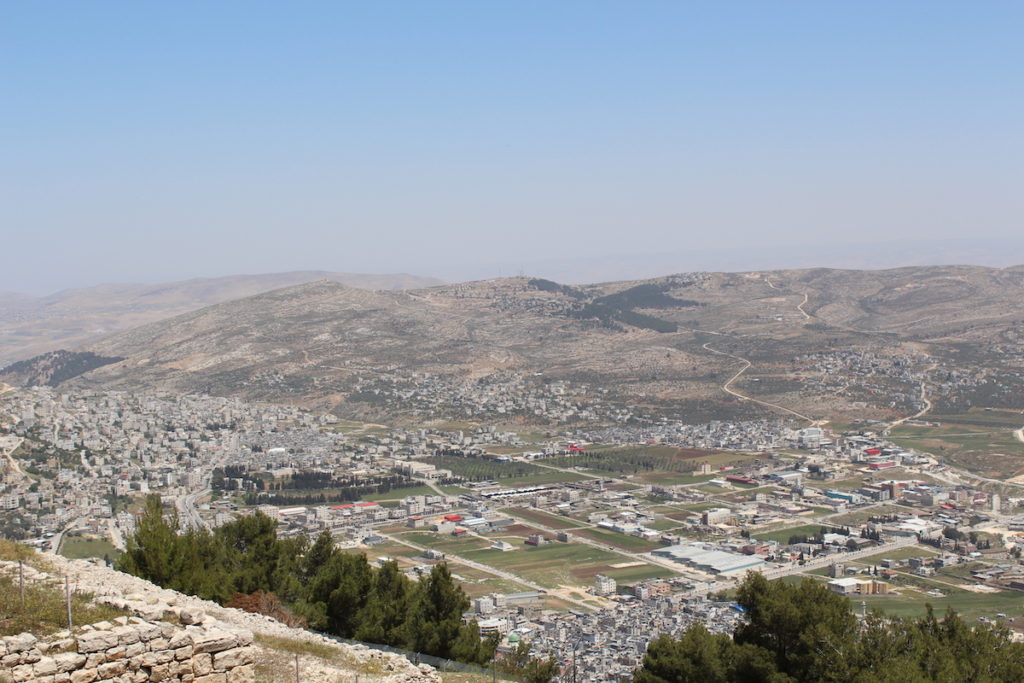
Mount Ebal

Is it now making sense why the Torah and the altar were placed on Mount Ebal? This is another one of the many prophetic shadow pictures in the Torah pointing to the redemptive work of Yeshua at the cross. Let us give glory to Elohim who knows the beginning from the end and to Yeshua the Messiah, the Lamb of Elohim, who was slain from the foundation of the world for our salvation! 

Does this strengthen your faith that Yeshua is indeed the Messiah, the Lamb of Elohim slain from the foundation of the earth? Who else could have fulfilled these prophecies?

Deuteronomy 27:11–28:68, Moses commanded the people.YHVH required the Israelites to recite a “pledge of allegiance” affirming their commitment to him before entering the Land. What can we learn from this? Is this something we should do from time to time in our own spiritual walk: recite pledges of commitment to YHVH and set up spiritual markers or reference points in our lives as tokens of our allegiance to him to which we can harken back when the going gets tough? These are acts of the will that when done can engage the heart and stir up feelings of love, devotion and remembrance.

Deuteronomy 27:11–16, Freedom versus bondage. Christian author Matthew Henry in his commentary on this verse points out something very interesting that none of the Jewish Torah commentaries I have read mention: The six tribes appointed to read the blessings from Mount Gerizim were all children of free women (Leah and Rachel). What are the spiritual implications of this? (Compare this with Paul’s discussion of the free and bondwoman pertaining to Isaac and Ishmael in Galatians 4:21–31.) To which children do the promises of YHVH’s material and spiritual blessing (namely, eternal life through Yeshua the Messiah) belong: those who are in bondage to or under the curses of the Torah-law because they walk in sin (which is the transgression of the law, see 1 John 3:4), or to those who walk in obedience to the Torah (i.e. in sinlessness or who walk in YHVH’s instructions and teachings in righteousness)? This brings up yet another issue. Is the purpose of the Torah simply to condemn people, as is taught in the mainstream church, and to bring people into spiritual bondage, and beyond that, the Torah’s only purpose is to point people to the cross after which it is to be discarded like a dirty old rag? This may be what men’s traditions and doctrines teach, but this is not what the Word of Elohim declares. Selah.

Deuteronomy 27:11–26, Cursed. What are the broader principles or remez understanding behind each of these curses? Imagine how much better the world be if people obeyed these commandments and what they imply. The Creator gave man these laws to keep the civil peace and order in society. When violated, they result in social upheaval, wars, strife,  conflicts, destruction and all sorts of evil consequences between individuals and people-groups.

  • Verse 16—Do not treat your father or mother with contempt: Respect your elders and older people in general.
  • Verse 17—Do not move your neighbor’s property line: Respect the property rights of others, and do not steal anything from your neighbor.
  • Verse 18—Do not make the blind to wander off the road: Take care of the handicapped, disabled and sick among you. Do not take advantage of them.
  • Verse 19—Do not take legal advantage of the stranger, fatherless or widow: Do not take advantage of the underprivileged, poor or the helpless people in society.
  • Verse 20—Do not have sexual relations with your step-mother: Do not have sexual involvements with any non-blood related family member.
  • Verse 21—Do not have sexual relations with animals: What more can be added to this command?
  • Verse 22—Do not have sexual relations with your sister: All incest is forbidden.
  • Verse 23—Do not have sexual relations with your mother-in-law: Again, do not have sexual involvements with any non-blood related family member.
  • Verse 24—Do not attack your neighbor secretly: Have open and honest dealings with everyone around you including your enemies.
  • Verse 25—Do not take a bribe to slay an innocent person: Do not pervert justice, lie or twist the truth to your advantage.
  • Verse 26—Do not violate YHVH’s Torah-law: All of YHVH’s commandments are to be followed.

Deuteronomy 27:11–28, Blessing and curses for obedience. In these verses we find listed some of the blessings and cures for Torah obedience. Do you believe the Torah principles (spiritual truths) of blessing for obedience and curses for disobedience to YHVH’s Word are for us today? If not why not? Is it because you are listening to Bible preachers and teachers who claim to know and teach the Word of Elohim, but who are instead teaching the doctrines and traditions of men by which the Word of Elohim has been made of none effect (see Mark 7:13)?

The following are some questions to ask yourself when considering Elohim’s Torah and the blessings and curses that come upon us as a result of our response to these instructions in righteousness, which are a reflection of the character and nature of the Creator: Does YHVH’s character, Truth or Word change? If the blessings listed in these verses are not being manifested in your life why might that be? Could it relate possibly to your level of Torah obedience and faith or trust level vis-à-vis YHVH and his Word? What changes could you make in your life that might place you in a more favorable position to receive his blessings rather than the curses?

Deuteronomy 27:15–18, The commandments are all inter-connected. To the casual reader, the admonitions contained in these verses may seem to be arranged in a random order, but this is not the case. Let’s discuss the purposeful design of the order in which Elohim gives this commandments.

Consider the following: The prohibition against idolatry (verse 15) is juxtaposed with that of degrading one’s parents (i.e. not honoring one’s parents, or as S. R. Hirsch states in his commentary, “who outwardly is respectful to his parents but inwardly considers himself vastly superior to them”) along with trespassing against one’s neighbor’s property by removing his neighbor’s boundary markers or landmarks. 

Now consider this: One who does not honor and fear YHVH but turns to idolatry (the second commandments) will not honor one’s parents (the fifth commandment) (and vice versa) will likewise not honor the property of one’s neighbor (including his neighbor’s wife). 

Juxtaposed next to these commands is the prohibition against misleading a blind person (verse 18). This means that we should not take advantage of one’s blindness by advising a blind person in a way beneficial to us and detrimental to him. 

Following this commandment is the principle about one who steals justice from another by perverting judgment against one who is weaker socially or financially or who is less informed at law than another thereby giving the advantage to the stronger (The ArtScroll Davis Edition Baal HaTurim Chumash/Devarim, pp. 2126–2127). 

Can you see how each command is interrelated with all the others? Does this not give one insight into the curious statement found in James 2:10, which declares that if you have broken one commandment you have broken them all? This should help us to see that in one way or the other, all of YHVH’s commandments are inter-related, all depend on each other, and they all stand or fall together. 

Now relate James 2:10 back to verse eight of the same chapter where James notes that the entire Torah-law can be summarized as the “royal law of love.” 

As you review YHVH’s list of prohibitions in Deuteronomy 27 can you see any other relationships between these juxtaposed concepts? Learning to exegete (draw truth out of) Scripture in this manner will yield a whole new level of spiritual revelation to the reader.


Deuteronomy 23 and 25—Natan’s Commentary Notes

More from Deuteronomy 23

Deuteronomy 23:9, Keep yourself from every wicked thing. An aspect of physical warfare or, more importantly as it pertains to the saint, in spiritual warfare that many Bible teachers who teach on the subject fail to cover is the spiritual state of the warrior.  The focus is usually on the enemy or the battle tactics employed, but, again, not on the condition of soldier who is going up against the enemy of the people of Elohim. This section of the Torah covers this oft-overlooked subject (vv. 9–14). 

The word wicked as found in this verse is the generic Hebrew word ra or ra’ah meaning in its most basic sense “evil, bad or distress.” So what does the Torah state in this passage that makes a person evil or bad and unclean and is thus offensive to Elohim? Simply this: bodily emissions that happen to naturally emanate from the human body whether it be human waste or seminal emissions. Such occurrences take a man from a state of ritually purity or being clean (Heb. tahor) to being unclean (Heb. tamay). The solution to the problem is, in the case of nocturnal emissions, cleansing by water, and in the case of the eliminations of bodily waste, burying the waste. What this teaches us it that if one goes into battle in an unclean state, this is offensive to Elohim, and the soldier may not have the favor of Elohim while he is engaging the enemy in battle. This is not a good thing for the warrior!

When it comes specifically to spiritual warfare (as outlined in 1 Cor 10:4–6 and Eph 6:10–18), the drash or homiletical level understanding of this passage teaches us that when engaging the enemy in spiritual battle, the saint must be as clean as possible spiritually. That means that all unconfessed sins need to be repented of and that all illicit behavior must be eliminated from one’s life if one expects the benefits of YHVH’s miraculous aid. One be continually washed clean of sin by the blood of Yeshua the Messiah and by the water of the Word and the Spirit of Elohim.

Because these principles of ritual and spiritual purity are usually not taught to the saints, it is no wonder that many times our prayers are not answered and that the enemy trounces Christians on the streets, in the courts, in the political arena and many other battlefields in various venues in our society. 

All this is to say that the saint must clean up his own act and house first before confronting the enemies of Elohim to do the same. Both Yeshua and Paul address the hypocrisy of those who point the fingers at others while guilty of the same or similar sins.

Judge not, that you be not judged. For with what judgment you judge, you will be judged; and with the measure you use, it will be measured back to you. And why do you look at the speck in your brother’s eye, but do not consider the plank in your own eye? Or how can you say to your brother, ‘Let me remove the speck from your eye’; and look, a plank is in your own eye? Hypocrite! First remove the plank from your own eye, and then you will see clearly to remove the speck from your brother’s eye. (Matt 7:1–5)

Therefore you are inexcusable, O man, whoever you are who judge, for in whatever you judge another you condemn yourself; for you who judge practice the same things. But we know that the judgment of Elohim is according to truth against those who practice such things. (Rom 2:1–2)

Deuteronomy 25

Deuteronomy 25:4, You shall not muzzle. According to Hirsch, this law applies not only to animals, but to workmen as well. It stands to reason logically, if YHVH cares about feeding animals while working, how much more should employers be concerned for their workmen? Rashi disagrees and says it refers only to animals (and not to workmen) and specifically to those animals that are involved in the production of food as would be the case with an ox that was used in treading out grain (to separate the kernel from the chaff). Paul disagrees with Rashi and views this Torah command as a more broadly applicable proverb implying that an employer should not deprive his employees of their wages. He specifically applies this principle to individuals who minster the gospel (1 Cor 9:9; 1 Tim 5:19). Those who work in YHVH spiritual field (the church), Paul reasons, should be supported by those they serve.

Continue reading
 

Deuteronomy 22 and 23—Natan’s Commentary Notes

Deuteronomy 22

Deuteronomy 22:1–4, Caring for a brother’s property. Concern for the property of others is the subject of these verses. In this respect, let us not forget the second half of the shema: You shall love your neighbor as yourself (Lev 19:18). What is the response of the wicked with respect to concern for their neighbor’s well being? (Read Gen 4:9.) On this passage of Scripture one rabbinical commentator states: “[T]he commandment to return lost property is ‘fundamental’ and that ‘all society depends upon it.’ It is not just a matter of one person taking care of another’s possessions or of ‘loving’ another. What is important here is the critical matter of ‘trust’ among human beings. A society depends upon the faith people place in one another. Without people feeling that they can rely upon one another—that others are looking out for what belongs to me and I must look out for what belongs to them—society collapses in suspicion, selfishness, and bitter contention” (A Torah Commentary For Our Time, vol. 3, p. 149).

Deuteronomy 22:9, You shall not sow your vineyards with different kinds of seed. (See notes at Lev 19:19.)

Deuteronomy 22:10, You shall not plow with an ox and with a donkey(that is, a kosher animal with a non-kosher animal). Baal Ha Turim, the ancient Jewish Torah scholar, interprets this verse to mean that a righteous person should not enter into a business partnership with a wicked person. The Mishnah states: “Distance yourself from a bad neighbor; and do not bind yourself to a wicked person (Avos 1:7, The ArtScroll Baal HaTurim Chumash, p. 2065). What does the Testimony of Yeshua say about being unequally yoked with unbelievers? (See 1 Cor 15:33; 2 Cor 6:14.)

Deuteronomy 22:5–12, Various laws. Matthew Henry in his commentary says of these various laws: “God’s providence extends itself to the smallest affairs, and his precepts do so, that even in them we may be in the fear of the Lord, as we are under his eye and care…. If we would prove ourselves to be God’s people, we must have respect to his will and to his glory, and not to the vain fashions of the world. Even in putting on our garments, as in eating or in drinking, all must be done with serious regard to preserve our own and other’s purity in heart and actions.” Let’s think and meditate on this.

Deuteronomy 22:6–7, If a bird’s nest.What does this passage teach us about caring for the environment and being good stewards of YHVH’s creation? How about showing mercy to animals and man’s role in preserving the species? What are the broader implications here? What are you doing to protect the environment, and to be good stewards of this earth? It starts at with each of us with our own home and garden—the tiny spot on earth that YHVH has given us to tend and keep.

Deuteronomy 23

Deuteronomy 23:2, A child of incest shall not. Mamzer (translated in the KJV as bastard; NKJV one of illegitimate birth) means “a child of a prohibited marriage.”Contrary to popular opinion, this is not referring to one born out of wedlock (the result of fornication or premarital relations), but rather the fruit of an incestuous or adulterous relationship (The ArtScroll Stone Edition Chumash, p. 1054). According to S. R. Hirsch, a Jewish Torah scholar, a mamzer was disadvantaged legally in no other way except that he was excluded from the assembly or congregation (qahal) of YHVH. According to The Theological Wordbook of the Old Testament, the Hebrew word qahal is equivalent to the Greek word ecclesia,which is commonly translated as church in the NT (ibid., vol. 2, p. 790). What does Torah’s treatment of a mamzer say about YHVH’s view of the sanctity of marriage and the family and the upholding of such as a cornerstone institution within the assembly of the saints? Hirsch comments on this verse, “[A] mamzer accordingly represents, by his existence, a sin against those laws by which God wishes marriage in His qahal to be elevated out of the sphere of simply physical association by that which [the Talmud in] Kiddushin [73a] expresses” (Judaica Press The Pentateuch/Deuteronomy, p. 456). 

In the Torah, premarital sex is not a capital offense. When it happened, the man was either to marry the young lady, or he had to pay a fine to her father. Incest, however, like homosexuality, was an abomination in YHVH’s eyes (Lev 18:6–18, 26–29), thus it would stand to reason that YHVH would take a harder stand on the product of such a sexual union. The point is to teach his people not to get involved in such sinful sexual practices in the first place. 

Deuteronomy 23:10–15, When the army goes out. With regard to the sanctity of the camp, the Jewish sages teach that whereas other armies triumph by force of numbers and arms, Israel’s success is in the hands of Elohim, and, therefore, its army’s most potent weapon is its righteous behavior (The ArtScroll Stone Edition Chumash, p. 1055). Holiness and righteousness (i.e. obedience to YHVH’s commands coupled with trusting faith in Yeshua and in his blood atonement) can help us defeat our enemies (see Rev 1:5; 12:11, 17; 14:12). Though the phrase, “Cleanliness is next to godliness” is not found in the Scriptures, it is nevertheless a true statement in light of this Torah passage.

Deuteronomy 23:18, Price of a dog. The price of a dog, according to Keil and Delitzsch, is not the price paid for the sale of a dog, but is a figurative expression used to denote the gains of a male prostitute, who was called thus by the Greeks because of the dog-like manner in which homosexuals debase themselves sexually. YHVH considers homosexuality so abominable that he specifically lists dogs (along with sorcerers, murders, idolators and liars) as being excluded from the New Jerusalem (Rev 22:15).


Deuteronomy 21–Natan’s Commentary Notes

Deuteronomy 21–25

This section of the Torah (Deut 21:10–25:19) contains 72 commandments, which is more than in any other Torah portion. In this passage there are rules pertaining to all aspects of human relations showing that the “Torah deals with the real world. It does not present a world where all people get along with one another or rush to take care of one another’s property. Instead, it ‘takes into account the grim reality that people do not achieve the desired observance of “you shall not hate others in your heart”’” (A Torah Commentary For Our Time vol. 3, p. 150). 

In studying this portion, one can easily miss the point of a particular command if one views it strictly in its pashat (most literal) meaning. For these commands to have relevance in our day, one must view them as principles that have a broad range of applications. The specific examples Torah gives are merely representative of one of but many life situations to which the principle behind the example could apply. Keeping this in mind, this Torah portion will give you much to ponder pertaining to your day-to-day walk (or halakhah).

In these chapters we see a plethora of laws concerning many seemingly small details regarding human life. Many people in the church have the tendency to broadly sweep away these commandments with such dismissive cliches as, “We’re now under grace…,” or “We’re not under the law anymore….” But please observe how many of the civil laws of our nation regulating actions between various members of society are based upon YHVH’s laws found in the Torah. 

As many of us make our way back to a more biblical truth-based lifestyle and orientation, we begin to see that (a) YHVH cares about the details of our lives, and (b) these laws, while sometimes hard to understand, are for our own well-being and blessing. Do you still nurse a “pick and choose” or “have it your own way” mentality with regard to YHVH’s biblical commandments choosing to follow the ones you want and making excuses why you can’t (or don’t want to) follow the rest? By doing so, what blessings are you depriving yourself of, and how are you hindering your love relationship with YHVH?

Some of the laws in these chapters may be hard to observe nowadays. With others, due to our church background, we may have the tendency to spiritualize them away, thus, in essence, rendering them of non‑effect in our lives and thereby placing ourselves above YHVH’s Torah-law thus becoming a law unto ourselves. Not a good thing! This is what Adam and Eve did in the garden at the tree of knowledge. Is this not humanism: every man doing what is right in his own eyes instead of obeying YHVH whatever the cost? Who is the Master of your life? You or YHVH? Let us not forget the words of Yeshua, “Not everyone who says to Me, ‘Lord, Lord,’ shall enter the kingdom of heaven, but he who does the will of My Father in heaven” (Matt 7:21), and “But why do you call Me ‘Lord, Lord,’ and not do the things which I say?” (Luke 6:46).

How do you view laws about women wearing men-type clothing, wearing fringes on the corners of your garments, mixing certain types of fibers in your clothing, lending money without interest, caring for the widows and orphans, personal hygiene, the family purity laws (e.g. men not having sexual relations with their wives during their monthly cycles), removing blood from all meat before eating it, men wearing beards, faithfully tithing, following the biblical dietary laws, and observing YHVH’s Sabbaths (weekly and annual), etc.? These are lifestyle-changing laws, many of which go contrary to the current mores of our society. 

Are we not called to be a kadosh, set-apart, special and peculiar (i.e. treasured) people before YHVH? Following these laws to the best of our ability will help us to be the people that YHVH has called us to be. What progress are you making to bring your life into conformity to his standards of righteousness?

Pursue peace with all people, and holiness, without which no one will see the Lord. (Heb 12:14)

[B]ut as He who called you is holy, you also be holy in all your conduct, because it is written, “BE HOLY, FOR I AM HOLY.” (1 Pet 1:15–16)

Deuteronomy 21

Deuteronomy 21:18–21, Stubborn and rebellious son.Many of the laws of YHVH’s penal code are preventative in nature. Such is the case with the wayward and rebellious son. In ancient Israel, there were no prisons, since it was the goal of YHVH’s Torah-laws to root out evil before it spread like a cancerous disease endangering society. In the case of the law of the rebellious son, parents’ love for YHVH must supersede even that of their children. This will help to insure that children will remain on the straight and narrow path when they become adults. What steps are you taking with regard to your children to prevent them from going down the path of faithlessness and rebellion?

Deuteronomy 21:22, Put to death…hang him on a tree.A man condemned of a crime worthy of capital punishment is to be put to death, and then hung on a tree. He is not killed by hanging. According to S. A. Hirsch, for two crimes only (blasphemy and idol worship) was the command given to hang the bodies. Even though these crimes brought on such an ignominious and shameful end as being hanged, Elohim still requires that the corpse—even of a criminal—to be honored by burial because it was still the life a human, who was made in the image of Elohim. As Hirsch notes, an unburied corpse is to be considered a disgrace and a degradation to all living humans. It also defiles the land, as this verse says. This commandment gives us some insight into how YHVH views the sanctity of life. The abhorrent practice of abortion, for example, degrades life in many ways. This not only includes how the baby is murdered in the mother’s womb, but how it is disposed of afterwards.

Deuteronomy 21:23, For a hanging person is a curse of Elohim.Compare this passage with Paul’s statements in Galatians 3:13 and then consider both of these passages in light of Isaiah 53:4–10. Rashi, a medieval Jewish Bible commentator, has an interesting comment on Deuteronomy 21:23. “For a hanging person is an insult of God. It is a degradation of the King, for man is made in the likeness of His image, and Israel are His sons. This can be compared to two twin brothers who resembled each other. One became a king, while one became ensnared in banditry, and was hung. Whoever would see him hanging would say, ‘The king is hanging!’” The rabbinical commentary on Rashi’s commentary ponders the meaning of Rashi’s statement as follows: “[Rashi’s] parable seems difficult. Could people really look at a hanging corpse and think that the King of kings [sic] is hanging? Also, what does Rashi add by noting that ‘Israel are his sons’? And finally, why does Rashi say that ‘one became a king,’ rather than ‘one was a king’ After all, God cannot be said to ‘have become’ a king” (The ArtScroll Sapirstein Edition Rashi/Deuteronomy, p. 227). These comments are curious in light of the fact that these Jewish sages were not believers in Yeshua the Messiah. How would you answer the commentator’s question from a Messianic perspective as pertaining to Yeshua?


Deuteronomy 20 Commentary—A Sword in One Hand, A Tree in the Other

Deuteronomy 20

Deuteronomy 20:1, Battle against your enemies. Scripture tells us to oppose the enemies of YHVH, who should also be our enemies. Today, our enemies are spiritual (2 Cor 10:3–5; Eph 6:12). This is because every physical enemy is an evil spiritual entity. Let’s face it, we are living in a time when the forces of evil are attacking and attempting to eradicate any vestiges of righteousness everywhere. Do you have the will to fight for what is right? 

The Bible calls us to be warriors—spiritual warriors. Paul talks about the spiritual battle in which we are all engaged (ibid.). One aspect of this battle is to cry aloud for the sake of truth, to be like a light on a hill, and to be a watchman on the wall warning those around you about what is coming. What are you doing in this regard or who are you in some way supporting those who are? One way to accomplish this is to support those who are trying to get the truth out, who are in the front lines fighting evil while attempting to promote righteousness. You can do this by helping them financially and through your prayers.

Deuteronomy 20:19, Do not destroy its trees. In its commentary on this passage, A Torah Commentary For Our Times states, “While the commandment deals specifically with cutting down trees during a siege, Jewish interpreters extend it to cover all forms of wasteful destruction under the principle of bal tashchit, or ‘do not destroy’…[all w]asteful destruction is condemned. ‘Anyone who deliberately breaks dishes, tears clothing, wrecks a building, clogs up a fountain, or wastes food violates the law of bal tashchit’” (various rabbinical sources are cite vol. 3, p. 143). 

In Genesis 2:15, Elohim commissioned Adam and Eve to “tend [or dress] and keep the garden.” The word tend literally means “to serve, work, dress, labor”in the sense of a servant or steward. The word keep means “to observe, guard, watch over, or preserve.” This was one of Elohim’s first Torah-commands to humans—to take care of or nurture the planet. Gardening is the oldest and noblest profession and was given to man by Elohim. Caring for trees and plants is a major aspect of this.

Do you view yourself as a steward with a divine mandate to help preserve, watch over, and guard all that YHVH has given you responsibility over including your body, your marriage, your children, your gifts and talents, your car, your job, your home and garden and everything else in your life? Do you view doing this as a good witness to those around you, as leaving a legacy for future generations, and as glorifying your Father in heaven?


Nuggets from Deuteronomy 17

Deuteronomy 17

Deuteronomy 17:1–3, Sacrifice.Yeshua, for us, offered himself as a spotless Lamb without blemish. Do you give YHVH your best, or do you give him the crumbs and leftovers? For example, do you give YHVH the best part of the day (the morning) for prayer, Bible reading and devotion, or the end of the day when you are tired and ready for bed? Do you give YHVH the first fruits (tithe) of your income or the leftovers (or none at all)? How are you helping to advance his kingdom on earth by using the talents, time and abilities he has given you, or are you using your energies and abilities to satiate the lusts of your flesh?

Deuteronomy 17:6 (and 19:15), By the testimony of two or three witnesses. In the Bible, one could not be accused of a crime (i.e. a sin) without the testimony of two or three eyewitnesses. This admonition is repeated in the Testimony of Yeshua:

But if he will not hear you, then take with you one or two more, that in the mouth of two or three witnesses every word may be established. (Matt 18:16)

This is the third time I am coming to you. In the mouth of two or three witnesses shall every word be established. (2 Cor 13:1)

Against an elder receive not an accusation, but before two or three witnesses. (1 Tim 5:19)

He that despised Moses’ law died without mercy under two or three witnesses. (Heb 10:28)

Most gossip and slander would stop if this commandment were followed, and thus much division and strife within the congregation of believers. 

How many times have you repeated hearsay and gossip without checking the source? Even if you know it to be true, is it beneficial and righteous to repeat it to others? One Jewish sage goes so far as to say that Messiah has not come back because of all the gossip and slander of the people of Israel. Perhaps. At the very least, the Spirit of Elohim is greatly grieved, our intimacy with Elohim is diminished, and our marriages, families, friendships and congregations are fractured, hurt or destroyed because we speak things that should not be uttered.

How often do we accuse, slander and gossip about other people through use of the “evil tongue” (lashon hara) without going through proper channels and following proper biblical protocols to resolve interpersonal conflicts as Yeshua instructed in Matthew 18? How often do we attack others and spread our evil reports and accusations about others when we were not even eyewitnesses to what occurred or were not involved in the matter? How often do we attack YHVH’s leaders and accuse them of evil when there are no other witnesses (1 Tim 5:19)? YHVH hates those who sow discord among brethren and lying false witnesses, and calls this practice an abomination (Prov 6:16–17, 19). So let’s all be careful with our mouths!

Deuteronomy 17:2–5, Dealing with wickedness. Probably no one reading this is involved in any of the gross idolatrous practices listed here, but there are those little foxes (or little sins) that spoil the grapes (Song 2:15) and the little bit of leaven (tiny sins) that inflates or sours the whole loaf of bread. What ­idols or heathen practices, unrighteous world views, worldly attitudes, secular tendencies, profane habits and thought ­patterns, verbal expressions, etc. have you assimilated into your life that are keeping you from walking a higher, and hence, a more intimate and anointed walk with YHVH? Ask the Ruach haKodesh (the Set-Apart Spirit) to reveal these spiritual idols and strongholds to you so you can rid your life of them.

Deuteronomy 17:8–13, Matters of controversy. How respectful and obedient are you to the spiritual leaders YHVH has placed over you? Or do you follow their wise counsel only if and when it suits you? Nowadays if we don’t like a leader we simply leave our congregation and find a new one. In ancient Israel, this was not an option, nor was it an option in the first century. There was only one congregation in each town, and if there was a disagreement, people had to learn to work out their differences. What if we were in that situation today? How would that change your method of operation if you couldn’t just “cut and run” whenever things didn’t go your way or you got offended?

Deuteronomy 17:14–20, King over you. It is YHVH’s will for Israel to be ruled by a king. In the Messianic Era (Millennium), King Yeshua the Messiah, the Son of David, will rule not only over Israel but over the entire world from Jerusalem. YHVH ordained righteous leadership to help guide his people in the ways of truth and righteousness. 

When there is no leadership, everyone does what is right in his own eyes as occurred during the time of the judges. The Bible gives numerous examples of the chaos that results in a society or a group of people where there is no leadership. For example, The ArtScroll Stone Edition Chumash points out, “Two of the saddest episodes after Israel arrived in its Land—the graven image of Micah (Judg 17–18) and the atrocity involving the concubine at Gibeah (Judg 19–21)—are described by Scripture as having been possible only because there was no king in Israel (Judg 18:1; 19:1); had there been the leadership and discipline of a righteous king, he would never have permitted such outrages to take place” (pp. 1028–1029). 

Elohim is not the author of confusion (1 Cor 14:33). Nowhere in the Bible does Elohim permit his people to be leaderless whether it was patriarchal leadership, Levitical leadership, the leadership of judges and prophets, kingly leadership, the leadership of apostles and elders culminating in the leadership of King Yeshua and the glorified saints that will be ruling with him as kings and priests in his millennial kingdom. 

Numerous times in Scripture, YHVH not only expects his people to obey the righteous leaders he has put in place, but even unrighteous civil leaders (at least until they demand that one disobeys the higher laws of Elohim).

Many times in the Hebraic Roots Movement, one encounters folks who have been emotionally traumatized and hurt in the past by ungodly church leadership. As a result, many of these people now refuse to come under any leadership at all godly or otherwise. They pride themselves in establishing congregations and fellowships “where no one is the leader.” This is a recipe for disaster. Get back to me in one, two or five years and let me know who your experiment in this ungodly venture went. Eventually division and strife will tear such groups apart! After all, if everyone has equal say and anything can go on, who is going to stand up and say “this is wrong” and “that is unbiblical”? When grievous wolves in sheep’s clothing come in to tear the flock apart, who is going to put these agents of Satan out of the fellowship? 

No, leaderless groups are not a good thing. Those who want this are either naive when it comes to the machinations of human nature, or are they are rebels themselves and really don’t Elohim to rule over them, since he is the author of godly, righteous leadership

Do you resist YHVH-ordained leadership? If you have been hurt or “burned” by unscrupulous and self-serving leaders in the past, do you now refuse to recognize YHVH-ordained leadership thus losing the blessings that such leadership could bestow on your life? Let’s not throw the proverbial baby of righteous leadership out with the bath water because of our past hurtful experience. 

Deuteronomy 17:18, He shall write. The king was to know the Torah so that he could rule righteously based on the Word of YHVH. The book of Revelation says that the saints will be kings and priest ruling with Yeshua in the Millennium. Do you want to rule with him? If so, what are you doing now to prepare yourself for that position of responsibility? Is the study of YHVH’s Word a priority in your life or does it get bumped to last place after you have completed all the physical things you feel you need to do? How we prepare now for the future will determine our level of reward in YHVH’s kingdom. Will you be the least or the greatest? This will be determined by your study and practice of Torah. (See Matt 5:19.)