Was the Epistle of James Named After King James?

James 1:1, James. This name is the English form of the Old French variation of James from the Late Latin name Iacomus, which was derived from the Greek New Testament name Iakobos, which in turn derives from the Hebrew name Ya’aqov. This was the name of five men recorded in the Testimony of Yeshua.

The Testimony of Yeshua/The New Testament

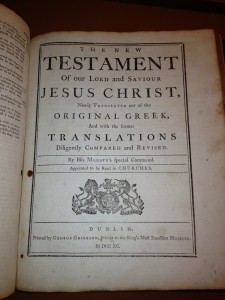
The Testimony of Yeshua/The New Testament from my 1790 KJV Bible.

It is speculated that the development of Iacobus to Iacomus is a result of nasalization in the French language of the o and assimilation to the following b followed by simplification of the cluster mb through loss of the b.

The notion that the name James derives from King James of England, who ordered the translation of the Bible version (published in 1611) that bears his name, is erroneous. This is because earlier English versions of the Bible (the Geneva Bible published in 1557 and the Wycliffe Bible published 1382 to 1395) used the name James (the English equivalent name Jacob) long before King James was born.


Blog Scripture Readings for 4/21 through 4/27/13

Aside

Parashat Emor — Leviticus 21:1 – 24:23
Haftarah — Ezekiel 44:15-31
Prophets — Jeremiah 12:1 – 18:23
Writings — Job 16:1 – 22:30
Testimony — Acts 25:1 – 28:31; James 1:1 – 3:18

Most of this week’s blog discussion points will be on these passages. If you have general comments or questions on the weekly Scripture readings not addressed in a blog post, here’s a place for you to post those. Just use the “leave a reply” link below.

The full “Read Through The Scriptures In A Year” schedule, broken down by each day, can be found on the right sidebar under “Helpful Links.” There are 4 sections of scripture to read each day. One each from the Torah, the Prophets, the Writings, and from the Testimony of Yeshua. Each week, the Torah and haftarah readings will follow the traditional one-year reading cycle.

Weekly Blog Scripture Readings for 4/21 through 4/27/13.

We are instructed in Vayikra/Leviticus 23:15-16: “You shall count for yourselves – 
from the morrow after the Shabbat, 
from the day when you bring the Omer of the waving – seven Shabbatot [weeks], they shall be complete. 
Until the morrow after the seventh Shabbat 
you shall count fifty days; 
and you shall offer a new meal offering to YHVH.”

This is the 4th week of the counting of 7 weeks.


On Crime and Punishment—Biblical Style

Leviticus 20:1, On capital crimes. This chapter contains a number of Torah laws that when violated carry capital punishment. In 1 Corinthians 6:9–11, several of the same crimes are mentioned (i.e., adultery, fornication, homosexuality, idolatry), but the violators were forgiven and received salvation (verse 11). Why were these sins punishable by death in ancient Israel, but not later on? The Leviticus 20 directives apply to Israelites or those from foreign nations who had attached themselves to Israel (verse 2) who are held to a higher accountability and thus should know better not to commit these sins in the first place. On the other hand, the believers in Corinth had practiced these sins before they came to a knowledge of the truth, and were thus held to a lower level of accountability because of their ignorance.

20343970

What about the Corinthian believer who was sleeping with his stepmother (1 Cor 5:1–5)? In Leviticus, in the nation of Israel, this sin would have been punishable by death. In the first century, the Jews didn’t have their own nation, but were under Roman law and were thus not able to execute people for capital crimes. The next best thing to do apart from capital punishment was to put the sinning man out of the congregation, which is what Paul did. This was tantamount to spiritual death. These are the exact discipline protocols Yeshua advised be carried out within the body of believers (Matt 18:15–20). Such an individual was to be excommunicated and treated as a heathen and sinner (verse 17). And how are heathens and sinners to be treated? They are to be evangelized and brought to repentance, which is what happened to the sinner in Corinth (2 Cor 2:5–8).

Now David committed adultery and murder in his affair with Bathsheba, but was not sentenced to death. Why? Why was the Torah not carried out fully in David’s case? Surely he knew that he was sinning beforehand. For one thing, he repented bitterly (see Ps 51) and was forgiven. He never again committed these sins. In his case, mercy of Elohim rejoiced over or trumped his judgment (Jas 2:13 cp. Ps 85:10; Jer 9:24; Ezek 33:11; Mic 7:18; Exod 34:6–7).

Though Leviticus 20 records capital punishment for a variety of crimes, in Israel’s long history, the Jewish sages inform us that very few executions ever occurred for violating these laws. Mercy and grace seemed to be more the rule than the exception, and this modus operandi carried over into the era of the New Covenant as well.


Wake Up Call to an Apostate Nation

Jeremiah 2:4–28 and 3:4, Weeping for and a Warning Against an Apostate Nation

In this scripture passage, Jeremiah, the weeping prophet (lamenting for the apostate condition of the nation of Israel), speaking on behalf of YHVH, pleads with Israel to return to YHVH, the Elohim (God) of Israel, who had graciously blessed that nation. Under YHVH’s watchful care, Israel had prospered, yet eventually, like the first century believers in Laodicea (Rev 3:14–22), material prosperity had led to their forsaking YHVH for secularism.

Shofar-NL blowing

Jeremiah addresses all levels of Israelite society: kings, princes, priests, prophets, pastors and the people. No one escaped his stinging rebuke. In our day, kings and princes would correspond to our political leaders, while prophets, priests and pastors to our spiritual leaders. The people would be everyone else.

In verse 13, Jeremiah states that Israel was guilty of two sins: they had forsaken YHVH, the Fountain of Living Waters, and had exchanged his divine and life-giving truth for the stagnant waters of man-made cisterns, which in Hebraic poetic symbolism is a metaphor for false, humanistic religious and philosophical systems of men. In verse 27, Jeremiah accuses Israel of turning its back on YHVH and exchanging worship of the Creator for worship of the creation and material objects (idols). This is reminiscent of what the Apostle Paul declares in his Epistle to the Romans (chapter one) of a society that rejects the divinely revealed truth of YHVH as found in the Scriptures, and then begins worshipping that which the Creator created including the earth, animals and their own bodies (resulting in hedonism and sexual perversion). In verse 21, Jeremiah declares that Israel had become like a degenerate plant and a strange or foreign grape vine, which can be related to the wild olive tree Paul speaks of in Romans 11. (See also Jer 11:16.)

With all this in mind, can we identify any spiritual parallels between ancient Israel and modern America? If Jeremiah were alive today what might he say to America?

A Wake Up Call — The Battle For the Soul of America

For several generations now, a righteous remnant of end-time warriors has been fighting an uphill battle against immorality, abortion, rebellion against the biblical laws of YHVH, Continue reading →

 

Blog Scripture Readings for 4/14 through 4/20/13

Aside

Parashat Achrei Mot – Kedoshim — Leviticus 16:1 – 20:27
Haftarah — Amos 9:7-15
Prophets — Jeremiah 4:1 – 11:23
Writings — Job 9:1 – 15:35
Testimony — Acts 20:1 – 24:27

Most of this week’s blog discussion points will be on these passages. If you have general comments or questions on the weekly Scripture readings not addressed in a blog post, here’s a place for you to post those. Just use the “leave a reply” link below.

The full “Read Through The Scriptures In A Year” schedule, broken down by each day, can be found on the right sidebar under “Helpful Links.” There are 4 sections of scripture to read each day. One each from the Torah, the Prophets, the Writings, and from the Testimony of Yeshua. Each week, the Torah and haftarah readings will follow the traditional one-year reading cycle.

Weekly Blog Scripture Readings for 4/14 through 4/20/13.

We are instructed in Vayikra/Leviticus 23:15-16: “You shall count for yourselves – 
from the morrow after the Shabbat, 
from the day when you bring the Omer of the waving – seven Shabbatot [weeks], they shall be complete. 
Until the morrow after the seventh Shabbat 
you shall count fifty days; 
and you shall offer a new meal offering to YHVH.”

This is the 3rd week of the counting of 7 weeks.


Same Play, Different Actors

An Overview of Jeremiah 1–8

Jeremiah chapters 1—8. Jeremiah prophesied to ancient Israel some 2800 years ago. What relevance could a bearded and robed prophet from the Middle East have to us living in the 21st century? The answer is simple: People are people! Only the actors, costumes, sets and venues change.

Prophet 15228598

So what social and spiritual issues burdened the old prophet’s heart?

  • Israel worshipped other gods besides YHVH Elohim (Jer 2:5).
  • Their religious leaders didn’t know Elohim (Jer 2:8).
  • False prophets filled the land (Jer 2:8) who predict only ear-ticklying nicety things (Jer 6:11).
  • Religious people relied on their own efforts—programs, man-made religious systems—instead of relying on the Spirit of Elohim to lead them (Jer 2:13).
  • The fear of YHVH Elohim was gone from the land (Jer 2:19; 5:24).
  • Israel had turned to false eastern religious systems (e.g. pantheism and earth worship, Jer 2:27).
  • The abominable practice of abortion/infanticide was socially acceptable (Jer 2:34).
  • The fatherless and needy were not being defended (Jer 5:28).
  • The religious system was full of self-appointed leaders who were con artists who lacked spiritual power (Jer 5:31).
  • False spiritual leaders were popular among the people (Jer 5:31)
  • The people and spiritual leaders were given over to greed and covetousness—i.e., the love of money (Jer 6:13; 8:10).
  • Everyone had rejected the Torah (Jer 6:19).
  • People refused to repent of their wicked sins (Jer 8:6).
  • The land was full of false spiritual teachers who didn’t know the Torah, and who spoke falsely (Jer 8:8–9).

From Jeremiah’s day until now, are things really different in our society or even in the church world?


Men Respect Your Wives by Keeping Your Distance

Leviticus 15:19–24, The laws of niddah apply to a women in her menstrual cycle. This is an area that many take for granted, but not YHVH in his Torah. A woman’s body produces life or death depending on whether an egg has been fertilized or not during her monthly cycle. There are many spiritual ramifications to this, and YHVH does not treat this matter lightly. While her egg is passing from her body she is in a state of impurity since, in a sense, death is occurring (an unfertilized egg is passing out). It is a time of grieving and emotional turmoil for the woman. This is NOT the time for a man to approach his wife. To do so, as already noted, is strictly forbidden (Lev 18:19).

8248913

Consider the benefits to the marriage of the husband and wife separating themselves sexually and emotionally at this time each month, and how it can benefit and enrich a marriage. The man learns self control and selflessness in that he is given the opportunity to be extra solicitous of his wife’s needs without expecting anything in return. What’s more, how much sweeter their time of intimacy will be when the do come back together intimately. The old adage, absence makes the heart grow fonder, could apply here.

The Torah considers a woman to be unclean for at least seven days, even if her flow lasted only one day. So at the minimum a man is to be separated from his wife (giving her an emotional break) for at least seven days, if not longer. On the eighth day (at the minimum) or the next day after her flow has stopped, she is no longer considered unclean (The ArtScroll Tanach Series Vayikra, p. 247). Eight is the biblical number signifying new beginnings. In this case, eight relates to the new cycle of life that begins as the woman’s body begins to produce a new egg with the potential for new life to occur.