The video explains one of the greatest mysteries of the Bible — Jacob”s dream of a ladder to heaven. this is the sotryof hte gospel message, which takes us from the Genesis all the way to the Book of Revelation.


The video explains one of the greatest mysteries of the Bible — Jacob”s dream of a ladder to heaven. this is the sotryof hte gospel message, which takes us from the Genesis all the way to the Book of Revelation.
Genesis 39:2, 21, 23, YHVH was with Joseph. This phrase is repeated three times in this chapter to emphasize an important spiritual principle. Even in the midst of Joseph’s unfair persecution first as a slave then as a prisoner, his faithfulness to YHVH insured YHVH’s divine protection and favor in these adverse circumstances. Many are the afflictions of the righteous, but YHVH delivers him out of them all (Ps 34:19), and YHVH promises to accompany his people through the floods and fires of adversities (Isa 43:2). Joseph’s prevailing through adverse and unjust circumstances with YHVH’s help should be a great source of encouragement for every believer.
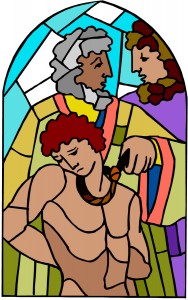
Joseph…a successful man. Even as a slave, YHVH blessed and prospered Joseph. YHVH can prosper us in any work situation in which we find ourselves — even if we’re not much better than a slave. If we but will apply ourselves to work hard and diligently, while staying faithful to YHVH as Joseph did, YHVH will prosper and promote us. Laziness, greed, theft, covetousness and irresponsibility has never gotten anyone anywhere in any employment situation.
Mark 5:1–20, The Gadarene demoniac. This encounter between Yeshua and this demon-possessed individual teaches us about the characteristics of one who is tormented or even possessed by an evil, unclean spirit.

The Scriptures are full of wonderful details and puzzle pieces that when fit together form the glorious picture of YHVH’s gospel plan of salvation. The following story is yet another example of this.
Genesis 38:29, Pharez [Heb. Peretz]. This name means “breach” or breaking through by pressing forward.” It is from the root word meaning “breach, gap, bursting forth, outburst; broken wall.” Yeshua is from this branch of Judah. Peretz received his name because of the violent nature of his birth. He was born before his twin brother, Zerah. The Peretz family line was the more prominent of the Peretz-Zerah family lines.
Matthew Henry in his commentary notes that it’s a wonder that of all the tribes Yeshua should proceed from this one considering its incestuous origins and YHVH’s displeasure over such sin. Yet Henry goes on to say that YHVH chooses human instruments not because of their merits, but out of grace, and that Yeshua came into the world to save sinners, even the chief of sinners, including those of his own family. Moreover, the worthiness of the Messiah wasn’t to be found in any meritorious moral qualities of his ancestors, but in himself alone. It is a wonder that the Jews boast at all about their lineage in light of its incestuous origins. As Jeremiah warns, a man should not glory in anything they are or have done but only that “he understands and knows me, that I am YHVH which exercise lovingkindness, judgment, and righteousness, in the earth, for in these things I delight” (Jer 9:23–24).
The inclusion of the accounts of Judah, Tamar, Pharez and Zerah further confirm the divine origin of the Scriptures. It is the generally accepted tradition in both Jewish and Christian circles and the opinion of conservative biblical scholars that Moses wrote the Torah (the first five books of the Bible). Genesis 38 gives important background information about the founding of the tribe of Judah and, more importantly, about the origins of the Messiah who was born out of this tribe. Other than a couple of oblique prophecies, there is no overt indication in the Torah that the Messiah, the Redeemer of Israel, would could come from the tribe of Judah, yet Moses included the inglorious details of the founding of this tribal family therein for no apparent reason. Those of us looking back in history at the Messiah’s birth can see how Genesis 38 fits perfectly into the overall biblical redemption story, but those in times past looking forward to the Messiah would have likely been hard pressed to see this. From our vantage point, this is yet another proof of the hand of the Divine Providence in the writing of the Scriptures.
1 Samuel 12:1ff, A king over you. The establishment of Saul as king in Israel was a constitutional or limited monarchy, unlike the kings of other Eastern nations of the time where the king had total, unlimited and absolute power. Their kings ruled by whim and fancy, while Israel’s would be subservient to the Torah; their kings placed their self-aggrandizement above the national interest, while Israel’s king was charged with upholding and safeguarding the nation’s righteousness, and with guiding Israel as the bearer of [Elohim’s]—not the king’s—majesty (The ArtScroll Stone Edition Chumash, p. 1187). “The Jewish king was bound to respect the liberty, honour, and the property of his subjects, and his powers were strictly limited by the fundamental laws of the Torah (Deut 17:14–20). Prophets, psalmists, and sages all conceived of the king as a shepherd of his people, whose scepter should be a scepter of peace, pity, and righteousness” (The Soncino Pentateuch, p. 649). This is the basis of a republican form of government, which, in theory, is the basis for American government. As you become more familiar with YHVH’s laws it will become evident that certain aspects of the American legal code derive from the Torah. This truth underscores the fact that our society has deep Judeo-Christian roots.
Parashat Vayeshev — Genesis 37:1 – 40:23
Haftarah — Amos 2:6 – 3:8
Prophets — I Samuel 11:1 – 17:58
Writings — Psalms 55:1 – 61:8
Testimony — Mark 3:20 – 6:55
Most of this week’s blog discussion points will be on these passages. If you have general comments or questions on the weekly Scripture readings not addressed in a blog post, here’s a place for you to post those. Just use the “leave a reply” link below.
The full “Read Through The Scriptures In A Year” schedule, broken down by each day, can be found on the right sidebar under “Helpful Links.” There are 4 sections of scripture to read each day. One each from the Torah, the Prophets, the Writings, and from the Testimony of Yeshua. Each week, the Torah and haftarah readings will follow the traditional one-year reading cycle.
Weekly Blog Scripture Readings for 11/29 through 12/5/15.
Mark 3:16–17, Surnamed Peter … sons of thunder. Yeshua chose twelve apostles, but the first three of the twelve that he chose were unique. This trio—Peter, James and John—formed the innermost circle of Yeshua’s associates, and ten times the Scriptures record their names together, as a group. Beyond that, Yeshua spoke prophetically over each one which, we can now see in retrospect, pertained to the calling he was giving them to canonize what would later become known as the New Testament. Let’s now examine the scriptural evidence for this assertion.

James and John — the Sons of Thunder
To Simon, Yeshua gave the nickname Peter, which means “a stone” (Gr. petros meaning “stone” as opposed to petra meaning “rock, cliff, ledge, large stone.” See Matthew 16:18 where juxtaposes these two words — the former he attributes to Peter, the latter to himself.
To James and John, the two sons of Zebedee, he gave the nickname Sons of Thunder (Aram. Boanerges). Did you ever wonder why he dubbed only these three disciples with sobriquets and not the others? Was Yeshua just having fun and playing games, or was he declaring over them, in these nicknames, what their prophetic mission was to be years later? “These are the original apostles who were given distinctive titles by [the Messiah] in order to convey some special assignments that they were expected to complete. Peter Continue reading