Here is a question from one of this blog’s readers for Natan:
So, I have a super bizarre question for you if you don’t mind. Using Scripture as your base, what is your opinion or interpretation of rightness or wrongness of donating your body to science after death? I have always felt that an earth burial was what was correct, but as I consider how transient we (and people in general) are these days, and the ridiculous cost of death. I am wondering if I should rethink this. Thoughts? I know, I’m a weirdo…
Natan’s response:
You’re not a weirdo. These are honest and reasonable questions that I have asked myself. I’m not aware of any biblical commands or principles that give instructions on this issue. That doesn’t mean there aren’t any, but only that I’m not aware of any. As we get older, we start to think of these things more, don’t we?
I have shied away from having my body used for science or for donating parts to those in need. Somehow, it goes against the grain of my thinking, but I can’t put my finger on why, or give Scriptures for it.
Similarly, people sometimes asking me about cremating vs. burying a body. Again, there are no scriptural commands on this issue, only Hebrew tradition. Traditionally, the body was buried, but this isn’t a biblical command.
I agree that in light of the high cost of burial services, cremation seems like a reasonable option.
Frankly, after I’m dead, I don’t care what happens to my body. Deal with it in the easiest and most cost effective way possible is my opinion. I don’t need a gravestone in a plot somewhere that no one will visit anyway. So why go through the bother? My inheritance is a heavenly one as I await the resurrection.
1 Corinthians 11:23, This is my body.We are sanctified through the offering of the body of Yeshua (Heb 10:10).When we eat the bread of communion, we are “eating” Yeshua who is the incarnate and Living Torah Word of Elohim (John 1:14). We are announcing that Yeshua is the spiritual bread of life from heaven that leads to eternal life (John 6:48–51), and we are announcing our desire to live by the totality of his Word (Matt 4:4).
The bread symbolizing the body of Yeshua was unleavened, which is a picture of Yeshua’s sinless life. By eating this bread, we declare our faith in his sinless life by which he was able to pay for our sins. We also declare our identification with his sinlessness as an example for us to follow.
Yeshua took the unleavened bread and broke it signifying our deliverance from our sin nature by the breaking or death of his sinless body. The unleavened bread broken during the Passover meal speaks of our deliverance from the power of sin by the death of our old man. The rite of baptism is a picture of this (Rom 6:4–13). This paves the way for us to live a sanctified (sin-free) life.
Numbers 17:1–13, Aaron’s rod. Aaron’s rod that budded is a picture of what? Who was the rod or Branch from the stem of Jesse that budded forth with spiritual life for all those who will place their faith in him? Spiritual life for you and me came from what dead tree? Can we not see that Yeshua and the message of the gospel is at the center of everything in the Bible from the beginning to the end? Can there be any doubt that Yeshua is the Messiah? Only he fulfilled all the prophetic types and shadows that we find in the Tanakh (Old Testament).
Aaron’s ministry was anointed of YHVH. The rod represented his authority and its budding represented the fruitfulness of his ministry. It symbolically pointed to the ministry of Yeshua. If we are disciples and imitators of Yeshua, aren’t we to be doing what Yeshua did, that is, bearing good spiritual fruit as he did?
Is your ministry anointed of YHVH? What are the spiritual fruits being born from it? Are people’s lives being changed for the good because of your spiritual example? Or, on the other hand, are you living in delusion due to the fact that your ministry, to one degree or another, is focused on yourself in that you think that you are called and anointed of YHVH, when in reality you have arrogantly appointed and promoted yourself like the rebels who challenged Aaron?
If we are to be pleasing to YHVH, we must periodically ask ourselves these hard questions and stay accountable before YHVH to ensure that we’re still walking on his straight and narrow path of righteousness.
To ensure that we don’t get side-tracked and start going down the path of self-adulation and aggrandizement, consider the following.
Numbers 17:13, Whoever comes near the tabernacle of YHVH must die.YHVH doesn’t allow sinful and rebellious man to come near his Presence. After the Israelites had rebelled against YHVH multiple times, the fear of YHVH,which they were lacking, had to be re-established. Here YHVH is teaching the Israelites these important lessons by establishing boundaries around the tabernacle.
When men have a proper fear and respect for YHVH Elohim and his human structures of authority, they are less likely to step out of line and sin against Elohim and against their fellow man. There must be a separation between YHVH’s Presence and man. That separation must be maintained and enforced to keep men in line spiritually and knowing their place before the Almighty.
On the fear of YHVH Elohim, review the following scriptures: Deuteronomy 10:12; Psalms 2:11; 33:8; 34:7; 96:4,9; 111;10; 2 Corinthians 5:11; 7:1; Hebrews 12:28.
On the transcendence of YHVH Elohim, review the following scriptures: 1 Chronicles 29:11–12; Psalms 89:6; 96:4–5; 97:9; 135:5; Isaiah 40:12–28; Ephesians 1:21; 4:6.
The bottom line here is this: Keep your eyes on Yeshua and the cross, not on yourself, and what’s in it for you, and stay in the fear of Elohim, and you and your ministry will be anointed and bear good fruit for the kingdom of Elohim.
Num 15:30 — Wilful sin defined. Penalty for wilful sin is being cut off from Israel (i.e. a death penalty).
Num 15:32–35 — Example of wilful sin given; i.e., a man wilfully violating the Sabbath.
Num 15:37–41 — Wearing tzitzit is an outward visible reminder to help keep one from sinning (violating YHVH’s commands).
Num 16:1 — The rebellion of Korah and company is an example of what wilful sin looks like on a societal level.
Num 16:2 — Korah et al rose up in pride like the Lucifer—the spirit of pride (of sin) and rebellion against YHVH’s commandments (Isa 14:12–17).
Num 16:7 — Pride of those who rise up against YHVH and divinely appointed leadership. In this case, it was pride and rebellion against Moses, who is a prophetic picture of Yeshua, godly leadership, the biblical leadership and the word and commandments of Elohim.
Boy reading from a gevil parchment scroll. This one is written on goat skin.
1 Corinthians 9:20
And unto the Jews I became as a Jew, that I might gain the Jews; to them that are under the law, as under the law, that I might gain them that are under the law; to them that are without law, as without law, (being not without law to Elohim, but under the law to Messiah,) that I might gain them that are without law. To the weak became I as weak, that I might gain the weak: I am made all things to all men, that I might by all means save some.
What does Paul mean when he says “under the law to Messiah”? The answer should turn the theology of the whole mainstream Christian church with regard to its view of the Torah-law totally on its head!
It is evident that when Paul uses the phrase, “under the law” in his writings, he at times infuses different connotations into this phrase. Only by studying the context of the surrounding passages in which this phrase is imbedded can we understand the exact connotation that Paul is attaching to the term “under the law.”
In this passage, the phrase “under the law” is found four times, and doesn’t connote “under the penalty of the law,” (as is the case with Paul’s usage of the term in Romans). The first three times this phrase is found here it means “in subjection to a legalistic perversion of the Torah” (as David Stern translates it in his Complete Jewish Bible and then explains reasons behind this translation in his Jewish New Testament Commentary). Here Paul identifies several groups of people, each of which had its own view of the Torah. These groups were (a) ethnic Jews, (b) those (ethnic Jews or otherwise) who had come under a legalistic view of the Torah in that they believed, for example, that circumcision was a precondition for salvation (certain Pharisees believed this [see Acts 15:1], and Paul was dealing with this doctrinal perversion in the first several chapters of Romans), (c) those (presumably Gentiles) who had no knowledge of the Torah, and (d) those new believers who were still weak and unstable in their faith.
In Paul’s final usage of this phrase in this passage he adds to the phrase under the law” [Gr. ennomos meaning “in the law”] the two words “in Christ.” This changes the whole meaning of the term under the law. As we have noted above, “under the law,” as Paul uses it can mean “under the [penalty of] the Torah,” or “under a legalistic perversion of the Torah,” but here Paul is referring to Torah obedience in the context of a faith in Yeshua. Is Paul referring here to Christians who keep the Torah? Yes! This is what the first century redeemed believers were, and what Paul confesses here about himself (1 Cor 9:21). Paul’s pro-Torah stance is totally consistent with other apologetic statements he makes concerning the Torah along with his confession to being totally Torah-obedient himself (e.g. Rom 3:31; 7:12, 22, 25; 1 Cor 7:19; Acts 21:24; 24:14; 25:8). Torah obedience was also to be a normative attribute of the life of the redeemed believer then and now (e.g. Acts 21:20; 22:12; Rev 12:17; 14:12; 22:14).
So what specifically does the phrase “not being without the Torah toward Elohim, but “under or in the law toward Messiah” mean? Simply this. There is a keeping of the Torah that is done through men’s legalistic efforts that is devoid of trusting faith toward Elohim, whereby one hopes to earn Elohim’s grace or merciful kindness through human effort. This approach Paul proves in Romans 3 and 4 was never how Elohim intended men to come into a spiritual relationship with him, since it is impossible for men to keep the righteous requirements of the Torah perfectly without sinning. Thankfully, salvation is by the grace of Elohim through faith in Yeshua (Eph 2:8–10). It is through Elohim working through his Holy Spirit through our relationship with Yeshua that we can do the good works (Eph 2:10) of loving Yeshua by keeping his Torah commandments (John 14:15; 1 John 2:3–6; 3:24; 5:2–3). When Yeshua and his apostles use the term commandments in their writings, how do we know that they’re referring to the Torah-commandments? In Luke 18:19–20, Yeshua answers this question when he connects the word commandments (Gr. entole) with the laws of Torah (in this case, the Ten Commandments, which is the cornerstone of or the basis for all the other 600 plus commandments in the Torah).
Therefore, when Paul says “not being without the Torah toward Elohim, but under [or, in] the law toward Messiah,” he is referring to Torah obedience within the paradigmatic context of Elohim’s grace toward us (which covers our past sins and delivers us from the penalty for violating the law, which is death), and to Yeshua living in the redeemed believer’s life through his Set-Apart Spirit, which enables one to love Yeshua by obeying his Torah (John 14:15).
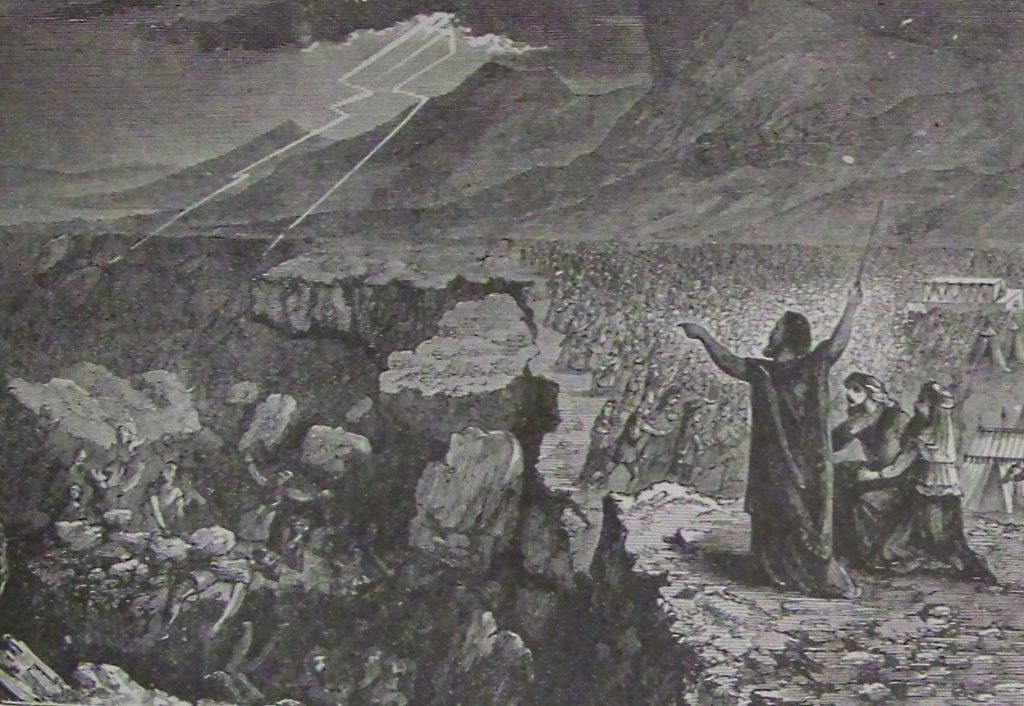
In this account of Korah and his rebellion against YHVH’s appointed authority figures, we see a progression of sin leading to more sin, followed by YHVH’s separation of sinners and saints, followed by divine judgment against the sinner concurrent with the intercession righteous on behalf of the wicked sinners. Perhaps this passage of Scripture will prove instructive on how Elohim deals with unrepentant sinners and what the response of the righteous should be in light of this.
Numbers 16:1–3, Took men…rose up…gathered together against. Notice a progression (or downward spiral) of actions on the part of Korah and his rebels. They separated themselves from fellowship, rose up against Moses, gathered together others of like mindand falsely accused leadership of wrong doings. This is the world’s formula for achieving political (humanistic) power and domination. It is the opposite method of advancing in YHVH’s kingdom where the way down is the way up; that is, when one lays one’s life down in service, spiritual reward, advancement and blessing will occur for that person (Matt 20:27; 23:10).
Rebels, like Korah, tend to separate themselves from fellowship, seek out other like-minded rebels, and then rise up in defiance and accusation against godly leadership. Again, this leads to political power. The way of spiritual power is laid out in Acts 2:42–47 where the followers of Yeshua continued steadfastly in the apostles’ doctrine, in fellowship, breaking bread together, in prayer and sharing their goods with one another. The result was real spiritual power authority and anointing from heaven, and not power based on usurpation, human pride, degradation of others and self-promotion. This can only happen as people forsake not the assembling of themselves together (Heb 10:25), function according to the place and spiritual calling within the spiritual body of Yeshua submitted one to another as they walk in the spiritual light YHVH’s instructions in righteousness—the Torah.
Additionally, Yeshua taught that true power in the kingdom of Elohim is a result of one laying one’s life down for his brother and serving him in love and humility. Such a person will be elevated to a position of influence and authority because he has learned to serve others in love and selflessness rather than seeking to be served, which stems from a heart of selfishness and pride (Matt 20:25–28; 23:11–12).
Most of this week’s blog discussion points will be on these passages. If you have general comments or questions on the weekly Scripture readings not addressed in a blog post, here’s a place for you to post those. Just use the “leave a reply” link below.
The full “Read Through The Scriptures In A Year” schedule, broken down by each day, can be found on the right sidebar under “Helpful Links.” There are 4 sections of scripture to read each day: one each from the Torah, the Prophets, the Writings, and from the Testimony of Yeshua. Each week, the Torah and haftarah readings will follow the traditional one-year reading cycle.
Weekly Blog Scripture Readings for 6/30/19 through 7/6/19.