So You Want to Start a Hebraic Congregation?

Over the years, many people around the world have asked for my advice about starting a Hebraic home fellowship or congregation. I tell them all the same thing: I learned to pastor through the school of hard knocks with guidance from no one, although I sough it to no avail. Sadly, I had no one to mentor me. As a result, I made a lot of mistakes and learned by trial and error. Therefore, I’m happy to advise people in any way I can, so that they don’t make the same mistakes that I made. That is the purpose of the following article.

My wife and I started and pastored a Hebraic congregation in 1998 that met in our home for more than two years. When we outgrew our home, we rented a church building for another 15 plus years until the fall of 2016. 

As a result of our experience, dozens of folks have asked my help in mentoring them in starting Hebraic fellowships. To date, I have put nothing in writing on this subject until now. Perhaps some of the questions and suggestions below will be of value to those people daring enough to start a fellowship.

A Word to Those Desiring to Start a Fellowship

Before giving instructions to Timothy about the qualifications for being an elder, Paul had this to say about those desiring to serve as leaders in the congregation of the saints:

This is a faithful saying: If a man desires the position of a bishop, he desires a good work. (1 Tim 3:1)

Desiring to start a fellowship is not a bad thing—especially if the Spirit of Elohim is leading you to do it. If not, forget it. What’s not of YHVH will fail. If  the Spirit is directing you, and you’re not being led by the dictates of your own carnal heart, then there are some things you need to consider first before launching out.

Are You Willing to Pay the Price?

Before starting a fellowship, one must ask oneself some hard questions. One must first count the costs; it’s going to “cost” you more than you think. Are you willing to pay the price?, Yeshua taught his disciples.

Continue reading
 

Spiritual Warfare 101…and Beyond!

2 Corinthians 10:4, The weapons of our warfare…spiritual. 

A Redeemed Believers Authority Through Yeshua—The Biblical Concept of Spiritual Warfare

Is the concept of spiritual warfare a biblical one? Perhaps no scripture of the Bible states the fact that it is more clearly than 2 Corinthians 10:3–5. (Eph 6:10–18 would be a close second!)

For though we walk in the flesh, we do not war after the flesh:(for the weapons of our warfare are not carnal [but, by implication are spiritual], but mighty through Elohim to the pulling down of strong holds;) casting down imaginations, and every high thing that exalts itself against the knowledge of Elohim, and bringing into captivity every thought to the obedience of Messiah. (2 Cor 10:3–5, emphasis mine)

Obviously, Paul understood and taught that redeemed believers are in an ongoing spiritual battle against something or someone, but what and who? James reveals that there are three possible sources of conflict for the redeemed believer: the world, the flesh and the devil (Jas 3:15). The flesh (man’s sin nature) is the greatest enemy that the saint faces. Paul discusses his struggles we face with the carnal man in Romans 7. The world is also a formidable enemy of the redeemed righteous ones. In John 17, Yeshua tells his disciples that though they are in the world, they are not to be of the world (John 17:11,14). He then goes on to describe the conflicts they would have with the world because they are his disciples. Finally, in Ephesians six, Paul describes the spiritual combat the saints face with Satan and his cohorts (Eph 6:10–18). He is constantly seeking to destroy us (1 Pet 5:8), and to find opportunistic inroads into our lives to establish a spiritual beachhead (Eph 6:16; 1 Pet 5:8). It is this latter subject which we will discuss in the following study.

The foundation for waging effective spiritual warfare is to have a deep spiritual relationship with Yeshua — to be loving him by obeying is laws through him (Rom 7:25–26).

The Legal Basis for the Believer’s Spiritual Authority

(Taken from Destined for the Throne by Paul E. Billheimer, pp. 71–80 with additional comments by NL.)

Universal Jurisprudence. It is vitally important for every redeemed believer to know the fullness and extent of the victory over sin, death and the devil that Yeshua secured for us at the cross. To fully understand this, we must comprehend the legal basis for that victory. Elohim is an El (God) of total justice. He established the universe to be governed by a legal system. As Supreme Judge of the universe, he must follow the laws of justice he established that keep order in the universe.

Continue reading
 

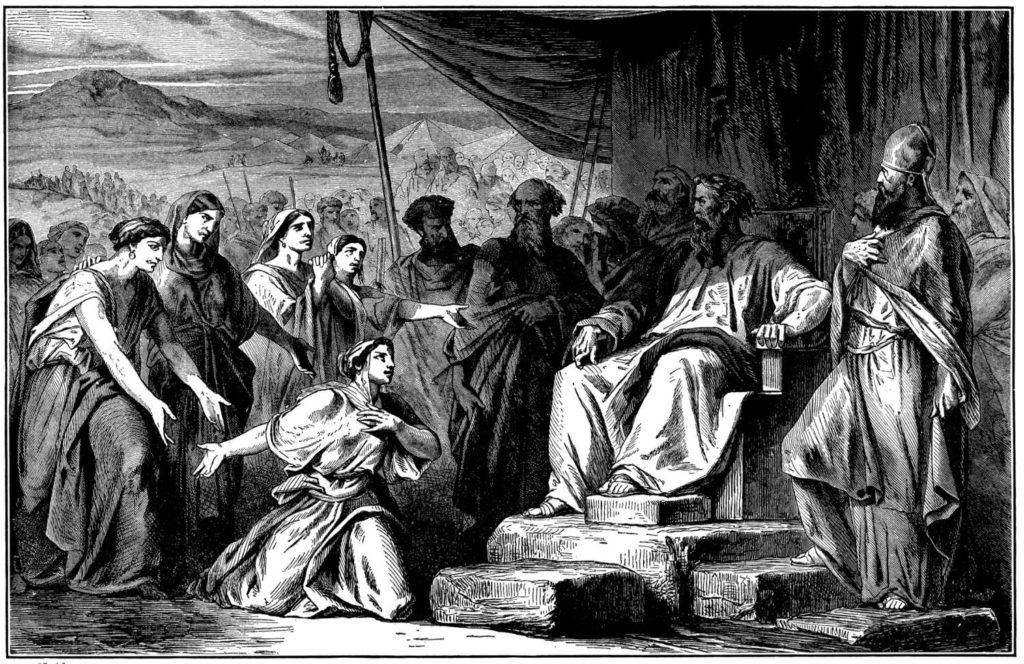
The Daughters of Zelophehad Help to Add to the Torah

Numbers 27:1–11, The daughters of Zelophehad. A Torah Commentary For Our Times/ATCFOT (UHAC Press, NY, 1993) has an interesting discussion regarding the incident involving the daughters of Zelophehad (Num. 27:1–11) that may answer some questions that contemporary women have regarding the Torah’s view of women. “Modern commentator Jacob Milgrom contrasts ancient Israelite practices of inheritance with those of their neighbors.” He notes that the practice of equality of inheritance between sons and daughters was upheld in Egypt and Mesopotamia one thousand years before the codification of the Torah. Later on the Greeks can be added to this list of countries that practiced “equal rights.” Milgrom then asks, “In face of such ‘equality’ of treatment how then are we to explain the fact that the Bible gives women no inheritance rights except in the case where there are no sons?” Does the Torah seem to discriminate against women regarding the inheritance of land and property from the estates of their parents, he asks? (p. 80).

“Milgrom suggest that in contrast to ancient Israel’s neighbors…where ‘centralized urban societies’ already existed, the early Torah laws of the Israelites reflect a nomadic-clan structure. In such a society ‘the foremost goal of its legal system was the preservation of the clan.’ Equity between members of the tribe or family preserves peaceful relationships and strengthens cooperation between all person.” He goes on to say that this explains the justness of the pleas of the daughters of Zelophehad where the principle of upholding the clan is preserved. The Torah sees that the daughters receive their father’s inheritance and at the same time that the clan and father’s name are preserved. (ibid.)

This solution does not promote equal rights, as we know it today, with sons regarding inheritance. Both the Torah and Talmud teach that in most cases inheritance of property is from father to son and that women share the lot of their husbands and do not inherit from their fathers (ibid., quoting from JPS Commentary: Numbers, pp. 482–484).

Continue reading
 

Dear Natan: Can I continue to use the non-biblical names for Elohim?

Question from Mark: I notice you use Messiah or Elohim etc…, would it be okay to use Jesus or God in my questions? 

Natan’s answer: That’s like me asking you if you’d be offended if I called you George or Kathy. You probably wouldn’t be offended, and you’d figure out who I was talking to, but those aren’t your names. Those are names that I made up and then started calling you. This is the same with Jesus, God and so on.
What you call Elohim, Yeshua and so on is between you and Him. He knows who you’re talking to if your heart is directed to him. However, I’m just challenging you to come to a higher level of biblical truth by using his real biblical and Hebrew names. If you’re content to stay at a lower level, which I don’t think you are or else you wouldn’t be emailing me with questions, then that’s your decision.


How to Offensively Stand Against Sin—Especially Sexual Temptation

Numbers 25:11, Has turned back my wrath…because he was zealous. Read Psalm 94:16. What are some other examples of righteous men and women in the Bible who stood up against evil in their day whom YHVH praised for doing so? Did Phinehas rise up against evil in his own carnally-minded, emotionally-based zeal? If not, then whose zeal was he full of? (Read verse 11 again.) When we take a stand against evil as led by the Word and Spirit of the YHVH Elohim, can it ever be wrong to do so, even though the world may not agree with us and may even criticize or persecute us for doing so? Not only that, Phinehas placed his life on the line between the righteous judgment of Elohim and those who were sinning. Many times, the servants of YHVH actually have to leave their comfort zones and place themselves in harm’s way on the ragged edge between good and evil to take a stand for YHVH Elohim. (Note Aaron’s actions in Num 16:46–50.) The examples of such actions from the pages of the Scriptures are too numerous to list. Some notable examples include: 

  • Noah preaching righteousness against the utterly corrupt generation of his day.
  • David versus Goliath (1 Sam 17)
  • Elijah confronting the prophets of Baal (1 Kgs 18:20ff)
  • John the Baptist confronting King Herod (Matt 14)
  • Yeshua confronting the religious leaders of his day on numerous occasions (e.g. Matt 23)
  • Peter and John versus the Jewish leaders (Acts 4)
  • Stephen confronting the Jewish leaders (Acts 7)
  • Paul and Silas preaching against false religion in Philippi (Acts 16) and preaching the gospel on the streets in Thessolonica (Acts 17), in Corinth (Acts 18) and again in Ephesus (Acts 19)
  • At times, YHVH tried to find such a person who would stand for his truth, but was unable to do so (see Jer 5:1; Ezek 22:30).

Numbers 25:17, Harass … and smite them. Midian is symbolic of the immoral pleasures of the society that surrounds the people of YHVH and that will subvert and overtake the righteous if left unchecked. YHVH commanded Israel to constantly harass and attack the Midianites for their subversion of Israel sexually. 

The best defense is a strong offense. 

As The ArtScroll Stone Edition Chumash points out, harassing the Midianites was to be an on-going state of mind (p. 877). Likewise, fighting the sin that would attempt to gain entrance into our lives must be a constant state of mind. YHVH commanded Israel to harass the Midianites and then to smite them. When sin arises, because our offensive and defensive positions against sin are secure, we will be ready to smite the sin that dogs us. 

Continue reading
 

Dear Natan: Is the “Once Saved Always Saved Doctrine” Biblical?

Question from Mark: What do you think about the “Once Saved Always Saved Doctrine”?

Natan’s answer: Is the “once saved always saved” doctrine of the Protestant reformer John Calvin biblically accurate? Apparently not everyone in Christendom since that time thought so. Jacobus Arminius didn’t. Neither did John Wesley and Charles Finney. Some notable biblical personalities didn’t subscribe to this doctrine either including Yeshua the Messiah, Paul and the writer of the Epistle to the Hebrews. 

The Bible clearly indicates in several places that one can lose one’s salvation.

For it is impossible for those who were once enlightened, and have tasted the heavenly gift, and have become partakers of the Holy Spirit, and have tasted the good word of God and the powers of the age to come, if they fall away [or apostatize], to renew them again to repentance, since they crucify again for themselves the Son of God, and put Him to an open shame. (Heb 6:4–6)

For if we sin willfully after we have received the knowledge of the truth, there no longer remains a sacrifice for sins… (Heb 10:26)

In the Parable of the Sower, Yeshua teaches that when the good seed of the Word of Elohim is sown onto the ground, three-fourths of the seed begins to germinate, but eventually dies. Only one-fourth of the seed actually falls onto good soil and produces fruit (Matt 13:1–9). He then goes on to explain that many people who receive the word of Elohim can and will eventually fall away due to a variety of factors (vv. 18–23). 

Paul specifically mentions two people who became believers, but whose faith become shipwrecked and they lost their salvation.

This charge I commit to you, son Timothy, according to the prophecies previously made concerning you, that by them you may wage the good warfare, having faith and a good conscience, which some having rejected, concerning the faith have suffered shipwreck, of whom are Hymenaeus and Alexander, whom I delivered to Satan that they may learn not to blaspheme. (1 Tim 1:18–20)

The Book of Acts gives the account of Simon the Samaritan (who is well known in early Christian historical accounts as Simon the Sorcerer and who became an enemy of the gospel) who was saved and even received the Spirit of Elohim, but because of his evil heart, lost his salvation (Acts 8:14–23).

Paul even suggests that he could lose his own salvation.

But I discipline my body and bring it into subjection, lest, when I have preached to others, I myself should become disqualified [or become a castaway, KJV]. 1 Cor 9:27)

Paul warns the saints that they could lose their salvation, and even includes himself in this warning.

Examine yourselves as to whether you are in the faith. Test yourselves. Do you not know yourselves, that Jesus Christ is in you?—unless indeed you are disqualified. But I trust that you will know that we are not disqualified [Greek, unapproved, rejected, reprobate]. ( 2 Cor 13:5–6)

New believers are especially vulnerable to losing their salvation, since they are like young and tender plants that are not deeply rooted spiritually. Once one has walked in the faith for a long time, had their faith tested, passed the tests, and has repeatedly overcome the pulls of the world, the flesh and the devil, assuredly they are less likely to lose their salvation. In fact, in several places the Bible talks about being sealed by the Spirit of Elohim (John 6:27; 2 Cor 1:22; Eph 1:13; 4:30; 2 Tim 2:19). This seems to indicate that at some point, one either can’t or is less likely to lose one’s salvation because they have established a proven track record of faithfulness to Elohim, and they would die before turning from their faith. 

However, Paul, the might apostle of Elohim, in humility, never assumed that about himself. He erred on the side of caution in assuming that he could lose his salvation. Maintaining such a mental disposition assured that he would always stay alert, keep up his defenses and his guard against anything that could imperil his salvation. The wise saint will follow Paul’s example.


 

Blog Scripture Readings for 7-21 Through 7-27-19

Aside

Parashat Pinchas — Numbers 25:10 – 30:1 (29:40)* 
Haftarah — 1 Kings 18:46 – 19:21 | Jeremiah 1:1 – 2:3**
Prophets — Ezekiel 25:1 – 31:18
Writings — Ezra 2:1 – 8:36
Testimony — 2 Corinthians 6:1 – 11:33

Most of this week’s blog discussion points will be on these passages. If you have general comments or questions on the weekly Scripture readings not addressed in a blog post, here’s a place for you to post those. Just use the “leave a reply” link below.

The full “Read Through The Scriptures In A Year” schedule, broken down by each day, can be found on the right sidebar under “Helpful Links.” There are 4 sections of scripture to read each day: one each from the Torah, the Prophets, the Writings, and from the Testimony of Yeshua. Each week, the Torah and haftarah readings will follow the traditional one-year reading cycle.

* Verse numbers in parenthesis refer to the verse number in Christian English Bibles when they differ from Hebrew Bibles or the Tanakh.

** A different Haftarah is read when it is a special sabbath in Jewish tradition. This week Parashat Pinchas occurs after the fast of the 4th month (17th of Tamm*z) on the traditional calendar. Otherwise, 1 Kings 18:46 – 19:21 would be read.

Weekly Blog Scripture Readings for 7/21/19 through 7/27/19.