Dear Natan: If I’m a Christian, should I keep the dietary laws?

Sherly asks, I know that you’re a Messianic Jew who keeps the biblical dietary laws, but I’m a Gentile Christian, so should I keep them too?

Here is my answers:

I have hundreds of articles and video teachings answering your question. Start searching then out and learning! In the mean time, here is the briefest answer that I know to give to your question:

First, I am not a Messianic Jew. Whether one is Jewish or non-Jewish has nothing to do with anything. What’s important is that one is a disciple of Jesus Christ/Yeshua the Messiah and is obedient to the Word of Elohim. 

A Christian, by definition, is one who follows and imitates Christ/Messiah. This is what Paul did (1 Cor 11:1; 4:14) and John did (1 John 2:6) as well as all the other New Testament disciples of Yeshua did. If I’m a follower of Messiah, then I will be doing what he did. He kept the commandments of Elohim; if he didn’t he was a sinner and not our perfect and sinless Savior. Likewise, if we don’t, we’re sinners. So shouldn’t we be following the examples of Yeshua and the NT saints? Isn’t this what the whole message of the NT and the whole Bible is all about—living righteous, holy and sin free lives? Any philosophy of men (I don’t care how many men, denominations or churches teach and believe it) that says otherwise doesn’t line up with the Word of Elohim. Period. So toss it and get back to the Bible!


Dear Natan: Is Paul justifying eating unclean meat in 1 Corinthians 6:12–13?

1 Corinthians 6:12–13, All things are lawful. When Paul said that all things are lawful to him, what do you think he meant? It’s now all right to murder, commit adultery, lie, steal, have sex with animals, practice witchcraft, and we can also add break the Sabbath, eat pork, etc., etc.? Obviously, violating the commands of Elohim wasn’t what he meant here, for doing such is, by biblical definition, sin (1 John 3:4), and those who love Yeshua will not be sinning, but will keeping his commandments (John 14:15). Moreover, it was our sin that put Yeshua on the cross, so why should we mock Yeshua’s death by continuing to practice sin? In fact, prior to 1 Cor 6:12, Paul listed a number of sins that will prevent one from entering the kingdom of heaven including drunkenness, sexual immorality, theft and so on. So obviously, breaking the laws of Elohim was not what he meant in verse 12. If Paul is here permitting the eating of unclean meat that the Bible forbids and calls an abomination, then he is also permitting sexual immorality—a sin which he juxtaposes in verse 13 with the eating of certain foods.

So if Paul wasn’t opposing the biblical dietary laws in verses 12 and 15, what was he really saying? According to David Stern in his Jewish New Testament Commentary, Paul was coming against the sexually libertine attitudes of the saints in Corinth whereby they had permitted the man who was having sexual relations with this stepmother and even allowing the sinner to remain in fellowship with the saints there. Stern goes on to say that the phrase, “All things are lawful to me…Food for the stomach…” is really analogous to the modern phrase, “If it feels good, do it”—a concept which Paul strongly opposes. Beale and Carson concur with Stern on this in their commentary on this verse (Commentary on the New Testament Use of the Old Testament, p. 713). In verse 15, Paul goes on to make the point that our bodies are the temples of the Set-Apart Spirit of Elohim and that we need to treat them as holy vessels by not engaging in sinful practices (whether sexual immorality or eating unclean meats).

Keener agrees with Stern that Paul was here confronting the ungodly and licentious Greek philosophers who would excuse their libertine carnal appetites by saying “I can get away with anything.” Paul, on the other hand, counters this by saying, “Maybe so, but ‘anything’ is not good for you” (The IVP Bible Background Commentary of the NT, pp. 464–465). Keener goes on to say that “‘Food for the stomach and the stomach for food’ was a typical Greek way of arguing by analogy that the body was for sex and sex for the body….That God would do away with both reflected the typical Greek disdain for the doctrine of the resurrection (chap 15), because Greeks believed that one was done with one’s body at death [which is why they reasoned that it was permissible to do whatever you pleased with your body now]. Paul responds to this Greek position with the Old Testament/Jewish perspective that the body is for God and he will resurrect it” (i.e. in v. 14, ibid.).

Paul then goes on to explain why a philosophy that excuses sinful behavior is not acceptable to Elohim or beneficial to the saint.

 

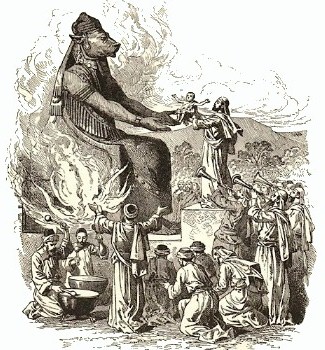
Abortion is the worship of Baal

Deuteronomy 18:10, One who causes his son or daughter to pass through the fire. This was done in honor of the Canaanite deity Moloch (see Lev 18:21 and 20:1–6). The name moloch/lKNin Hebrew means “king”with the root of the word meaning “to rule or reign.” Child sacrifice (the ancient form of modern abortion or infanticide) though a pagan practice that YHVH abhorred, was practiced by both houses or kingdoms of Israel as they drifted into syncretism with the heathen cultures around them (see 1 Kgs 11:7; 2 Kgs 16:3; 21:6; 23:10,13; Jer 7:31; 19:5; Ezek 16:20; 23:37). 

Baal appears to be a synonym of Molach or Moloch (see Jer 19:5 and the Ency. Britan. eleventh edit., vol. 18, p. 676).  After the children were sacrificed to this demon entity, the dead bodies were thrown into the garbage dump of the Valley of Hinnom or Tophet just below the Temple Mount in Jerusalem (Jer 7:31; 19:5–6). Apparently, the children were not burned alive, but were slain (by knife) like any other sacrifice before being thrown into the fire and then into the garbage dump (ibid.). The ancients sacrificed their children to appease their bloodthirsty gods of prosperity, sensuality and fertility (The Story of Civilization, vol. 1, by Will Durant, pp. 66–67, 297). 

What can we learn from these random pieces of information concerning the ancient practice of child sacrifice? It was done in honor of their deity; in other words, their idol was the king that ruled their lives. What is the chief deity in modern America and most everywhere else in the world? Money and wealth? Sex and pleasure? Fun and entertainment? In ancient times, children were killed by a knife, thrown into the fire and then into the garbage dump. Today, what happens in America? Parents abort their babies or have them murdered while being born (partial birth abortion) by using burning solutions to kill the baby in the womb and scalpels and scissors to hack the baby to pieces to aid in its extraction. Afterwards the dead baby is placed in a dumpster.

What reasons do parents give for killing their children? “It will cost too much to raise them and it’s too much trouble” (greed, hedonism and selfishness). “It will interfere with my career” (greed). “I want to have pleasure ­without ­responsibility” (hedonism and greed). Regardless of the excuses, the reasons today are the same as those of the ancients: prosperity, greed, hedonism and so on. Are we any different or any more “civilized” than the ancients? YHVH called abortion an abomination (which means “disgusting, abominable,abhorrent, detestable or loathsome,” Deut 18:12). 

Make no mistake about it. The modern practice of abortion is still the worship of the ancient murderous demon-god Moloch or Baal whether those practicing abortion know it or not. The reason for engaging in this abominable practice are still the same, and the evil spirit motivating people to do it is still the same. Humans are no different today than they were thousands of years ago. Only the actors and costumes have changed. The actions and evil heart of man remains the same without transforming power of Word and Spirit of Elohim at work to convert sinful humans from the kingdom of darkness and the worship of and obedience to Baal (Satan) to the kingdom of light and the worship of and obedience to YHVH Elohim.

Do you abhor that which YHVH calls an abomination? In Scripture, does YHVH call children and fertility a curse … or a blessing? (See Deut 28:11, Ps 127:3–5.)


Blog Scripture Readings for 9-1 Through 9-7-19

Aside

Parashat Shoftim — Deuteronomy 16:18 – 21:9
Haftarah — Isaiah 51:12 – 52:12
Prophets — Amos 2:1 – 8:14
Writings — 1 Chronicles 17:1 – 23:32
Testimony — 1 Timothy 5:1 – 6:21; 2 Timothy 1:1 – 4:22; Titus 1

Most of this week’s blog discussion points will be on these passages. If you have general comments or questions on the weekly Scripture readings not addressed in a blog post, here’s a place for you to post those. Just use the “leave a reply” link or the “share your thoughts” box below.

The full “Read Through The Scriptures In A Year” schedule, broken down by each day, can be found on the right sidebar under “Helpful Links.” There are 4 sections of scripture to read each day: one each from the Torah, the Prophets, the Writings, and from the Testimony of Yeshua. Each week, the Torah and haftarah readings will follow the traditional one-year reading cycle.

Weekly Blog Scripture Readings for 9/1/19 through 9/7/19.


Does praying over your unclean meat now make it clean to eat?

How many times have you heard this unbiblical idea of man expressed in church circles “I prayed over my bacon, and presto changeo, what the Word of Elohim forbids me to eat and calls an abomination is now okay for me to eat.” Yeah right!!!

1 Timothy 4:3–5, Foods. Many take this passage to mean that simple “prayer over the food” sanctifies nonkosher food. Were we to take this logic to its illogical conclusion, then we might suppose that prayer over skunk meat, certain poisonous types of frogs, snakes and salamanders as well as poisonous mushrooms would make them edible. Of course, this is ridiculous. Is this really what Paul, the orthodox Jewish Torah scholar, is teaching? Once again, understanding Scripture in its context is essential to obtaining its proper interpretation. These verses read:

Forbidding to marry, and commanding to abstain from meats, which Elohim has created to be received with thanksgiving of them which believe and know the truth. For every creature of Elohim is good, and nothing to be refused, if it be received with thanksgiving, for it is sanctified by the Word of Elohim and prayer. (emphasis added)

What does this passage really say? Does it say that the meat we eat is sanctified (i.e. set aside for special use) only through the act of prayer?

In verse five Paul teaches that the meat we eat is sanctified through prayer and the Word of Elohim. When Paul wrote this letter to Timothy there was no Testimony of Yeshua or New Testament—only the Tanakh or Old Testament. Where in the Tanakh do we find which meats YHVH has set aside or sanctified for man as edible? Leviticus chapter eleven, of course. Furthermore, in verse three above Paul talks about “them which believe and know the truth.” How does Scripture define truth? Yeshua defined truth as the Word of Elohim (namely the Hebrew Scriptures, which is all that existed at that time) (John 17:7). The Tanakh define truth as the Torah-law of YHVH (which contain YHVH’s biblical kosher laws pertaining to clean and unclean meats; see Ps 119:142 and 151). 

So when examined in its proper context this passage in 2 Timothy in no way teaches that it is scripturally permissible for believers to indulge in unclean meats. On the contrary, this passage in fact validates the biblical kosher laws as outlined in the Torah and shows clearly, if we let Scripture speak for itself and define its own terms instead of reading into it our own meanings, that the biblical dietary laws are for believers today.


Are YOU a rebel who hates godly leadership?

Deuteronomy 17:14–20, King over you. It is YHVH’s will for Israel to be ruled by a king. In the Messianic Era (Millennium), King Yeshua the Messiah, the Son of David, will rule not only over Israel but over the entire world from Jerusalem. YHVH ordained righteous leadership to help guide his people in the ways of truth and righteousness. 

When there is no leadership, everyone does what is right in his own eyes as occurred during the time of the judges. The Bible gives numerous examples of the chaos that results in a society or a group of people where there is no leadership. For example, The ArtScroll Stone Edition Chumash points out, “Two of the saddest episodes after Israel arrived in its Land—the graven image of Micah (Judg 17–18) and the atrocity involving the concubine at Gibeah (Judg 19–21)—are described by Scripture as having been possible only because there was no king in Israel (Judg 18:1; 19:1); had there been the leadership and discipline of a righteous king, he would never have permitted such outrages to take place” (pp. 1028–1029). 

Elohim is not the author of confusion (1 Cor 14:33). Nowhere in the Bible does Elohim permit his people to be leaderless whether it was patriarchal leadership, Levitical leadership, the leadership of judges and prophets, kingly leadership, the leadership of apostles and elders culminating in the leadership of King Yeshua and the glorified saints that will be ruling with him as kings and priests in his millennial kingdom.

Numerous times in Scripture, YHVH not only expects his  people to obey the righteous leaders he has put in place, but even unrighteous civil leaders (at least until they demand that one disobeys the higher laws of Elohim).

Many times in the Hebraic Roots Movement, I have encountered folks who have been burned by ungodly church leadership. They now pride themselves in establishing congregations and fellowships “where no one is the leader.” This is a recipe for disaster. Get back to me in one, two or five years and let me know who your experiment in this ungodly venture went. Eventually division and strife will tear such groups apart! After all, if everyone has equal say and anything can go on, who is going to stand up and say “this is wrong” and “that is unbiblical”? When grievous wolves in sheep’s clothing come in to tear the flock apart, who is going to put these agents of Satan out of the fellowship? 

No, leaderless groups are not a good thing. Those who want this are either naive when it comes to the machinations of human nature, or are they are rebels themselves and really don’t Elohim to rule over them, since he is the author of godly, righteous leadership


“In the mouth of two or three witnesses…”

Deuteronomy 17:6 (and 19:15), By the testimony of two or three witnesses. In the Bible, one could not be accused of a crime (i.e. a sin) without the testimony of two or three eyewitnesses. This admonition is repeated in the Testimony of Yeshua:

But if he will not hear you, then take with you one or two more, that in the mouth of two or three witnesses every word may be established. (Matt 18:16)

This is the third time I am coming to you. In the mouth of two or three witnesses shall every word be established. (2 Cor 13:1)

Against an elder receive not an accusation, but before two or three witnesses. (1 Tim 5:19)

He that despised Moses’ law died without mercy under two or three witnesses. (Heb 10:28)

Most gossip and slander would stop if this commandment were followed, and thus much division and strife within the congregation of believers. 

How many times have you repeated hearsay and gossip without checking the source? Even if you know it to be true, is it beneficial and righteous to repeat it to others? One Jewish sage goes so far as to say that Messiah has not come back because of all the gossip and slander of the people of Israel. Perhaps. At the very least, the Spirit of Elohim is greatly grieved, our intimacy with Elohim is diminished, and our marriages, families, friendships and congregations are fractured, hurt or destroyed because we speak things that should not be uttered.

How often do we accuse, slander and gossip about other people through use of the “evil tongue” (lashon hara) without going through proper channels and following proper biblical protocols to resolve interpersonal conflicts as Yeshua instructed in Matthew 18? How often do we attack others and spread our evil reports and accusations about others when we were not even eyewitnesses to what occurred or were not involved in the matter? How often do we attack YHVH’s leaders and accuse them of evil when there are no other witnesses (1 Tim 5:19)? YHVH hates those who sow discord among brethren and lying false witnesses, and calls this practice an abomination (Prov 6:16–17, 19). So let’s all be careful with our mouths!