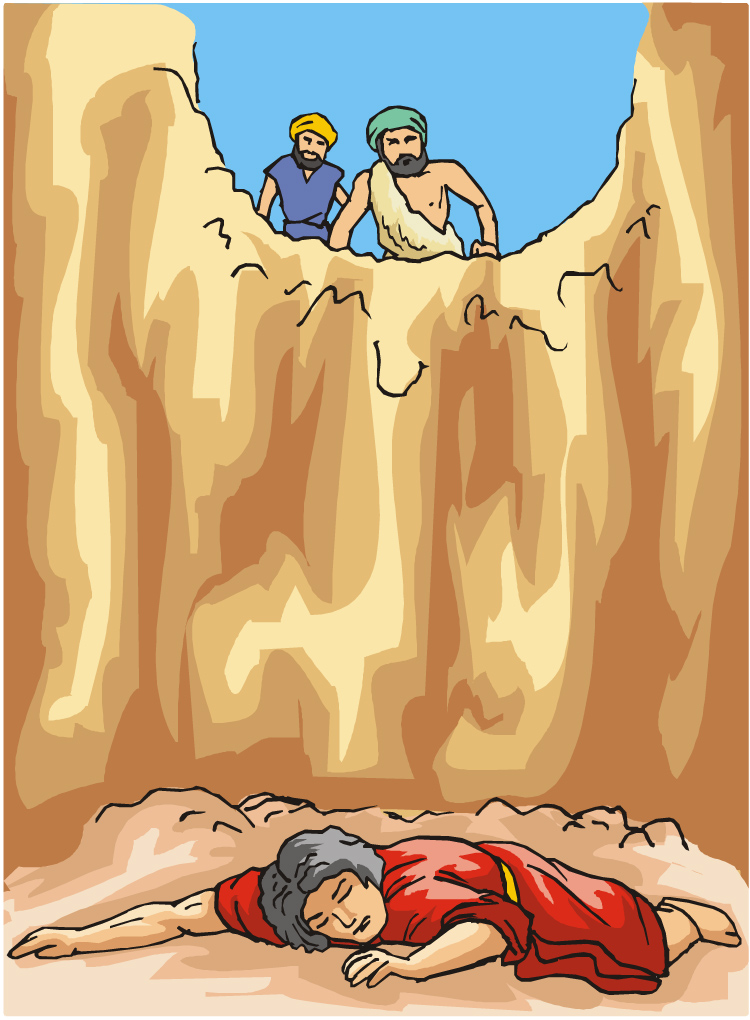
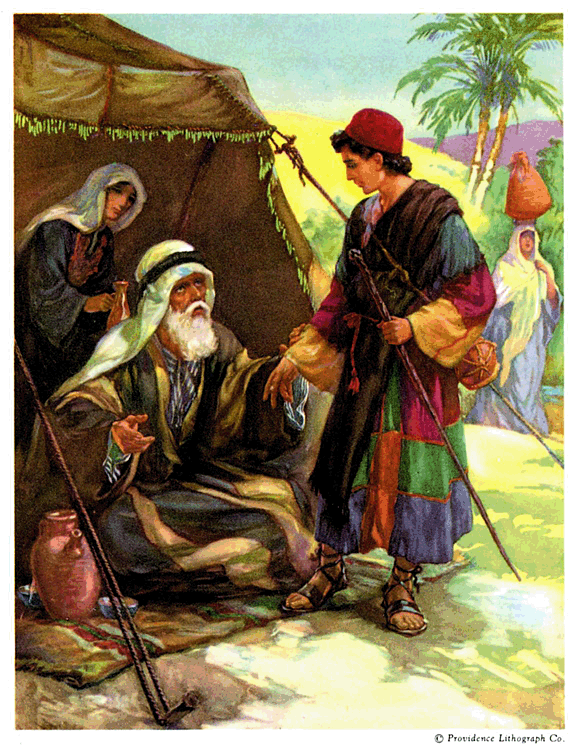
The Bible is full of many inspiring examples of people who were unjustly treated and found themselves in almost impossible situations. Yet, because of their faith in Elohim, they not only survived their circumstances, but thrived. The story of Joseph is another such example. Be encouraged and inspired as you read this.
Genesis 39:2, 21, 23,YHVH was with Joseph. This phrase is repeated three times in this chapter to emphasize an important spiritual principle. Even in the midst of Joseph’s unfair persecution first as a slave then as a prisoner, his faithfulness to YHVH insured YHVH’s divine protection and favor in these adverse circumstances.
Many are the afflictions of the righteous, but YHVH delivers him out of them all (Ps 34:19), and YHVH promises to accompany his people through the floods and fires of adversities (Isa 43:2).
Joseph’s prevailing through adverse and unjust circumstances with YHVH’s help should be a great source of encouragement for every believer.
Joseph…a successful man. Even as a slave, YHVH blessed and prospered Joseph. YHVH can prosper us in any work situation in which we find ourselves—even if we’re not much better than a slave. If we but will apply ourselves to work hard and diligently, while staying faithful to YHVH as Joseph did, YHVH will prosper and promote us. Laziness, greed, theft, covetousness and irresponsibility has never gotten anyone anywhere in any employment situation.
There are more than twenty references in the Bible to “going down to Egypt,” coming “up from Egypt” or words to this gist. Egypt can be taken as a biblical metaphor for the secular world and all that is in it that is in opposition to YHVH’s paths of righteousness. Egypt represents the low spiritual way of following the world, flesh and the devil that is evil that leads to death and separation from Elohim, while the Promised land, and specifically Jerusalem, is a metaphor for the spiritual high place of truth, righteousness and godliness that leads to eternal life. This is why the Bible speaks of “going down to Egypt” and “going up to Jerusalem.”
Each person has only two choices in life on how they will conduct their lives. They must make a choice—they will make a choice purposely or inadvertently. They can choose the proverbial downward path or the highway to hell or the upward path or the highway to heaven. Everyone chooses one path or another, even if they are not aware of the conscious decision to do so. To not make a choice is, by default, to choose the downward path.
Most people are somewhere in the middle, which is a vast grey area. They neither choose one path or the other. They choose just enough of the upward path to alleviate their guilt, but not enough of it to radically change their lifestyles. They still want enough of the downward path to satiate the lust of the flesh, the lust of the eyes and pride of life.
So what did Yeshua have to say about those who choose this wide, well-traveled middle road?
I know your works, that you are neither cold nor hot. I could wish you were cold or hot. So then, because you are lukewarm, and neither cold nor hot, I will vomit you out of My mouth. (Rev 3:15–16)
To those who find themselves on this path, Yeshua is standing outside of the door of their spiritual house and saying,
Behold, I stand at the door and knock. If anyone hears My voice and opens the door, I will come in to him and dine with him, and he with Me. (Rev 3:20)
To those who respond positively to his invitation, he promises them a place in the Promised Land of his everlasting kingdom or the New Jerusalem, which is coming down from heaven.
For here have we no continuing city, but we seek one to come. (Heb 13:14)
For he looked for a city which hath foundations, whose builder and maker is Elohim. (Heb 11:10)
Him that overcometh will I make a pillar in the temple of my Elohim, and he shall go no more out: and I will write upon him the name of my Elohim, and the name of the city of my Elohim, which is New Jerusalem, which cometh down out of heaven from my Elohim: and I will write upon him my new name. (Rev 3:12)
To him who overcomes I will grant to sit with Me on My throne, as I also overcame and sat down with My Father on His throne. (Rev 3:21)
And I John saw the holy city, new Jerusalem, coming down from Elohim out of heaven, prepared as a bride adorned for her husband. (Rev 21:2)
With this lofty heavenly, spiritual goal and reward in mind for those who continue here below in faithful obedience and overcoming perseverance, what should be our demeanor? What wise admonitions must we keep in mind, so that we will be faithful to the end—until the object of our faith arrives (Heb 11:1)?
Wherefore gird up the loins of your mind, be sober, and hope to the end for the grace that is to be brought unto you at the revelation of Yeshua the Messiah; as obedient children, not fashioning yourselves according to the former lusts in your ignorance: but as he which hath called you is holy, so be ye holy in all manner of conduct; because it is written, Be ye holy; for I am holy. And if ye call on the Father, who without respect of persons judgeth according to every man’s work, pass the time of your sojourning here [on earth] in fear: forasmuch as ye know that ye were not redeemed with corruptible things, as silver and gold, from your vain conversation received by tradition from your fathers; but with the precious blood of Messiah, as of a lamb without blemish and without spot: who verily was foreordained before the foundation of the world, but was manifest in these last times for you, who by him do believe in Elohim, that raised him up from the dead, and gave him glory; that your faith and hope might be in Elohim. Seeing ye have purified your souls in obeying the truth through the Spirit unto unfeigned love of the brethren, see that ye love one another with a pure heart fervently: being born again, not of corruptible seed, but of incorruptible, by the word of Elohim, which liveth and abideth for ever. (1 Pet 1:13–23, emphasis added)
Mark 10:17–22, Yeshua’s model for one-on-one evangelism is here revealed. In his encounter with the rich, young ruler, Yeshua reveals a method of evangelizing in a one-on-one scenario. He uses the following five-step approach:
Yeshua first establishes the character of YHVH Elohim and how man falls short of this in comparison. Namely, YHVH is good, and man is not.
Next, Yeshua presents the Torah as Elohim’s moral and spiritual standard that determines the definition of good—right and wrong.
Yeshua then shows the young man that he was violated that standard of goodness by violating the Torah’s standard of righteousness.
He advises the young man then to repent of his Torahlessness (or of breaking YHVH’s laws, which is the biblical definition of sin, see 1 John 3:4).
Finally, Yeshua invites the young to make the total commitment to being a good person and to follow him.
We see this evangelistic model again in Acts 17:24 when Paul addresses the Greeks on Mars Hill.
Psalm 67:1–2,Face to shine…that your way. In analyzing this biblical passage, let’s apply some mathematical logic and discover the wonderful place to which it leads us. It’s a place that’s higher and better than any other! Here we go…
YHVH’s face or countenance shines like the sun in its full strength (Rev 1:16). He is the Sun of righteousness (Mal 4:2). The sun is the greater light that shines in the darkness of this world (Gen 1:16). The physical sun points to and is a representation of Yeshua who isn’t the greater light, but the Greatest Light that shone on this earth before the physical sun was created on the fourth day, and will shine once again on the New Jerusalem (Rev 21:23) as he shone on the first three days of creation (Gen 1:3).
Presently, Yeshua is the Light of the world (John 8:12) that is contained in his Torah-Word, which is truth, and which is revealed by the Spirit of Elohim (John 16:13) to those who humbly and repentantly seek it like little children (Matt 18:3–4).
Moreover, Yeshua is the Word of Elohim that was made flesh (John 1:1, 14), and he is a spiritual light that shines in the darkness of this world to show men the way out of the darkness and to his Father in heaven (John 1:4;–5; 8:12, 9:5 cp. 14:6) who himself dwells in supernal light (1 Tim 6:16; Dan 2:22; 1 John 1:5; Jas 1:17).
Light in the Scriptures is also a metaphor for truth (John 3:21) and the Torah (Prov 6:23 cp. Ps 119:142, 151). Light is also a metaphor for the Word of Elohim (Ps 119:105). Yeshua was and is that Word (John 1:1, 14).
Now let’s go back to Psalm 67:1–2. When Elohim causes his face to shine on us, we will be blessed and receive his mercy (verse 1). The result will be that we will know his ways and his salvation, which is Yeshua (salvation is the Hebrew word Yeshua in verse 2).
Can the truth of Elohim’s word be any clearer than this? When we understand these simple biblical truths, and humbly submit ourselves to them and walk in the light of this glorious truth, our lives will be in perfect alignment or in sync with the plumb line of YHVH’s laser light-like truth. This puts us on the straight and narrow path that leads to eternal life, and it places us in the middle of YHVH’s river of life (Ps 1:3) that flows from his throne and a tree of life (Prov 3:18 cp. Ps 1:3, read vv. 1–6 for context).
This spot is where it’s at—the sweet spot of life (see Ps 1:1–6)! Yet men are so hard-hardhearted, stiffnecked, rebellious and arrogant that they refuse to see these simples truths because they love the darkness of their sin and refuse to come to the light of Yeshua (John 3:19–20).
Those of you who are privileged to have the light of YHVH’s countenance shining on you, give him the glory he deserves for his wonderful merciful grace in your life, and take a moment to offer up a heartfelt prayer of thanksgiving!
In my many years as a Torah-minded disciple of Yeshua, I have observed a most destructive attitude among those of us who view the Bible from a more Hebraic perspective including valuing the Torah as a lifestyle guide. It is this: to view others (especially those who are still in the mainstream Christian church) as inferior spiritually to us. This is not a good thing, and is contrary to the teachings of Yeshua, as you will see from the following study.
When I was a pastor, I continually warned people against this attitude. An “us versus them” mentality creates pride, Phariseeism, strife, division, self-righteousness and a whole host of other evils. Yeshua warned his disciples against this, and continually admonished them to be humble and grateful, and not arrogant about the truths they had been given.
As you can see from the following study, sectarianism is a most destructive mindset and attitude that needs to be uprooted from of our thinking and repented of. It not only hinders us in our spiritual growth, but prevents us from reaching out in love to our brothers and sisters (the lost sheep of the house of Israel) and from gathering them in, as Yeshua commanded his disciples (and us) to do.
Mark 9:38–41, Yeshua forbids sectarianism.What can we learn from Yeshua’s instructions in this passage? Simply this. Though another person may not be in our particular spiritual camp, if they are doing good and are not against us, we’re to give them credit for the good that they are doing. This is the high road of love, mercy and grace that Yeshua expects his disciples to follow in regards to those of other congregations, denominations, sects or ministries.
Mark 9:38–50, Avoid strife and contention. This is a very enigmatic passage that commentators struggle with trying to explain, since Yeshua links together so many seemingly disparate concepts. I say “seemingly,” since there is nothing average about the Master’s intellect, or his deep and insightful knowledge and understanding of spiritual Truth. Our inability to comprehend his sayings should only spur us onward to dig all the more into their heights and depths of meaning, thus uncovering the nuggets of truth from within the transcendent intellect of our Master and Creator!
Yeshua the Master begins his discourse by discouraging sectarianism. “Those who aren’t against us are for us.” He then promises rewards to those who are kind to his disciples, implying that his disciples should in turn be kind to others who, though they may not be a part of your particular group, they may not necessarily be working against you, for they may also be kingdom workers but with a different assignment than yours (vv. 38–41).
The spirit of Antimessiah (Antichrist) is on a dramatic rise in our day. It is even rampant among those who are returning to the Hebraic, Torah-centric roots of the Christian faith where some people are losing their faith in Yeshua the Messiah. A few are even converting to Rabbinic Judaism, which denies the messiahship and deity of Yeshua and the divine inspiration of the Testimony of Yeshua. Some of the blame for this can be laid at the feet of a few of the modern-day descendants of the non-believing Pharisees (i.e. the Rabbinic Jews), who use clever arguments to beguile unstable and unlearned souls into humanistic reasoning devoid of a living faith in Yeshua their Savior and the Redeemer of man. Because of a spiritual blindness that Scripture prophesied would come upon the Jews producing a hardness of heart toward Yeshua the Messiah, unbelieving Jews ignore the numerous prophetic shadow-pictures pointing to Yeshua the Messiah contained in their own Tanakh.
May the following study strengthen your faith in Yeshua the Messiah, in his divine origination in the very heart, mind and essence of Elohim, and in the fact that he was foreordained to come to this earth to reconcile sinful man to his Heavenly Father through his self-sacrifice on the cross. All this was prophesied long ago in the Tanakh. The ancient Jewish sages speak of a messianic figure coming called Messiah son of Joseph (Mashiach ben Yosef), the Suffering Servant, whose life and ministry would parallel that of Joseph, yet these same Jewish sages fail to see the connection between Joseph’s life and that of Yeshua. Let’s now chronicle the striking and uncanny parallels between Joseph and Messiah the son of Joseph, the Suffering Servant. (Many of these comparisons come from the book, Gleanings in Genesis, by Arthur W. Pink ).
I have a friend who is a pastor, a Torah-keeper and a lover of Yeshua who is conducting a survey of Hebraic-minded folks. She is trying to ascertain the effect that the Torah has had on people’s life, on their relationship with Yeshua, on their spiritual walk and on their understanding of the Bible. The more people that respond to this survey, the more accurate the data will be. The survey will take about 15 to 20 minutes to complete. I’ve asked her to share the results with us. Please consider taking the time to respond to this survey, which will help us to understand better the spiritual state of those folks who are a part of the so-called Hebrew Roots Movement. Thank you.
Here is the link to the survey. It is completely anonymous.