Blog Scripture Readings for 5-4 through 5-10-14

Aside

THIS WEEK’S SCRIPTURE READINGS FOR STUDY AND DISCUSSION:

Parashat Behar — Leviticus 25:1 – 26:2 
Haftarah — Jeremiah 32:6–27
Prophets —Jeremiah 10:1 – 16:21
Writings — Job 27:1 – 33:33
Testimony — Acts 28:1–31; James 1:1 – 5:20; 1 Peter 1:1–25

Most of this week’s blog discussion points will be on these passages. If you have general comments or questions on the weekly Scripture readings not addressed in a blog post, here’s a place for you to post those. Just use the “leave a reply” link below.

The full “Read Through The Scriptures In A Year” schedule, broken down by each day, can be found on the right sidebar under “Helpful Links.” There are 4 sections of scripture to read each day. One each from the Torah, the Prophets, the Writings, and from the Testimony of Yeshua. Each week, the Torah and haftarah readings will follow the traditional one-year reading cycle.

Weekly Blog Scripture Readings for 5/4 through 5/10/14.


New Video: When Is the Second or Greater Exodus?

The Bible speaks about an end times, greater or second exodus of YHVH’s people from spiritual Babylon where they’ve been held captive economically, politically and religiously. What is the second exodus and when does it occur? This is part two of a two part series. Part one answers the question, “What is the greater or second exodus?”


Omer Count

We are in the 2nd week of seven weeks of the counting of the omer. Today is the 14thomer_count day of 50 days in the counting of the omer leading up to the biblical Feast of Weeks (Pentecost). (Lev 23:15-16)


Omer Count

We are in the 2nd week of seven weeks of the counting of the omer. Today is the 13th day of 50 days in the counting of the omer leading up to the biblical Feast of Weeks (Pentecost). (Lev 23:15-16)

omer_count


Omer Count

We are in the 2nd week of seven weeks of the counting of the omer. Today is the 11th day of 50 days in the counting of the omer leading up to the biblical Feast of Weeks (Pentecost). (Lev 23:15-16)

omer_count


Overview of the Biblical Feasts

Leviticus 23

If you had to sum up the entire message of the Bible in one word what would it be? Probably words such as love, hope, salvation, eternal life or heaven are coming to your mind. But I challenge you to find a better word than the following: r-e-c-o-n-c-i-l-i-a-t-i-o-n. The dictionary defines reconciliation as “to restore to friendship or harmony, to settle or resolve a quarrel, to make consistent or congruous.” When man chose to rebel against YHVH and to give in to sin at the Tree of the Knowledge of Good and Evil at the very beginning he chose the path of separation from his Heavenly Father. Sin causes man to be separated from a totally holy, righteous and sinless Creator. Since that time YHVH has been endeavoring to reconcile man to himself. He has laid out criteria for man to follow for this to occur—for man to once again have a friendly, loving and intimate relationship with his Heavenly Father as did Adam before he sinned.
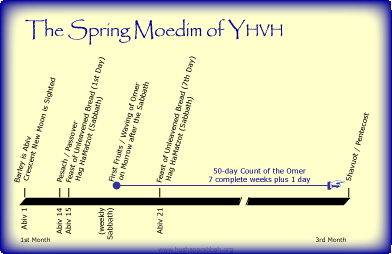
Feasts, Spring

The set-apart appointed times (moedim) or divine rehearsals/gatherings (miqra kodesh) of YHVH are prophetic shadow-pictures or symbols of the steps man must take to be reconciled to his Heavenly Father. They are the complete plan of salvation or redemption rolled up into seven easy-to-understand steps. Though a child can understand these steps, the truths contained therein can at the same time be expanded and unfolded until one literally has rolled out before oneself the entire message of the Bible from Genesis to Revelation—a message that to the human comprehension is staggering, deep and rich beyond understanding. These feast days are literally the skeletal structure upon which the truths of the entire Bible hang. The message of redemption, sanctification, salvation, the atonement, glorification, eschatology, the history of Israel, the entire Gospel message, the covenants, the marriage of the Lamb, the bride of Messiah and Yeshua the Messiah are all prefigured within the glorious spiritual container of YHVH’s set apart feasts contained in seven steps—seven being the biblical number of divine perfection and completion.
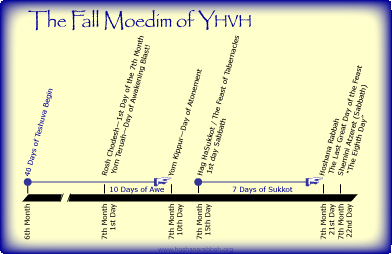
Feasts, fall

Quite assuredly, without a deep, walking-it-out comprehension of the feast days of YHVH, no matter how learned one is in biblical understanding, or how academically astute and mentally acute in biblical erudition one may be, one will not have a deep understanding of those scriptural subjects listed above. How can one understand end-time events such as the second coming, the great tribulation and the rapture unless one understands the feast days from a deep Hebraic perspective? One simply cannot have just a knowledge of Greek, the Gospels, the Apostolic Scriptures along with a surface understanding (i.e., traditional Christian perspective) of the prophecies of the “Old Testament” and expect to understand eschatology (the study of end-time events) unless one immerses themselves in understanding and keeping the feast days of YHVH. One cannot throw out the foundation or the skeletal structure and expect to have a body of understanding that amounts to anything at all. Simple logic and common sense and the very truth and character of YHVH Elohim demands and dictates this so.

Continue reading →

 

Speaking Evil of a Ruler

Acts 23:5, Speak evil. Actually, the passage in the Torah to which this verse makes reference is Exodus 22:28, which forbids reviling Elohim and cursing (i.e., condemning, putting a spell on or threatening) a ruler, which is what Paul does when he threatens the high priest with the judgment of Elohim, even though Paul, as an apostle commissioned by Yeshua, may have been justified in executing righteous judgment. He nevertheless set us an example of showing resect to human leaders though evil and lawless they maybe.

Mouth 4 20837968

 Exodus 22:28, Curse a ruler. The TWOT notes that in Hebrew there are six words that are all translated into the English word curse in the KJV. Each word has a different connotation, which our word curse fails to convey. In this verse, behind curse is the Hebrew word arar meaning “bind with a spell, to hem in with obstacles, render powerless, to resist.” This word is used for Elohim cursing the serpent and the earth (Gen 14, 17), Cain, and Balak hiring Balaam to curse Israel (Num 22:6ff). In the majority of times, the use of arar is used in the Scriptures falls under three broad categories: (a) the declaration of punishments (Gen 3:14, 17); (b) the utterance of threats (Jer 11:3; 17:5; Mal 1:14); (c) the proclamation curses for violation of Elohim’s laws (Deut 27:15; 28:16–19) (Ibid.).