
The Door and the Veil of the Tabernacle: Onward and Upward in Yeshua!

Exodus 26:36–37, Door of the tent. This door had the same colors as the door to the outer courtyard (blue, crimson, white and purple) and was also woven of fine linen. The door was the same size in area, though it was a different dimension than the first door, for it was taller and narrower. This teaches us that the view of Yeshua becomes higher, and the way to the holiest place becomes narrower and the requirements become more stringent as one draws closer in proximity to YHVH’s glorious presence.

Five wooden pillars covered in gold supported by bronze bases held the curtains up. Again, the wood-covered gold speaks of the righteousness of the saints. Bronze speaks of Elohim’s judgment and five can speak of both the five books of YHVH’s Torah as well as the five-fold ministry the purpose of which is to ground YHVH’s people in his Torah-instructions in righteousness. In so doing, the Saints will become like Yeshua, who was the physical embodiment of the Torah—or YHVH’s Torah-Word made flesh (the Living Torah, John 1:1, 14).

The Door of the Tent in More Detail

This door had the same coloring as the outer door: purple, white, crimson and blue. This door had different ­dimensions as the outer door, but occupied the same area. This door was about half the width, but twice as high as the outer door. This speaks of the fact that as one grows and matures spiritually, the way of life, the path of righteousness and the way to intimacy with the Father gets narrower and the standards are elevated.

It was held up by five pillars picturing the fivefold ministry (Eph 4:11), which is likened to a hand: The apostle is like the thumb. The other fingers cannot work properly without it. It has more flexibility than the rest and can do things the others can’t. The prophet is like the index finger and points out people’s faults and points the direction people are to walk in, yet he must be very gracious, humble and self-effacing in his activity since he has three fingers pointing back at himself. The evangelist represents the middle finger which extends or reaches outward the farthest to bring people to YHVH. The shepherd (pastor) is the ring finger representing gentleness and love. The teacher, like the little finger that is used to dig stuff out of one’s nose and ears, digs out nuggets of truth in hard to reach places (e.g. ear and nose).

The five pillars were made of acacia wood overlaid in gold, which speaks of Yeshua’s humanity and his divinity. The pillars were set in bases of bronze speaking of YHVH’s righteous judgments and that all judgment will be left up to Yeshua who is over all and has judged and will judge all (Heb 2:8; Eph 1:22). Furthermore, Yeshua as head of the body of believers, the gates of hell will not prevail against his elect (Matt 16:18; Heb 3:6).
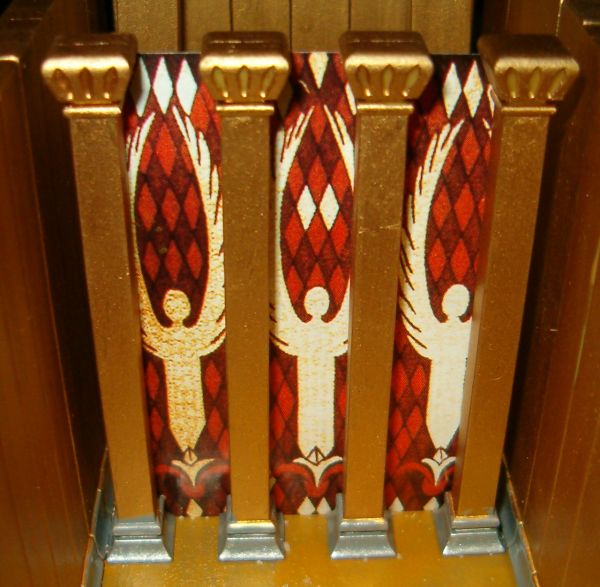
Exodus 26:31–37, A viel. The veil or parochet divided between the holy or set-apart place and the holy of holies or most set-apart place. It was woven of fine linen of the same four colors as were the previous two curtains—blue, crimson, purple and white, except this veil had cherubim embroidered into it. The most set-apart place is a picture of returning to the Garden of Eden, which had cherubim guarding its entrance (Gen 3:24), except this time it is the New Jerusalem in the New Heaven and New Earth.

It was this same veil that was rent from top to bottom in the second temple in Jerusalem at the time of Yeshua’s crucifixion (Matt 27:51). The writer of the Epistle to the Hebrews teaches a correlation between the tearing of Yeshua’s flesh on the cross and the tearing of the veil, and that this event opened the way for believers to be able to enter into the most set-apart place and to come boldly before the throne of Elohim through the shed blood of Yeshua (Heb 10:19–22 cp. 4:14–16).

The Veil in More Detail

This veil to the most set apart place (also knonw as the oracle or deveer) contained the four colors of the other two veils: crimson, blue, purple and white. Unlike the others, this veil had embroidered cherubim on it. It hung on four pillars of overlaid gold acacia wood. The pillars were set in bases of silver with the curtain hanging by rings of gold.

This veil is what separated men from the very Presence of Elohim. At Yeshua’s death the veil in the temple was split from top to bottom (Matt 27:51) opening the way to all into the holy of holies by and through the redemptive work of Yeshua on the cross (Heb 10:19–22).


All Hail to Yeshua, Who Is the Word of Elohim, Is Elohim, the Only Son of Elohim and the Creator

John 1:1, The Word was Elohim. Is Yeshua or the Father the God (Elohim) of the Old Testament (Tanakh)? For many believers in Yeshua, there is confusion as to who it was in the Godhead who interacted with the Israelites in the Tankah. Was it the Father or the Son? In the minds of the apostolic writers, there was no confusion about this. Yeshua, in his preincarnate state, was the One that YHVH Elohim the Father used to both create (John 1:3; Col 1:16; Heb 11:3), and then to interact with mankind. He was the Word of YHVH Elohim, the Father, who become flesh and dwelt among men (verse 14). This truth is easily confirmed in several passages in the Testimony of Yeshua (New Testament).

First, Yeshua himself claims to be YHVH or the I Am of the burning bush (see John 8:58 cp. Exod 3:14). The Jews viewed Yeshua’s claim to be deity as blasphemous, which is why they picked up stones to kill him (John 8:59). Next, Yeshua in declaring to the Jewish religious leaders that “I send you prophets, wise men and scribes: some you will kill…” (Matt 23:34), he is claiming the rights and prerogatives of YHVH — a right and role that solely belonged to YHVH in the Tanakh.

Yeshua also declared that no man has seen the face of Elohim the Father (John 5:37). Yet in the Torah, we have several instances of men seeing YHVH (e.g., Gen 17:1; 18:1; 26:2; 48:3). If we are to take what these scriptures say literally, then it could not have been YHVH the Father these individuals saw, but rather YHVH the Son who later become Yeshua. Not only that, Yeshua even goes so far as to say that the Israelites of old not only never saw the Father’s face, but neither at anytime even saw his form nor heard his voice (John 5:37). Therefore, it becomes evident that while on Mount Sinai, Moses didn’t see the backside of the Father, but rather that of the pre-incarnate Yeshua (Exod 33:18–23).

What’s more, in John 14:15, Yeshua, speaking to his disciples, declares, “If you love me, keep my commandments.” When Yeshua says commandments here, we know from Luke 18:20 that he has the Torah in mind. In this statement, Yeshua is actually quoting himself when he made the same statement to the children of Israel while he was delivering to them the Oracles or Torah of Elohim at Mount Sinai (Exod 20:6; Deut 11:1).

Stephen, in agreement with John, clearly demonstrates that Yeshua was the prophesied “prophet like Moses” who was to come (see Deut 18:15), and who was the Angel, or more correctly, the Divine Messenger from Elohim, who gave the Torah to the Israelites (Acts 7:37–38). Paul goes on to say in enigmatic terms that Yeshua was the spiritual rock from which the Israelites drank and that followed them (1 Cor 10:4). And finally, Paul equates Yeshua, “the Word of Elohim made flesh and that dwelt among us” (John 1:14) with the Written Torah which YHVH gave through Moses to the Israelites. This he does when he quotes Deuteronomy 30:11–14 and substitutes the word Torah for Yeshua (see Rom 10:5–13). In Paul’s mind, Yeshua was not only synonymous with the Torah, but he was very much present with the children of Israel.

The Word was Elohim. Numerous scriptures in the Testimony of Yeshua clearly show that the apostolic writers believed in the deity of Yeshua (see Matt 1:23; Luke 24:52; John 5:18; 8:58–59; 9:38; 10:33; 19:7; 20:28; Phil 2:6; Col 2:9; 1 Tim 3:16; Tit 2:13; Rev 21:3, 6, 23; 22:1–5). Amazingly, even James (Heb. Ya’acov), the writer of the epistle that bears his name and believed to be the biological half brother of Yeshua equates Yeshua with YHVH of the Tanakh (Jas 5:7, 8, 10, 11 cp. 1:1). This is evident in his usage of the word “Lord” where he equates the Lord Yeshua (verses 8 and 10) with the LORD (or YHVH) of the Tanakh (verses 10 and 11).

The Word was Elohim. The Greek grammar of this statement is very specific. It says, “and the Word was God/Elohim.” It doesn’t say, “And the Word was the God,” which is Sabellianism or modalism, which is the belief that the Heavenly Father, Resurrected Son and Holy Spirit are different modes or aspects of one monadic Elohim. It also doesn’t say, “and the Word was a god,” which is Arianism, which is the belief that Yeshua the Son of God did not always exist, but was created by and is therefore distinct from and inferior to Elohim the Father (Basics of Biblical Greek, pp. 27–28, by William Mounce).

All things were made through him. Yeshua is the Creator. (See also Col 1:16; Heb 11:3.)


The Amazing Menorah and the Saint

Exodus 25:31–39, Menorah of pure gold. The menorah was beaten out of a solid ingot of pure gold and stood on the left side of the holy place inside the tabernacle. It was the only light in the holy place. The menorah had seven branches with three on either side of a central stem. Each branch had three decorative cups, a knob and a flower resembling that of an almond flower. The cups were called lamps and each was filled with the purest olive oil and contained a wick that was lit. The menorah was lit each day, and each of the six outer lamps were designed so that when lit its flame pointed toward the central stem. The menorah had tools—tongs and spoons—to tend the wick. These implements were used to clean and to prepare the lamps and to remove the previous day’s ashes.

The menorah is a picture of Yeshua, the Tree of Life, who likened himself to a vine and his followers to branches” (John 15:1–7). It also pictures the idea that the saints are members of the body of Yeshua (1 Cor 12:12) and are established in him (2 Cor 1:21). His followers are connected to him, draw sustenance from him, and the spiritual light of their lives point toward him in all that they do. Believers are to be “on fire” for doing the work of Yeshua. The Spirit of Elohim directed by the Torah—both pictured by the olive oil—fuels that fire. On the Day of Pentecost, the believers in the upper room received fire of YHVH’s Spirit and had his Torah-law written in their hearts. Through the empowerment of the Spirit—both the fruits and the gifts—the saints were able take the light of the gospel out to the world. The significance of the menorah in the believer’s life is evidenced by the fact that Scripture reveals that it (not the cross) is the actual symbol for assembly of believers in Yeshua (Rev 1:12,20).

The Golden Menorah in More Detail

The menorah represents the tree of life; the oil represents the Spirit of Elohim in the believer’s life. It also represents Yeshua the tree or vine with believers as the branches grafted in to the “trunk” of the tree or Yeshua and receiving the Spirit of life from him. As a result of Yeshua’s Spirit in the believer’s life the fruits and gifts of the Spirit of Elohim shine like a menorah on a hill into the surrounding darkness of this world. Gold represents the pure (divine) character of Yeshua and the believer, and oil represents the Spirit of Elohim through whose work in the believer’s life that pure gold-like character is formed and refined. Prophetically the menorah points to the Day of Pentecost or Feast of the Harvest of First Fruits (Shavuot) when the Spirit of Elohim was poured out upon YHVH’s people and the Torah-law was written on their hearts empowering them to walk in the paths of Torah-light/righteousness (Ps 119:105, 172) and to share the good news or gospel with others.

It is estimated that the menorah was constructed of 90 pounds of gold, which is 1440 ounces. If gold is $1200 per ounce the menorah would have been worth $1,728,000 in the value of the gold alone, not including the workmanship to construct it.

Some believe that the light of the menorah was reflected to point only forward. It was the only light in the set-apart place. We are to go forward only in our spiritual walk, not backward. Advance spiritually in light, but retreat and you do so in darkness (Ps 119:105).

The almond tree is the first fruit tree that blossoms in the spring in Israel. Yeshua is the firstborn among many brethren. The seven branches of the menorah, which are a picture of Yeshua, corresponds to the seven spirits of YHVH in Isaiah 11:2 and Revelation 4:5.

The wicks of the menorah were made from the priest’s worn out or discarded garments. From this we learn that we can’t discard the work of yesterday’s ministers, for we stand on their shoulders and use what they put into us to light our path spiritually to see what is ahead for us. What are we leaving behind us for the next generation?

Matthew Henry says in his biblical commentary on Exodus 27:20 that the pure oil signifies the gifts and fruits of the Set-Apart Spirit which all believers receive from Messiah (Mashiach) who is the oil-anointed One. Mashiach is the vine to which we are attached, for we are the arms and branches (John 15:1–2) and the branches are attached to the sustenance-carrying vascular system of the main trunk (as pictured by the hollow-tubed seven-branched gold menorah). The menorah is another picture of Yeshua who is the tree of life to which we must be attached. Only then will we be lights shining the fruits and gifts of the Spirit into the darkness of men’s lives as Yeshua commanded us to be (i.e. menorahs on a hill, Matt 5:14–16). That is why the symbol of the elect body of believers is the menorah as we see in Revelation 1:13 and 20.


Blog Scripture Readings for 2-26 Through 3-4-17

Aside

THIS WEEK’S SCRIPTURE READINGS FOR STUDY AND DISCUSSION:

Parashat Terumah — Exodus 25:1 – 27:19
Haftarah — 1 Kings 5:26 – 6:13
Prophets — 2 Kings 7:1 – 13:25
Writings — Psalms 136:1 – 145:21
Testimony — Luke 24:36-53; John 1:1 – 4:54

Our new Scripture Reading Schedule for 2016-2017 is available to download!

Most of this week’s blog discussion points will be on these passages. If you have general comments or questions on the weekly Scripture readings not addressed in a blog post, here’s a place for you to post those. Just use the “leave a reply” link below.

The full “Read Through The Scriptures In A Year” schedule, broken down by each day, can be found on the right sidebar under “Helpful Links.” There are 4 sections of scripture to read each day. One each from the Torah, the Prophets, the Writings, and from the Testimony of Yeshua. Each week, the Torah and haftarah readings will follow the traditional one-year reading cycle.

Weekly Blog Scripture Readings for 2/26/17 through 3/4/17.


Exodus 21:1—24:18 Parashat Mishpatim

This is a gospel-oriented Torah study. Our goal is to connect the good news of Yeshua the Messiah (the gospel message) to its Hebraic, pro-Torah roots or foundations. The information given here is more than head knowledge. Understanding and wisdom (the right application of knowledge that is based on truth) is taught thus making biblical truth practical, relevant and applicable to your daily life. The truths of the Bible not only have the power to transform your life here and now for the better, but eventually to take you past the veil of death and into eternity.

This Torah study is subdivided in sections by topic in a magazine format thus making it easy to watch at several sittings.

May you be blessed as you watch this video.

For a free, printable adult and youth Torah study guide on this Torah portion (parashah), please go to http://www.hoshanarabbah.org/parshiot.html


Blog Scripture Readings for 2-19 Through 2-25-17

Aside

THIS WEEK’S SCRIPTURE READINGS FOR STUDY AND DISCUSSION:

Parashat Mishpatim — Exodus 21:1 – 24:18
Haftarah — 2 Kings 12:1-17; Exodus 30:11-16**
Prophets — 1 Kings 22:1-53; 2 Kings 1:1 – 21:29
Writings — Psalms 125:1 – 135:21
Testimony — Luke 22:1 – 24:35

Our new Scripture Reading Schedule for 2016-2017 is available to download!

Most of this week’s blog discussion points will be on these passages. If you have general comments or questions on the weekly Scripture readings not addressed in a blog post, here’s a place for you to post those. Just use the “leave a reply” link below.

The full “Read Through The Scriptures In A Year” schedule, broken down by each day, can be found on the right sidebar under “Helpful Links.” There are 4 sections of scripture to read each day. One each from the Torah, the Prophets, the Writings, and from the Testimony of Yeshua. Each week, the Torah and haftarah readings will follow the traditional one-year reading cycle.

** A different Haftarah is read when it is a special sabbath in Jewish tradition. This week it is Shabbat Shekalim on the traditional calendar. Otherwise, Jeremiah 34:8-22; 33:25-26 would be read.

Weekly Blog Scripture Readings for 2/19/17 through 2/25/17.