Beware of False Prophets and Biblical Gurus—Accountability of “Prophets”

How many YouTube, internet and podcast “prophets” are out there claiming to hear form Elohim, and are making all sorts of prophetic proclamations as they build their empires of fame and fortune supposedly in the name of Elohim? Caveat emptor! Let the buyer beware!

Many people who claim to be prophets have a hard time being accountable to anyone. After all, they’re sure that they have heard from Elohim, so who is anyone to question them? In their mind, to question them is to question Elohim. Lack of accountability of prophets to other prophets or spiritual elders is contrary to what the Bible teaches (1 Cor 14:29). Yet such accountability is a rare occurrence in most churches where the gifts of prophecy operate.

Such a demeanor of self-delusion among “prophets” who refuse to be unaccountable to anyone can become a major stronghold of pride on the part of these individuals

If they claim to be speaking for Elohim when they are not, they are running the risk of blaspheming Elohim by speaking lies in his name. In this case, in reality, they’re speaking from the dictates of their own evil hearts,  and not by the Spirit of Elohim, which is something that Elohim hates and condemns (Jer 23:16–22; Ezek 13:2–7).

Such “prophets” are under the influencing control of their carnal nature instead of the Spirit of  Elohim lack, and they lack self-control, humility and meekness. Moreover, those who are driven by their own passions of impetuosity, pride, anger and accusativeness are especially vulnerable to false prophetic proclamations. They are operating not from a sound (or moderate and self-controlled) mind that is under the control of the Spirit of Elohim, but from an unsound mind (2 Tim 1:7). Such people are even open to demonic spirits because they are controlled by a spirit of pride and hypocrisy. They hate accountability from other people because the light of truth shining through others onto them might expose them for who they really are and not who they suppose themselves to be—prophets speaking the oracles of Elohim.

Furthermore, when these “prophets” have psychological disorders (e.g. they are “bi-polar,” manic-depressive, or have an obsessive-compulsive disorder) or they are under the influence of either medically prescribed psychotropic drugs or non-prescribed “legal” pyscho active drugs (like cannabis) and this is combined with some knowledge of the Scriptures and a passion for the Bible great delusion can come forth all ostensibly in the name of YHVH Elohim. In reality, these “prophets” proclaiming a toxic mix of truth error. Beware!

Add to this the alluring opportunities modern technology presents these “prophets” for stardom due to easy access to social and digital media platforms and outlets like Facebook and YouTube, the possibilities for spreading their false prophetic delusion far and wide to others is great. Anyone—literally anyone—can look good on a digital platform, and can gain sycophantic and fawning followers (just look at the sins that have been uncovered on many of the current and past crop of televangelists), but do we really know their true character or who they really? That’s why the Bible admonishes us to know those who labor among us (1 Thess 5:12), and why YHVH has given us the gift of the discernment of spirits (1 Cor 12:10).


Acting Defensively as a Cover-Up for Own Sinful Inadequacies

How often do people have a personality and a worldview that is based on a mental and spiritual paradigm that is defensive and self-protective? Someone with such a personality often excuses and absolves themselves of responsibility for their actions by shifting the blame off of self by accusing others for the negative consequences their actions. The actions of such a person often proceed from that person’s mental and spiritual carnal nature strongholds. It is out of these strongholds (e.g. pride, selfishness, fear, greed, lust, bitterness, etc.) and an attempt to cover their  sin (instead of dealing with it through admission of responsibility followed by confession and repentance) that these defensive, self-preservationist actions occur. Those on the receiving end of the person’s defensive, sinful actions will see this person as accusative, angry, contentious, lying, arrogant and fearful. These are the bad fruits of a carnally-minded person.

Moreover, our own sins often blind us from clearly seeing the sins of others. What happens, in an effort to cover up our own sins and absolve and excuse ourselves from responsibility for our own sinful actions, is that we often condemn and accuse others of that which we ourselves are guilty. This is called blame shifting and is a merely a slight-of-hand diversionary tactic to distract the attention of those we’re trying to deceive. By resorting to this defensive strategy, we get the critical eye of others off ourselves and we effectively are able to cover and hide our own sins thus escaping responsibility for our own evil actions.

This is why we have to be so careful when pointing fingers at others for any reason. Perhaps we are guilty of the same sin for which we’re accusing others.

In fact, the wise person, when he sees himself accusing someone of something, will stop for a moment of self-reflection and self-analysis to determine if he is actually reacting in a hypocritical and duplicitous manner. If so, this is an excellent opportunity for one to gain an insight into the dark areas of one’s own soul and to admit his own glaring sinfulness and to confess and repent of that sin. This takes great courage and spiritual maturity, but provides one with a great opportunity to overcome sin and to grow closer to Elohim by becoming more like Yeshua.

Accountability to others is vitally important to help keep us on the narrow path of righteousness and truth and to even aid us in maturing spiritually. With the help of those to whom we make ourselves accountable, we will learn to act under the controlling influence of the Word and Spirit of Elohim. We will be disinclined merely to act out of carnal emotional and mental (often demonically-influenced) impulses that are based on sin-strongholds that exist deep in our soul as a result of past wounds and hurts. These past hurts continually jerk us around by dictating how to act and what to say when we are confronted with difficult, embarrassing situations (Gal 5:16–17). Instead of being led by the Spirit of Elohim to respond appropriately in crisis situations resulting in the fruit of the Spirit being produced (Gal 5:16, 22–25), such a person, instead, tends to react emotionally, impulsively and defensively and the outcome is the works of the flesh (Gal 5:19–21).

This is why accountability to others is important. Other people will help us to see our blind spots and, if we can get past our own pride and proclivity to react self-defensively, to overcome our fleshly, carnal, sinful tendencies, and to walk under the control of the Spirit of Elohim thus producing the fruit of the Spirit instead of the works of the flesh.

As a result, our interpersonal relationships will improve, stress will diminish and the peace of Elohim will fill our lives and will live in an atmosphere of love, joy and peace instead of strife, contention and anger.


Blog Scripture Readings for 12-24 Through 12-30-18

Aside

THIS WEEK’S SCRIPTURE READINGS FOR STUDY AND DISCUSSION:

Parashat Vayechi — Genesis 47:28 – 50:26
Haftarah — 1 Kings 2:1-12
Prophets — 2 Samuel 2:1 – 9:13
Writings — Psalms 83:1 – 89:29
Testimony — Luke 1:67 – 4:44

Our annual Scripture Reading Schedule for 2017-2018 is available to download and print.

Most of this week’s blog discussion points will be on these passages. If you have general comments or questions on the weekly Scripture readings not addressed in a blog post, here’s a place for you to post those. Just use the “leave a reply” link below.

The full “Read Through The Scriptures In A Year” schedule, broken down by each day, can be found on the right sidebar under “Helpful Links.” There are 4 sections of scripture to read each day: one each from the Torah, the Prophets, the Writings, and from the Testimony of Yeshua. Each week, the Torah and haftarah readings will follow the traditional one-year reading cycle.

Weekly Blog Scripture Readings for 12/24/17 through 12/30/17.


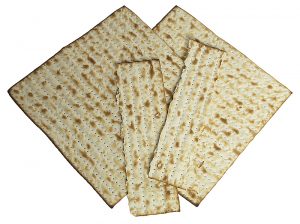
Did Yeshua Eat Leavened Bread During the Passover/Last Supper Communion Service?


There has been a perennial question among many Christians as to whether Yeshua ate leavened or unleavened bread during his last supper Passover communion service. This is because of the Greek words for bread that appear in the Greek NT manuscripts. The excerpt below answering this question is from a larger article I wrote years ago entitled “Passover…When Do We Celebrate It? At the Beginning OR the End of Aviv 14?” available at https://www.hoshanarabbah.org/pdfs/psvr_dy.pdf .

I take the position that Yeshua didn’t eat leavened bread during communion, since it would have violated biblical (Tanakh or OT) types and shadows pointing to Yeshua’s sinlessness. I cannot and will not eat leavened bread in communion because I don’t want in any way to imply or even remotely suggest that Yeshua was a sinner. In this excerpt from my article, I explain the reasons for my position.

Unleavened Bread Versus Leavened Bread

At this point, many questions arise for the honest Bible student. Whatever Yeshua was doing with his disciples Passover-wise, it was before he was to suffer, as Luke 22:15 states. Was he eating an actual Passover lamb? Or just eating bread that was now to become an emblem of his body, a picture of the sacrificial lamb itself? If he was eating bread, and not lamb itself, then why is the term for the bread that he ate with his disciples that night a reference to generic bread (see Matt. 26:26; Mark 14:22; Luke 22:9; 24:30; 24:35; John 13:18), and not unleavened bread, which is a totally different word in the Greek language? To be sure, unleavened bread, not leavened bread, was eaten during the Passover meal in accordance with the Hebrew Scriptures (Num. 9:10-11; Josh. 5:11).

Could this reference to generic (leavened) bread, to which the Gospel writers make unanimous reference in all of their accounts, have been referring to Yeshua as “the bread of life?” Yeshua refers to himself as the “bread of life” (the same Greek word [artos, Strong’s G740] for generic, leavened bread is used in Yeshua’s “Last Supper” accounts as well as in his references to his being the bread of life) in several places in the Gospel of John (6:31, 33, 34,  35, 41, 48, 50, 51, 58). If Yeshua was keeping an early Passover meal with his disciples, that is, early on the fourteenth of Abib instead of late on the fourteenth, which is when the Jews kept it and when the Passover lamb was sacrificed in the temple, which corresponded to when Yeshua was hanging on the cross, then it would have been permissible to eat leavened bread. Torah commands that only unleavened bread be eaten during the seven-day Feast of Unleavened Bread between the fifteenth and the twenty-first days of the first month (Exod. 12:15; 13:6-7; 23:15; 34:18; Lev. 23:5-6; Num. 28:17; Deut. 16:3, 8). Leavened bread is not prohibited from being eaten on the fourteenth (although the Hebrew Scriptures or Tanakh does forbid its being eaten during the actual Passover ceremony itself [Num. 9:10-11; Josh. 5:11], which would have started at the end of the fourteenth and overlapped into the fifteenth, which was the first day of the Feast of Unleavened Bread), though it is safe to say, that most Israelite homes had already been de-leavened by then. The Jews kept Passover (and still do to this day) at the end of the fourteenth and ate their Passover meal actually at the beginning of the fifteenth, which is the beginning of the time when Torah forbids the eating of leavened bread for seven days.

So Yeshua could have eaten leavened bread at the beginning of the Passover day as an object lesson to his disciples (and to us) that he was the bread of life, to which the Passover lamb pointed, and he would not have violated Torah.

That Yeshua ate leavened bread is one line of reasoning that some students of Scripture use to attempt to disprove that his last supper was a Passover Seder. However, to counter this point, some will refer to the Scripture passage in 1 Corinthians 11:17-34, which is a reference to the last meal that Yeshua had with his disciples. There is no mention specifically here of a Passover Seder, but only a meal and the term for bread here is artos­, the Greek word for generic, leavened bread. Does this, passage therefore prove that what Yeshua did with his disciples was not a Seder, even though Yeshua himself referred to it as such? If so, why the usage of the word artos and not the Greek word azumos (Strong’s G106) for unleavened bread? Furthermore, some find it unimaginable that Yeshua would be partaking of leavened bread and likening it to his body, when leavened bread contains yeast or sour dough, a type of sin, and we know that Yeshua had no sin in him. Others say that it was appropriate for him to eat leavened bread, since he took our sins upon himself and that he went to the cross with leaven (a picture of our sins) in him. It might also be added that using the generic term for bread (in reference to the last supper) does not prove conclusively that it was indeed leavened bread. It could have been unleavened. Unleavened bread is still bread. It’s simply a flat bread. But why doesn’t Scripture say so then? If we believe that every detail of Scripture is divinely inspired, we have reason to be confused when certain things do not seem to add up.

We take the position that Yeshua did not eat leavened bread during his Paschal meal, and for a very good reason. In the levitical sacrificial system, YHVH forbad the offering of leavened bread with the sacrifices on all occasions except on the Feast of Pentecost when two leavened loaves were lifted up representing Israel. Even the twelve loaves of bread on the Table of Showbread in the Tabernacle (representing Israel in a purified or sin-free state) were unleavened. Leaving is clearly a picture of sin. Yeshua, the perfect sacrificial Lamb of Elohim fulfilled the sacrificial system types perfectly. It seems unthinkable that the Lamb of Elohim, slain from the foundation of the world, who was sin-free, could have eaten leavened bread and had leavening, a picture of sin, in him when he went to the cross. For this reason, we believe Yeshua ate unleavened bread.


Mary and Elizabeth: Godly Women Produce Godly Sons!

A brief discussion from the Gospel of Luke about Mary (the mother of Yeshua) and Elizabeth (the mother of John the Baptist) may shed some clues on why their sons attained such high spiritual stature. Behind godly sons are often godly mothers!

Luke 1:6, Righteous…blameless. Zachariah and Elizabeth (Heb. Elishevah) were totally Torah-observant to the point of being blameless in YHVH’s eyes. This confirms Moses’ words in Deut 30:11–14 that Torah-obedience isn’t outside the realm of human possibility as some in the church erroneously teach today.

Luke 1:28, Blessed are you among women. These words of Gabriel were repeated verbatim in Elizabeth’s prophecy concerning Yeshua (verse 42). Doubtless this was a supernatural confirmation to Mary concerning her role as the mother of the Messiah, for how could her cousin have known what the angel had spoken to her previously?

Luke 1:36, Elizabeth your relative. While Mary was of the royal lineage of David through her father, she also was a relative on her mother’s side of Elizabeth, the priest-wife of Zacharias, who was a daughter of Aaron (Luke 1:5).  In Matthew one and Luke three two different genealogies are given for Yeshua, both of which  go back to King David. One is presumed to be that of Joseph and the other is that of Mary. In this way, Yeshua was a direct descendant of David legally through Joseph, his step-father, and genetically through Mary, his mother. Does this mean that Mary was of priestly as well as Davidic lineage. Yes, but not patrilineally, only matrilineally. In the Scriptures, tribal lineage was determined through the father’s family line and not the mother’s.

In the case of Mary and Elizabeth, they would have shared common grandparents making them cousins. Their grandfather would have been a priest. In the case of Elizabeth, her father—the son of her priestly grandfather—would have carried the priestly line making her a daughter of Aaron (Luke 1:5). In the case of Mary, her mother would have been her priestly grandfather’s daughter meaning that she was of priestly lineage but not her children, unless she married a priest.

It seems that Yeshua would have carried some priestly blood in his genes, but he was not legally a priest through patrilineal descent. To be sure, Yeshua was a priest, but not one of Aaronic lineage but after the order of Melchizedek, which was the priesthood of the firstborn son passed on generationally. Yeshua was the first born son of Elohim eternally, which is why he is presently at the right hand of Elohim acting as our Great High Priest (Heb 1:3 cp. 3:1; 4:4; 8:1).

Therefore, Mary laid claim to a Davidic as well as a priestly lineage (Jesus the Messiah, by Edersheim, p. 105). This means that Yeshua was not only of direct Davidic lineage but was of priestly lineage as well.

Luke 1:39, Now Mary arose. Those with similar divine missions or callings naturally want to be with others like them. Such divine encounters are too unbelievable and incomprehensible for those who haven’t encountered something similar that it is hard to relate to those who have. This is probably why, in part, the prophets of old, at times, lived together in a community. Those who see into the spiritual realm and operate by faith are constricted spiritually when they have to be around those who don’t.

Luke 1:41–45, When Elizabeth heard. During this greeting, Elizabeth had a spiritual encounter that helped her to connect the dots to understand what was going in YHVH’s divine plan for John and Yeshua. Zechariah would have revealed to her the angel’s previous message (vv. 13–17). Now when the babe leapt in her womb at Mary’s arrival and she was filled with the Spirit (a visceral experience), and then prophetic words came out of her mouth, this was evidence and confirmation to both of them of YHVH’s plans for their sons. YHVH has supernatural ways of conveying his divine will to his people, so that only people of faith will see and understand. All others, unless confronted with visible signs and empirical evidence (as verified by logic, or observable evidence or experience), will dismiss these spiritual revelations and circumstances as delusion. The unbelievers usually resort mockery and scoffing ridicule. Those who walk by faith and hear the voice of YHVH and know his ways of communication are undeterred, however, as they follow the Elohim wherever he leads them.


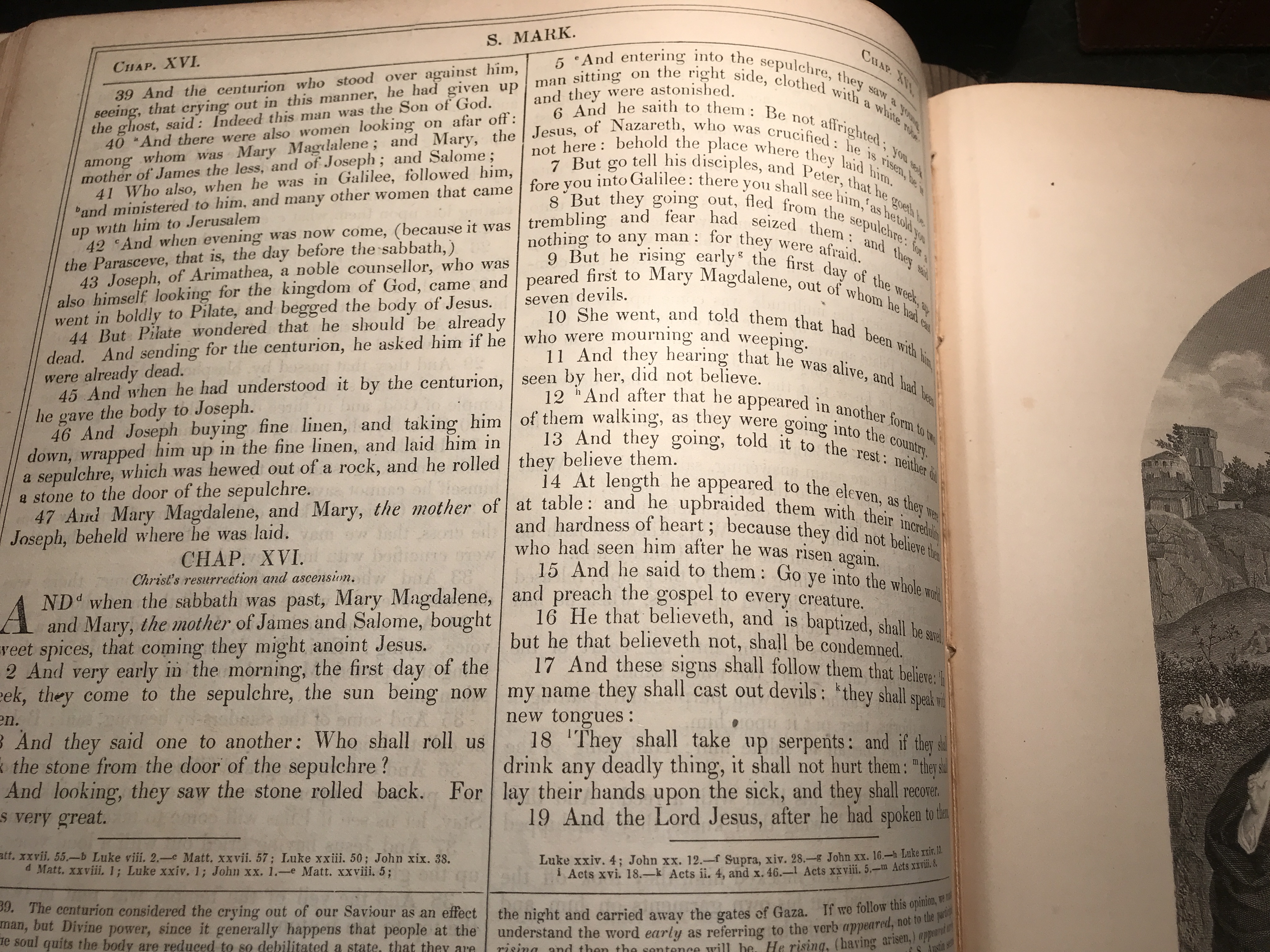
Mark 16:15–18: In or Out of the Bible?


Mark 16:9–20, The Great Commission. Many modern scholars call into question the genuineness of these last twelve verses. For a discussion on whether these verses of Mark’s Gospel should be included in the Bible, see E. W. Bullinger’s (1837-1913) The Companion Bible (appendix 168).

Bullinger states that the two oldest Greek manuscripts of the Testimony of Yeshua (from the fourth century) don’t contain these verses. On the other hand, more than six hundred other Greek manuscripts do contain them as do the oldest Syriac manuscript known as the Peshitto (which Bullinger believes is from the second century) and the Curetonian Syriac (from the third century). He notes that Jerome when translating the Bible into Latin (The Vulgate, A.D. 382) had access to Greek manuscripts older than any now extant,which is why he included these twelve verses in his Bible. Additionally, he notes that the Gothic Version (A.D. 350), the Coptic (fourth or fifth century), the Armenian (fifth century), Ethiopic (fourth to seventh centuries) and Georgian (sixth century) versions all contain these last twelve verses. Bullinger goes on to say that there are nearly one hundred ecclesiastical writers before the oldest extant Greek manuscripts who attest to the authenticity of these verses. Moreover, between A.D. 300 and 600 there are about two hundred more writers who do.

Bullinger gives two reasons why he believes these verses may have been omitted from several of the oldest Greek NT manuscripts. After the destruction of Jerusalem in A.D. 70 extending forward one hundred years, there is a complete blank regarding the history of the early church and a complete silence about this era from Christian writers. Therefore, no one knows what was going on in the church during this period including whether such signs and wonders as enumerated in these last verses in Mark’s Gospel were still occurring. He speculates that when later translators came to the last twelve verses of Mark and saw no trace of these spiritual gifts currently being manifested in the church (in the fourth century), some marked them as doubtful, spurious or even omitted them altogether. This same doubt has been passed on to modern scholars.