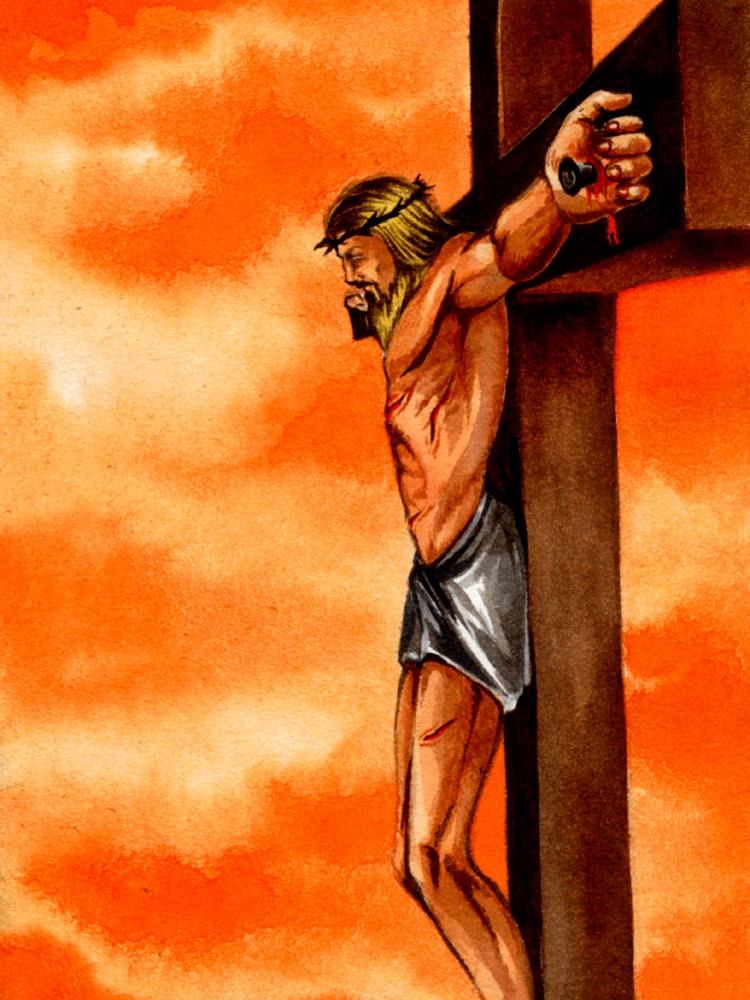
No Broken Bones

John 19:36, Not one of his bones. The bones in the body of Yeshua couldn’t be broken, for the Living Word of Elohim can’t be broken even as the Written Word of Elohim can’t be broken (John 10:35).

James says that if we break one of YHVH’s Torah commands, we have broken them all (Jas 2:10). Sin is the breaking of the Torah (1 John 3:4).

Yeshua, the Living Torah, was perfect and sinless. He never broke a single Torah command, even as not a single bone in his body was broken. He was the perfect, blemish and sin-free sacrificial Lamb of Elohim with no broken bones (Exod 12:46).


Blog Scripture Readings for 3-18 Through 3-24-18

Aside

THIS WEEK’S SCRIPTURE READINGS FOR STUDY AND DISCUSSION:

Parashat Tzav — Leviticus 6:1(8)* – 8:36
Haftarah — Jeremiah 7:21– 8:3; 9:22-23 | Malachi 3:4-24**
Prophets — Isaiah 19:1 – 26:21
Writings — Proverbs 22:1 – 28:28
Testimony — John 19:1 – 21:25; Acts 1:1 – 2:47

Our annual Scripture Reading Schedule for 2017-2018 is available to download and print.

Most of this week’s blog discussion points will be on these passages. If you have general comments or questions on the weekly Scripture readings not addressed in a blog post, here’s a place for you to post those. Just use the “leave a reply” link below.

The full “Read Through The Scriptures In A Year” schedule, broken down by each day, can be found on the right sidebar under “Helpful Links.” There are 4 sections of scripture to read each day: one each from the Torah, the Prophets, the Writings, and from the Testimony of Yeshua. Each week, the Torah and haftarah readings will follow the traditional one-year reading cycle.

* Verse numbers in parenthesis refer to the verse number in Christian English Bibles when they differ from Hebrew Bibles or the Tanakh.

** A different Haftarah is read when it is a special sabbath in Jewish tradition. This week it is Shabbat HaGadol on the traditional calendar with a special Haftarah reading of Malachi 3:4-24.

Weekly Blog Scripture Readings for 3/18/18 through 3/24/18.


New Video: How to Live in a Spiritual God Bubble Above It All

Tired of God in a manmade box, religiosity, church walls that keep you from flying high, religious head-knowledge that leaves you high and dry, meaningless rituals, religious middle men con artists who your money and as they enslave you spiritually? Sick of the world and its evil negativity? Want to fly above it all? Here are some tips to help you to create your own personal God bubble, place of peaceful refuge that will help you to soar above it all and give you a personal and direct relationship with the Creator of the Universe.


What is truth? Is there one single Truth?

In this age of moral relativism or situational ethics, it is unpopular to believe in, much less purport, that there is one single truth. Most humans live under the notion that every person can determine their own truth for themselves. The problem with this delusion is that when your truth conflicts with my truth there will inevitably be conflict. Ultimately, the result is theft, murder and wars.

The reality that a single truth is better than multiple truths is reflected in the laws of a nation. Ostensibly there is supposed to be one set of laws (or one truth that determines what is right and wrong) for all the citizens of that country, state or city. Obviously, if every person had a different set of  rules or truths when they got behind the wheel of an automobile, mayhem would occur. So at this level, it’s not difficult to see the need for one set of rules or, literally, one truth.

The difference of opinion as to what constitutes truth, however, occurs when we take this discussion to the moral and spiritual level. Truth at this level is less tangible and quantifiable. That’s why there are so many religions and philosophies extant. There seems to be something out there for everyone. It’s like going to an ice cream store with 1,031 flavors. And if you don’t like one of the existing flavors of “truth” you simply make up your own and call yourself “spiritual.” That’s what new ageism is all about! Each person can make up their own truth. This is, in reality, a self-styled religious system where  each person picks and chooses what they will or will not do. It’s the “have it your own way approach” to life. Or to put it another way, “Do what thou wilt,” which is a mantra of modern day satanists. Or “if out feels good, do it,” which was the hippy mantra of a generation ago. The Bible calls it “every man doing what’s right in his own eyes,” and further tells us that “there is a way that seems right to a man, but the end result is death.”

Ultimately, this is the rejection of the one, single divinely revealed Truth of Elohim. It’s the rejection of Torah—the instructions, teachings and precepts of Elohim. In reality, it’s accepting the lie of the serpent in the Garden of Eden at the tree of knowledge when he  told the first humans, in essence, “You really don’t have to obey Elohim. You can pick and choose which of his commands you want to do and reject the rest.” Well, anyone who knows their history and who has their eyes open to reality around them can see how that approach has worked out from then until now.

Make no mistake, the rejection of Elohim’s one truth is, in reality, a flat out rebellion against the Creator and a rejection of his truth, which the Bible defines as witchcraft or satanism (1 Sam 15:23).

Man lost paradise on earth when he rejected Elohim’s truth. The utopian paradise that everyone secretly longs for in their heart will not be regained until Yeshua the Messiah returns and establishes his kingdom on earth with the Torah as the one truth that everyone must live by. Even then, not everyone will accept Yeshua’s rule and truth. Those who don’t  will be condemned at the white throne judgment and cast into the lake of fire at the end of the age. Those humans who have accepted the Truth of Elohim will be allowed to eat from the tree of life and will experience the utopian paradise of the New Jerusalem on the new earth in the new heavens.

This all starts with an understanding of the definition of truth.

John 17:17, Truth. Yeshua, the One sent to this earth from Elohim in heaven, says here, “Thy [Elohim’s] Word is truth.” In Matthew 4:4, Yeshua said, “Man shall not live by bread alone, but by every word that proceeds out of the mouth of Elohim.”

So what is truth? The word in Hebrew for truth is emet (spelled aleph, mem, tav), which is comprised of the first, middle and last letters of the Hebrew alphabet. Truth embodies everything from the beginning to the very end of YHVH’s Word (literally, his Torah or the first five books of the Bible, and secondarily, the whole Bible from Genesis to Revelation).

Interestingly, the Scriptures call Yeshua “the beginning and the end of our faith” (Heb 12:2), and likens him metaphorically to alpha and omega (Rev 1:8, 11; 21:6; 22:13), which are the first and last letters of the Greek alphabet. These letters corresponds in symbolic meaning to the aleph and tav, which are the first and last letters of the Hebrew alphabet.

In Hebrew thought, truth consists of all of the Word of Elohim from the first letter in the Hebrew alphabet to the last letter. This same idea is picked up by the Jewish apostolic writers of the Testimony of Yeshua and applied to Yeshua who was the Word of Elohim sent to humanity in human form. As the human embodiment of the divine Word of Elohim he was referred to as the alpha and omega, or, in Hebraically, the aleph and the tav. We see this idea expressed in John 1:1–5 and 14 where it says of Yeshua,

In the beginning was the Word [Torah], and the Word was with Elohim, and the Word was Elohim. The same was in the beginning with Elohim. All things were made by him; and without him was not any thing made that was made. In him was life; and the life was the light of men. And the light shineth in darkness; and the darkness comprehended it not.… And the Word was made flesh and dwelt among us, (and we beheld his glory, the glory as of the only begotten of the Father) full of grace and truth.


John 18:38, What is truth? 

What Is Truth?

Pilate asked Messiah Yeshua, the Son of Elohim, a question many inquiring minds have Continue reading


Blog Scripture Readings for 3-11 Through 3-17-18

Aside

THIS WEEK’S SCRIPTURE READINGS FOR STUDY AND DISCUSSION:

Parashat Vayikra — Leviticus 1:1 – 5:26 (6:7)*
Haftarah — Isaiah 43:21 – 44:23 | Ezekiel 45:16 – 46:18**
Prophets — Isaiah 9:1 – 18:7
Writings — Proverbs 15:1 – 21:31
Testimony — John 13:17 – 18:40

Our annual Scripture Reading Schedule for 2017-2018 is available to download and print.

Most of this week’s blog discussion points will be on these passages. If you have general comments or questions on the weekly Scripture readings not addressed in a blog post, here’s a place for you to post those. Just use the “leave a reply” link below.

The full “Read Through The Scriptures In A Year” schedule, broken down by each day, can be found on the right sidebar under “Helpful Links.” There are 4 sections of scripture to read each day: one each from the Torah, the Prophets, the Writings, and from the Testimony of Yeshua. Each week, the Torah and haftarah readings will follow the traditional one-year reading cycle.

* Verse numbers in parenthesis refer to the verse number in Christian English Bibles when they differ from Hebrew Bibles or the Tanakh.

** A different Haftarah is read when it is a special sabbath in Jewish tradition. This week it is Shabbat HaChodesh — on Rosh Chodesh — on the traditional calendar with a special reading of Ezekiel 45:16 – 46:18 as well as the maftir: Exodus 12:1-20.

Weekly Blog Scripture Readings for 3/11/18 through 3/17/18.


Blog Scripture Readings for 3-4 Through 3-10-18

Aside

THIS WEEK’S SCRIPTURE READINGS FOR STUDY AND DISCUSSION:

Parashat Vayakhel-Pekudei — Exodus 35:1 – 40:38
Haftarah — 1 Kings 7:51 – 8:21 | Ezekiel 36:16-38**
Prophets — Isaiah 1:1 – 8:22
Writings — Proverbs 8:1 – 14:35
Testimony — John 10:1 – 13:16

Our annual Scripture Reading Schedule for 2017-2018 is available to download and print.

Most of this week’s blog discussion points will be on these passages. If you have general comments or questions on the weekly Scripture readings not addressed in a blog post, here’s a place for you to post those. Just use the “leave a reply” link below.

The full “Read Through The Scriptures In A Year” schedule, broken down by each day, can be found on the right sidebar under “Helpful Links.” There are 4 sections of scripture to read each day: one each from the Torah, the Prophets, the Writings, and from the Testimony of Yeshua. Each week, the Torah and haftarah readings will follow the traditional one-year reading cycle.

** A different Haftarah is read when it is a special sabbath in Jewish tradition. This week it is Shabbat Parah on the traditional calendar with a special reading of Ezekiel 36:16-38 as well as the maftir: Numbers 19:1-22.

Weekly Blog Scripture Readings for 3/4/18 through 3/10/18.


22 Practical Tips to Walking in the Presence of Elohim


It’s time to extricate YHVH Elohim from our religious boxes to which we have confined him. These boxes are the times and places where we go and do our “God-thing.”  This can be church or other religious services, grace at meals, and even our personal devotional times. After having thrown a bit of religious ritualism at Elohim, too often we toss our hair back, adroitly slip him onto the back burner and then go our way as if he weren’t much of a part of our lives. In this way, we keep Elohim confined to a few small boxes that we have labeled “religion.” It ends up that we live our lives how we want to without having to think too much about him. In this way, we keep him trapped in these closet prisons of our own contrivances, when, in reality, he wants and demands to be part of every aspect of our lives. Too many of us have no problem with  Elohim being our Savior—but being the Lord and Master over every area of our lives all the time, well, that’s another thing! To experience the blessings and riches of Elohim’s river life, each of us must immerse ourselves in his river and stay in it continually. The following tips will help you to do that.

Here are 22 practical tips for bringing YHVH into every aspect of your daily life:

  1. In all thing, be thankful to YHVH (1 Thess 5:18). Throughout the day, be aware of all your blessings and thank YHVH for them. Even thank him for the trials.
  2. Pray in the Spirit (in your heavenly prayer language, 1 Cor 14:2, 15, 18).
  3. Meditate on a Bible verse (Pss 1:2; 119:78, 148).
  4. Prayerful intercede for people during the course of the day as they come to your mind.
  5. Ask YHVH questions and then wait for him to bring you the answer. He may download the answer into your mind, or it may come through someone else or in some other way.
  6. Pray for divine appoints each day and then wait for them to come and give YHVH thanks when they come. A divine appointment is a “chance” meeting of someone with whom you can share the word of Elohim or in some way be a spiritual light to them by pointing them to Elohim.
  7. Worship and praise YHVH throughout the day by singing songs to him.
  8. Pray before and after meals, or even after taking a drink of water. Before the meal, praise and worship YHVH. After the meal, thank him for the meal you’ve just had (Deut 8:10 cp. Matt 14:19; 15:36; 26:26; John 6:11; Acts 27:35).
  9. View yourself as an ambassador for the kingdom of Elohim in everything you do and say that involves others. Endeavor to be salt and light to those around you for the glory of Elohim (Matt 5:13–16; Eph 5:8; 1 Thess 5:5).
  10. Practice the 16 attributes of YHVH’s love as found in 1 Corinthians 13 — especially when you find yourself in difficult situations where being loving is hard to do.
  11. Live each moment and day as if it were your last.
  12. Express joy in the face of adversity.
  13. Endeavor to plant spiritual seeds wherever you go.
  14. When bad things happen to you, count your blessings, express joy, be thankful, bless your enemies, pray for those who despitefully use you (Matt 5:44).
  15. Always practice the golden rule (Matt 7:12).
  16. Practice being a peacemaker especially in difficult situations when you want to defend yourself, or fight back (Matt 5:9; Rom 12:18).
  17. Do something selfless or altruistic for someone each day. It’s more valuable spiritually if it cost you something and no one knows you did it.
  18. Do everything including the most minimal task for YHVH’s glory and out of love for him. Work as if you were working for YHVH, not for men.
  19. Read your Bible and pray after you get up in the morning and as you’re going to sleep each night even if it’s only for a few minutes.
  20. Put the audio Bible on your iPod, smart phone or similar electronic device and listen to it during your day.
  21. Wear biblical tzitzits or fringes on the four corners of your garments as the Torah commands to help remind you of your relationship with YHVH and to obey his commands (Num 15:37–41; Deut 22:12).
  22. Fast periodically even if it’s only for a meal or two. Among the many spiritual benefits of fasting, when you feel the hunger pangs, it will remind you to think about YHVH Elohim and the need to grow closer to him by controlling and sublimating the carnal appetites.