Blog Scripture Readings for 5-20 Through 5-26-18

Aside

THIS WEEK’S SCRIPTURE READINGS FOR STUDY AND DISCUSSION:

Parashat Nasso — Numbers 4:21 – 7:89
Haftarah — Judges 13:2-25
Prophets — Jeremiah 24:1 – 30:24
Writings — Ruth 4; Lamentations 1:1 – 5:22
Testimony — 1 John 4:1 – 5:21; 2 John; 3 John; Jude; Romans 1:1 – 2:29

Our annual Scripture Reading Schedule for 2017-2018 is available to download and print.

Most of this week’s blog discussion points will be on these passages. If you have general comments or questions on the weekly Scripture readings not addressed in a blog post, here’s a place for you to post those. Just use the “leave a reply” link below.

The full “Read Through The Scriptures In A Year” schedule, broken down by each day, can be found on the right sidebar under “Helpful Links.” There are 4 sections of scripture to read each day: one each from the Torah, the Prophets, the Writings, and from the Testimony of Yeshua. Each week, the Torah and haftarah readings will follow the traditional one-year reading cycle.

Weekly Blog Scripture Readings for 5/20/18 through 5/26/18. This week is the seventh week of seven complete weeks of the count of the omer.


What world religion fits the biblical definition of the spirit of antichrist?

1 John 2:18, The Antichrist. Other biblical references that many Christians scholars believe allude to the end times Antichrist figure include:

  • The Beast (Rev 13:4)
  • The abomination that causes desolation (Matt 24:15)
  • The desolator (Dan 9:27)
  • The man of sin (or lawlessness), the son of perdition (2 Thess 2:3)
  • The little horn (Dan 7:8)
  • The Assyrian (Mic 5:5; Isa 10:5; 14:25)

Many antichrists. How does John define the spirit of antichrist? From 1 John 2:18–19, 22; 4:3; 2 John 7 we learn that the Antichrist and all spirits of antichrist have come out of the first century apostolic faith of the Jewish Christian community. From these passages we also learn that the spirit of antichrist denies that Yeshua is the Messiah (Savior and Redeemer of man), denies that Yeshua is part of the “Godhead,” that he is deity and is the Son of Elohim, and denies the incarnation of Yeshua. This is how the Bible defines the spirit of antichrist.

What should be our reaction when we encounter this demonic spirit of antichrist? The wise counsel of John in his second epistle sums up our firm conviction on this matter.

Whoever transgresses and does not abide in the doctrine of Messiah does not have Elohim. He who abides in the doctrine of Messiah has both the Father and the Son. If anyone comes to you and does not bring this doctrine, do not receive him into your house nor greet him; for he who greets him shares in his evil deeds. (2 John 9–11)

What additionally can we learn about the person of the Antichrist and the spirit of antichrist from the four passages where antichrist is mentioned in John’s epistles?

From 1 John 2:18–19, 22; 4:3; 2 John 7 we learn that the Antichrist and all spirits of antichrist have come out of the first century apostolic faith of the Jewish Christian community. This eliminates some of the world’s large religions (e.g. Hinduism, Buddhism) as being contenders for the end times religious system of the Antichrist. That leaves paganized mainstream Christianity and Islam. From these passages we also learn that the spirit of antichrist denies that Yeshua is the Messiah (Savior and Redeemer of man), denies that Yeshua is part of the “Godhead,” is deity and is the Son of Elohim, and denies the incarnation of Yeshua. Only Islam fits this biblical description of an antichrist religion.


Coming Before Elohim With the Right Mind-Set

Numbers 3:38, The the outsider who comes near. This verse teaches the principle of the fear and reverence of YHVH when approaching his divine Presence. Other scriptures that teach our need to be careful when approaching him include Psalms 15:1–5; 24:3–5 and Ecclesiastes 5:1–2 (see also Gen 28:16–17; Exod 3:5; Lev 10:3; Josh 5:15; Ps 89:7; Heb 12:28–29).

As YHVH didn’t permit the Israelites to come near to him except through the intermediary of the Aaronic priests, similarly we can only come to our Father in heaven through the intermediary of Yeshua the Son of Elohim, and our Great High Priest (Heb 4:14), who is the spiritual door and way to the Father (John 14:6). Although, YHVH permits his set-apart ones (the saints) to come boldly before him through the agency of Yeshua’s high priesthood and his blood (Rev 5:6–8) to obtain mercy and grace in time of need (Heb 4:16), let’s not forget two things.

First, we come to YHVH Elohim in human weakness needing help and grace from him who is greater than us; therefore, we need to maintain a humble disposition.

Second, our Elohim is a consuming fire (Heb 12:29); therefore, we need to serve him with reverence and godly fear (Heb 12:28), since in his hands he holds the power of life and death (Matt 10:28). Fire is a biblical metaphor for judgment, and YHVH will judge all people including his own people (Heb 10:30–31) for all that they have done while in the flesh whether good or bad to determine levels of rewards and punishment (Matt 5:19; 16:27; 2 Cor 5:10; Rev 20:12; 22:12). In fact, Peter admonishes us to conduct our lives in the fear of Elohim and to be holy as he is holy who will judge each man according to his works (1 Pet 1:17).


Do you see yourself as a priest in training?

Numbers 3:11–13, I myself have taken. Here YHVH chooses the tribe of Levi instead of the firstborn male of each Israelite family to be Israel’s spiritual leaders. When the Israelites exited Egypt, YHVH chose and sanctified the firstborn male of each family to the be spiritual leader of his home in what is called the law of the firstborn (Exod 13:2, 11–16). As it had been the responsibility of the firstborn to lead his family spiritually, and, as the patriarch of his family, to pass down the family legacy and spiritual traditions to the next generation, YHVH now placed this mantle on the shoulders of the Levites. It was now their responsibility to teach the Israelites what YHVH had commanded them to do (Deut 24:8). They became the Torah teachers in Israel (Deut 33:10; Neh 8:7, 9, 13; 2 Chron 30:22) along with the priests (Lev 10:11; Mal 2:7). They were scattered throughout the land of Israel for this purpose (2 Chron 17:8–9). The reason that YHVH gave this responsibility over to the sons of Levi was because the firstborn of each family had failed to lead their families in YHVH’s paths of righteousness, and they failed to prevent the Israelites from golden calf worship (Exod 32). Only Levi remained faithful to YHVH during the golden calf incident, and thus YHVH granted them the blessing of the priestly service (Exod 32:26–29).

Originally, it had been YHVH’s intent for the entire nation of Israel to be a kingdom of priests (Exod 19:6) in order to be a light to the nations and lead the nations to YHVH and his Torah by their righteous example (Deut 4:6–8). This is why YHVH placed the land of Israel, and specifically Jerusalem, at the center of the major trade routes of the ancient world between Africa, Asia and Europe.

The Levitical priesthood (along with the elaborate tabernacle sacrificial system) was a temporary institution that YHVH added (Gal 3:19 cp. Jer 7:21–22) to the nation of Israel’s legal system because of the firstborn’s failure to prevent Israel from worshipping the golden calf idol. In a general sense, YHVH didn’t give the Israelites the Torah at this time—the principles of which they and their forefathers already had been given (e.g., Gen 26:5). So what other law was added? At Mount Sinai, the Torah was codified into a legal system (with civil penalties including the institution of a sacrificial system as a penalty for sin) and became the constitution of the nation of Israel, and YHVH also gave them the institution of the Levitical priesthood and the sacrificial system (Gal 3:19), which (along with the rest of the Torah) pointed them to Yeshua (Gal 4:16, 2). The sacrificial and Levitical systems were completely fulfilled by the Messiah as the writer of Hebrews goes into great detail to explain to us (Heb 5–11).

As already noted, it was YHVH’s intention for all Israel to become a kingdom of priests (not just the tribe of Levi) to teach the nations his spiritual truths. YHVH’s original purpose for Israel is now being fulfilled in the royal priesthood of all redeemed believers to which Peter makes reference in his first epistle (1 Pet 2:9). When the Romans destroyed the temple in Jerusalem, the Levitical priesthood along with the sacrificial system ceased to exist. This occurred some forty years after the death and resurrection of Yeshua who, at that time, became man’s sacrifice for sin once and for all and is now in heaven officiating as our Great High Priest as the writer of Hebrews reveals to us. When the temple priesthood was destroyed, YHVH’s royal priesthood of all believers was ready to take its place. In a sense, the present priesthood model defaults to the original priesthood model where the leader of each family was the priest of his home. The only difference is that the patriarchal priesthood model has been expanded and now all redeemed believers have the opportunity to become a priest in Yeshua’s eternal kingdom regardless of gender and family birth order.

Presently, the saints are preparing to be a kingdom of priest as they learn to live out and to teach others YHVH’s Torah truths. This learning process is preparing them to become kings and priests (or a kingdom of priests, Exod 19:6) in Yeshua’s millennial kingdom after his second coming where they will teach the nations the truth of YHVH (Rev 1:6; 5:10; 20:6), even as the Levites of old taught the nation of Israel YHVH’s Torah.


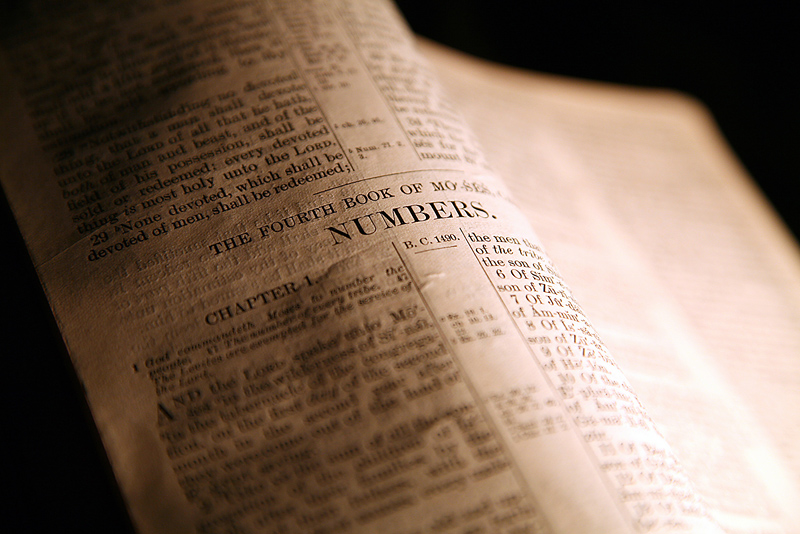
General Overview of the Book of Numbers (B’midbar)

The English name Numbers derives from the fact that in this book the Israelites are counted or numbered on several occasions (see chapters 1, 2, 3, 4, 26). Leviticus ends with YHVH instructing his people to count their flocks for tithe purposes, while Numbers begins with YHVH, as the ultimate Good Shepherd (or in Hebrews, YHVH Rohee), counting the Israelites themselves, who are the sheep of his pasture (Pss 74:1; 79:13; 95:7; 100:3). The fact that this counting took place in the wilderness proves that it was not for political or national economic reasons, but was in fulfillment of YHVH’s Torah instructions. Each Israelite was to give a half-shekel of silver toward the maintenance of the tabernacle. The shekels then counted would give the exact number of Israelites (Exod 30:12–16).

The Hebrew name B’midbar meaning “in the wilderness” originates from the fact that this book chronicles Israel’s wandering in the wilderness. The Book of Exodus, on the other hand, records the deliverance of Israel from Egypt, its establishment as a nation, its covenantal relationship with YHVH and the construction of the tabernacle (mishkan), which was the symbol of YHVH dwelling or tabernacling in the midst of his chosen people. The Book of Leviticus deals with the inner workings of that tabernacle and the mechanics of how sinful man could maintain a right spiritual relationship with a righteous Elohim. This was accomplished through the agency of the Levitical priesthood that would function within the tabernacle as a human intermediary between man and his Creator.

The Book of Numbers covers much of Israel’s forty years wandering in the wilderness and recounts the early years of this nation under YHVH’s theocratic rule. Recorded are Israel’s triumphs and defeats, its obedience and disobedience to YHVH’s rule of law and the resulting consequences whether blessing or curses.

In this book, we see several main subdivisions. Chapters 1:1–10:10 cover instructions from YHVH to Israel while still at Mount Sinai. Chapters 10:11–36:13 cover the Israelite’s actual wilderness journey. The second section dealing with the wilderness journey has two main parts: the perishing in the wilderness of the older generation (10:11–25:18), and the preparation of the second generation of Israelites to enter the Promised Land (chapters 26–36).

Reoccurring themes in the Book of Numbers include the continual murmuring of Israelites and the divine punishment on them as a result. YHVH made promises to care for them and lead them into the Promised Land. Instead of having faith and trust in him, with few exceptions, the Israelites exhibited doubt and unbelief in YHVH. As a result, the entire older generation, with the exception of faithful Joshua and Caleb, perished in the wilderness never to realize the promises YHVH had made to them concerning the Promised Land. This is a poignant lesson for all believers in their faith walk. The spiritual application of this lesson is not missed by the writer of the Epistle to the Hebrews in chapter four of that book. When YHVH makes promises, his people need to embrace those promises with enthusiastic and optimistic faith and never let them go. After all, if we cannot trust our Creator, then who or what can we trust?

In this book, we see revealed the grace of YHVH, that he is longsuffering and slow to anger (14:20–38), but that he is also just, and as a father, he disciplines those he loves. His judgments are measured and progressive. The more his children refuse to obey him and resist him, the stronger the judgments. Eventually, the older generation of Israelites died off in the wilderness. This teaches us that death is the final judgment against the sin of rebellion and unbelief. There are no eternal rewards or spiritual inheritance for those who refuse to take hold of YHVH’s promises and to go forward in faith and faithful obedience to him.

We see the work and person of the future Yeshua the Messiah in the Book of Numbers as well. As Provider, he meets all of Israel’s needs both physical and spiritual. Paul reveals that Yeshua was the spiritual Rock that gave them water in the wilderness (1 Cor 10:4). Twice, Israel received water from the rock (Exod 17:1–7 and Num 20:1–13). Additionally, the secular prophet, Balaam, prophesied about the Messiah who was to rise out of Israel like a star (Num 24:17). Leading rabbinic Jews sages, such as Akiva ben Joseph of the early modern era, mistakenly applied this verse to the Jewish zealot, Bar Kokhba, when he endeavored to throw off the yoke of Roman rule over the Jewish people during the Second Jewish Revolt of A.D. 133–135.


False Teachings and Destructive Heresies of the Early Church Fathers

2 Peter 2:1, False teachers…destructive heresies. When did several prominent but destructive, non-biblical heresies creep into the early church, which are now major doctrines in mainstream Christianity? Here is a partial list along with the approximate times the early church fathers began teaching these doctrines.

False Teachings and Destructive Heresies in the Early Church

The Human Soul Is Immortal

The immortality of the soul was not a Hebraic concept, but originated from the ancient Greek philosophers. This pagan concept made its way into the church as Gentiles who were steeped in the thinking of the Greek philosophers gained control of the early church after the death of the last apostles.

A.D. 130— The Epistle of Mathetes to Diognetus, ch. 6

Ca. A.D. 155—The First Apology of Justin Martyr, ch. 18

Ca. A.D. 180—Irenaeus’ Against Heresies, Book Two, ch. 34 

Ca. A.D. 180—Irenaeus’ Against Heresies, Book Five, chaps. 7.1; 31.1

Teachings Against the Sabbath and Biblical Feasts

A.D. 130—The Epistle of Mathetes to Diognetus, ch. 4. The author calls the Sabbath and biblical feasts “utterly ridiculous and unworthy of notice.” 

Ca. A.D. 130—Epistle of Barnabas, ch. 2 (also ch. 14). The author says that the Sabbaths (weekly Sabbath and biblical feasts) are abolished.

Early part of second century A.D.—Epistle of Ignatius to the Philippians, ch. 14

Observance of the Lord’s Day (Sunday) Advocated Over Sabbath Observance

There is no record in the Bible of the early New Testament believers replacing the seventh-day Sabbath with Sunday. To say so is wishful thinking, a twisting of the Scriptures and biblical revisionism. It wasn’t until the fourth century at the Council of Nicea under Roman emperor Constantine that the Sunday officially replaced the Sabbath in the early church. Until that time, many Christian churches still observed the Sabbath throughout the Roman empire. The process of transitioning from Sabbath to Sunday observance was a slow one beginning in the early second century and had its roots largely in antisemitism.

Early part of second century A.D.—Epistle of Ignatius to the Magnesian, ch. 9. The author says to keep the Sabbath on Sunday.

Early part of second century A.D.—Epistle of Ignatius to the Trallians, ch. 9

Ca. A.D. 130—Epistle of Barnabas, ch. 14

Ca. A.D. 155—The First Apology of Justin Martyr, ch. 67

Teachings Against the Torah

Early part of second century A.D.—Epistle of Ignatius to the Philadelphians, ch. 6. The author declare, “If anyone preach the Jewish law, listen not to him.”

Early part of second century A.D.—Epistle of Ignatius to the Magnesian, ch. 10

Ca. A.D. 155—The First Apology of Justin Martyr, ch. 47. The author states that out of “weak-mindedness,” some Christians observe the Mosaic law. Sabbath and feast days observance are optional, but not encouraged.

Anti-Semetic/Anti-Torah Theology

Early part of second century A.D.—Epistle of Ignatius to the Magnesian, chaps. 8, 10

Ca. A.D. 180—Irenaeus’ Against Heresies, Book Four, ch. 16.4. The author declares that the Decalogue was not cancelled by the New Covenant, but the statues and judgments of the Torah were a bondage to the Israelites and are no longer binding on Christians.

Teachings Against the Biblical Dietary Laws of Clean and Unclean Meats

Early part of second century A.D.—Epistle of Ignatius to the Philadelphians, ch. 6. The author states that one who adheres the biblical dietary laws “has the apostate dragon dwelling within him.”

Easter Celebration Established a Christian Holiday

Ca. A.D. 150—The celebration of the resurrection within the early church began in the middle of the second century (History of the Christian Church, vol. 2, pp. 207–8, by Philip Schaff). The date of Easter and its formal establishment and disconnection from Passover occurred in A.D. 325 at the council of Nicea.

Sabbath Officially Changed to Sunday

A.D. 321—Sunday officially becomes the weekly day of worship (in place of the Sabbath) by a legal enactment of Emporer Constantine (History of the Christian Church, vol. 3, p. 378ff, by Philip Schaff; History of the Christianity, vol 1, p. 93, by Kenneth Scott Latourette)

Christmas Established as a Christian Holiday

Ca. A.D. 354—Christmas originated in the middle to the end of the fourth century as a Christian holiday as an outgrowth of a pagan festival celebrating the birth of the pagan sun god.

 

The Seven Steps to Spiritual Maturity—to Be Complete in Love

2 Peter 1:5–7, Add to your faith. This list of seven character qualities shows us the progressive steps one must go through to become mature spiritually. 

Faith: First there is initial faith in YHVH Elohim, which is the starting point in our spiritual walk. This is the same faith Abraham had when YHVH told him to leave Babylonia, and it was accounted to him for righteousness sake (Gen 15:6; Rom 4:3).

Virtue: Second, initial faith in Elohim is “filled out with” (as J. P. Green translates it) virtue, which is defined as “moral excellence.” This can be no less than one’s learning to conform one’s lives to the high standards of the Torah, which tells us how to walk in relationship with Elohim (as summarized by the first four of the ten commandments) and our fellow man (as summarized by the last six of the ten commandments). Virtue is the opposite of sin, and the Torah shows us what sin and moral excellence are by showing us what to do (the path of blessing and life) and what not to do (the path of curses and death).

Knowledge: Third, as one begins to walk out Torah-obedience, one gains a deeper and more perfect understanding of the heart, will and mind of Elohim as expressed in the Creator’s instruction manual for living—the Torah, which is Truth and is the path that leads to life. At the same time, one gains an understanding of the opposite side, which is that of sin and leads to death.

Self-control: Fourth, as one gains a fuller understanding of the difference between good and evil, right and wrong as defined by YHVH’s instructions in righteousness, the Torah, and as one fortifies oneself morally by choosing consistently to do the right thing, one gains self-control. One learns to control or master one’s fleshly passions and desires including selfishness, pride, greed, anger and lust and all the other works of the flesh (Gal 5:19–21).

Perseverance or patience: Fifth, as one becomes proficient and consistent in self-control, one begins to learn patience or perseverance, which is steadfastness, constancy and endurance. At this stage in one’s spiritual development, one becomes less likely to be buffeted around or thrown off balance by one’s own carnal impulses or by those of other people that are directed at us (persecution).

Godliness: Sixth, as our life more consistently begins to reflect the heart, mind and will of YHVH Elohim as exemplified in his Torah and the rest of his Word (the Scriptures) and as walked out by Yeshua, the Living Torah-Word of Elohim, then our words, thoughts and actions will begin to reflect the very character and nature of our Father in heaven, which is godliness, to those around us, even as the moon reflects the light of the sun into the darkness of the night world. At this point, who we are is more defined by the character of Elohim than by the carnal, sin nature of the typical man.

Brotherly kindness: Seventh, obedience to the Torah naturally results in our being kinder and gentler to those around us, since the Torah demands that we treat others how we want to be treated and tells us how to love our neighbor as ourself (Matt 7:12; Mark 12:28–30; Rom 13:8–10). After one has completed these seven steps, one becomes perfect or complete in biblical love, which is the eighth step.

Love: The eighth step to spiritual maturity is love (for Elohim and our fellow man), which is the summation of all the fruit of the Spirit (Gal 5:22–24) and is the highest level of spiritual attainment (1 Cor 13:1–13) and is the summation of the entire Torah (Mark 12:28–30; Rom 13:8–10). The previous eight steps are the components of a complete or perfect biblical love. Biblical love isn’t some nebulous or ethereal concept based on some heady concept, lofty emotions or vague feelings. Rather love is a concrete idea that is rooted in one’s actions toward one’s brother as delineated in the previous seven steps. This type of love is unconditional, and is an unselfish love for others even when there is no personal benefit to be gained as Paul succinctly and concretely teaches in 1 Corinthians 13—the love chapter. This is the love of Elohim—the love that he has for men, and the love that he wants us to develop, so that we will be like him, so that he can live with us forever in his eternal kingdom. After we have matured through these eight steps, we become spiritually and morally complete or perfect and are prepared to spend eternity with YHVH Elohim in the New Jerusalem of heaven on earth. Love is the eighth step, and eight is the number signifying new beginnings and infinity; therefore, love is the character trait that launches us into a new beginning of a immortal life in Elohim’s eternal kingdom of the heaven on earth of the New Jerusalem.