Does the “Voice” of YHVH Elohim ever contradict itself?


Deuteronomy 28:15, To the voice of YHVH. What is the voice of YHVH?


Is his voice that which uttered the Torah at Mount Sinai? Is it the voice of his Spirit inside of a Spirit-led, redeemed believer? Is it the voice of Yeshua as largely recorded in the red letters of the Testimony of Yeshua, or is it the entire Word of YHVH Elohim called the Scriptures? If the answer to the question is “all of the above,” then should any parts or aspects of Elohim’s voice contradict with any other?

If we have a Biblical view or theology where we believe that one aspect of YHVH’s voice contradicts with and another in that we believe a part of it has been “done away with,” then what does this imply about the mind and nature of YHVH? There is a psychological term for this. It is called schizophrenia.

Now in our right mind, we would never dare label YHVH with such terms, for to do so would be blasphemy, right? Yet, in reality, many of our religious beliefs make YHVH into something that he is not, and we risk become an unwitting party to attaching this blasphemous labeling to the Almighty Creator if we subscribe to these false theologies that, in one way or another, tell us one part or another of the Word of Elohim is no longer for us today.

One thing is certain. YHVH is not a liar, nor does he ever contradict himself. If there seems to be a problem with inconsistency in YHVH’s Word, the problem is with OUR ­misunderstanding or misinterpretation of it, and NOT with the actual Word or voice of YHVH!


The Sabbath: Physical and Spiritual Rest

Hebrews 4:9–10, Rest. The Greek word sabbatismos means “a keeping of the Sabbath” and is derived from the Hebrew word sabbaton meaning “the seventh day or Sabbath.” It is  derived from the Hebrew word shabbat meaning “sabbath,” which originates from the root verb shabat meaning “to cease, desist, rest.”

Those who have entered into the Sabbath rest do so by following the example of YHVH the Creator who not only rested spiritually, but literally rested on the seventh day after the creation. He set this as an example for man to follow.

Some people see this verse in Hebrews only as a mandate to rest from their spiritual works by putting their faith in Yeshua. This is only partial rest. We must follow the example of YHVH who literally rested on the seventh day as well. Yeshua was YHVH the Creator (Heb 1:10; John 1:3, 10). He kept the Sabbath as YHVH the Creator, and as Yeshua the Messiah. (If Yeshua didn’t keep the Sabbath, then he was a sinner in that he violated the law, and is not our perfect, sin-free Savior! And if he kept the Sabbath, and he did, we are to imitate him as his obedient disciples and imitators by doing what he did. See 1 Cor 11:1.)

When we rest both physically and spiritually, we’re walking out a higher level of truth by walking out both the letter and the spirit of the law as Yeshua taught us to do in his Sermon on the Mount (Matt 5:17–48), and as such, we’ve positioned ourselves before YHVH to receive more divine revelation from him. In other words, the more we obey him faithfully in love, the more truth he can entrust us with for safekeeping, for he knows we won’t take for granted or trample his precious truth nuggets. To those who are faithful in much, YHVH gives more. That’s how it works in his spiritual economy.

You see, the Jews keep the physical Sabbath, but have missed the revelation of spiritual rest in Yeshua, while the mainstream Christians have rejected the physical Sabbath rest but accepted the spiritual rest in the Messiah. Both sides have half the truth. Let’s put the two halves together and walk out the full truth!

Keeping the seventh day Sabbath with this fuller understanding is another way of connecting the gospel message to its Hebraic, pro-Torah roots.


The Commandments of Torah—A Strong Chain

Deuteronomy 27:15–18, The commandments are all inter-connected. To the casual reader, the admonitions contained in these verses may seem to be arranged in a random order, but this is not the case.

Consider the following: The prohibition against idolatry (verse 15) is juxtaposed with that of degrading one’s parents (i.e. not honoring one’s parents, or as S. R. Hirsch states in his commentary, “who outwardly is respectful to his parents but inwardly considers himself vastly superior to them”) along with trespassing against one’s neighbor’s property by removing his neighbor’s boundary markers or landmarks. Now consider this: One who does not honor and fear YHVH but turns to idolatry (the second commandments) will not honor one’s parents (the fifth commandment) (and vice versa) will likewise not honor the property of one’s neighbor (including his neighbor’s wife).

Juxtaposed next to these commands is the prohibition against misleading a blind person (verse 18). This means that we should not take advantage of one’s blindness by advising a blind person in a way beneficial to us and detrimental to him.

Juxtaposed to that is one who steals justice from another by perverting judgment against one who is weaker socially or financially or who is less informed at law than another thereby giving the advantage to the stronger (The ArtScroll Davis Edition Baal HaTurim Chumash/Devarim, pp. 2126–2127).

Can you see how each command is interrelated with all the others? Does this not give one insight into the curious statement found in James 2:10, which declares that if you have broken one commandment you have broken them all? We can see that in one way or the other, all of YHVH’s commandments are inter-related, all depend on each other, and they all stand or fall together.

Now relate James 2:10 back to verse eight where the entire Torah-law can be summarized as the “royal law of love.” As you review YHVH’s list of prohibitions in Deuteronomy 27 can you see any other relationships between these juxtaposed concepts?

Learning to exegete (draw truth out of) Scripture in this manner will yield a whole new level of spiritual revelation to the reader.


Do you view yourself as Elohim’s special/peculiar treasure?

Deuteronomy 26:18, His special people. Heb. am segulah. (See notes at Exod 19:5.)

Exodus 19:5, Peculiar treasure. This term or treasured people (Heb. am segulah) is

used several times in the Torah. Here (Exod 19:4–6) YHVH betrothed himself to and married the people of Israel and they became his am segulah or treasured possession among all the peoples of the nation, a kingdom of priests and a kadosh or set-apart nation. Later Moses restates this same idea to the younger generation Israelites about to enter the Promised Land (Deut 14:2); and finally in Deuteronomy 26:18 (see also 7:6) he again calls Israel his “treasured people” and admonishes them to keep his Torah-commands that he might “make you high above all the nations which he has made, in praise, and in name, and in honor, and that you may be a set-apart people unto YHVH your Elohim.” In the Testimony of Yeshua, this theme is again picked up by Peter in his first epistle (1 Pet 2:9) when he refers to the saints as “a chosen generation, a royal priesthood, a set-apart nation, a peculiar people.” 

Am segulah/hllgso means “possession, treasure, valued property, peculiar treasure.” The basic meaning of the word is “personal property.” Well attested in Hebrew, Ugaritic, and Aramaic, the Akkadian sakalu, ‘to acquire property’ and sikiltum ‘personal property’ are also doubtless related. While the word occurs only eight times, it is filled with theological and spiritual treasures. The preacher in Ecclesiastes reports that the accumulation of the finest of personal possessions is sheer vanity. Those who fear the Lord become his peculiar possessions whom he will never forget, even in that time of great judgment (Mal 3:16–18, see TWOT).

“Israel was God’s personal possession (Ps 135:4). Moses reminded Israel that God chose her and redeemed her from bondage not because of her goodness, but solely because he loved her and was faithful to the promises given to the patriarchs. Israel should reflect God’s holiness and live out his commandments (Deut. 12:2ff), reflecting his standards in a life of wholehearted compliance with the terms of the covenant made at Sinai (Ex. 19:5-6) and renewed at their entrance into Canaan. Then would they have good success (Deut. 26:16-19). So it should be with all believers. These verses are doubtless alluded to in Titus 2:14 and 1 Peter 2:9” (Ibid.).

How do you view yourself spiritually? How does Elohim view you? How are these two views different from each other? How you view yourself should be determined by what the Scriptures say about you. What does Elohim’s Word say, and do you believe it?

  • I am complete in Yehshua who is the head of all principality and power. (Col 2:10)
  • I am free from the law of sin and death. (Rom 8:2) 
  • I am alive with Yeshua. (Eph 2:5)
  • I am far from oppression, and fear does not come near me. (Isa 54:14 )
  • I am born of Elohim, and the evil one does not touch me. (1 John 5:18)
  • I am holy and without blame before him in love. (1 Peter 1:16; Eph 1:4; Col 2:10)
  • I have the mind of Yeshua the Messiah/the Anointed One. (Phil 2:5; 1 Cor 2:16)
  • I have the peace of Elohim that passes understanding. (Phil 4:7)
  • I have the Greater One living in me, greater is he who is in me than he who is in the world. (1 John 4:4)
  • I have received the gift of righteousness and reign as a king in life by Yeshua Mashiach. (1 John 4:4 Rom 5:17)
  • I have received the Spirit of wisdom and revelation in the knowledge of Yeshua, the eyes of my understanding being enlightened. (Eph 1:17–18)

(For a complete list of what the Scriptures say about you, please see http://www.hoshanarabbah.org/pdfs/who_i_am.pdf.)


Tithing—An Act of Grateful and Prayerful Worship

Deuteronomy 26:4–11, You shall answer. This was the prayer that one was to make when one brought their tithe to YHVH. Bringing one’s tithe to YHVH was an act of gratefulness and worship and was brought with a joyful heart for the blessing the Almighty had bestowed upon the tithe-giver.

Deuteronomy 26:11, You shall rejoice. Bringing one’s tithes and offerings to YHVH is to be a joyful event since it is a reflection of our gratitude to him for abundantly blessing us. (Compare this verse with 2 Corinthians 9:6–11.) Giving to YHVH is a form of worship since it allows us to put our treasure where our heart is (Luke 12:34). Please join me in praying this prayer: 

Father, help us to give to you out of the abundance of our hearts joyfully and with gratitude for your blessings and bounty in our lives. Help me not to be a fair-weather giver only, but to give out of obedience, even sacrificially, that we may learn to have faith in your promises of provision and to obey you no matter the circumstances. Amein.

(For a brief study on tithing and giving, please see my teaching entitled, “Is Tithing for Us Today?” which is available on our ministry website at http://www.hoshanarabbah.org/pdfs/tithing.pdf.)


Blog Scripture Readings for 8-26 Through 9-1-18

Aside

THIS WEEK’S SCRIPTURE READINGS FOR STUDY AND DISCUSSION:

Parashat Ki Tavo — Deuteronomy 26:1 – 29:8 (9)*
Haftarah — Isaiah 60:1-22
Prophets — Amos 9; Obadiah; Jonah 1, 2, 3, 4; Micah 1:1 – 2:13
Writings — 2 Chronicles 1:1 – 8:18
Testimony — Hebrews 3:1 – 9:28

Our annual Scripture Reading Schedule for 2017-2018 is available to download and print.

Most of this week’s blog discussion points will be on these passages. If you have general comments or questions on the weekly Scripture readings not addressed in a blog post, here’s a place for you to post those. Just use the “leave a reply” link below.

The full “Read Through The Scriptures In A Year” schedule, broken down by each day, can be found on the right sidebar under “Helpful Links.” There are 4 sections of scripture to read each day: one each from the Torah, the Prophets, the Writings, and from the Testimony of Yeshua. Each week, the Torah and haftarah readings will follow the traditional one-year reading cycle.

* Verse numbers in parenthesis refer to the verse number in Christian English Bibles when they differ from Hebrew Bibles or the Tanakh.

Weekly Blog Scripture Readings for 8/26/18 through 9/1/18.


Do you fully discern the Lord’s body?


Gather my saints together unto me; those that have made/cut a covenant with me by sacrifice. (Psalm 50:5

Psalms 50:5, Made/cut a covenant…by sacrifice. This refers to the method by which covenants were made in ancient times between two parties. This same ritual occurred when YHVH made (or cut) a covenant with Abraham in Genesis chapter 15 except that YHVH took all the responsibilities for fulfilling the covenant upon himself, for Abraham was asleep when this covenant was cut (Gen 15:9–10, 12). All Abraham had to do was to have faith in YHVH and all the blessings of the Abrahamic Covenant would fall upon him (Gen 15:6). We know from Paul’s discussion in Romans chapter four that the Abrahamic Covenant is the original biblical model for how an individual can receive salvation from Elohim. We also know that when YHVH made his covenant with Abraham, the vision Abraham had while he was asleep prophetically pointed to Yeshua’s death on the cross and his initiating the new/renewed covenant as prophesied in the Tanakh (e.g. Jer 31:31–33; also see my discussion of Gen 15:12–21 at Abraham’s vision). Yeshua at his last supper and subsequent crucifixion fulfilled this ancient prophecy as well as the spiritual types and shadows discussed in Psalm 50:7 and Genesis 15:9–21. At his last supper, Yeshua made a new covenant with his disciples through his body (the bread) and blood (the wine), which redeemed believers now commemorate when they take communion. 

And as they were eating, Jesus took bread, and blessed it, and brake it, and gave it to the disciples, and said, Take, eat; this is my body. And he took the cup, and gave thanks, and gave it to them, saying, Drink ye all of it; for this is my blood of the new testament, which is shed for many for the remission of sins. (Matt 26:26–28)

And when he had given thanks, he brake it, and said, Take, eat: this is my body, which is broken for you: this do in remembrance of me. (1 Cor 11:24)

Prior to his death on the cross, Yeshua’s predictively explained the significance of his broken body and spilled blood as it relates to covenantal agreement between him and those who would place their faith in him (as Abraham did in Gen 15).

35And Jesus said unto them, I am the bread of life: he that cometh to me shall never hunger; and he that believeth on me shall never thirst.…47 Verily, verily, I say unto you, He that believeth on me hath everlasting life.…50 This is the bread which cometh down from heaven, that a man may eat thereof, and not die.53 Then Jesus said unto them, Verily, verily, I say unto you, Except ye eat the flesh of the Son of man, and drink his blood, ye have no life in you.…58This is that bread which came down from heaven: not as your fathers did eat manna, and are dead: he that eateth of this bread shall live for ever. (John 6:35, 47, 50, 53, 58)

In the context of the Passover service when the saints through the ritual of communion annually commemorate Yeshua’s “cutting” the new covenant with his saints and then ratifying that covenant through his death, Paul has the following to say about the significance of Yeshua’s body:

For as often as ye eat this bread, and drink this cup, ye do shew the Lord’s death till he come. Wherefore whosoever shall eat this bread, and drink this cup of the Lord, unworthily, shall be guilty of the body and blood of the Lord. But let a man examine himself, and so let him eat of that bread, and drink of that cup. For he that eateth and drinketh unworthily, eateth and drinketh damnation to himself, not discerning the Lord’s body. (1 Cor 11:26–29)

Those who carelessly take communion are literally disrespecting not only the high value of the covenant that was made (or cut), but the tremendous price of making a covenant with Elohim (i.e. it cost Yeshua his life, and the believer must also die to himself as he accepts, unconditionally, Yeshua as his Lord and Master). Moreover, careless partakers of communion are not only underestimating the cost of their salvation, but the value and the benefits of that salvation, which is spiritual rewards including eternal life. Elohim is not only not duty bound to give immortality to such people, but would be foolish to immortalize people who don’t sufficiently recognize and appreciate the cost and value of covenantal agreement. In doing so, he would risk having another rebellion on his hand at some point in the future.

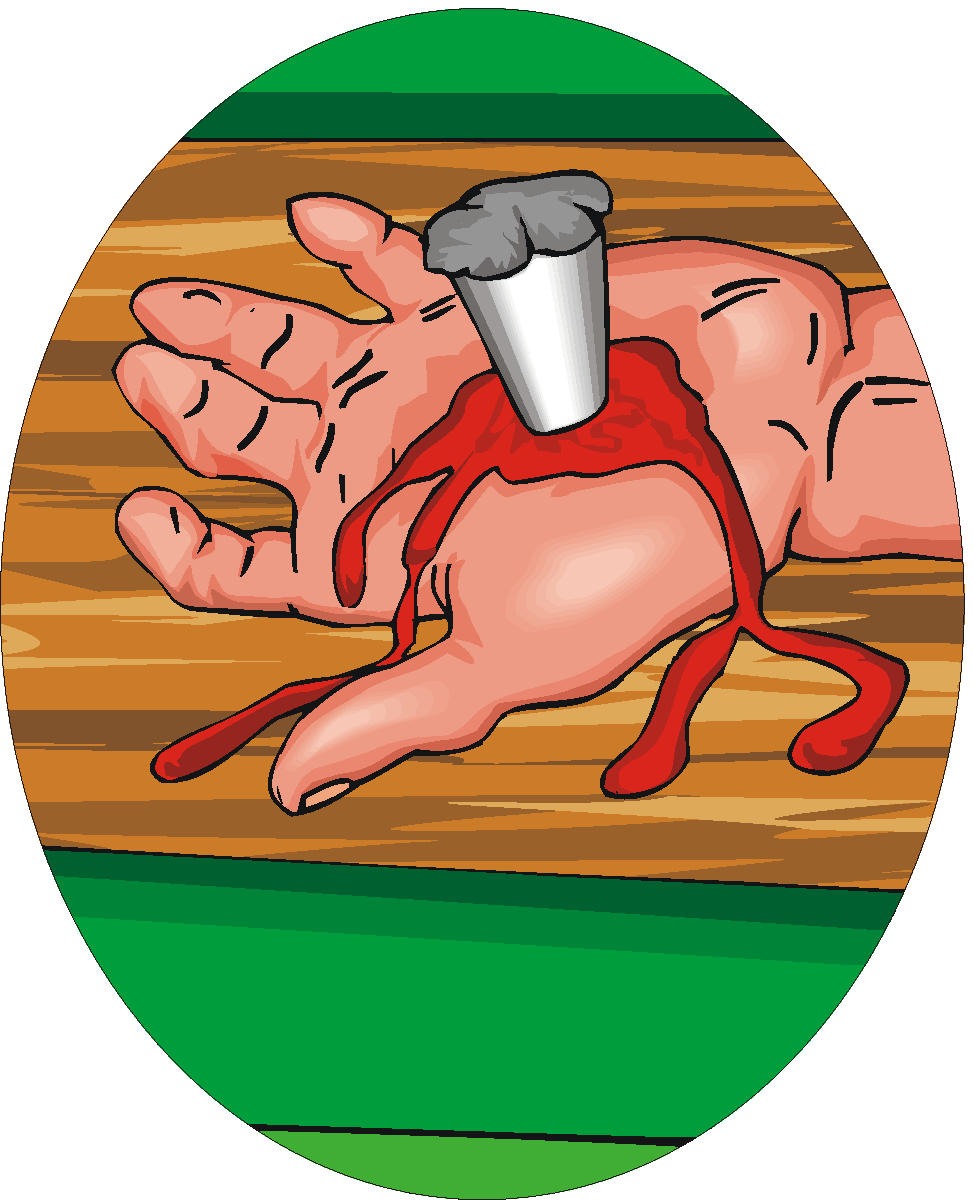
An ancient relic of crucifixion.

So when Yeshua died on the cross, he become the sacrifice that was cut (i.e. his body was brutally mutilated prior to and during his crucifixion) to which this verse in this Psalm 50 makes allusion. 

Moreover, Abraham not only had faith in YHVH, but he had to walk out that faith the rest of his life, for faith without works is dead (Jas 2:14–26). Similarly, those who place their faith in Yeshua must also back up that faith by doing his words (John 5:24), doing good (John 5:29; 3:21), loving him and keeping his commandments (John 14:15), coming to the light of Elohim’s truth (John 3:20–21), and showing that they are overcoming the word, the flesh and the devil resulting in eternal life and great spiritual rewards in the world to come (Rev 2:7, 11, 17, 26; 3:5, 12, 21). 

At the same time, those who don’t place their trust in Yeshua by accepting the covenant he “cut” through his death on the cross and then by backing that faith up with good deeds, or those who have “accepted” Yeshua, but lightly esteem him, will have a terrible price to pay.

For he that eateth and drinketh unworthily, eateth and drinketh damnation to himself, not discerning the Lord’s body. For this cause many are weak and sickly among you, and many sleep. (1 Cor 11:29–30)

Marvel not at this: for the hour is coming, in the which all that are in the graves shall hear his voice, and shall come forth; they that have done good, unto the resurrection of life; and they that have done evil, unto the resurrection of damnation. (John 5:28–29)

He that believeth on him is not condemned: but he that believeth not is condemned already, because he hath not believed in the name of the only begotten Son of God. (John 3:18)