Tithing—An Act of Grateful and Prayerful Worship

Deuteronomy 26:4–11, You shall answer. This was the prayer that one was to make when one brought their tithe to YHVH. Bringing one’s tithe to YHVH was an act of gratefulness and worship and was brought with a joyful heart for the blessing the Almighty had bestowed upon the tithe-giver.

Deuteronomy 26:11, You shall rejoice. Bringing one’s tithes and offerings to YHVH is to be a joyful event since it is a reflection of our gratitude to him for abundantly blessing us. (Compare this verse with 2 Corinthians 9:6–11.) Giving to YHVH is a form of worship since it allows us to put our treasure where our heart is (Luke 12:34). Please join me in praying this prayer: 

Father, help us to give to you out of the abundance of our hearts joyfully and with gratitude for your blessings and bounty in our lives. Help me not to be a fair-weather giver only, but to give out of obedience, even sacrificially, that we may learn to have faith in your promises of provision and to obey you no matter the circumstances. Amein.

(For a brief study on tithing and giving, please see my teaching entitled, “Is Tithing for Us Today?” which is available on our ministry website at http://www.hoshanarabbah.org/pdfs/tithing.pdf.)


Blog Scripture Readings for 8-26 Through 9-1-18

Aside

THIS WEEK’S SCRIPTURE READINGS FOR STUDY AND DISCUSSION:

Parashat Ki Tavo — Deuteronomy 26:1 – 29:8 (9)*
Haftarah — Isaiah 60:1-22
Prophets — Amos 9; Obadiah; Jonah 1, 2, 3, 4; Micah 1:1 – 2:13
Writings — 2 Chronicles 1:1 – 8:18
Testimony — Hebrews 3:1 – 9:28

Our annual Scripture Reading Schedule for 2017-2018 is available to download and print.

Most of this week’s blog discussion points will be on these passages. If you have general comments or questions on the weekly Scripture readings not addressed in a blog post, here’s a place for you to post those. Just use the “leave a reply” link below.

The full “Read Through The Scriptures In A Year” schedule, broken down by each day, can be found on the right sidebar under “Helpful Links.” There are 4 sections of scripture to read each day: one each from the Torah, the Prophets, the Writings, and from the Testimony of Yeshua. Each week, the Torah and haftarah readings will follow the traditional one-year reading cycle.

* Verse numbers in parenthesis refer to the verse number in Christian English Bibles when they differ from Hebrew Bibles or the Tanakh.

Weekly Blog Scripture Readings for 8/26/18 through 9/1/18.


Do you fully discern the Lord’s body?


Gather my saints together unto me; those that have made/cut a covenant with me by sacrifice. (Psalm 50:5

Psalms 50:5, Made/cut a covenant…by sacrifice. This refers to the method by which covenants were made in ancient times between two parties. This same ritual occurred when YHVH made (or cut) a covenant with Abraham in Genesis chapter 15 except that YHVH took all the responsibilities for fulfilling the covenant upon himself, for Abraham was asleep when this covenant was cut (Gen 15:9–10, 12). All Abraham had to do was to have faith in YHVH and all the blessings of the Abrahamic Covenant would fall upon him (Gen 15:6). We know from Paul’s discussion in Romans chapter four that the Abrahamic Covenant is the original biblical model for how an individual can receive salvation from Elohim. We also know that when YHVH made his covenant with Abraham, the vision Abraham had while he was asleep prophetically pointed to Yeshua’s death on the cross and his initiating the new/renewed covenant as prophesied in the Tanakh (e.g. Jer 31:31–33; also see my discussion of Gen 15:12–21 at Abraham’s vision). Yeshua at his last supper and subsequent crucifixion fulfilled this ancient prophecy as well as the spiritual types and shadows discussed in Psalm 50:7 and Genesis 15:9–21. At his last supper, Yeshua made a new covenant with his disciples through his body (the bread) and blood (the wine), which redeemed believers now commemorate when they take communion. 

And as they were eating, Jesus took bread, and blessed it, and brake it, and gave it to the disciples, and said, Take, eat; this is my body. And he took the cup, and gave thanks, and gave it to them, saying, Drink ye all of it; for this is my blood of the new testament, which is shed for many for the remission of sins. (Matt 26:26–28)

And when he had given thanks, he brake it, and said, Take, eat: this is my body, which is broken for you: this do in remembrance of me. (1 Cor 11:24)

Prior to his death on the cross, Yeshua’s predictively explained the significance of his broken body and spilled blood as it relates to covenantal agreement between him and those who would place their faith in him (as Abraham did in Gen 15).

35And Jesus said unto them, I am the bread of life: he that cometh to me shall never hunger; and he that believeth on me shall never thirst.…47 Verily, verily, I say unto you, He that believeth on me hath everlasting life.…50 This is the bread which cometh down from heaven, that a man may eat thereof, and not die.53 Then Jesus said unto them, Verily, verily, I say unto you, Except ye eat the flesh of the Son of man, and drink his blood, ye have no life in you.…58This is that bread which came down from heaven: not as your fathers did eat manna, and are dead: he that eateth of this bread shall live for ever. (John 6:35, 47, 50, 53, 58)

In the context of the Passover service when the saints through the ritual of communion annually commemorate Yeshua’s “cutting” the new covenant with his saints and then ratifying that covenant through his death, Paul has the following to say about the significance of Yeshua’s body:

For as often as ye eat this bread, and drink this cup, ye do shew the Lord’s death till he come. Wherefore whosoever shall eat this bread, and drink this cup of the Lord, unworthily, shall be guilty of the body and blood of the Lord. But let a man examine himself, and so let him eat of that bread, and drink of that cup. For he that eateth and drinketh unworthily, eateth and drinketh damnation to himself, not discerning the Lord’s body. (1 Cor 11:26–29)

Those who carelessly take communion are literally disrespecting not only the high value of the covenant that was made (or cut), but the tremendous price of making a covenant with Elohim (i.e. it cost Yeshua his life, and the believer must also die to himself as he accepts, unconditionally, Yeshua as his Lord and Master). Moreover, careless partakers of communion are not only underestimating the cost of their salvation, but the value and the benefits of that salvation, which is spiritual rewards including eternal life. Elohim is not only not duty bound to give immortality to such people, but would be foolish to immortalize people who don’t sufficiently recognize and appreciate the cost and value of covenantal agreement. In doing so, he would risk having another rebellion on his hand at some point in the future.
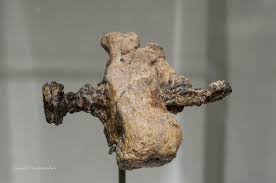
An ancient relic of crucifixion.

So when Yeshua died on the cross, he become the sacrifice that was cut (i.e. his body was brutally mutilated prior to and during his crucifixion) to which this verse in this Psalm 50 makes allusion. 

Moreover, Abraham not only had faith in YHVH, but he had to walk out that faith the rest of his life, for faith without works is dead (Jas 2:14–26). Similarly, those who place their faith in Yeshua must also back up that faith by doing his words (John 5:24), doing good (John 5:29; 3:21), loving him and keeping his commandments (John 14:15), coming to the light of Elohim’s truth (John 3:20–21), and showing that they are overcoming the word, the flesh and the devil resulting in eternal life and great spiritual rewards in the world to come (Rev 2:7, 11, 17, 26; 3:5, 12, 21). 

At the same time, those who don’t place their trust in Yeshua by accepting the covenant he “cut” through his death on the cross and then by backing that faith up with good deeds, or those who have “accepted” Yeshua, but lightly esteem him, will have a terrible price to pay.

For he that eateth and drinketh unworthily, eateth and drinketh damnation to himself, not discerning the Lord’s body. For this cause many are weak and sickly among you, and many sleep. (1 Cor 11:29–30)

Marvel not at this: for the hour is coming, in the which all that are in the graves shall hear his voice, and shall come forth; they that have done good, unto the resurrection of life; and they that have done evil, unto the resurrection of damnation. (John 5:28–29)

He that believeth on him is not condemned: but he that believeth not is condemned already, because he hath not believed in the name of the only begotten Son of God. (John 3:18)

 

Does “Jewish Fables” = the Torah?

Titus 1:14, Jewish fables. Many people in the mainstream church are content to dismiss the Torah merely as Jewish fables having little or no relevance to Christians. Yet, the same preachers will passionately promote Christmas trees, Santa Claus and Easter bunnies. So what’s wrong with this picture? 

Moreover, many Bible teachers in the mainstream church teach that this verse refers to the Torah. They use it in attempting to prove that the commandments of the Torah are no longer valid for believers. Is this correct? In reality, Paul can’t be referring to the Torah here without contradicting himself elsewhere. In numerous places, he strongly upholds and defends obedience to the Torah (Rom 3:31; 7:7, 12, 14; 13:8–10; 1 Cor 7:19; 9:21; Gal 3:10; 6:2; 2 Tim 6:14; Tit 2:14) and even claims to follow it himself (Acts 21:24; 24:1425:8; 28:17; 1 Cor 9:21). He must be talking about the Jewish traditions of men, which Yeshua said in Matthew 15:3–9 and Mark 7:7–9 make of non-effect the word of Elohim. 

In fact, this is exactly what Paul is referring to here in this verse when he says “Jewish fables and commandments of men.” This is not a reference to the Torah the commandments which, in truth, came from YHVH Elohim and not from men. In the same verse, Paul contrasts these commandments of men with “the truth” from which men have turned away. 

So what is this truth that Paul references here? Since Bible defines its own terms, we must look to it for the definition of the word truth. Elohim is the source of truth (Deut 32:4 cp. Pss 86:11; 89:14; 117:2), he is truth (Ps 25:10; 31:5; 33:4), and his Torah is truth (Ps 119:142, 151). 

Truth is the opposite of a fable. One example of a Jewish fable and a commandment of men would be the idea that one can’t be saved unless they’re first circumcised (Acts 15:15:1, 5), which was the subject of the Acts 15 council. Paul vehemently fought this Jewish fable, and the whole Book of Galatians, for example, largely deals with this issue. If Paul had meant the Torah when mentioning “Jewish fables” then this makes Paul into a schizophrenic liar (since he promotes and lauds the Torah and claims to follow it elsewhere), while elsewhere he views the Torah as irrelevant and not necessary to be obeyed. Were Paul against the Torah, this would put Paul at odds with Yeshua who upheld the Torah (Matt 5:17–19) and with himself when he said to imitate Yeshua the Torah-keeper as he himself did (1 Cor 11:1). 

From this brief discussion, it should be obvious to a logical minded person that Paul doesn’t have the Torah in view when he mentions fables in this verse.


Laws and more laws—What is the point of it all?

Deuteronomy 21–25

This section of the Torah (Deut 21:10–25:19) contains 72 commandments, which is more than in any other Torah portion. In this passage there are rules pertaining to all aspects of human relations showing that the “Torah deals with the real world. It does not present a world where all people get along with one another or rush to take care of one another’s property. Instead, it ‘takes into account the grim reality that people do not achieve the desired observance of “you shall not hate others in your heart”’” (A Torah Commentary For Our Times, vol. 3, p. 150). In studying this portion, one can easily miss the point of a particular command if one views it strictly in its pashat (most literal) meaning. For these commands to have relevance in our day, one must view them as principles that have a broad range of application. The specific examples Torah gives are merely representative of one of but many life situations to which the principle behind the example could apply. Keeping this in mind, this Torah portion will give you much to ponder pertaining to your day-to-day walk (or halakhah).

In these chapters we see a plethora of laws concerning many seemingly small details regarding human life. Many people in the church have the tendency to broadly sweep away these commandments with such dismissive cliches as, “We’re now under grace …” or “We’re not under the law anymore …..” But please observe how many of the civil laws of our nation regulating actions between various members of society are based upon YHVH’s laws found in the Torah. As many of us make our way back to a more biblically-based lifestyle and orientation, we begin to see that (a) YHVH cares about the details of our lives and (b) these laws, while sometimes hard to understand, are for our own well-being and blessing. Do you still nurse a “pick and choose” or “have it your own way” mentality with regard to YHVH’s biblical commandments choosing to follow the ones you want and making excuses why you can’t (or don’t want to) follow the rest? By doing so, what blessings are you depriving yourself of, and how are you hindering your love relationship with YHVH?

Some of the laws in these chapters may be hard to observe nowadays. With others, due to our church background, we may have the tendency to spiritualize them away, thus, in essence, rendering them of non‑effect in our lives and thereby placing ourselves above YHVH’s Torah-law and thus becoming a law unto ourselves. Is this not humanism: every man doing what is right in his own eyes instead of obeying YHVH whatever the cost? Who is the Master of your life? You or YHVH? 

How do you view laws about women wearing men-type clothing, wearing fringes on the corners of your garments, mixed certain types of fibers in clothing, lending without interest, caring for the widows and orphans, personal hygiene, family purity laws (e.g. men not having sexual relations with their wives during their monthly cycles), removing blood from all meat before eating it, men wearing beards, faithfully tithing, following the biblical dietary laws, and observing YHVH’s Sabbaths (weekly and annual), etc.? These are lifestyle-changing laws, many of which go contrary to the mores of our society. 

Are we not called to be a kadosh, set-apart, special and peculiar (i.e. treasured) people before YHVH? What progress are you making to bring your life into conformity to his standards of righteousness?


Blog Scripture Reading Schedule for 8-19 Through 8-25-18

Aside

THIS WEEK’S SCRIPTURE READINGS FOR STUDY AND DISCUSSION:

Parashat Ki Tetze — Deuteronomy 21:10 – 25:19
Haftarah — Isaiah 54:1-10
Prophets — Amos 2:1 – 8:14
Writings — 1 Chronicles 23:1 – 29:30
Testimony — 2 Timothy 4; Titus 1, 2, 3; Philemon; Hebrews 1:1 – 2:18

Our annual Scripture Reading Schedule for 2017-2018 is available to download and print.

Most of this week’s blog discussion points will be on these passages. If you have general comments or questions on the weekly Scripture readings not addressed in a blog post, here’s a place for you to post those. Just use the “leave a reply” link below.

The full “Read Through The Scriptures In A Year” schedule, broken down by each day, can be found on the right sidebar under “Helpful Links.” There are 4 sections of scripture to read each day: one each from the Torah, the Prophets, the Writings, and from the Testimony of Yeshua. Each week, the Torah and haftarah readings will follow the traditional one-year reading cycle.

Weekly Blog Scripture Readings for 8/19/18 through 8/25/18.


Abortion and Worshipping the Demon-God Moloch

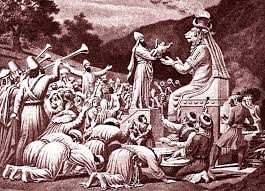
Deuteronomy 18:10, One who causes his son or daughter to pass through the fire. This was done in honor of the Canaanite deity Moloch (see Lev 18:21 and 20:1–6). The name moloch in Hebrew means “king” with the root of the word meaning “to rule or reign.” Child sacrifice (the ancient form of modern abortion/infanticide), though a pagan practice that
YHVH abhorred, was practiced by both houses or kingdoms of Israel as they drifted into syncretism with the heathen cultures around them (see 1 Kgs 11:7; 2 Kgs 16:3; 21:6; 23:10,13; Jer 7:31; 19:5; Ezek 16:20; 23:37). Baal appears to be a synonym of Molach (see Jer 19:5 and the Ency. Britan. eleventh edit., vol. 18, p. 676). The dead bodies of sacrificed children were thrown into the garbage dump of the Valley of Hinnom or Tophet just below the Temple Mount in Jerusalem (Jer 7:31; 19:5–6). Apparently, the children were not burned alive, but were slain (by knife) like any other sacrifice before being thrown into the fire and then into the garbage dump (Ibid.). The ancients sacrificed their children to appease their bloodthirsty gods of prosperity, sensuality and fertility (The Story of Civilization, vol. 1, by Will Durant, pp. 66–67, 297). 

What can we learn from these random pieces of information concerning the ancient practice of child sacrifice? It was done in honor of their deity; in other words, their idol was the king that ruled their lives. What is the chief deity in modern America and most everywhere else in the world? Money and wealth? Sex and pleasure? Fun and entertainment? In ancient times, children were killed by a knife, thrown into the fire and then into the garbage dump. Today, what happens in America? Parents abort Continue reading