New Video: The Feast of Pentecost Unveiled

Many people have only  a vague understanding of Pentecost, even though some churches have incorporated this term into their name. The early church celebrated this biblical feast, so why don’t we?

What are the deeper implications of this biblically commanded assembly?

In this video, learn how Pentecost relate to the grace of Elohim, the former and latter rain, the bride of Yeshua, YHVH’s instructions in righteousness and the second coming of Yeshua.


Understanding Pentecost / The Feast of Weeks

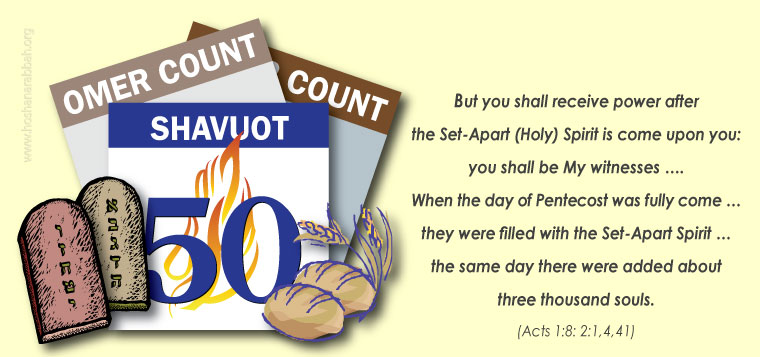
The Feast of Pentecost or Feast of Weeks  (Heb. Shavuot) is nearly upon us. This year it will occur on Sunday, May 19. Over the next few days, I will be posting some information on this third of seven biblical feasts of YHVH Elohim.

Shavuot_banner

In the roughly 49 days between Passover (Pesach) and the Feast of Pentecost (Chag Shavuot), a momentous spiritual dynamic occurs. This period of time is comprised of forty-nine days or seven days of seven weeks, which is seven times seven—the biblical number for complete or full perfection. Add one day and you arrive at Pentecost. Fifty is the biblical picture of jubilee picturing redemption from the enslavement to this world.

Historically, the children of Israel were redeemed from their sins by the blood of the lamb on the first Passover in Egypt. At this time, YHVH betrothed himself to Israel (Exod 6:7). YHVH then led them out of Egypt into the wilderness, and on Shavuot he married them at Sinai (Exod 24 cp. Ezek 16:8; Jer 2:2; 31:32). At the same time, YHVH gave them his Torah, which was their ketubah or marriage vows.

Shavuot is a picture of the bride of Yeshua the Messiah coming into full maturity spiritually and coming to marriageable age. She has gone from being a spiritual child and slave in Egypt to becoming the fully mature spiritual bride and queen of the King of the universe.

At the time of Yeshua, he betrothed himself to both houses of Israel on Passover. Then, on Pentecost, he then sent his Spirit, the Comforter, as a seal of this covenant. He hasn’t married this bride (that’s you and me) yet — something that occurs at his second coming. In the mean time, he has placed her in a 2000-years-long wilderness to get ready for him — to fall in love with him (to love him by keeping his Torah commands; John 14:15) by receiving his Torah into their hearts.

In the end times, he’s going to bring his bride (the saints) out of the wilderness of Babylon (called the Second Exodus), and they will repent of their Torahless ways. We are now getting ready for this day.

Understanding the prophecies of the Bible that speak of these end-time events, and understanding who the principal players are (the two houses of Israel) is the key to insure that we’re ready for our Messiah — that we’ll be wise and not foolish virgins who have our lamps full of oil (the Torah and Spirit of Elohim).

Shavuot, along with Passover (Pesach) and the Feast of Tabernacles (Sukkot) are three times each year when YHVH commands his people to gather together to celebrate before him (Exod 23:14–17).

Stay tuned. There’s more to come on this subject!


New Video: The Omer Count & Our Destiny as YHVH’s Bride-Priest

The Israelites’ Passover exodus from Egypt as ex-slaves and their journey to Mt. Sinai where they received the Torah 50 days later and became the Priest-Wife of YHVH prophetically parallels our spiritual journey out of the world to become the bride of YHVH-Yeshua.

This video is like a road map that explains the count of the omer, so you’ll understand where you’ve come from (i.e., bondage in spiritual Egypt), where you’re at (your present life), and what your ultimate spiritual destiny will be (as the bride of YHVH-Yeshua, the soon coming King of kings).

The children of Israel made mistakes that prevented them from entering the Promised Land. You will learn what mistakes not to make, which will keep you from entering the Promised Land of YHVH’s spiritual and eternal kingdom.


Counting the Omer—The Story of Your Life

 From the Depths of Slavery to a Kingdom of  Priests

Every detail in Scripture is for our learning and edification. All the examples of the past are for our learning upon whom the ends of the world are come (1 Cor 10:11; Rom 15:4). Everyday, YHVH is uncovering the prophetic mysteries hidden in the Scriptures that are being revealed to those who diligently seek him by diligently studying to show themselves approved as a workman rightly dividing YHVH’s Word (2 Tim 2:15).

omer_count_b

YHVH’s command for us to count the omer as a countdown to the Feast of Weeks (Heb. Shavuot; Gr. Pentecoste, Lev 23:15–16) memorializes the Israelites’ journey from spiritual babyhood to adulthood. During this 49-day count, Israel ascended from out of the depths of slavery and suffering in Egypt, was baptized in the Red Sea, and then arrived at Mount Sinai—a place of a spiritual standing before YHVH as a kingdom of priests (Exod 19:6). It was there that YHVH gave them his instructions in righteousness—the Torah on Shavuot. This period represents Israel’s passage from slavery to freedom. They came out of slavery permeated with the leaven—the sins, values, and pagan concepts—of Egypt leaving it all behind as pictured by the Feast of Unleavened Bread. YHVH gave Israel 49 days to overcome and to get rid of the impurities of Egypt, and to  become the nation Israel—a holy priesthood and the bride of YHVH. There, at the foot of Mount Sinai, YHVH wanted them to become his ambassadors to this world of his heavenly kingdom and truths.

The counting of the omer is the story of our lives also. It pictures our going from bondage to Continue reading


The Biblical Feasts—Yesterday, Today and Forever

The Feast Days Were Ordained At Creation

And Elohim said, Let there be lights in the firmament of the heaven to divide the day from the night; and let
them be for signs, and for seasons, and for days, and years. (Gen. 1:14 )

Earth 1

Here we see the linking of the heavenly bodies with the sacred seasons and feast days of YHVH Elohim. The word signs (owth, Strong’s H226) means “a distinguishing mark, banner, a remembrance, a proof, an omen, a warning, a token, an ensign, a miracle.” The heavenly bodies were created as signs or signals of something. The word seasons (moed, Strong’s H4150) means “a congregation, feast, season, appointed time, assembly.” What is being taught here is that the sun, moon and stars are signals that set the appointed times, sacred assemblies or feast days of YHVH for his people. In Leviticus 23:4 we see further proof of this point: “These are the feasts of YHVH, even holy convocations, which you shall proclaim in their seasons” (emphasis added). Please note the possessive pronoun their indicating that the feast days “own” or “possess” the seasons and thus predate the seasons, which are determined by the astral bodies. In other words, YHVH created the heavenly bodies and seasons for the feast days, which are a shadow-picture of his plan of salvation or redemption for the world. It could be said that the entire physical creation was made in order to have a place where in to implement and showcase YHVH’s glorious plan of salvation.

The Feast Days Are Forever

And this day shall be unto you for a memorial; and you shall keep it a feast to YHVH throughout your generations; you shall keep it a feast by an ordinance forever (Exod 12:14).

[I]t shall be a statute forever throughout your generations in all your dwellings (see also verses 21 and 31; Lev 23:14).

Forever (olam, Strong’s H5769 ) means “everlasting, perpetual, evermore, always, continuous, unending future, for eternity.” Is it possible that Yeshua had the created purpose of the heavenly bodies as well as this earth in mind as well as the eternal nature of the Feast Days contained in the Torah-law of YHVH when he addressed the permanent and inviolate nature of YHVH’s Torah-law, of which the feasts are a part, in Matthew 5:17–19:

Think not that I am come to destroy the Torah, or the prophets: I am not come to destroy, but to fulfil. For verily I say unto you, Till heaven and earth pass, one jot or one tittle shall in no wise pass from the law, till all be fulfilled. Whosoever therefore shall break one of these least commandments, and shall teach men so, he shall be called the least in the kingdom of heaven: but whosoever shall do and teach them, the same shall be called great in the kingdom of heaven.

The Feast Days Were Observed in the Apostolic Period

  • Acts 18:21, “But bade them farewell, saying, I must by all means keep this feast that comes in Jerusalem …” (one of the Pilgrimage Festivals; namely Passover/Days of Unleavened Bread or Pentecost or Feast of Tabernacles)
  • Acts 20:6, Unleavened Bread
  • Acts 20:16, Pentecost
  • 1 Corinthians 5:7–8, “Therefore let us keep [or celebrate] the feast [referring to Pesach and Hag Ha Matzot], not with old leaven, neither with the leaven of malice and wickedness; but with the unleavened bread of sincerity and truth.”
  • Acts. 27:9, the Day of Atonement
  • Acts 21:24, “… you yourself also walk orderly, and keeps the Torah” (which includes observance of YHVH’s annual festivals).

The Feast of YHVH to Be Observed in the Millennium

  • Zechariah 14:16, 18, 19, The Feast of Tabernacles
  • Ezekiel 45:17, The Sabbaths (plural, includes the weekly and annual Sabbaths or festivals) and solemnities (moedim) or appointed times (see also verse 9).
  • Ezekiel 45:21, Passover and Feast of Unleavened Bread
  • Ezekiel 45:25, The Feast of Tabernacles
  • Ezekiel 46:1, The weekly Sabbath
  • Ezekiel 45:17 and 21, solemn or appointed times (moedim) and feasts (Strong’s H2282 ; chag meaning “pilgrimage feast, festival, celebration, holy day, time of dancing, cyclical/yearly seasonal event; i.e., the feast days).”

 

Are Passover and the Day of Atonement Redundant?

Leviticus 16:1–34, A cursory reading of the Scriptures seems to indicate that there exists overlapping similarities between some of the blood atonement ceremonies of Passover/Pesach and the Day of Atonement/Yom Kippur. What are the differences between the sin atonement offerings of Pesach and Yom Kippur (Day of Atonement)?

Are Passover and Atonement mirror images of each other, more or less?

Are Passover and Atonement mirror images of each other, more or less?

Perhaps realizing the fact that the Passover occurs during the spring feast day season and the Day of Atonement occurs during the fall feast day season may answer this question. Prophetically the spring feast days picture Messiah Yeshua’s first coming, while the fall feast days prophetically point to his second coming. How does this understanding shed light on the answer to this question?

Both Pesach and Yom Kippur picture redemption through the shed blood of Yeshua; that is, being delivered from bondage to sin and the rudiments of this world. Passover symbolizes the first steps a new believer takes when coming out of spiritual Egypt and accepting Yeshua, the Lamb of YHVH, as one’s Savior and Master.

Yom Kippur, on the other hand, pictures the blood of the Lamb covering over the sins of the individual and the corporate sins of the nation of Israel. Yom Kippur also prophetically points to the time when Yeshua will return to the earth to initiate the final regathering of lost Israel, and to prepare to marry his bride, redeemed Israel. Perhaps this understanding will help to answer why another Passover-like moed (appointed time) is needed. Yom Kippur doesn’t focus so much on leaving Egypt, but rather on YHVH’s people preparing to enter the millennial kingdom under the Messiah.


New Video: How Firstfruits Day Prophetically Pictured the Death and Resurrection of Yeshua

This video explains how the ceremonies Elohim ordered the ancient Israelites to do on Firstfruits (or Wavesheaf) Day prophetically pictured the death,  burial and resurrection of Yeshua (Jesus) the Messiah some 1500 years before that event occurred, thus proving both the divine origination of the Bible and the divine mission of Yeshua.

A free study guide is available at http://hoshanarabbah.org/pdfs/firstfruits.pdf.