Psalm 42:4, I used to go. The psalmist declares that as a result of his deep hunger and thirst for the Living Elohim (vv. 1–2) that he used to go with the multitude to the house of Elohim—with those who kept the pilgrims feasts (i.e. Passover/Unleavened Bread, the Feast of Weeks/Pentecost and the Feast of Tabernacles. It says that “he used to go…” implying that he no longer goes. Why? There could be many reasons for this, but for whatever reason, he is no longer able to go. This is not because he doesn’t desire it, but evidently because the opportunity no longer presents itself for him to go with the multitude to worship at the house of Elohim.
I can easily relate to the psalmist’s dilemma. Many of us today find ourselves in the same situation. I, for example, live in a large city of millions of people. When my wife and I were leading a congregation, for many years we—almost single-handedly with little outside help—organized numerous gatherings of the saints year after year around the YHVH’s feasts. Once we retired from this ministry due to age, health and weariness, no one else in our region picked up this anointed mantle, this righteous burden and yoke, this mitvah. So my wife and I are now alone with nowhere to go on YHVH’s pilgrim feasts, even though out soul still thirsts for the Living Elohim.
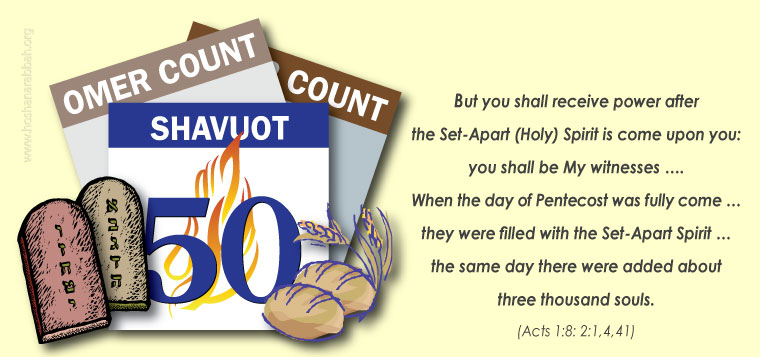
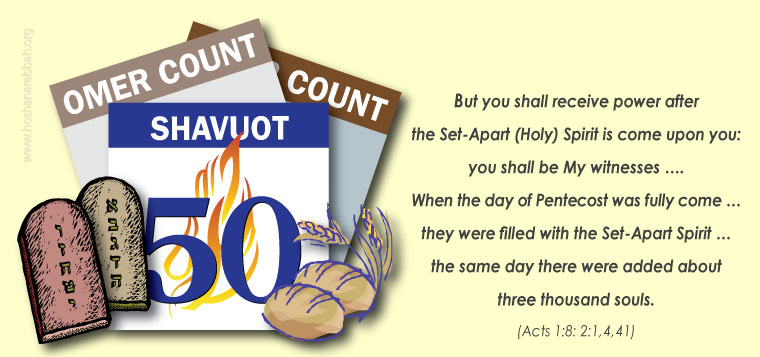
Shavuot is the third festival in YHVH’s cyclical parade of annual sacred appointed times. It is also known as the Feast of the Harvest of the First Fruits (Exod 23:16), Day of First Fruits (Num 28:26) and the Feast of Weeks or Shavuot (which is Hebrew for weeks, Exod 34:22; Deut 16:10, 16; 2 Chr 8:13). Shavuot falls fifty days “from the day after the [weekly] Sabbath” (NKJV) that falls during the Days of Unleavened Bread, and hence the derivation of the name Pentecost (meaning “to count fifty”) as recorded in the Testimony of Yeshua (or New Testament/NT, Acts 2:16).
According to the first-century Jewish historian, Flavius Josephus, the concept of counting fifty was expressed by the Jews of that day by the Hebrew word Asartha (Ant. III, x, 6). The 19th century Jewish scholar S. R. Hirsch in his Torah commentary refers to it as Azereth (The Pentateuch-Leviticus, p. 663). Both of these references seem to pointto the Hebrew word VRMG atzerah (or atzereth, Strong’s H6116/TWOT 1675c) meaning “an assembly or solemn assembly.”
YHVH through his Torah (the law of Moses) instructed his people that Shavuot was…
a day of rest where laborious or servile work was prohibited (Lev 23:21)
a commanded assembly (Lev 23:21)
a time when the priests offered up offerings and sacrifices (Lev 23:18–20)
a time when all males were to bring the tithes of the increase of their income (Exod 23:14; Deut 16:16)
a time when the priests were to offer up as a wave offering to YHVH two loaves of leavened bread made of the freshly harvested wheat (Lev. 23:17–20)
to occur where YHVH would place his name and all were to go there to celebrate it (Deut 16:11)
a time of rejoicing (Deut 16:11)
to be forever (Lev 23:21)
An Agricultural Festival With Prophetic Implications
Ancient Israel was an agricultural society that had a spring harvest of grain and a fall harvest of fruit. The spring harvest consisted of the smaller barley harvest, which began during the Days of Unleavened Bread, and the much larger wheat harvest occurring fifty days later at Shavuot. Both the barley and wheat harvests were prophetic pictures symbolizing new life and new creation, and both were presented to YHVH by the priests for his acceptance—a sheaf of barley on First Fruits Day on the Sunday during Hag HaMatzot (the Feast of Unleavened Bread, Lev 23:10–11), and two loaves of leavened wheat bread on Shavuot (Lev 23:17).
On First Fruits Day, the priests of Israel would raise the newly harvested barley and wave it before YHVH for his acceptance. This was a prophetic picture of Yeshua who upon his resurrection Saturday evening, and subsequent ascension to heaven later on the first day of the week to be accepted by the Father (John 20:17) at the exact time the priests were waving first fruits sheaf of barley heavenward. Literally, Yeshua was the first to resurrect from the dead, and can thus be called the first of the first fruits of the resurrection from the dead.
Fifty days later Pentecost occurred when the priests offered to YHVH the two loaves of leavened bread made of wheat from the first fruits of the larger of the two spring harvests. This foreshadowed the larger harvest of souls during the time period from the giving of the Ruach HaKodesh (the Set-Apart Spirit) until Yeshua’s second coming. We are at the close of that time period now as the end of the age draws near. The Feast of Pentecost in Acts chapter two ushered in this time period with the harvest of thousands of people (Acts 2:41,47). It must be inserted here that an even larger harvest of people for the kingdom of YHVH is yet to occur during the fall feast days, which corresponds with the largest harvest of the entire year—the fall fruit harvest. This spiritual harvest will occur just prior to and after the return of Yeshua as an innumerable multitude of people come to faith in Yeshua out of the great tribulation (Rev 7:14) and when many more will be saved during the Messianic Age (or Millennium) itself.
The Prophetic Implications of the Feast of the Harvest of First Fruits
As we have seen, The Feast of the Harvest of First Fruits is another name for Shavuot (Exod 23:16; 34:22; Num 28:26). At Passover time, the barley (Exod 9:31 cp. chap. 12) was ready to be harvested in the land of Israel. Fifty days later at Pentecost, the larger wheat crop was ready for harvest (Exod 34:22). Barley and wheat were the two main grain crops of Israel (Deut 8:7–8; 2 Chron 2:15; Jer 41:8). In the late summer, the larger harvest of fruits and vegetables occurred.
These three harvests coincided, as noted above, with Israel’s three pilgrimage festivals: Passover, Pentecost and the Feast of Tabernacles. The success of these three harvests was contingent upon the arrival of the fall (early or former) rains and the latter rains of the spring upon the land of Israel. In biblical and Jewish thought, these rains are prophetic of an outpouring of the Spirit of Elohim upon the earth, as well as of an outpouring of YHVH’s Torah-understanding and glory. This two-fold aspect of YHVH’s Word (spirit and truth) is expressed in many ways in many places throughout the pages of Scripture:
spirit and truth (John 4:23–24; 1 Pet 1:22)
letter and spirit (2 Cor 3:6; Col 1:6)
grace and truth; the truth in love (Eph 4:15)
truth and life (John 14:15)
judgment and mercy (Jas 2:13)
power and authority (Luke 4:36)
word and spirit (Eph 6:17)
Moses and Elijah
“Old” and “New Testaments”
Mount Sinai and Mount Moriah/Zion
the two houses of Israel (the Jews/Judah emphasizes the letter of the law/the Torah, while Ephraim/the Christians emphasize the spirit of the law/grace/Yeshua.
The land of Israel and the rain and harvest cycles are spiritual shadows of future outpourings of YHVH’s Spirit and the revelation of his Written Word upon people’s lives as they accept Yeshua and allow his Spirit to teach and instruct them concerning the ways of Elohim. The early rain and the latter rain also teach us about the pouring out of Elohim’s Spirit in a corporate way upon all flesh. The early rain prophetically points to the outpouring of the Set-Apart Spirit during Yeshua’s first coming and the latter rain points to the outpouring of his Spirit during Yeshua’s second (The Seven Festivals of Messiah, by Eddie Chumney, pp. 97–98). Chumney goes on to note that the concept of harvest represents the salvation of people with the spring harvest representing those who would receive Yeshua as Messiah in the present age and the fall harvest representing those who would come to Messiah at the end of the present age (ibid., p. 98).
The Giving of the Torah at Mount Sinai on Shavuot
Not of secondary importance to what we have already discussed regarding important things that occurred on Shavuot, was the giving of the Torah at Mount Sinai that occurred on this day as well. On Shavuot, YHVH “married” Israel (Ezek 16:1–13) when he formulated a covenantal agreement with her to which to which she agreed when she said “I do” three times (Exod 19:8; 24:1–8). The Torah was the basis of that covenant, or the marriage vows, if you will to which Israel swore allegiance.
YHVH gave his people the words of life to live by, but because of the hardness of their hearts they were not able to be faithful to his Torah. Like a wife who says “I do” in response to her wedding vows, but cannot remain faithful to her marriage covenant, so Scripture likens Israel to such a woman who became a spiritual harlot (Ezek 16:14–34).
In spite of Israel’s apostasy and spiritual whoredoms, YHVH had made promises to Abraham and to his descendants that were unconditional in nature. Whether Abraham’s descendants remained faithful to YHVH or not, YHVH’s promises to Abraham were inviolate. Though the Israelites had violated the vows they made to YHVH at Mount Sinai, he revealed to the ancient Hebrew prophets that he would eventually formulate a second renewed covenant with Israel, and this time he would pour out upon them his Spirit and write his Torah-laws in their hearts (Jer 31:31–33; 24:7; Ezek 11:19; 36:25–27).
On Passover at the last supper, YHVH-Yeshua betrothed himself to Israel all over again (Matt 26:28; 1 Cor 11:25). As a seal or pledge of this betrothal, he promised to send to his disciples the Comforter or Set-Apart Spirt (John 14:26; 15:26; 16:7; Eph 1:13–14). This occurred on the day of Pentecost when he poured out his Spirit upon Yeshua’s disciples. Each received the fire of his Spirit (Act 2:1–4). In this, YHVH fulfilled his promise to give his people a heart of flesh to replace their heart of stone, thus empowering or enabling them to keep his Torah-commandments (Heb 8:7–13). In other words, Yeshua, the Living Torah-instructions of YHVH, came to take up residence within the very hearts and minds of redeemed believers through the indwelling and empowering presence of his Set-Apart Spirit. In so doing, Yeshua is living out or fulfilling his Torah from within each redeemed Israelite believer even as he himself lived out or fulfilled the Torah-Word of YHVH when he walked this earth.
We can enter into this same renewed covenant with Yeshua who is the Living Torah and our heavenly Bridegroom when we do as the Apostle Paul says in Romans 10:9 and 10 and confess with our mouths the Master Yeshua and believe in our heart that Elohim has raised him the dead.
Romans 10:13 goes on to say, “Whoever shall call upon the name of the Master shall be saved.” Yeshua also said, “Whosoever therefore shall confess me before men, him will I confess also before my Father which is in heaven” (Matt 10:32). After confessing him, repenting of our sins, we must then be baptized and be prayed over to receive the Spirit of Elohim (Acts 2:37–41). Then one must continue to walk steadfastly in the truth of the gospel message, stay in fellowship with like-minded believers, and maintain a personal relationship with YHVH through personal devotional prayer (Acts 2:42).
Isn’t this a beautiful picture of YHVH’s love and care for his bride—his people? This is all part of the wonderful plan of salvation/redemption that YHVH laid out thousands of years ago to bring people into a life-giving relationship with himself through his instructions in righteousness—the Torah. This has all being accomplished through Elohim’s Son, Yeshua the Messiah, the Living Torah who now leads and guides his people through the wilderness of life not via a pillar of fire over a physical tabernacle, but through the fire of the Ruach HaKodesh living in the spiritual temple of each individual believer’s heart and mind, which guides them spiritually from within.
On Shavuot the first century redeemed believers were divinely empowered with the Ruach HaKodesh, called the immersion in the Ruach HaKodesh (or the baptism of the Set-Apart Spirit, Acts 1:5,8). As a result of the empowerment of the Spirit of Elohim, we see Peter being transformed from a spiritual mouse (compare John 20:23 with John 21:3) into a spiritual lion or dynamo (Acts 2:14–41). The immersion or saturation in the Sprit or Ruach is for the purpose of being empowered with supernatural gifts and enablements (the gifts of the Ruach, see 1 Cor 12) in order to be equipped to go out into the harvest field of human souls spiritually empowered and ready to bring in the spiritual harvest of souls. On the day of Pentecost, YHVH wrote the Torah into the hearts of the redeemed believers by the Ruach, and then supernaturally empowered them to take both the message of Torah—the light of his truth—coupled with the good news of the Redeemer, Messiah Yeshua—the Living Torah word of Elohim—to a lost and dying world. This is the fundamental message and purpose of Shavuot in the Book of Acts.
More Notes from Natan’s Pen
Natan’s Bible Commentary Notes
Leviticus 23:15, Day/morrow after the Sabbath. The Pharisees and their modern successors, the rabbinic Jews, begin the counting of the omer leading up to the Feast of Weeks from the first day of the Feast of Unleavened Bread, which occurs on the fifteenth day of the first month. The problem with this is that the Tanakh never refers to any of the biblical holidays as Sabbaths with the exception of the Day of Atonement (Isa 58:4–10 cp. 13). Therefore, from the evidence in the Tanakh and by strict biblical definition, it is a stretch to refer to the first day of Unleavened Bread as a Sabbath. Therefore, the Sabbath mentioned in this verse must be referring to the weekly Sabbath, and can’t be referring to the first day of the feast of Unleavened Bread.
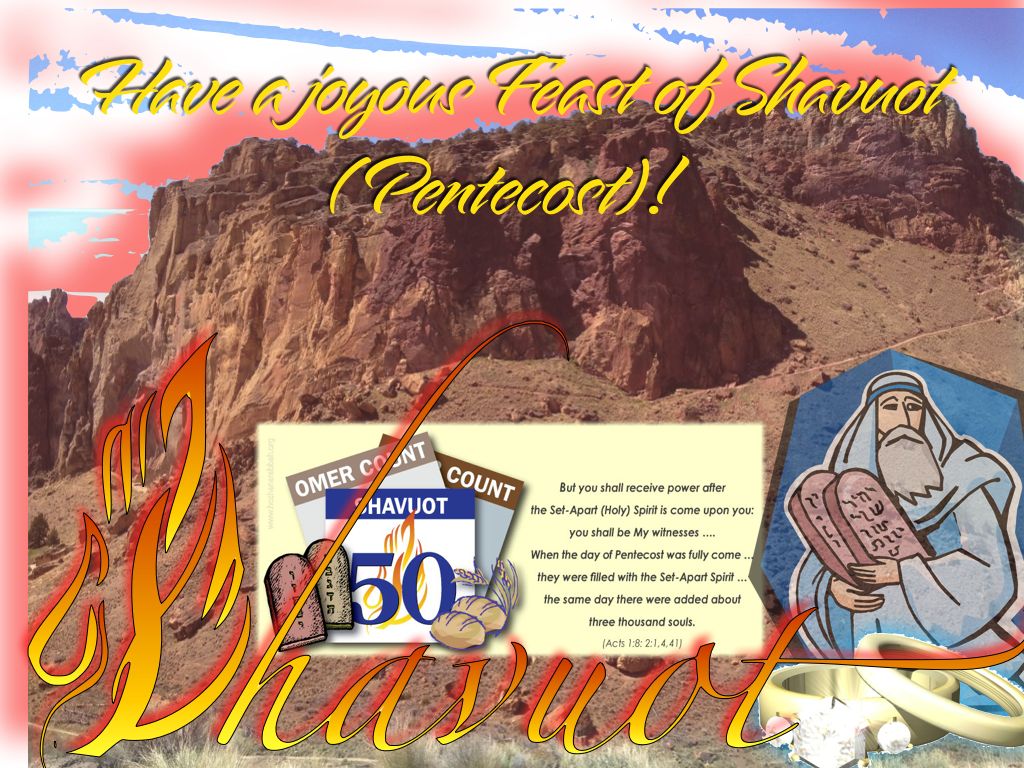
Tomorrow, Sunday May 31, is Shavuot, the Feast or Weeks or Pentecost, the third of YHVH Elohim’s seven biblical festivals (see Lev 23). To help you to celebrate this joyous festival whether you are alone or with other people, over the years, we at Hoshana Rabbah Biblical Discipleship Resources have developed a number of free resources.
We often get asked the question, “What am I supposed to do on the feasts?” To start with, do what the early Hebraic believers did when they got together. Check out Acts 2:42–47; 20:20; 1 Cor 14:26; Col 3:16 and Eph 5:18–19.
YouTube Videos on on the Feast of Weeks/Pentecost: Go to our channel and then click on the Sabbath and Biblical Feasts playlist and scroll down until you come to videos dealing with Shavuot/Pentecost.
Celebrating the (Re)New(ed) Covenant Involving YHVH Writing Torah on Our Hearts
Long ago Jeremiah prophesied that YHVH would make a new (or renewed) covenant being with his people Israel, which would involve both houses of Israel (Judah and Ephraim, or, prophetically speaking, the Jews and the Christians), and that he would write his Torah on their hearts.
Behold, the days come, saith YHVH, that I will make a new covenant with the house of Israel, and with the house of Judah: Not according to the covenant that I made with their fathers in the day that I took them by the hand to bring them out of the land of Egypt; which my covenant they brake, although I was an husband unto them, saith YHVH: But this shall be the covenant that I will make with the house of Israel; After those days, saith YHVH, I will put my law in their inward parts, and write it in their hearts; and will be their Elohim, and they shall be my people. And they shall teach no more every man his neighbour, and every man his brother, saying, Know YHVH: for they shall all know me, from the least of them unto the greatest of them, saith YHVH: for I will forgive their iniquity, and I will remember their sin no more. (Jer 31:31–34)
Contextually, in the verses surrounding this prophecy, we discover some other important details.
Verse 27, The houses of Judah and Israel were to be mingled throughout the beast (heathen) nations of the world as punishment for breaking their covenant with YHVH that they made with him on Shavuot (the Feast of Pentecost) at Mount Sinai (Exod 19–20, 24).
Verse 28, At some point in the future, YHVH’s punishment of Israel for breaking their covenant and their resulting exile among the gentile nations will come to the end. He will rebuild and restore the nation of Israel.
Verses 29–30, Whereas in times past, Israel was punished as a collective nation for their sins when they disobeyed YHVH and were similarly blessed when they obeyed him, now each person will be cursed or blessed for his own sins. Salvation is more of an individual matter now.
Verses 31–33, YHVH promises to make a renewed covenant with the two houses of Israel at some time in the future (from Jeremiah’s perspective). It will be different from the covenant he made with Israel at Sinai in two major ways:
Though it will be a covenant with Israel collectively (both houses), it also will be made with individuals.
He will deal with the heart of each individual Israelite when he writes his Torah on their hearts.
Verse 34, This renewed covenant will involve mercy and forgiveness (grace). It will involve a personal relationship between each person and YHVH (“they shall all know me…”).
Verses 35 and 37, As the sun, moon, stars, the sea, and expanse of the heavens and the earth exist, so YHVH will renew his Torah covenant with Israel. The words of Yeshua in Matthew 5:18 are reminiscent of the this prophecy. Not one jot or tittle (Heb. yud or tag, which are the smallest elements of the Hebrew alphabet) of YHVH’s Torah will pass as long heaven and earth still exist.
Verse 36, The very survival of the nation and people of Israel (and hence the fulfillment of the covenants YHVH made with Abraham), is dependent on YHVH regathering and restoring Israel. If YHVH doesn’t bring this to pass, then YHVH is a liar and his Word is a lie and there is no hope for the world! This cannot be!
This was fulfilled during the time of the writing of the Testimony of Yeshua (New Testament). The author of Hebrews talks about this in Hebrews 8.
But now, Yeshua the Messiah has attained a more excellent public service, since He is the Mediator of a more excellent covenant, one that was legislated with better promises than the former. (Heb 8:6)
The “better promises” is everything that Yeshua taught about salvation and eternal life as a person puts their trust in him. These better promises he taught during his life and ministry, and formalized this at his last supper through the communion elements. It is all these glorious promises to which the whole Levitical and sacrificial system pointed, which, as the author of Hebrews makes clear, was fulfilled in Yeshua.
If the first covenant had been faultless, there would have been no need to look for a second one. Finding fault with THEM He said, “Look, the days are coming, says Yehovah, when I’ll enact a New Covenant with the descendants of Israel, and with the descendants of Judah. It wont be like the covenant that I made with their ancestors during the time when I took them by the hand and brought them out of the land of Egypt, because they didnt remain loyal to My covenant, and I rejected them, declared Yehovah. But this is the covenant that I’ll enter into with the descendants of Israel after that time, says Yehovah; I’ll put My Torah in their minds—inscribing it on their innermost thoughts. I’ll be their Aloha, and they’ll be My people. No one will teach doctrine to their fellow citizens [evangelize], or a friend, or ask: “Do you know Yehovah” [witness to anyone], because they’ll all know Me, from the youngest of them to the oldest. I’ll be merciful regarding their wrongful behavior; and I’ll no longer remember their sins.” When He [Yeshua] mentioned, a New Covenant, He was saying that the first one was old and about to be repealed; and what was then old and failing, was about to disappear. (Heb 8:7–13, GV)
Other Scriptures Relating to the Renewed Covenant and the Heart of Man
The Tanakh is full of scriptures that speak of the renewed covenant where YHVH will write his Torah on the hearts of men. For example, in Jeremiah 32:40, YHVH reiterates his promise to make an everlasting promise with Israel. This new covenant will involve his putting his fear in their hearts. As a result, they will no longer depart from him.
The short answer to this question is next Sunday, May 31. The long answer to this question and why the biblical feast of Shavuot falls on this day and not some other day is in the article below.
Since Shavuot is the only biblical holiday that involves counting days and weeks (hence its name, the Feast of Weeks), there are different opinions about when to start the count leading up to Shavuot. The Torah tells us to count from the Sabbath associated with the Feast of Unleavened Bread.
And you shall count for yourselves from the day after the Sabbath, from the day that you brought the sheaf of the wave offering: seven Sabbaths shall be completed. Count fifty days to the day after the seventh Sabbath; then you shall offer a new grain offering to the LORD. (Lev 23:15–16, NKJV)
This sounds simple enough. Or is it?
The question and the subject of the debate is which Sabbath do you start counting from? The day after the weekly Sabbath occurring during the Feast of Unleavened Bread or the day after the high holy day Sabbath of the first day of the Feast of Unleavened Bread, which occurs on the fifteenth day of the first month of the biblical year?
In the first century in the time of Yeshua and the apostles, there were two main opinions among the leading Jews on when to start counting the weeks (called “the counting of the omer”) leading up to Shavuot. The religious sect of the Pharisees, whose spiritual descendants are the modern rabbinic Jews started the counting of the omer from the day after first high holy day of the Feast of Unleavened Bread, which is a high holy day Sabbath (John 19:31). On the other hand, the Sadducees, the other main Jewish sects of the first century (along with the Boethusians, which was likely a sub-sect of the Sadducees; see A History of the Jewish People in the Time of Jesus Christ, second division, vol 2, p. 37, by Emil Schurer; Commentary on the NT from the Talmud and Hebraica, vol. 4, p. 23 [commentary on Acts 2:1], by John Lightfoot) counted the omer from the day after the weekly Sabbath that falls within the week of the Feast of Unleavened Bread. Some modern Messianics follow the rabbinic method, while others follow the Sadducean method.
It is generally understood by historical scholars that the Jewish sect of the Pharisees interpreted the written Torah in light of Jewish oral tradition, while the Sadducees rejected oral tradition and adhered strictly to the written Torah (Schurer, pp. 37–38). According to Schurer,
In this rejection of the legal tradition of the Pharisees, the Sadducees represented the older standpoint. They stopped at the written law. For them, the whole subsequent development was without binding power” (ibid. p. 38). To the scribes and Pharisees, in contrast to the Sadducees, oral tradition took precedence over the Written Torah-law. It was intolerable to them that people should “interpret Scripture in opposition to tradition. The traditional interpretation and the traditional law are thus declared absolutely binding. And it is consequently but consistent when deviation from these is declared even more culpable than deviation from the Written Torah. It is more culpable to teach contrary to the precepts of the scribes, than contrary to the Torah itself [according to the B. Talmud, Sanhedrin ix.3]. (ibid. p. 12)
The first century Jewish historian Flavius Josephus (37 AD to 100 AD) confirms this. He writes,
[T]he Pharisees have delivered to the people a great many observances by succession from their fathers, which are not written in the law of Moses; and for that reason it is that the Sadducees reject them, and say that we are to esteem those observances to be obligatory which are in the written word, but are not to observe what are derived from the tradition of our forefathers. (Ant. XIII.10.6)
Commenting on Josephus’ statement, Louis Finkelstein, a noted the twentieth century rabbinic scholar writes,
Leviticus 23:2, Feasts. These feast (moedim) days are set-apart times for YHVH’s consecrated people. They are divine appointments between the Creator of the Universe and his called-out ones. Furthermore, they are love feasts (Jude 12) between YHVH-Yeshua and his bride, the saints of the Most High Elohim. The seven feasts of YHVH are also the perfect seven-step divine plan showing how YHVH-Yeshua will redeem his backslid people Israel, his adulterous bride, back to himself. These days are the embodiment of the gospel (the good news) message of the coming marriage between Yeshua and his bride and the establishment of his kingdom upon this earth in a full and universal sense! We show our belief, faith, love, anticipation and obedience to him by walking them out.
To not set aside time for YHVH feasts from one’s secular schedule is to ignore the call of the Bridegroom, Yeshua, for us to go out to meet him. It is to deprive oneself of the joys of communing with the Set-Apart (Kadosh) One of Israel in this special and set-apart way. It is to disregard and treat as common and profane the consecrated times that YHVH established for him and his people to come together. It is to disregard the covenants, the national constitution and marriage agreement between YHVH and his people—redeemed Israelite believers who have been grafted in to the olive tree of Israel through a relationship with Yeshua, the Messiah, the Anointed Sent One of Israel (Rom 11:13–24; Eph 2:11–19). To disregard YHVH’s feast days is to show disregard for his Torah-commands—his precepts, teachings and instructions in righteousness. To do this is to violate his commandments, which is sin (1 John 3:4)!
So what’s keeping you from celebrating YHVH’s feasts?
Leviticus 23:2,My feasts [Heb. moedim]. YHVH calls these feasts his feasts. They’re not men’s feasts or the Jewish feasts! They came from YHVH and belong to him. When men pervert YHVH’s feasts by mixing in pagan traditions, they’re no longer YHVH’s feasts, but men’s feasts (e.g. Isa 1:13–15; Amos 5:21; Hos 2:11). When men pollute his feasts and appointed times, YHVH says that he hates them because they’re no longer his feasts (Isa 1:14–15).
In Ezekiel 20, we see that YHVH’s feasts (or sabbaths) are a covenantal sign between YHVH and his people (Ezek 20:12) that they were to live by (Ezek 20:11), yet which Israel, in rebellion, refused to do while in the wilderness. Instead they defiled his sabbaths by, presumably, not doing them and doing other things on those holy days (Ezek 20:13). Israel’s rebellion against YHVH with regard to their refusal to keep his sabbaths brought upon them YHVH’s judgments (Ezek 20:13). In other words, it was YHVH’s will for the Israelites to keep his sabbaths in the wilderness, but because of their idolatrous rebellion, they refused to do so.
In fact, YHVH calls refusing to observe his sabbaths idolatry and for this sin (along with other sins), the Israelites had to wander in the wilderness for forty years (Ezek 20:15–16). In profaning his sabbaths, YHVH accuses the Israelites of despising his Torah (Ezek 20:16).
YHVH then goes on to urge his people to not follow the example of their rebellious forefathers, but rather to walk in all of his Torah commands (including his sabbaths, Ezek 20:18–20). Because of their profaning his sabbaths, he punished them by scattering them in exile among the heathens. Those modern saints who refuse to keep YHVH’s Sabbath and feasts are walking in the same sin as the ancient Israelites.
Often people who refuse to keep YHVH’s feast days holy do so because the feasts conflict with their secular activities (such as their jobs). YHVH calls this idolatry and being like the heathen (Ezek 20:30, 32).
In the end times, YHVH is going to separate his people out from the heathen and bring them back into covenantal agreement with him including obedience to his sabbaths (Ezek 20:33–38). He will purge from his people those rebels who refuse to obey him including keeping his sabbaths (Ezek 20:38), which are a sign of his covenantal relationship with them.