Jacob’s Prophecy to the Christians (pt 1)

Genesis 46:14 and 16, Jacob’s Prophecy Over Ephraim and Manasseh

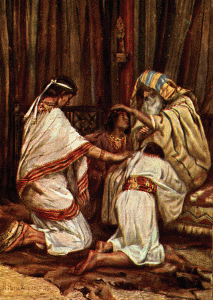
While prophesying over Joseph’s sons, Ephraim and Manasseh, Jacob crossed his hands over their heads making the symbol of the paleo-Hebrew letter tav  (like the letter t or x in the alphabet), which resembles a cross and in that ancient Hebraic script and pictographically means “sign of the covenant.” Jacob then spoke of the Heavenly Messenger (the Hebrew word malak mistranslated as “angel” in most Bibles) of YHVH (i.e., the preincarnate Yeshua) who had redeemed him from all evil (see Gen 31:11–13). Jacob then prophesied that the descendants of Ephraim and Manasseh would become like “fish in the midst of the land” (literal translation of Gen 48:14–16; see The ArtScroll Stone Edition Tanach).

In light of this prophetic symbolism, which present day religious group would qualify as having fulfilled Jacob’s prophecy as to who the descendents of Ephraim and Manasseh would be? Which religion on earth uses the fish as their symbol, speaks of a Messenger from YHVH as their Redeemer, and has the sign of the paleo-Hebrew letter tav, which looks like a cross? The Buddhists? The Moslems? The Hindus? Even the Jews? No! Only Christianity fits this enigmatic criteria.

Many Christians are without a doubt the literal descendants of Ephraim and Manasseh. Those who are not, according to the Apostle Paul, once they come to saving faith in Yeshua in some unique sense become the descendants of Abraham (e.g., Gal 3:7,29). Many of these unsaved descendants of Abraham will recognize Yeshua their Messiah on the day that he returns to Jerusalem (e.g., Zech 12:10).


The “Two” Messiahs of the Old Testament

The Scriptures Reveal Two Messiahs Are to Come:
One Who Will Be Like Joseph and One Who Will Be Like David

Let’s note a startling statement from Orthodox Jewish sources: Mesorah Publications The ArtScroll Bereishis, vol. 1(b) states in its commentary on Genesis 48:19 regarding Ephraim:

“R. Munk explains: ‘while it is true that the dispersion [of the descendants of Ephraim and Manasseh] was caused by the unfaithfulness and sinfulness of Ephraim’s descendants (Hos 7:8ff), Jacob’s blessing was not in vain for “they will return to God” and will have their share in the world to come (Sanhedrin 110b).’ And R. Eliezer adds: ‘Even the darkness in which the Ten Tribes were lost will one day become as radiant as the day’ (according to the version of Avos d’Rabbi Nosson 36). And in the perspective of history, did not these exiled children of the Patriarchs enlighten the nations among whom they were scattered? They did so by teaching their conquerors the fundamental ideas of the knowledge and love of God, ideals they had never forsaken. Hence they too have a messianic vocation and their Messiah, the Mashiach ben Yosef, Messiah son of Joseph (Succah 52a), also called Messiah son of Ephraim (Targum Yonasan on Exodus 40:11), will play an essential role in humanity’s redemption, for he will be the precursor of the Mashiach ben David, Messiah Son of David. It is therefore not surprising to find that the prophet Jeremiah (3:12) speaks affectionately of Ephraim. In this light, Jacob’s words, ‘his offspring’s fame will fill the nations nation,’ assume the significance of a blessing” (pp. 2121–2122). (emphasis added)

What the Jewish sages are saying here is that Messiah the Son of Yosef/Joseph—the Messiah whose coming precedes that of Messiah the Son of David—is the Messiah that causes the house of Ephraim (that is the ten northern tribes of Israel, many of whose descendants are currently found within the Christian church) to return to YHVH. Yeshua (Jesus), the son of Joseph, of whom the life and ministry of Joseph, the son of Jacob, was an antetype or prophetic shadow picture, is the very Messiah, unbeknownst to them, of whom they speak.

In Jewish literature, the Messiah whose life would resemble Joseph was referred to as the suffering servant or “Messiah Son of Joseph” (Mashiach Ben Joseph), while the Messiah whose life and ministry would resemble David was referred to as warrior king or “Messiah Son of David” (Mashiach Ben David). The Jewish sages came to this conclusion because when reading the messianic prophecies in the Tanakh (OT) they saw two different, even conflicting Messiahs whose roles were very different from each other. What was not known by the ancient Jewish sages, and was a subject of much debate, was which Messiah would come first, when he would come, would he be the same person or two different individuals, and how much time would separate the two comings.

For believers in Yeshua, this does not seem like a dilemma, for we look back in time and can see clearly that Yeshua fulfilled the Suffering Servant role at his first coming, and will fulfill the Conquering King role at this second coming. But two thousand years ago, without the benefit of historical perspective, this was not so easy a matter to figure out. Even the disciples were at times in a quandary as to which mission Yeshua was to fulfill as evidenced by their last question to him before his final ascension, “Will you at this time restore again the kingdom to Israel?” (Acts 2:6).

Let’s review some of the passages in the Tanakh that point to the two different Messiahs:

Messiah Son of Joseph

  • The Suffering Servant will die a martyrs death for the sins of his people (Isa 52:13–53:12).
  • In the end of times, the Jews will look upon him whom they pierced and mourn for him as one mourns for his only son (Zech 12:9–10).
  • Verse one of Psalm 22 are some of the last words to come out of Yeshua’s mouth while he hung dying on the cross. This psalm predicts certain aspects of the Suffering Servant Messiah’s ministry.
  • John 1:45 may be a double entendre allusion to Yeshua as being not only the (adopted) son of Joseph, the husband of Mary, but to his being Messiah Son of Joseph as well.

Messiah Son of David

  • He will restore righteous government in Jerusalem (Isa 1:26)
  • He shall judge the nations (Isa 2:4)
  • All on earth shall worship him (Isa 2:17).
  • He shall rule the earth and destroy the wicked (Isa 11:4).
  • Under his rulership, all Israelites will be restored to their homeland (Isa 11:12).
  • Matthew 9:27; 12:23; 15:22; 20:30, 31; 21:9,15; 22:42 are references to the expectations of the Jewish followers of Yeshua that he was Messiah Son of David.
 

Did Jacob Wrestle with the Pre-incarnate Yeshua?

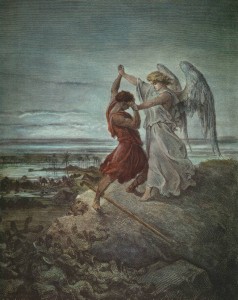
Genesis 32:24–32, Jacob Wrestling With the Messenger of YHVH. In verse 24 we read,

And Jacob was left alone; and there wrestled with a man [Heb iysh, Strong’s H376] or heavenly messenger [i.e. Heb malak]. (KJV, see Hosea 12:4)

In the following passages, we see that this man was Elohim.

You have power with Elohim and with men, and have prevailed. (verse 28, based on the KJV)

… for you have striven with the Divine [Elohim] and with man and have overcome. (verse  28, The ArtScroll Stone Edition Tanach and Chumash)

Then Jacob says that he has “seen [Elohim] face to face” (KJV, CJB and The Soncino Edition Pentateuch, Second Edition). The two standard Orthodox Jewish versions of the Torah, The ArtScroll Stone Edition Tanach and The ArtScroll Stone Edition Chumash, and Samson Raphael Hirsch’s Torah commentary The Pentateuch (by Judaica Press) all read, “For I have seen the Divine face to face.” Here they have translated the Hebrew word Elohim as the Divine (OHBP OHVKT/Elohim panim).

Which translation of the word Elohim is the correct one? Before resorting to human sources to solve this dilemma, does the Word of Elohim itself interpret this passage for us giving it clear light? Most assuredly so. In Hosea 12:2-5 we read,

[YHVH] hath also a controversy with Judah, and will punish Jacob according to his ways; according to his doings will he reward him. He took his brother by the heel in the womb, and by his strength he had strove with [Elohim]. He strove with an angel [Heb malak or heavenly messenger in many instances referring to YHVH himself, as noted elsewhere in this work] and prevailed: he wept, and made supplication to him; he found him in Beth-El, and there he spoke with us; and [YHVH Elohim] of hosts; [YHVH] is his name. (based on the KJV)

The Stone Edition Tanach renders this passage as follows (starting in verse four):

In the womb he seized his brother’s heal, and with his strength he struggled with [an angel of] God; he struggled with an angel and prevailed; [the angel] wept and beseeched him: ‘In Beth-el He will find us and there He will speak with us.’ HASHEM is the God of Legions; HASHEM is His remembrance. (bracketed supplied word are in the original)

So which translation is correct? The first one indicates Jacob was wrestling with a Heavenly Messenger who was none other than YHVH Elohim, while the second translation is cast in such a light as to imply that Jacob was wrestling with merely an angel.

Does the word Elohim mean the Divine? It is interesting to note that in the Authorised Version the word Elohim appears 2606 times in the Tanakh. It is translated as God 2346 times, god 244 times and several other words less than five times each (e.g. judge, goddess, great, mighty, angels). As in all cases with a word which can have several meanings, the context of the Scripture passage will determine its meaning and its subsequent translation from the original language into English. The word divine was not employed in the 1611 Authorized Version (KJV) in reference to Elohim anywhere in the Tanakh, since the word had a pejorative connotation (as in divination or one who divines the future). This is not the case in our modern parlance as the modern Webster’s New Collegiate Dictionary defines divine in its primary definition as “relating to, or proceeding directly from God, being a deity, directed to deity.” All standard English (Christian )versions (NKJV, NAS, NIV, NRSV) translate this passage as “God face to face” and none use the term “the Divine face.” The New Brown-Driver-Briggs-Gesinius Hebrew-English Lexicon defines Elohim (in those Scripture passages where it is a clear reference to deity, as opposed to a goddess or a human judge) as the true God, Yahweh is (the) God. Never does this Hebrew lexicon define Elohim as the Divine. Similarly, nowhere does the TWOT in defining the word Elohim suggest that the Divine could be an appropriate substitute for the title of YHVH, Elohim. So we must ask, why do the two Jewish translations of this passage (noted above) seem to run cross grain to a plethora of other translations, both Jewish and Christian, as well as noted lexicographers to translate it as they do? Is this a case of translation bias? Could translating Elohim panim as Elohim face to face as so many other translators do be a tacit admission that Elohim can appear as a man, hence giving credence to the Christian assertion that Yeshua was Elohim in the flesh? It is interesting to consider this. But before jumping to conclusions, let us examine other passages in the Tanakh where Elohim and man seem to come face to face. How do the Jerwish sages treat these passages? How do their commentaries explain these difficult passages?

What do some leading rabbinic commentaries say on these passages? Continue reading


Hidden Message in the Names of the 12 Tribes

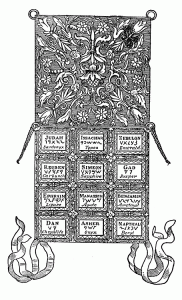
Genesis 29:32–30:24, The Scriptures record that the gospel was preached not only to the first century believers, but to ancient Israel (Heb 4:2), as well the Patriarchs (Gal 3:8). Here is another example of this in the meanings of the names of the twelve sons of Jacob. They are: Reuben, Simeon, Levi, Judah, Dan, Naphtali, Gad, Asher, Issachar, Zebulun, Joseph and Benjamin (who was not born until Gen 35:18). Translated their names mean:

  • Reuben/“See, a Son,” (this points to Yeshua).
  • Simeon/“Hearing” (hear the Son or gospel/good news).
  • Levi/“Joined” (referring to the union by which the Set-Apart Spirit makes us one with the Son through the hearing of the gospel).
  • Judah/“Praise” (the response of the redeemed upon being joined to Yeshua and becoming regenerated spiritually or born from above).
  • Dan/“Judgment” (the believer, though worthy of judgment for his sin, has passed from judgment to life through the atoning blood of Yeshua.
  • Naphtali/“Wrestling” (this speaks of the believer’s life as he struggles against the world, flesh and the devil endeavoring to walk righteously).
  • Gad/“Troop, Company” (this speaks of the fellowship of believers in the household of faith), the result of fellowship is Asher/“Happiness.”
  • Issachar/“Hire” (once a part of the spiritual body of believers, one is equipped for works of service in advancing the kingdom of Elohim as a bondservant).
  • Zebulun/“Dwelling, Exalt, Honor” (we are to occupy until Yeshua comes again while we honor and exalt him before the Gentiles.
  • Joseph/“Adding(can refer to adding to the body of believers in Yeshua through outreach or to rewards in YHVH’s eternal kingdom for a job well done laboring in YHVH’s spiritual field).
  • Benjamin/“Son of My Right Hand” (a reference to Yeshua who sits at the right hand of YHVH and to believers who are seated with Yeshua in heavenly places, by faith).

Or another way to look at it is this:

  • Judah means “Now I will praise YHVH.” (Gen 29:35)
  • Reuben means “Surely YHVH has looked upon my affliction.” (Gen 29:32)
  • Gad means “What good fortune.” (Gen 30:11)
  • Asher means “Happy am I.” (Gen 30:13)
  • Naphtali means With great wrestlings have I wrestled.” (Gen 30:8)
  • Manasseh means “For Elohim [said he], ‘has made me foreget all my toil.’” (Gen 41:51)
  • Simeon means “ Because YHVH has heard that I was hated.” (Gen 29:33)
  • Levi means “ Now this time will my husband be joined to me.” (Gen 29:34)
  • Issachar means “Elohim has given me my wages.” (Gen 30:18)
  • Zebulon means “Elohim has endowed me with a good gift, now my husband will dwell with me.” (Gen 30:20)
  • Joseph means “YHVH shall add to me.” (Gen 30:24)
  • Benjamin means “You shall have this son. (Gen 35:17–18)

Combined the names tell the following story: Now will I praise YHVH. Surely YHVH has looked upon my affliction. What good fortune. Happy am I. With great wrestlings have I wrestled and I have prevailed. For Elohim has made me forget all my toil because YHVH has heard that I was hated. Now this time will my husband be joined unto me. Elohim has given me my wages. Elohim has endowed me with a good gift. Now my husband will dwell with me. YHVH shall add to me. You shall have this son.

It starts with Yeshua and ends with him. He is the Aleph and the Tav (or the Alpha and Omega), the Beginning and the End, the Author and Finisher of our faith! Give him glory! Pause and reflect on these names. Is it possible that the mind of man could have cleverly contrived these names and their order about 1800 years before the birth of Yeshua?

Where are you in this prophetic scenario? In your spiritual walk have you passed through the reality of each of the twelve steps? Perhaps this is the world’s original “twelve-step program”!


Isaac and Rebekah: Yeshua and Us (Pt 2)

The story of Isaac and Rebekah coming together in marriage is amazingly prophetic of Yeshua and his end-times spiritual bride — the saints of redeemed Israel. Here is the story as it unfolds in the pages of your Bible and recorded hundreds of years before the birth of Yeshua the Messiah!

Genesis 24:54, Elizar wanted to leave Babylon immediately with Rebekah and return to Abraham. This is prophetic of YHVH’s plea to his end-time people to come out of Babylon the Great (Rev 18:4) — a last days religious, economic and political system that represents all that is evil and contrary to the Word, will and ways of YHVH-Elohim and Yeshua his Son.
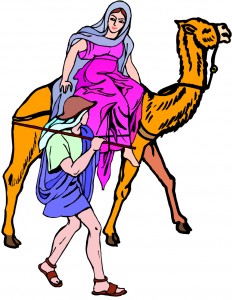
Genesis 24:55, Although Elizar and Rebekah wanted to leave her father’s house in Babylon, her family was not willing to let go of her, but insisted that she remain with them in Babylon. In the end times, some believers will heed YHVH’s call to come out of Babylon the Great, while others will be reluctant to leave succumbing rather to the alurements of Babylon to stay “in her” (see Rev 18:3 cp. 2 Thess 2:1–12 with emphasis on verse 10–12).

Genesis 24:58, Rebekah was a woman of faith and was willing to immediately leave her home in Babylon to marry Isaac in Canaan, whom she had never seen. Those saints who wish to be the bride of Yeshua must be willing to leave the spiritual defilement of modern Babylon and to follow the Lamb wherever he goes, even though they have never literally seen him (Rev 14:4).

Genesis 24:62, The very next time we see Isaac after the Akeidah is in verse 62 where he is meditating, supplicating and praying at the well of Lachairoi, which means, “well of the living one seeing me.” This is a prophetic picture of Yeshua the Son, in heaven awaiting his return to earth after his resurrection. There in the Presence of his Father, the Living One who sees him, and whose throne is the well or source of the river of life, Yeshua is making intercession for the saints who are his bride to be (Rom 8:34; Heb 7:25).

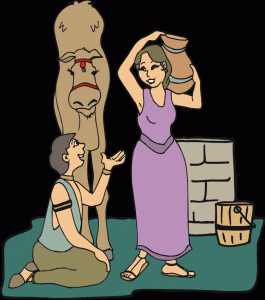
Genesis 24:64, Rebekah arrives from Babylon on a camel — a semi-kosher animal, which chews its cud, but does not have a completely split hoof (Deut 14:7). This animal is emblematic of Babylon — a word that means “mixture” of good and evil. This alludes to the fact that the bride of Yeshua who comes out of spiritual Babylon (Rev 18:4), like the animal Rebekah was riding, will not be a perfectly “kosher” or righteous or a Torah-obedient bride, but will be a mixture of good and evil. This also points to the grace of Elohim who loves us and accepts us as his Son’s bride, even though we are still worldly and carnal.

Now let’s look at this spiritual picture from a slightly different angle. Elizar is a prophetic picture of the Spirit of Elohim finding and preparing a bride for Isaac (a picture of Yeshua). Rebekah answers the call of the Spirit, leaves Babylon, and with her come the ten camels picturing the ten tribes of Israel, which she is responsible for feeding and bringing out of Babylon. It is our role as redeemed Torah-obedient Israelites who have faith in Yeshua to share the truth of the Torah with as many of our Christian brethren as possible who are still caught up in many non-biblical and even pagan religious traditions. As we give them water (i.e., the Word of Elohim) from the wells of salvation (i.e, Yeshua who is both the Written Torah and the Living Torah, i.e, the Word of Elohim that was made flesh, see John 1:1, 14), they will want to come out of spiritual Babylon (Rev 18:4) and return to the Promised Land of the Hebraic roots of their faith. This fulfills Malachi’s end-times prophecy about the hearts of the children being turned back to their fathers (Mal 3:6).

Genesis 24:65,When Rebekah arrives in the Promised Land, Isaac comes out to meet her, his bride, who had just come from Babylon. This is a prophetic picture of Yeshua coming from heaven to meet his spiritual bride in the air at the resurrection of the saints (1 Cor 15:51–53; 2 Thess 4:13–18; Rev 11:14–18). Meanwhile, Rebekah covered herself with a veil. This prophetically points to the saints of Yeshua who receive their glorified bodies at the resurrection at his second coming. It also is a picture of the New Jerusalem descending upon the bride of Yeshua like a glorious spiritual bridal gown when (or after) Yeshua returns (Rev 21:2).

Genesis 24:67, Upon meeting, Isaac immediately takes Rebekah to his tent to consummate the marriage. This prophetically speaks of the marriage supper of the Lamb where Yeshua and his bride become one, which occurs during the Millennium (Rev 19:7–9).

 

Isaac and Rebekah: Yeshua and Us (pt 1)

The story of Isaac and Rebekah coming together in marriage is amazingly prophetic of Yeshua and his end-times spiritual bride — the saints of redeemed Israel. Here is the story as it unfolds in the pages of your Bible and recorded hundreds of years before the birth of Yeshua the Messiah!

There are many prophetic spiritual types and shadows to be found in the Torah that point forward prophetically to Yeshua the Messiah. A series of events in Isaac’s life beginning in Genesis 22 and culminating in chapter 24 provide us with some amazing antetypical glimpses into events that would surround the life of Yeshua the Messiah some 1800 years later.

For example, in Genesis 22 we find the Akeidah or binding of Isaac on Mount Moriah is a prophetic shadow-picture of Yeshua’s crucifixion on the altar of the cross. But note the conclusion of this incident in verse 19. There we see that Abraham returns to his young men with no mention made of Isaac being with him. Where was Isaac? Obviously, he was accompanying his father, however the Scriptures fail to mention this. Interestingly, according to Jewish folklore, Isaac was actually killed, but that he was later resurrected. This further strengthens the assertion we have made that the Akeidah was a prophetic picture of the substitutionary death and resurrection of Yeshua at the cross. If Isaac was an antetype of Yeshua, then logically, Abraham would be a type of Elohim the Father. So for illustrative purposes, let’s assume that Isaac’s absence is a picture of Yeshua’s crucifixion and, thus following this scenario, when does Isaac (or Yeshua) next appear on the scene? A wonderful story is about to unfold from the pages of the Bible as we answer this question!

Genesis 24:1, After the death of Sarah, Abraham’s first order of business is to find a wife for Isaac. Similarly, after Yeshua was resurrected from the dead he returned to heaven where his Father began to prepare a spiritual bride for him, which are the saints of redeemed Israel (read 2 Cor 11:2; Rev 19:7–9).

Genesis 24:2ff, Who did Abraham employ to procure for his son a bride? It was Elizar (or Eliezar), his eldest and most trusted servant. In Hebrew, Eliezar means “El (God) is my helper.” Who is the Chief Servant, if you will, of the Father in heaven who is presently searching for and preparing a bride for Yeshua his Son? It is the Set-Apart (Holy) Spirit of Elohim who the Scriptures call the Comforter or Helper (John 14:16, 26; 15:26; 16:7).

Genesis 24:10, Elizar went to Babylon to find a bride for Isaac. In the last days, where is YHVH calling his people out of in order to prepare them to be the bride of Yeshua? (See Rev 18:2, 4.)  Continue reading


The Vision of the Smoking Furnace and YOU!

A Vision of the New Covenant

In Genesis 15:17–18fp, we read,

And it came to pass, that, when the sun went down, and it was dark, behold a smoking furnace, and a burning lamp that passed between those pieces. In the same day YHVH made a covenant with Abram …

What is the meaning of this? This is nothing other than YHVH giving Abraham a prophetic vision of Yeshua the Redeemer of Israel dying on the cross paying for the sins of Abraham’s descendants who would break that very covenant that YHVH made with Abraham on that day. Both Jewish and Christian biblical commentators recognize aspects of this truth.

Let’s first establish that YHVH passed through the pieces of sacrificed animal. Rashi, the medieval Jewish Torah scholar, recognizes that the Divine Presence was the one who passed through the pieces of animal while Abraham slept (Rashi’s commentary on Gen 15:10). Furthermore, the ArtScroll Tanach Series Bereishis/Genesis Commentary, vol 1a, states, “The smoke [which rose up into the thick darkness (Radak)] was the ‘Cloud and thick darkness’ which appeared at the revelation of the Torah and the torch in its midst was ‘the fire’ which appeared at Sinai [see Exod 19:18; Deut 5:4]”…. [Elohim] caused His Presence, symbolized by the fire, to pass through and conclude the Covenant.… [T]he culmination of this vision was that the fire consumed the pieces, causing their smoke to ascend to heaven…” (p. 534–535). Christian commentators Keil and Delitzsch in their commentary on this passage state, “In this symbol [i.e., the smoking pot and the fiery torch], Jehovah manifested Himself to Abram, just as He afterwards did to the people of Israel in the pillar of cloud and fire” (Hendrickson, p. 138). So both notable Jewish and Christian scholars relate the smoke and the fire Abraham saw pass between the pieces of meat to YHVH’s Presence in the cloud and pillar of fire that led Israel in the wilderness. We read in Exodus 13:21,

And YHVH went before them by day in a pillar of a cloud, to lead them the way; and by night in a pillar of fire, to give them light; to go by day and night.

Then in Exodus 14:19 it is written:

And the angel of Elohim, which went before the camp of Israel, removed and went behind them; and the pillar of the cloud went from before their face, and stood behind them.

Who is this “Angel” of Elohim (in other places: he is called “the Angel” of YHVH)? Angel is an unfortunate translation. The Hebrew word for angel is malak (מלאך) and simply means a heavenly or a human messenger. Prophetically this word can refer to human messengers such as the one coming in the spirit of Elijah prior to Messiah’s coming, as well as to the Messiah himself (“Messenger/Malak of the covenant” in Malachi 3:1). In Genesis  32:22–30, Jacob wrestles with a man the Scriptures identify as the Malak of YHVH (Hos 12:3–5) and whom Jacob called Elohim (verse 30). This same Individual redeemed Jacob (Gen 48:18) and is identified with the Malak of Elohim … the Elohim of Bethel (Gen 31:11 and 13), and appeared to Moses at the burning bush (Exod 3:2). Now this same Entity is leading Israel in the wilderness. Again who is he? Stephen in Acts 7:37-39 identifies the Messiah (i.e. “that Prophet” Moses mentioned in Deut 18:15) with the “Angel” or Heavenly Messenger which spoke to the children of Israel from Mount Sinai and who gave them the “living oracles,” who the Israelites later rejected for pagan gods. Paul elsewhere said of that same Personage that the Israelites did “all drink the same spiritual drink: for they drank of that spiritual Rock that followed them: and that Rock was Messiah” (1 Cor 10:4).

Of that pillar of fire that led them, we see that it gave them light, we know that light, in the Scriptures, is synonymous with YHVH’s Torah (e.g., Prov 6:23). Additionally, we know that Yeshua the Messiah is the Light of the World — the Word of Elohim in living form (personified) (John 1:1–14).

So, the pre-incarnate Yeshua, in passing through the pieces of meat, ratified the Abrahamic Covenant. He accepted the offering as it went up to heaven in a cloud of smoke even as fire came forth from the same cloud in the Holy of Holies in the Tabernacle and the same pre-incarnate Yeshua accepted the first sacrifice on the Altar of Sacrifice (Lev 9:24, see also Judges 6:20–21; 13:19–20).

But there is more.  Continue reading