Yeshua as Son of God Prophesied in the OT

One day, Yeshua asked his disciples who they thought he was. Peter answered, “You are the Messiah, the Son of the living God. (Matt 16:15–16) How did Peter know this? Were there any hints in the Tanakh (Old Testament) that the Messiah would be the Son of Elohim, since these were the only Scriptures Peter had?
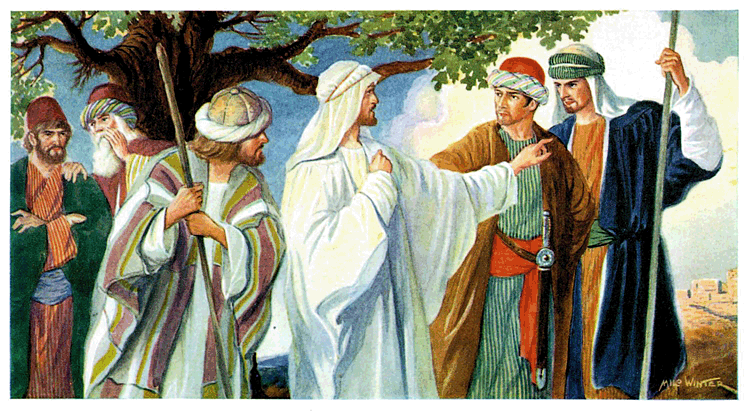
Yeshua teaching disciples

Their are numerous prophecies in the Tanakh about the Messiah. Here is a list scriptures that speak specifically that he would be the Son of Elohim with some brief comments following.

Therefore Adonai himself shall give you a sign: Behold, a virgin shall conceive, and bear a son, and shall call his name Immanuel [Heb. God with us]. (Isaiah 7:14)

Many Bible prophecies have double meanings or fulfillments. Such is the case with this prophecy. It was partially fulfilled in Isaiah’s life (Isa 8:3), but not completely. Isaiah’s son was neither deity nor was he known as “God with us.” Yeshua the Messiah was (Matt 1:23).

He shall cry unto me, “You are my father, my El [God], and the rock of my salvation.” Also I will make him my firstborn, higher than the kings of the earth. (Psalm 89:26, 27)

Again, this prophecy has a double fulfillment. It was partially fulfilled by David and his sons, but not completely. Only Yeshua, who also was from David’s lineage, fulfilled the superlative aspects of this prophecy. Not only that, Solomon, David’s son who ruled after him, wasn’t David’s firstborn. Yeshua was Elohim’s firstborn, however.

Who has ascended up into heaven, or descended? Who has gathered the wind in his fists? Who has bound the waters in a garment? Who has established all the ends of the earth? What is his name, and what is his son’s name, if you can tell? (Prov 30:4)

This is a clear and direct reference to the Son of Elohim, who, the Testimony of Yeshua (the New Testament) tells us in several places, was also the One through whom Elohim created all things (e.g. John 1:7). Continue reading

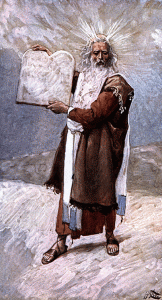
 

Yeshua…A Prophet Like Moses (Does the Church Really Teach This?)

Deuteronomy 18:15, A prophet from your midst, like me, shall YHVH your Elohim raise up for you. Obviously, this was fulfilled in the person of Yeshua the Messiah. The non-believing Jews, however, attempt to prove that this verse does not apply to Yeshua. For example, The ArtScroll Stone Edition Chumash in its commentary states, “Moses told the nation that just as he was one of them, so God would designate future prophets [plural] from among the people to bring them his word” (p. 1033, emphasis added). What is wrong with this statement? Is the verse quoted accurately? Moses said “prophet” singular, not “prophets” plural, as the commentary says. So in this manner, the commentators switch the focus off of one single prophet who would arise, and make it appear as if all the prophets recorded in the Scriptures helped to fulfill this prophecy. This is dishonest biblical interpretation.

Moses' shining face

On another note, does the Christian “Jesus” who, it is taught by many church leaders, broke the Sabbath and came to do away with the Torah-law of Moses fulfill this prophecy? Didn’t Moses say that the prophet would speak only the words that Elohim would give him (and the implication is that those words would not contradict what was given at Mount Sinai)? So did Yeshua come to do away with the Torah-law or not? (Read Matt 5:17–19.) In commissioning his disciples in Matthew 28:20, didn’t Yeshua tell them to do and to pass on to others all that he had commanded them? Didn’t Paul tell us to, “Follow me as I follow the Messiah” (1 Cor 11:1)? So how is it that so many people in Christianity believe otherwise about Messiah Yeshua and Paul relative to their teachings on the Torah-law? The point we are trying to make here is that the “Jesus” of the Sunday church who, it is taught, came to annul the Torah, does not fit the criteria of this prophecy of Deuteronomy 18:15–19. Either the Torah prophecy is wrong and Christian tradition is correct or it is the other way around. We choose the former to be the truth, not the latter!


New Video: Religion Vs. Relationship—Sitting at Yeshua’s Feet Is the Key to Victory

In your spiritual walk, are you more like Martha who was busy trying to earn Yeshua’s favor with her activities or like Mary who was sitting at the Master’s feet learning and worshipping? Religious acts are important, but building a daily relationship with Yeshua is the higher level to reach for. This video explores the idea of sitting at Yeshua’s feet and the central place of the cross in the believer’s life as evidenced in the service in the Tabernacle of Moses.


New Video: Mount St. Helens & God’s Coming Judgment on America

America wake up and turn away from your sins! See actual on-site video footage of Mount St. Helens 33 years after its 1980 eruption. This video is a brief documentary on its volcanic eruption with my personal memories of that day, and how this relates to God’s coming judgment on America, and how you can be saved out of this judgment.

IMG_0153


After Two Days (Is That Now?)

Hosea 5:15–6:3, I will go and return to my place. This passage is a clear prophecy concerning the resurrection of the righteous dead of which Messiah Yeshua is the first to raise.

Verse two contains a Hebrew parallelism, which is a Hebraic literary device where the same thought is expressed differently back-to-back. The word revive is the Hebrew word chayah, the basic Hebrew root verb meaning “to live or to have life.” The word raise up is the Hebrew word quwm meaning “to rise, arise, stand, stand up.” According to TWOT, the basic meaning of this word “denotes rising up from a prostrate position (e.g. Josh 3:16).”

YHVH is speaking here in the broader context of this passage concerning his Messianic role as the lion of Judah (Rev 5:5). After presenting himself as such to both houses of Israel (Ephraim [i.e., the Christians] and Judah [i.e., the Jews]) at his first coming, verse 14 states that Messiah would “go away … and none shall rescue him.”

Then in verse 15 we read that, “I [Messiah speaking] will go and return to my place till they [Ephraim and Judah] acknowledge their offense and seek my face ….” (This refers to Yeshua’s absence from the earth between his first and second comings.) What is their offense? Continue reading


He’s Your Savior, But Is He Your LORD?

The Lordship of Yeshua

The Lordship of Yeshua over all aspects of our lives must be stressed in the Hebraic Roots Movement and, presently, to our shame, it is not. The rule of Torah is trumpeted loudly by many Hebraic roots Torah teachers, but the lordship of Yeshua, sadly, is not. Yet the lordship of Yeshua is a dominant theme in the Testimony of Yeshua (or New Testament), and we’re preaching a skewed gospel message if we don’t teach this. Not only this, but we need to teach that the Torah and Yeshua are synonymous concepts, and that without Yeshua in our lives, we can’t even properly obey the Torah.

33389587

In the Scriptures, Yeshua has many titles. In the Testimony of Yeshua he is referred to as Christ or the Messiah 569 times. But this isn’t his main title. The title Lord holds that place with more than 700 references in the Testimony of Yeshua. By comparison, the name Jesus occurs 745 times in the Testimony of Yeshua.

The Greek word for lord is kurios, which is defined as “he to whom a person or thing belongs, about which he has power of deciding; master, lord; the possessor and disposer of a thing; the owner; one who has control of the person, the master; in the state: the sovereign, prince, chief, the Roman emperor; is a title of honour expressive of respect and reverence, with which servants greet their master; this title is given to: God, the Messiah.”

Acts 10:36 and Romans 10:12 say that Yeshua is Lord of all. The lordship of Yeshua over all aspects of our lives must be stressed in the Hebrew Roots Movement. Currently it is not, even though his title Lord is mentioned more than 700 times in the Testimony of Yeshua.

We must also teach that the lordship of Yeshua equates with the rule of the Torah in our lives. This may be a hard concept for many coming out of the church system to swallow, but it is the truth of Scripture. It goes like this: The Torah = the Word of Elohim = Yeshua = the Living Word of Elohim incarnate = the Lord/Master of our Lives (John 1:1, 14; Rom 10:4–8).

Romans 10:4 says Yeshua is the “end goal of the Torah.” Continue reading


Yeshua in Us: The Power to Obey Torah

Philippians 1:11, The fruits of righteousness which are by Yeshua the MessiahIt is impossible for a man to keep the Torah on his own strength as Yeshua’s encounter with the rich young ruler proves (Matt 19:16–22). When the young man asked Yeshua what he must do to have eternal life, Yeshua seems to set the man up for a fall when he declares, “If you want to enter into life, keep the commandments.” Yeshua is not being disingenuous here. Were one to keep the Torah perfectly without sinning, hypothetically, one would not fall under the death penalty for violating the laws of Elohim (i.e., sin). Presumably one could earn eternal life by one’s own good works. But no man has ever accomplished this superhuman feat except the superhuman Yeshua! Continuing, when the young ruler proudly declares his perfect Torah obedience, Yeshua shows him that he was, in fact, violating the Torah in at least one area—covetousness and greed. Yeshua shows him how to come into Torah compliance, and then admonishes him to come and to follow him. What Yeshua is teaching here is that it’s impossible to keep the Torah perfectly without factoring Yeshua, the Living Torah, into the equation. The point that we can’t keep the Torah without Yeshua directly intervening in our lives, I hope to conclusively demonstrate below.

Torah scroll open 2

One way that Yeshua helps his followers obey the Torah is by sending us his Spirit as an internal spiritual force into our hearts to nudge and lead us into Torah-obedience.

What’s more, Yeshua also gives us the divine gift of his grace to accomplish the same thing. His grace removes the guilt, stain and penalties for our past sins, and with a clear conscience and a clean spiritual slate before YHVH, minus the past baggage of sin weighing us down, we are able to go forward under the power of YHVH’s Spirit to walk in accordance with his Torah. Praise Yeshua! An illustration of this would be a runner who trains wearing a backpack filled with rocks. Once the weight is removed from his back, when he runs, he feels as if he were flying through the air.

Our faith in, love for and continual abiding in Yeshua is the key to receiving his systemic spiritual empowerment to walk a life that mirrors Yeshua. Paul invites us Continue reading