Personal Prophecy or Fortune Telling?

1 Kings 14:1–17, Here the evil King Jeroboam who had turned his back on Elohim when he introduced idolatry into the northern kingdom of Israel, in his time of personal need, sought a word from the prophet of Elohim. He wondered whether his sick son, his only heir, would recover or not. He sent gifts via his wife to the prophet Ahijah hoping to “purchase” a word from the LORD. Instead, Ahijah pronounced judgment upon the child and upon Jeroboam.

We see a similar situation in 2 Kings 8:7–9 where the wicked king of Syria attempted to hire Elisha the prophet for money to find out whether he would recover from his illness or not. Instead, the man of Elohim pronounced judgment on the king.

Finally, Saul, sought to hire the prophet Samuel to give him a word regarding his lost donkeys (1 Sam 9:6–9). Saul’s penchant to divine the future remained unabated, for later in his life he sought to consult Samuel via the witch of Endor in an effort to know his future fate (1 Sam 28:7). Again judgment was pronounced on Saul.

What do these examples all have in common? Individuals were seeking to know the future by those they deemed to have prophetic capabilities. Does the Bible condone this practice? From the examples cited, it would seem not. This is not to denigrate in any way the true role of the biblical prophet. However, the biblical norm is that the prophet of Elohim came to you with a word; you didn’t go to him seeking a word—or to divine your future. And no money was ever exchanged!

In certain areas within the church, prophets and prophecy have became a fad. Many “prophets” have almost a cult following. Many of these “prophets” profit handsomely as they peddle prophetic words and personal prophecies. The problem is that these “prophets” are hard-pressed to find biblical examples to justify their activities. For many of them, it seems that their subjective experiences determines what they believe, teach and practice rather than the objective truth as recorded in Elohim’s Word.

Would you care to open this can of worms and share your insights and experiences in the area of “personal prophecy” and your experiences with church “prophets”?

 

The Burning Bush, Yeshua and You

In Exodus 13:21 we read,

“And YHVH went before them by day in a pillar of a cloud, to lead them the way; and by night in a pillar of fire, to give them light; to go by day and night.”

Then in Exodus 14:19 it is written,

“And the angel of Elohim, which went before the camp of Israel, removed and went behind them; and the pillar of the cloud went from before their face, and stood behind them.”

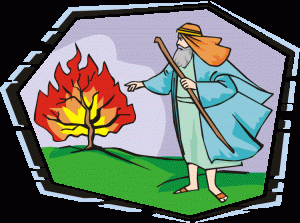
Who is this “Angel” of Elohim (elsewhere he is called “the Angel” of YHVH)? Angel is an unfortunate translation. The Hebrew word for angel is malak/מלאך and simply means “a heavenly or a human messenger.” Prophetically this word can refer to human messengers such as the one coming in the spirit of Elijah prior to Messiah’s coming, as well as to the Messiah himself (as in “the Messenger/Malak of the covenant” in Malachi 3:1). In Genesis 32:22–30 Jacob wrestles with a man Scripture identifies as the Malak of YHVH (Hosea 12:3–5) and whom Jacob called Elohim (verse 30). This same Individual redeemed Jacob (Gen 48:18) and is identified with the Malak of Elohim … the Elohim of Bethel (31:11 and 13) and appeared to Moses at the burning bush (Exod 3:2). Now he is leading Israel in the wilderness. Again who is he? Stephen in Acts 7:37–39 identifies the Messiah (i.e. “that Prophet” Moses mentioned in Deut 18:15) with the “Angel” or Heavenly Messenger that spoke to the children of Israel from Mount Sinai and who gave them the “living oracles,” who the Israelites later rejected for pagan gods. Paul elsewhere said of that same Personage that the Israelites did “all drink the same spiritual drink: for they drank of that spiritual Rock that followed them: and that Rock was Messiah” (1 Cor 10:4).

Continue reading →


A Popular Subject with Yeshua—Not So With the Church

Luke 8:10, The mysteries of the kingdom. The Greek word for mystery is musterion meaning “hidden thing, secret, mystery; religious secrets, confided only to the initiated and not to ordinary mortals; a hidden or secret thing, not obvious to the understanding.”

Of the some 136 subjects recorded in the Gospels of Matthew and John pertaining to the life and words of Yeshua, there are 144 verses dedicated to Yeshua speaking about the kingdom of Elohim (or heaven). In fact, it was the fourth subject he talked most about (after himself, his Father and the hypocritical religionists of his day). In the four Gospels, there are 109 direct references to the kingdom of Elohim (or heaven).

This being so, why do we not hear much about this subject in churches? What is the kingdom of God/Elohim (or heaven)? What are the mysteries of the kingdom? Matthew 4:23 characterizes the message Yeshua preached as “the gospel (good news) of the kingdom.” Just prior to this (verse 17), we read that Yeshua preached saying, “Repent, for the kingdom of heaven is at hand.” Again, is this message preached in the church? If not, why not?


Did Yeshua Heal Everyone All The Time?

Luke 5:17, The power [Gr. dumanis] of YHVH was present.

Let’s explore the healing activities of Yeshua. The Greek word dunamis means “strength, power, ability” or as often used in the Testimony of Yeshua, “miraculous power.” This is an interesting statement pertaining to the dynamics of Yeshua’s healing activities. Did Yeshua heal all people all the time, or only when the power of Elohim was present for him to do so? This verse, at least in this case, would indicate the latter. Elsewhere, we read that Yeshua “healed many that were sick” (Mark 1:34), but not all that were sick. On other occasions, the Gospel record implies that Yeshua did in fact heal all the sick who were brought to him (Matt 4:23–25; 9:35).

The Gospels reveal some other interesting facts about Yeshua’s healing activities that we often pass over. On at least one occasion, Yeshua prayed to heal someone and they were only partially healed. After he prayed for them the second time, they were completely healed (Mark 8:22–25). Often Yeshua healed people after he was “moved with compassion [love and pity]” for someone who was sick (Matt 14:14; Mark 1:41; Luke 7:13–15). The Greek word for compassion, literally means “to be moved in one’s bowels,” or in the deepest areas of one’s emotions. Some people simply touched Yeshua’s clothing as he was walking by, and the miraculous power (Gr. dunamis) of Elohim flowed from him and healed them (Matt 9:20; Mark 6:56; Luke 8:44).

Elsewhere, it appears that Yeshua’s healing activities were hampered by the presence of those who ridiculed him and exhibited doubt and unbelief, which is why, on one occasion, he put the unbelievers out of the room and closed the door when he raised the little girl from the dead (Mark 5:40–42). Similarly, in his hometown of Nazereth, Yeshua “could do no mighty works there” except for healing a few sick people, “because of their [the townspeople’s] unbelief” (Mark 6:5–6; also Matt 13:58). Matthew’s account adds that the people of Nazareth were offended (literally, scandalized, stumbled over, judged unfavorably, distrusted) by Yeshua. Because of their low esteem for him, they lacked the faith to receive healing, which is why he healed so few people in that town.

What can we learn from the example of Yeshua about healing the sick? Do you have some personal experiences that would correlate with what we read in the Gospels about Yeshua’s healing activities?


On Shiloh, Donkeys, the Vine, the Blood of Grapes and the Messiah

Genesis 49:10–12, The scepter shall not depart from Judah, nor a lawgiver from between his feet, until Shiloh come; and unto him shall the gathering of the people be. Binding his foal unto the vine, and his ass’s colt unto the choice vine; he washed his garments in wine, and his clothes in the blood of grapes: His eyes shall be red with wine, and his teeth white with milk.

This passage is a clear reference to the Messiah and the Messianic Age (the time when Messiah would come) and has been so recognized by the Jewish sages from time immemorial (ArtScroll Stone Edition Chumash, p. 279). “The general consensus (with few exceptions) of Rabbinic interpretation is that this phrase [Until Shiloh arrives] refers to the coming of the Messiah …” (ArtScroll Bereishis/Genesis Torah Commentary, Vol. 1b, p. 2152). In fact, Onkelos [a second-century scholar who translated the Torah (Pentateuch) into Aramaic] in his Aramaic version of the Torah translates this version as follows: “Until the Messiah comes, to whom the kingdom belongs” (Ibid.). Rashi (b. 1040 and recognized by Jewish scholars as probably the preeminent Torah commentator of the modern era) “concurs and similarly comments: Until the King Messiah will come…, to whom the kingdom belongs. According to the Midrash, shiloh is a composite of the Hebrew words shi  and lo meaning “a gift to him” — a reference to King Messiah to whom all peoples will bring gifts. See Isaiah 18:7; Psalms 76:12” (Ibid. p. 2153). It should not be difficult to see the fulfillment of this rabbinic understanding in the magi’s giving of gifts to the young child Yeshua (Matt 2:11).

Continue reading →


Are You a Literal Descendant of Jacob?

Genesis 46:14 and 16, Jacob’s Prophecy Over Ephraim and Manasseh
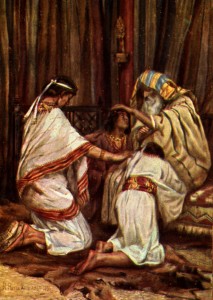
While prophesying over Joseph’s sons, Ephraim and Manasseh, Jacob crossed his hands over their heads making the symbol of the paleo-Hebrew letter tav (like the letter t or x in the alphabet), which resembles a cross and in that ancient Hebraic script and pictographically means “sign of the covenant.”

Jacob then spoke of the Heavenly Messenger (the Hebrew word malak mistranslated as “angel” in most Bibles) of YHVH (i.e., the preincarnate Yeshua) who had redeemed him from all evil (see Gen 31:11–13).

Jacob then prophesied that the descendants of Ephraim and Manasseh would become like “fish in the midst of the land” (literal translation of Gen  48:14–16; see The ArtScroll Stone Edition Tanach).

In light of this prophetic symbolism, which present day religious group would qualify as having fulfilled Jacob’s prophecy as to who the descendents of Ephraim and Manasseh would be?

Which religion on earth uses the fish as their symbol, speaks of a Messenger from YHVH as their Redeemer, and has the sign of the paleo-Hebrew letter tav, which looks like a cross? The Buddhists? The Moslems? The Hindus? Even the Jews? No! Only Christianity fits this enigmatic criteria.

Many Christians are without a doubt the literal descendants of Ephraim and Manasseh. Those who are not, according to the Apostle Paul, once they come to saving faith in Yeshua in some unique sense become the descendants of Abraham (e.g., Gal 3:7,29).

For more on this subject, refer to Natan’s article entitled, “Is America in End-Times Bible Prophecy?” (http://www.hoshanarabbah.org/pdfs/america.pdf).


Out of the Fog and into the Light of Your Destiny—An Example from the Life of Joseph

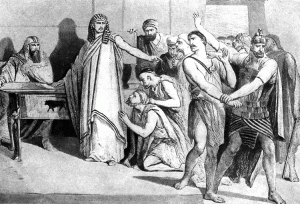
Genesis 45:5, 7, 8 — Elohim sent me. This illustrates the remarkable, persevering faith of Joseph who, by this time, had been in Egypt for 22 years.

Joseph was sold into slavery at age 17, was freed from prison and made ruler of Egypt at age 30, then seven years of plenty followed, and two years of famine had passed by the time he was reunited with is brothers.

Only after 22 years in Egypt did Joseph finally figure out Elohim’s grand and wonderful plan for his life, and how it involved the saving of his family.

Had Joseph lost faith along the way, become embittered over his misfortunes, and turned from Elohim, the nation of Israel may have never been preserved.

Keeping one’s eyes on Elohim, and refusing to lose faith during the dark times can yield some amazingly triumphant outcomes, as we learn from the life of Joseph.

What is an example from your life where only after years of endless struggle, while refusing to lose faith in Elohim, did you finally realize that through it all he was working out a glorious plan, bringing you into your destiny, and that he had been preparing you for some assignment or mission all along?