Who Are the 144K and Innumerable Multitude?

Here are some of notes from my Book of Revelation Commentary on the two groups of saints on earth during the great tribulation period, which happens before the resurrection and second coming.

These notes are simply my best understanding of these scriptures to this point. There is still more to learn on these subjects.

The 144,000 Saints Versus the Great and Innumerable Multitude

There are two groups of believers mentioned Revelation chapters 7 and 14. They are Yeshua’s 144,000 bride-priests and the carnal or lukewarm believers who get spiritually refined in great tribulation.
15536600

The 144,000 are spiritual virgins who follow the Lamb wherever he goes. They are redeemed believers and first fruits of Elohim (Rev 14:4).

The 144,000 are without deceit or fault before YHVH’s throne of judgment (Rev 14:5). How can it be said that someone is without fault and be Torahless, since Torah defines sin (1 John 3:4)? Indeed, those who are the saints that make up the 144,000 must be Torah-observant and be walking under the blood of Yeshua (Rev 12:17; 14:12).

The meaning of the names of the patriarchs of the 12 tribes have a hidden message pertaining to the bride, which is more proof that the 144,000 are the bride of Yeshua.

  • Judah means “Now I will praise YHVH.” (Gen 29:35)
  • Reuben means “Surely YHVH has looked upon my affliction.” (Gen 29:32)
  • Gad means “What good fortune.” (Gen 30:11)
  • Asher means “Happy am I.” (Gen 30:13)
  • Naphtali means “With great wrestlings have I wrestled.” (Gen 30:8)
  • Manasseh means “For Elohim [said he], ‘has made me foreget all my toil.’” (Gen 41:51)
  • Simeon means “Because YHVH has heard that I was hated.” (Gen 29:33)
  • Levi means “Now this time will my husband be joined to me.” (Gen 29:34)
  • Issachar means “Elohim has given me my wages.” (Gen 30:18)
  • Zebulon means “Elohim has endowed me with a good gift, now my husband will dwell with me.” (Gen 30:20)
  • Joseph means “YHVH shall add to me.” (Gen 30:24)
  • Benjamin means “You shall have this son.” (Gen 35:17–18)

Combined the names tell the following story: Now will I praise YHVH. Surely YHVH has looked upon my affliction. What good fortune. Happy am I. With great wrestlings have I wrestled and I have prevailed. For Elohim has made me forget all my toil because YHVH has heard that I was hated. Now this time will my husband be joined unto me. Elohim has given me my wages. Elohim has endowed me with a good gift. Now my husband will dwell with me. YHVH shall add to me. You shall have this son. Continue reading →


New Video: Yom Teruah Past, Present and Future

In this video, I discuss Yom Teruah vs. Rosh Hashanah, the end-time prophetic implications of YT relating to the resurrection and second coming, and everything you want to know about the shofar including how it was used historically, why you should have one, how the shofar is at the center of the YT celebration.


New Video: Shofar Show and Tell

In this video, Natan shows you his private shofar collection including some exotic horns, and some of his homemade shofars. You will learn how to blow a shofar and see ram’s horns in their raw state. Natan then recounts his personal testimonies of supernatural things happening when he has sounded the shofar. Ever see a seaweed shofar? This video will show you several.


Blog Scripture Readings for 9/8 through 9/14/13

Aside

There is no Parasha Reading for this week
Haftarah — Hosea 14:2-10; Micah 7:18-20; Joel 2:15-27**
Prophets — Zechariah 2:1 – 9:17
Writings — 2 Chronicles 24:1 – 31:21
Testimony — Revelation 9:1 – 15:8

Most of this week’s blog discussion points will be on these passages. If you have general comments or questions on the weekly Scripture readings not addressed in a blog post, here’s a place for you to post those. Just use the “leave a reply” link below.

The full “Read Through The Scriptures In A Year” schedule, broken down by each day, can be found on the right sidebar under “Helpful Links.” There are 4 sections of scripture to read each day. One each from the Torah, the Prophets, the Writings, and from the Testimony of Yeshua. Each week, the Torah and haftarah readings will follow the traditional one-year reading cycle.

Weekly Blog Scripture Readings for 9/8 through 9/14/13.

** A different Haftarah is read when it is a special sabbath in Jewish tradition. The Shabbat that falls between Yom Teruah and Yom Kippur is called “Shabbat Shuvah” or “Sabbath of Return/Repentance” and this special Haftarah is read on that day. On the calendar that begins the new year with the aviv barley and the sighting of the first sliver of the new moon, Shabbat Shuva would fall this week (a week later than on the traditional Hillel 2 calendar) and would be read for this week’s Haftarah.


Yom Teruah—The Day of Shofar Blowing or Shouting

On the evening of Saturday, September 7, 2013, the first sliver of the new moon will be spotted in the land of Israel, thus signaling the first day of the seventh month of the biblical calendar and the biblical feast of Yom Teruah or the Day of Shofar Blowing/Shouting. (If you’d like to learn more about the biblical calendar versus the traditional, non-biblical, Constantine-approved calendar of ca. A.D. 360 used by the modern rabbinic Jews, please see my studies on the subject at http://www.hoshanarabbah.org/teaching.html#feast.)

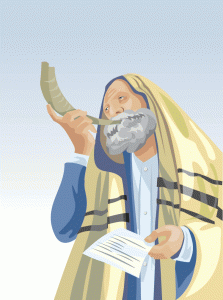
Shofar man

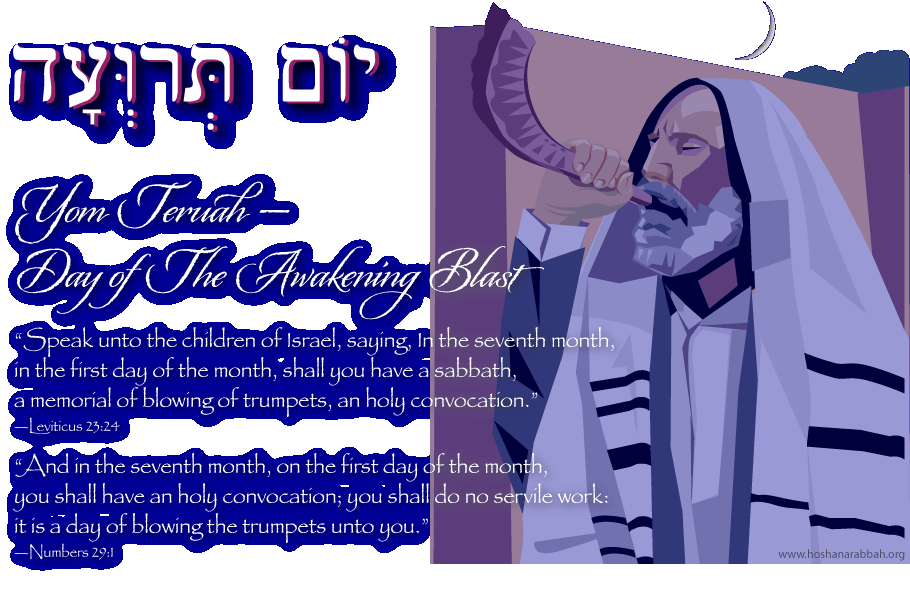
Happy Yom Teruah!

Yom Teruah—The Beginning of the Fall (End-Time) Harvest

Yom Teruah or the Day of Shouting; the Shofar Blasts (commonly called “Rosh Hashana”) occurs at the end of the summer months and marked the beginning of the fall harvest or festival season for the ancient Hebrews. Prophetically, the summer months between the spring feast of Shavuot/Weeks (Pentecost) and the fall feast of Yom Teruah is a spiritual picture of what is often called the “Church Age,” which is the period of time from the Feast of Pentecost in Acts 2 until the return of Yeshua the Messiah at the end of the age and lasting for approximately 2000 years. For many, especially those living in hotter climes, summer is a time of leisure, vacation, weariness and fatigue due to the excessive heat. Likewise, many Bible believers have fallen asleep growing spiritually weary while waiting for the return of the Messiah. Yeshua discusses this issue in the Parable of the Ten Virgins (Matt 25) who all grew weary and fell asleep awaiting the coming of the Bridegroom (Yeshua).

This all changes on the first day of the seventh month of the biblical Hebrew calendar when off in the distance the sound of a shofar blast suddenly pierces the atmosphere and registers in the eardrums of those who have fallen asleep. Not only does this shofar blast signal the beginning of the seventh month when the new crescent moon is sighted, but it announces the return of the Bridegroom (Yeshua) coming for his bride (the virgin saints). Continue reading →


Happy Yom Teruah!

Happy Yom Teruah — September 8, 2013 (on the biblical visible new moon calendar)

Happy Yom Teruah — September 8, 2013 (on the biblical visible new moon calendar)


Immortal Soul Idea—Pagan, Not Biblical

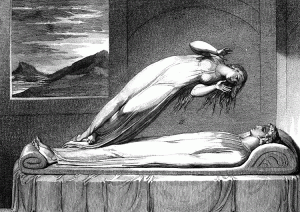
Revelation 6:9, Under the altar…souls. In Hebraic biblical thought, the earth is the altar (see The ArtScroll Tehilim/Psalms Commentary on Ps 118:27), and at death, the soul is not immortal, but simply goes into the grave with the body awaiting the resurrection (Ps 49:15; Ezek 18:4).

Immortal Soul 24316181

Below is a brief discussion on the origins of the idea of the immortality of the soul.

The Idea of an Immortal Soul Comes from the Pagans, Not the Bible

In his book, Judaism, by Harvard professor, George Foot Moore, the author asserts that in ancient Israel there was no concept of the afterlife. The abode of the dead was the grave (sheol). The only hope of life after death was expressed in the notion of the resurrection of the righteous sometime in the future. (vol. 2, pp 287–292)

The Greek thinkers postulated the dual nature of man where it was believed the man’s true self was an imperishable soul, which during what we call life is the inmate of the mortal body. At death the soul leaves this tenement, while the body dissolves into its material elements and perishes. The soul then flits away to the realm of spiritual or noumenal existence to which by its essential nature it belongs. The ideas of immortal souls and of the happy lot to which the souls of the good go at death seemed to some Jews to fit in so well with their own religious conceptions as to belong to them (Ibid., pp. 292–293). Continue reading →