An Op-Ed on Greedy Dogs in the Pulpit

Luke 11:33, No one. As Jonah witnessed to Nineveh proclaiming the message of repentance (vv. 29–32), even so, Yeshua is teaching us that we must do the same to our generation.

Greedy Ministers33349153

Furthermore, if when proclaiming the gospel message of repentance (turning from sin or Torahlessness and turning to Yeshua) our eye is evil—a Hebraism for greedy or covetous—then our  whole message will be compromised or tainted. How is this? If we have been called to preach the good news or gospel of the kingdom of Elohim, and we’re in it to make money, then those hearing our message may view it as suspect because they see behind our preaching an ulterior motive. Are we preaching the message out of pure altruism and seeking no financial gain or other personal benefit, or do we have a hidden agenda—namely, personal enrichment? If the latter, are people going to believe our message more or less? How is this going to reflect on the message itself—favorably or negatively? Is this going to help bring people into the kingdom of Elohim or keep them out of it?

Sadly, many in the church system have perfected the nefarious art of taking people’s Continue reading →


What is the Significance of the Abib Barley?

Every detail in the Scriptures is important.

The longer we study the Bible, the more our spiritual radar zeroes in on these seeming insignificant details and the more we see how they relate to other details elsewhere in the Scriptures. Pretty soon, the pieces of the puzzle fall into place, and like digging for gold, spiritual nuggets are discovered.

To the serious biblical studier, it becomes impossible to dismiss the Bible as simply another  religious book written by men. As more of these puzzle pictures form, one realizes that the Bible has been fearfully and wonderfully crafted by an intellect that is superior to that of any man. A small detail in Exodus 9:31 is another example of this as the following study will show.

Exodus 9:31, The barley was in the head. Barley was cultivated as a grain crop in ancient Egypt, as well as in Israel, and grows wild like a weed throughout the region to this day. Several passages in the Scriptures witness to the fact that the barley was the indicator of which month was to be the first month of the year for the Israelites, so that they could determine when the biblical feasts were to be observed.

Barley 32335508

Observe the month of Abib, and keep the Passover unto YHVH your Elohim: for in the month of Abib YHVH your Elohim brought thee forth out of Egypt by night. (Deut 16:1, emphasis added)

Please notice, the definite article the proceeding the phrase “month of Abib.” The state of the barley indicates a specific month in the spring. Months in the biblical Hebrew calendar have always been determined by the first visible sliver of the new moon from antiquity. This specific month is to be the beginning the biblical new year (Exod 12:2). The month of the Abib is not so much the name of a month as it is a description of the month. Below are listed the other three places in the Scriptures where this phrase is found.

This day came you out in the month Abib. (Exod 13:4)

You shall keep the Feast of Unleavened Bread: (you shall eat unleavened bread seven days, as I commanded thee, in the time appointed of the month Abib; for in it you came out from Egypt: and none shall appear before me empty). (Exod 23:15)

The feast of unleavened bread shall you keep. Seven days you shall eat unleavened bread, as I commanded you, in the time of the month Abib: for in the month Abib you came out from Egypt. (Exod 34:18, emphasis added on all)

What does the word abib in the phrase “the month of the Abib (or Aviv)” mean? The Hebrew word abib is found only six times in the Bible and is transliterated into the English (in the KJV) as “abib,” meaning “in the ear,” or “green ears of grain.” The Theological Wordbook of the Old Testament, defines the word abib or aviv as follows: Continue reading →


And people wonder why America is in the mess it’s in…

The following article is from http://endoftheamericandream.com/archives/guess-what-percentage-of-american-children-live-in-a-home-with-a-traditional-family-structure

Guess What Percentage Of American Children Live In A Home With A Traditional Family Structure?…

Family - Photo by Eric WardIt is hard to believe, but in America today only 46 percent of children live in a home that has both a mother and a father that are in their first marriage.  An additional 15 percent live in a home that has two parents where at least one of them has been remarried.  But that means that an all-time record high 39 percent of all U.S. kids are living in a home with either just a single parent or no parents at all.  These numbers were just released by Pew Research, and they are rather startling.  The “traditional family” that most of us took for granted growing up is dying.  More Americans than ever are delaying marriage, having children out of wedlock and rejecting the traditional family structure.  But is this good for our kids?  Is this good for the future of America?

The decay of the traditional family structure in the United States is something that has been going on for a very long time.  According to Pew Research, the percentage of American children living in a traditional family home has plummeted by 27 percent since 1960…

Less than half (46%) of U.S. kids younger than 18 years of age are living in a home with two married heterosexual parents in their first marriage. This is a marked change from 1960, when 73% of children fit this description, and 1980, when 61% did, according to a Pew Research Center analysis of recently-released American Community Survey (ACS) and Decennial Census data.

The primary reason for this change is the fact that attitudes toward sex, marriage and child rearing in this country have dramatically changed since then…

Americans are delaying marriage, and more may be foregoing the institution altogether. At the same time, the share of children born outside of marriage now stands at 41%, up from just 5% in 1960.

Once upon a time, marriage was held in high honor, our young people were taught to look forward to being parents, and there was something sacred about sex.

But these days sex has become a national sport and our young people are trained that marriage should be put off for as long as possible and that having kids is a burden.

As a result, single Americans now make up more than half the U.S. population for the first time ever, and approximately one out of every three childrenin the United States lives in a home without a father.

When sex becomes a sport, it is inevitable that many people start behaving like animals that are only concerned with their own personal pleasure.  This includes even some of the most “respectable” members of the community like doctors.  For example, check out what one doctor down in Florida has been charged with doing…

A Florida doctor has been accused of repeatedly drugging at least three female patients with cocaine and sedatives and sexually assaulting them.

Dr Daniel McBath, an osteopath from Dade City had his license restricted by the state last week for ‘egregious and predatory’ behavior involving three women.

In a normal society, something like that would be a national scandal.  But since we are bombarded with news stories like this every single day, it hardly made a blip on the news.

Meanwhile, the idea of having children has become greatly undesirable to large numbers of our young people.  Kids are considered by many to be financial burdens that destroy our “freedom” to have fun and enjoy our lives.

And this terrible attitude manifests itself in the way that many of our young people are treating their young children.

For instance, in one recent article I discussed a case down in Florida where a man and his wife stuffed themselves full of food at a Golden Corral while their four pound baby girl died from starvation in her car seat outside the restaurant.

In another extremely disturbing incident down in Florida, one father recently threw his five-year-old girl off a 60 foot bridge…

The father of a five-year-old girl who was thrown to her death off a 60-foot bridge in Tampa Bay has been charged with murder.

John Jonchuck Jr, 25, was arrested half an hour after a man was seen speeding towards a bridge and throwing a child 60ft into the water on Wednesday night.

Rescuers found Phoebe Jonchuk 40 minutes later but she could not be resuscitated.

Of course not all parents are like that.  Most are trying to do the best that they can.

But overall, our increasing rejection of the traditional family structure is putting a lot of financial strain on those that are raising children.  This is especially true of single mothers.  If you are a child and you do not live with two parents, you are far, far more likely to be living in poverty.   Just check out the following numbers which I originally shared in a previous article…

#1 The National Center for Children in Poverty says that 45 percent of all U.S. children belong to low income families.

#2 According to a Census Bureau report that was released just this week, 65 percent of all children in America are living in a home that receives some form of aid from the federal government…

“Almost two-thirds (65 percent) of children,” said the Census Bureau, “lived in households that participated in at least one or more of the following government aid programs: Temporary Assistance for Needy Families (TANF), the Supplemental Nutrition Assistance Program (SNAP), the Special Supplemental Nutrition Program for Women, Infants, and Children (WIC), Medicaid, and the National School Lunch Program.”

#3 According to a report recently released by UNICEF, almost one-third of all children in this country “live in households with an income below 60 percent of the national median income”.

#4 When it comes to child poverty, the United States ranks 36th out of the 41 “wealthy nations” that UNICEF looked at.

#5 An astounding 45 percent of all African-American children in America live in areas of “concentrated poverty”.

#6 40.9 percent of all children in the United States that are living with only one parent are living in poverty.

#7 These days, a lot of single mothers are really, really struggling to survive.  A decade ago, the number of women in America that had jobs outnumbered the number of women in America on food stamps by more than a 2 to 1 margin.  But now the number of women in America on food stamps actually exceedsthe total number of women that have jobs.

#8 It is hard to believe, but right now 49 million Americans are dealing with food insecurity.

#9 According to a report that was released last month by the National Center on Family Homelessness, the number of homeless children in the United States has reached a new all-time high of 2.5 million.

For much more, you can read the remainder of that article right here.

As you can see, our rejection of the traditional family structure is hurting the kids the most.

But what is causing Americans to increasingly turn their backs on the traditional family structure?

Reverend Franklin Graham thinks that he knows the answer…

Reverend Franklin Graham, son of world renowned evangelical preacher Billy Graham, said that America is increasingly embracing a “culture of death” that echoes what has occurred in Europe, and which stems from a “sinful, godless worldview that rejects Christ.”

A further problem in America, he added, is that “Christianity is constantly under siege from the halls of government and education, which seek to suppress any public expressions of faith.”


 

Yeshua Heals the Gadarene Demoniac

Matthew 8:28–34 (also Mark 4:35–5:20 and Luke 8:26–39),

c2

“And when [Yeshua] had come to the other side [of the Sea of Galilee] into the country of the Gergesenes, there met him two possessed with demons [or, a man with an unclean spirit, Mark 5:2], coming out of the tombs, exceeding fierce, so that no man might pass by that way [or, no man could tame him, Mark 5:4]. And, behold, they cried out, saying, ‘What have we to do with you, Yeshua, Son of Elohim? Have you come here to torment us before the time?’ And there was a good way off from them an herd of many swine feeding. So the demons besought him, saying, ‘If you cast us out, allow us to go away into the herd of swine.’ And he said unto them, ‘Go [or, come out of the man, unclean spirit, Mark 5:8].’ And when they were come out, they went into the herd of swine, and, behold, the whole herd of swine [and, they were about two thousand, Mark 5:13] ran violently down a steep place into the sea, and perished in the waters. And they that kept them fled, and went their ways into the city, and told every thing, and what was befallen to the possessed of the demons. And, behold, the whole city came out to meet Yeshua, and when they saw him, they besought him that he would depart out of their coasts.” Mark’s account adds the following (Mark 5:15–20): “And they come to Yeshua and stared at him that had been possessed by the legion of demons, sitting, and clothed, and in his right mind and they were afraid. And they that saw it told them how it befell to him that was possessed with the demons, and also concerning the swine. And they began to beg him to depart out of their coasts. And when he was come into the ship, he that had been possessed with the devil begged him that he might be with him. Howbeit Yeshua would not allow it, but said unto him, ‘Go home to your friends, and tell them how great things the Master has done for you, and has had compassion on you.’ And he departed, and began to preach [proclaim] in Decapolis the great things Yeshua had done for him and all men did marvel.”

Prophetic Points to Analyze:

  • Mark 4:37, a great storm
  • Mark 4:38, asleep on a pillow
  • Matthew 28, the other side
  • Matthew 28, two possessed with demons
  • Matthew 28, coming out of the tombs
  • Matthew 28, no man could tame him
  • Matthew 30, swine
  • Mark 5:13, two thousand
  • Matthew 32, perished in the waters
  • Matthew 34, coasts
  • Mark 5:20, Decapolis

In this passage, we find more symbolic and prophetic language pertaining to the exile and future redemption of lost, scattered and spiritually apostate Israel. Here Yeshua had crossed to the other side of the Sea of Galilee into the region of the Gergesenes—a name which is a variant of Gadarenes and is plural for the word Gadara. This city was located on the east side of the Jordan River six miles southeast of the Sea of Galilee, and was one of the cities of the Roman province of Decapolis (i.e., “ten cities”). This was in the ancient territory of the tribe of Gad (one of the ten tribes of the Northern Kingdom or house of Israel).

The sea over which Yeshua crossed is a scriptural prophetic metaphor for the sea of humanity in general (e.g., see Dan 7:3). In Mark’s account, we learn that the sea was stormy at the time of Yeshua’s crossing (Mark 4:35–41). This is a prophetic picture of political turmoil and upheaval among the governments and peoples of the earth. Through this storm, Yeshua had been asleep with his disciples in the safety of the boat riding atop of the sea. This is a picture of YHVH’s preserving his saints through the horrendous times the Scriptures call the day of YHVH’s wrath (or the wrath of Elohim, i.e., the seven last plagues or bowl judgments of the Book of Revelation) during which time YHVH will pour out his wrath and judgment upon the unregenerate inhabitants of the earth.

A similar scenario occurred in Noah’s day. Noah and his family rode safely over the top of the waves, which were filled with drowned humanity. Noah was spared from the wrath of Elohim against a wicked and unrepentant generation. Similarly, the end-time saints of YHVH will not have to endure his final wrath as long as they are in the same spiritual boat Continue reading →


Blog Scripture Readings for 1-11 through 1-17-15

Aside

THIS WEEK’S SCRIPTURE READINGS FOR STUDY AND DISCUSSION:

Parashat Va’eira — Exodus 6:2 – 9:35
Haftarah — Ezekiel 28:25 – 29:21
Prophets — 2 Samuel 17:1 – 23:39
Writings — Psalms 96:1 – 103:22
Testimony — Luke 8:26 – 11:13

Most of this week’s blog discussion points will be on these passages. If you have general comments or questions on the weekly Scripture readings not addressed in a blog post, here’s a place for you to post those. Just use the “leave a reply” link below.

The full “Read Through The Scriptures In A Year” schedule, broken down by each day, can be found on the right sidebar under “Helpful Links.” There are 4 sections of scripture to read each day. One each from the Torah, the Prophets, the Writings, and from the Testimony of Yeshua. Each week, the Torah and haftarah readings will follow the traditional one-year reading cycle.

Weekly Blog Scripture Readings for 1/11 through 1/17/15.


Who is the “Angel of the Lord”?

Exodus 3:2; 13:21; 14:20
The Burning Bush and the Messenger of YHVH

The “Angel” of YHVH In the Pillar of Fire

In Exodus 13:21 we read,

And YHVH went before them by day in a pillar of a cloud, to lead them the way; and by night in a pillar of fire, to give them light; to go by day and night.

Then in Exodus 14:19 it is written,

And the angel of Elohim, which went before the camp of Israel, removed and went behind them; and the pillar of the cloud went from before their face, and stood behind them.

Who is this “Angel” of Elohim (elsewhere he is called “the Angel” of YHVH)? Angel is an unfortunate translation. The Hebrew word for angel is malak and simply means “a heavenly or a human messenger.” Prophetically this word can refer to human messengers such as the one coming in the spirit of Elijah prior to Messiah’s coming, as well as to the Messiah himself (as in “the Messenger/Malak of the covenant” in Malachi 3:1). In Genesis 32:22–30 Jacob wrestles with a man Scripture identifies as the Malak of YHVH (Hosea 12:3–5) and whom Jacob called Elohim (verse 30). This same Individual redeemed Jacob (Gen 48:18) and is identified with the Malak of Elohim … the Elohim of Bethel (31:11 and 13) and appeared to Moses at the burning bush (Exod 3:2). Now he is leading Israel in the wilderness. Again who is he? Continue reading →


Overview of the Books of the Torah (Main Themes)

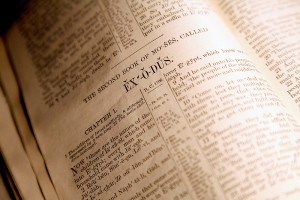
Exodus (Shemot) is the book whose principle theme is redemption—Israel’s deliverance from Egypt (Mitzraim). Here we learn how YHVH saves his people and we are shown that his people are redeemed in order to worship him.

The Theme of Redemption

Say, therefore, to the sons of Israel, “I am YHVH, and I will bring you out from under the burdens of the Egyptians, and I will deliver you from their bondage. I will also redeem you with an outstretched arm and with great judgments. Then I will take you for My people, and I will be your Elohim; and you shall know that I am YHVH your Elohim, who brought you out from under the burdens of the Egyptians. I will bring you to the land which I swore to give to Abraham, Isaac, and Jacob, and I will give it to you for a possession; I am YHVH.” (Exod 6:6-8, emphasis added)

Worship

And he said, “Certainly I will be with you, and this shall be a token unto you, that I have sent you, when you have brought forth the people out of Egypt, you shall serve Elohim upon this mountain.” (Exod 3:12, emphasis added)

And I say unto you, “Let my son go, that he may serve [Hebr. awvawd, Strong’s H5647] me, and if you refuse to let him go, behold, I will slay your son, even your firstborn.” (Exod 4:23, emphasis added)

And you shall say unto him, “YHVH Elohim of the Hebrews has sent me to you, saying, ‘Let my people go, that they may serve [Hebr. awvawd, Strong’s H5647] me in the wilderness, and, behold, until now you would not hear.’” (Exod 7:16, emphasis added)

The Basic Outline of Exodus

Chapters 1–6 show us the need for redemption.

Chapters 7–11 show us the power or might of the Redeemer as the ten plagues are poured out upon Egypt.

Chapters 12–18 show us the character of redemption; purchased by blood and emancipated by power.

Chapters 19–24 we are taught the duty of the redeemed.

Chapters 25–40 we see the restoration of the redeemed—provisions are made for the failures of the redeemed.

The Metaphors in Exodus

Egypt is a metaphor for the world, the place of sin and bondage where one is held captive before being delivered or redeemed by the power of YHVH and the blood of Yeshua, the Lamb of Elohim. It is interesting to note that ­although Egypt was the land of science and art, it was similarly the land of death. Their religion was fixated with death.

Pharaoh is a metaphor for Satan, a merciless taskmaster who opposes the people of YHVH every step of the way.

Pharaoh’s magicians is a metaphor for demonic spirits, doing Pharaoh’s bidding in opposing Israel.

Moses is a prophetic metaphor for Yeshua (his first coming), the Deliverer of his people from the bondage and power of sin, death and hell, which is the power of the enemy, Satan.

The blood of the lamb on the door posts is a metaphor for Yeshua, the Redeemer, whose death on the cross atoned for man’s sins causing YHVH’s judgment against sin to passover us.

The crossing of the Red Sea is a metaphor for our union with Messiah Yeshua in his death and resurrection via the ritual of tevilah (immersion or baptism) at a mikvah (a gathering of waters).

The journey through the wilderness is a metaphor for the trials and testing that occur during the redeemed believer’s spiritual walk through this life with YHVH’s provision to meet every need and his protection from every attack of the adversary.

Exodus 1-65289158

The giving of the Torah is a metaphor for the obedience and submission that we owe to YHVH, our new Master.

The Tabernacle of Moses with its furnishings is a metaphor for YHVH’s plan of redemption (salvation) for mankind and the steps in man’s spiritual maturation into intimacy with the Father through Yeshua the Messiah.