Some Good News for a Change…the Miraculous Power of Prayer

Go to http://www.ksdk.com/story/news/features/2015/02/03/hear-miraculous-recovery-teen-rescued-ice/22819829/ to watch video of interview with miracle boy.

Teen who fell in icy pond makes ‘miraculous’ recovery

A 14-year old St. Charles boy who spent 15 minutes underwater after falling through the ice of Lake Ste. Louise has made a recovery no one can explain.

 12278 110 4LINKEDIN 42COMMENTMORE

A 14-year old St. Charles boy who spent 15 minutes under water after falling through the ice of Lake Ste. Louise has made a recovery no one can explain.

It’s a recovery so complete, our Kay Quinn spoke on-camera to young John Smith about his near-drowning, and his amazing story of survival.

Three 14-year-old boys fell through the ice on Martin Luther King Day.

When rescuers arrived, one was almost out of the water, another was holding onto the ice and one couldn’t be found.

Eighth grader John Smith is doing something doctors never believed would be possible.

“I don’t remember much about it to be honest, but I do remember the tubes,” says Smith.
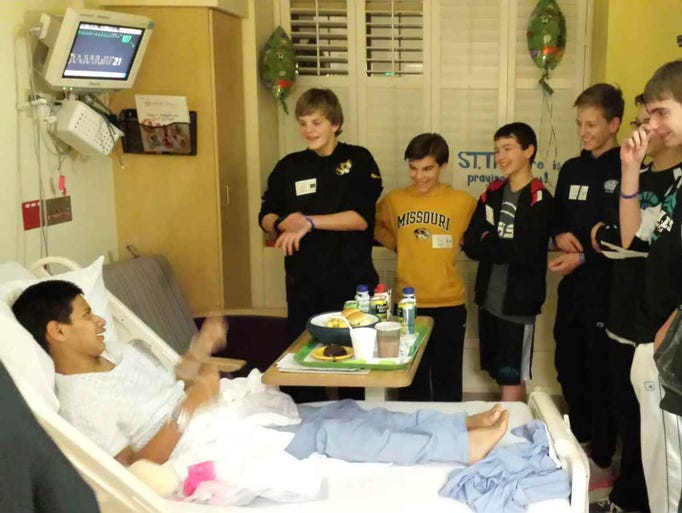
He is walking and talking, here with his pastor Jason Noble by his side. And trying to make sense of how he’s not just alive, but thriving after being under water for 15 minutes.

“After listening to what the paramedics and doctors said I’m pretty surprised at the outcome,” says John.

An outcome some say fits in with all of the other miracles that day and in the days that followed.

Like the fact Lake St. Louis Fire and Emergency crews had just practiced ice rescues the week before they pulled John out.

And the doctor who was on duty in the emergency room at SSM St. Joseph Hospital West the day of the accident: Dr. Kent Sutterer, whose daughter’s in the same class with John at Living Word Christian School.

“In my mind this is a very grim, very poor chance of survival already,” says Dr. Sutterer of the moment John came in.

Dr. Sutterer and his team performed CPR on John for 27 minutes with no success. The question was raised: how long should they continue?

“He was dead for 45 minutes,” says Dr. Sutterer.

What happened next defies explanation. Dr. Sutterer called John’s mother into the room to give her the news.

“She started praying loudly,” says Dr. Sutterer.

“I don’t remember what all I said,” recalls John’s mother, Joyce Smith. “But I remember, ‘Holy God, please send your Holy Spirit to save my son. I want my son, please save him.’ And they hadn’t been getting a pulse at that time, so all of a sudden I heard them saying, ‘We got a pulse, we got a pulse.'”

“Within a matter of a minute or two, his heart started again,” says Dr. Sutterer.

It’s an experience that’s shaken many of those in the emergency room that day. This veteran of responding to medical crisis wrote a letter about it as a way to cope.

“His heart was jump started by the Holy Spirit listening to the request of his praying mother,” reads Dr. Sutterer, from the letter he wrote.

Dr. Jeremy Garrett who oversaw John’s recovery even goes a step further. “It’s a bonafide miracle.”

John was airlifted to SSM Cardinal Glennon Children’s Medical Center about two hours after the accident. Dr. Garrett says he knew within about the first 16 hours after John’s arrival that his body would physically survive the ordeal what he didn’t know was how much brain function he would have.

Dr. Garrett watched John’s body react to being under water so long: his circulatory system went into shock, acid built up in his bloodstream.

But within 48 hours, family members reported things he didn’t expect. Like John opening his eyes.

Then, relatives told him this teen who loves to play and watch basketball was responding to questions about his two favorite players.

“So I did a very interesting neurologic exam,” says Dr. Garrett. “We said, well John, pretend your left hand is Lebron James and your right hand is Michael Jordan, then asked him a series of questions and he got them all right. It’s truly amazing.”

What’s happened since then has been a dizzying rate of continuous recovery. One even doctors are trying to keep up with.

“To watch your son sit up and amaze the doctors, the neurologist comes in and says, we don’t know what to do next because we’ve never seen this before,” says Joyce.

While we were visiting, John’s rescuers from the Lake St. Louis fire department showed up, bringing lunch. Seeing for themselves, the boy who survived 15 minutes under the ice.

“I know it doesn’t fit into our neat little box of today,” says John’s father, Brian Smith of this miracle, “but again, you can’t refute the clinical evidence.”

And while these parents haven’t spoken of his impulsive decision to walk out on the ice that day with two friends, they know their son has learned more than any lecture could teach him.

“I’m surprised I’m alive but it’s a real miracle that I’m alive, and I thank God I’m alive, and there’s a reason I’m alive, so I’m just going to kind of follow what God has in store for me throughout my life,” says John.

John still has a cough, and he’s getting physical therapy to help him regain some of the movement in his hands.

But he could go home by the end of the week.


The Blessing and Glory of the Torah—Readjusting Prejudicial Mindsets

Exodus 20:1, And Elohim spoke all these words, saying.

The following is an excerpt from a larger article on the subject of the Torah, which can be found at http://hoshanarabbah.org/pdfs/torahprimer.pdf.

What Is the Essence of the Torah?

Let us answer the question by posing a question. Why do you call yourself a believer, Messianic, Christian or otherwise? Why do you believe that the Scriptures are the Word of Elohim? Why are you currently reading this teaching article? Why were you created and what is your purpose in life? What is the meaning of life and what is your future destiny? Is there a Supreme Being in this universe and what does he expect from you, as a human, if anything at all? Does he care about you personally, and if he does, does he have anything to say to you about life – and about your life, in particular?

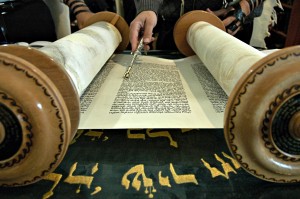
Torah reading in a synagogue with a hand holding a silver pointer

Very few humans alive, or who have ever lived, have answers to these questions. Most humans simply exist. Few actually live with purpose and meaning to their lives.

But you are privileged, for you are about to learn the answers to which so-called philosophers, sages and religious luminaries have been seeking since man has existed. Tidal waves of religion, philosophy and politics have swept across this planet carrying away peoples and nations promising to answer men’s most perplexing questions. Though volumes have been written, though countless libraries are full of millions of books, scrolls, papyri, clay tablets, documents and computer files, the answer to it all is surprisingly simple. In fact one word: It is T-O-R-A-H! The Torah of YHVH-Elohim is the Light of Truth from the Originator of Light and Truth. And it has been miraculously transmitted from heaven to earth, from the infinite to the finite, from the spiritual, boundless, eternal, omniscient and all wise mind of Elohim to the limited confines of physical existence on earth. Like a beam of Light shot through space from the great beyond, penetrating the darkness of human existence that Light became the written Torah, the Word of Elohim in the form of a Torah scroll written in Hebrew script of the set-apart Hebrew tongue (lashon kadosh) thousands of years ago.

The Torah-Word of Elohim forms the very bedrock foundation of the Scriptures. The spiritual building of the Prophets, Writings and Testimony of Yeshua rests squarely and securely upon the foundation of the Torah without which the rest would instantly crumble into nonexistence. Elohim was so determined to make that foundation so rock solid that he literally dictated it audibly letter-for-letter and word-for-word to the man Moses, who like a stenographer, wrote down exactly what he heard. This become the Books of the Law of Moses, or the Torah of YHVH Elohim. None of the Prophets or Writings in the Tanakh, though the inspired and infallible Word of Elohim, were so transmitted. The only words in all of Scripture that approach this level of purity and perfection are those words of the Written Word or Torah made flesh; namely, the words of Yeshua as recorded in the Gospels of the Testimony of Yeshua.

The level of one’s understanding of  the written Torah is the key to having a deep and abiding understanding of Yeshua, the Living Torah, and ultimately of having a blessed, a right, eternal relationship with our Father in heaven. ­Having a deep walking-it-out understanding of the Torah will also determine one’s level of rewards in the Kingdom of Elohim — whether YHVH bestows the title of The Least or The Greatest upon one (Matt. 5:19).

Below are quoted some deeply held, age-old convictions that the Jewish sages have lived and died for regarding the Torah. As you read them, please keep in the forefront of your thoughts the concept of Yeshua, the Living Torah-Word of Elohim, who was made flesh Continue reading →


The spirit of Antichrist is in the White House!

Shame on President Obama for his idiotic comments at the National Prayer Breakfast linking the acts of some Christians with the murderous jihadists cutting people’s heads off and burning people alive! The President reveals how vacuous his understanding is of Islam, history, Christianity and the Bible. Or, is he simply a lying propagandistic spinmeister who knows the facts, but could care less about them in an effort to force his ideological agendas upon the American people?!

I feel like we’re living in Goebbels Germany, or that I’m reading the Pravda of the former Soviet Union.

First, the Koran tells its followers to spread its faith by dismembering and murdering its enemies. History records that Mohammed did this. On the other hands, Yeshua/Jesus told his followers to love your enemies and his disciples followed his example.

Second, true disciples of Yeshua do not behead, crucify or burn their enemies. A thousand years ago when some “Christians” did this in medieval Europe, this was aberrant not normative Christianity. What the Muslims are doing to their enemies is normative not aberrant Islam according to the Koran. Go read the Koran for yourself and you’ll see what I’m saying is correct.

Third, the Crusades were in defensive response to the jihadist Muslims of that day that had taken over major parts of southern Europe and were moving northward quickly. This is history 101. As a former college professor, Mr. Obama doesn’t know this? Yeah right! So what’s his point?

The fact is, we have Edom in the White House, which is the spirit of Antichrist. Period!


Want to come into YHVH’s presence? Whoa!

Exodus 19:10, Consecrate them today.

Discussion A. Why is it essential to study the example of the children of Israel preparing themselves to come into the presence of YHVH in Exodus 19? After all, if Yeshua did it all for us, we can just come boldly before the Father’s throne anytime, anyway we want, right (Heb 4:16)?

antique chair upholstered in velvet

Let’s explore this concept a little to see what the Bible has to say about it.

Paul says in I Corinthians 10:11,

Now all these things happened to them [i.e., the children of Israel] as examples, and they were written for our admonition, upon whom the ends of the ages have come. (See also Rom 15:4.)

The writer of Hebrews has something similar to say in his prefatory remarks to his statement in Hebrews 4:16 about coming boldly before the throne of YHVH through the merits of the sinless righteousness of Yeshua our High Priest. In the preceding several verses, the author draws upon the example of the children of Israel (Heb 4:1–10) as an example for us not to follow. They were a faithless and disobedient (they rebelled against the Torah-word of Elohim) lot!

Then in Hebrew 4:11, the author starts with the connecting word “therefore,” indicating that what follows is related to that which preceded it. He goes on to admonish us not to follow the Israelites’ example of disobedience (i.e., Torahlessness or lack of faith in and obedience to the word of Elohim).

Next, the author likens the word of Elohim to a sharp two-edged sword that has the ability to separate between those who come to YHVH with wrong (carnal) heart motives versus those who have right ones, for nothing is hidden from the Almighty, so religious pretense and sham need not apply (Heb 4:12–13).

This reminds me of Yeshua’s harsh rebuke against the religious hypocrites of his day who thought that just because they were the sons of Abraham, they had a special “in” with Elohim. Quoting Isaiah, Yeshua criticized their sham religious expressions accusing them of drawing near with their mouths, but having hearts that were far from him (Matt 15:8–9 cp. Isa 29:13). In fact, Isaiah goes on in the same verse to deal with the issue of the improper fear of Elohim (Isa 29:13b). Yes, the fear of Elohim—a subject not taught much in the church these days (it’s not user-friendly)! Perhaps we Continue reading →


New Video: From Sabbath to Sunday—Historical Overview

This indepth teaching explores the origin of Suandy observance, and how and when the churched moved from Sabbath to Sunday. Natan explores the New Testament record and the writings of the early church fathers to answer this question. Be preapred for some shocking revelation based on the facts! A study guide with footnote references is available at http://hoshanarabbah.org/blog/2015/02/01/from-sabbath-to-sunday/.


From Sabbath to Sunday

Hello Everyone. Here is a new study I have just authored that I’m releasing for the first time. If you find any typos, please let me know. No matter how many times I edit my stuff, I always miss some things. Thanks in advance. Enjoy! Natan


How the Early Church Forsook the Sabbath for Sunday Worship

by Natan Lawrence
Hoshana Rabbah Biblical Discipleship Resources

Purpose of This Study

The study of how the early (post-apostolic) church turned away from a Torah-centric orientation and embraced the theology that is now the skeletal framework of modern mainstream Christianity is a complex and difficult one, since we have to look back 2000 years to review scanty historical data. Different researchers will view the same tiny amount of documentation that remains from that era and arrive at different conclusions. The final analysis is often determined by the theological glasses the scholar is wearing and thus viewing the data from. Those who start with a pro-Torah penchant or even bias versus an anti-Torah bias will likely come to different conclusions.

Suffice it to say, the brief study that follows will in no way do justice to the subject of how the early church turned Sabbath to Sunday. Our goal is merely to introduce the reader to a different point of view than they have commonly heard in the mainstream church. In this study, we will have achieved our goal if we can gently persuade the reader at least to have an open mind, and to prove all things to see if they are true, and, perhaps, they will, at least, consider the idea that some long-held and institutionalized mainstream Christian beliefs may be more fiction than fact.

Christian Tradition With Regard to Sunday

Why the mainstream church embraces Sunday over Sabbath observance can be summarized succinctly as follows:

The celebration of the Lord’s Day [Sunday] in memory of the resurrection of Christ dates undoubtedly from the apostolic age. Nothing short of apostolic precedent can account for [its] universal religious observance in the churches of the second century. There is no dissenting voice. This custom is confirmed by testimonies of the earliest post-apostolic writers, as Barnabas, Ingnatius and Justin Martyr… (History of the Christian Church, vol 2, pp. 201–202, by Philip Schaff).

In his book, Our Father Abraham, Christian scholar Marvin Wilson takes a more moderated approach when discussing the issue of the early church’s switch from Sabbath to Sunday. He admits the existence of tension between the Jews and Gentile believers over adherence to the Torah making a move from Sabbath to Sunday “exceedingly difficult, if not virtually impossible.” Potential Jewish converts to Christianity, he notes, would have been suspect of any faith that would abandon the Torah (law of Moses) or the Jewishness of one’s past (Ibid., pp. 79–80). Unlike some of his more dogmatic scholarly colleagues, Wilson admits that it is not known when the early church began Sunday worship. He seems to concede to some possible allusions to Sunday worship in the New Testament (NT) by citing several of the scriptures that Christians perennially use to “prove” Sunday observance in the primitive (apostolic) church (e.g., Acts 20:7; 1 Cor 16:2), but he’s reluctant to see these as a clear apostolic mandate for a switch from Sabbath to Sunday. He admits that the Acts 20 passage may be a reference to the Saturday evening (Heb. havdallah or Motza’ei-Shabbat) service, which was, in reality, simply an extension of the regular daily Sabbath service into the evening (Ibid., p. 80).

Our approach to analyzing the subject of when Sunday worship began in the Christian church will be somewhat different than the conventional method of sabbatarians to simply refute the arguments Sunday-keepers make in favor of Sunday worship by quoting NT verses that may suggest a Sunday replacement of the Sabbath. This approach, though seemingly a valid one, ignores the proverbial elephant in the room. That “elephant” is the undeniable pro-Torah views and practices of Yeshua and his apostles, which, when considered, makes their changing Sabbath to Sunday observance a highly incongruent if not an impossible proposition without making the Word of Elohim to lie and the apostles to be lying hypocrites.

The Elephant in the Room: The Apostles Were Pro-Torah

Before commencing our trip back in history to discover the origins of Sunday worship, it’s proper for me to disclose my bias. I start from the premise that all the apostles were not only pro-Torah, but were Torah obedient. This is based on many scripture references, a few of which are referenced below (hundreds more could be given!).

  • Speaking of Paul, “You yourself also walk orderly and keep the law….” (Acts 21:24)
  • Paul states, “I am indeed a Jew, born in Tarsus of Cilicia, but brought up in this city at the feet of Gamaliel, taught according to the strictness of our fathers’ law, and was zealous toward God as you all are today.” (Acts 22:3)
  • Paul testifies, “But this I confess to you, that according to the Way which they call a sect, so I worship the God of my fathers, believing all things which are written in the Law and in the Prophets.” (Acts 24:14)
  • Paul says, “Neither against the law of the Jews, nor against the temple, nor against Caesar have I offended in anything at all.” (Acts 25:8)
  • Paul writes, “Do we then make void the law through faith? Certainly not! On the contrary, we establish the law.” (Rom 3:31)
  • Paul writes, “Therefore the law is holy, and the commandment holy and just and good.” (Rom 7:12)
  • Paul writes, “I thank God—through Jesus Christ our Lord! So then, with the mind I myself serve the law of God.” (Rom 7:25)
  • Paul writes, “Owe no one anything except to love one another, for he who loves another has fulfilled the law. For the commandments, you shall not commit adultery, you shall not murder, you shall not steal, you shall not bear false witness, you shall not covet, and if there is any other commandment, are all summed up in this saying, namely, you shall love your neighbor as yourself. Love does no harm to a neighbor; therefore love is the fulfillment of the law.” (Rom 13:8–10)
  • Paul writes, “Circumcision is nothing and uncircumcision is nothing, but keeping the commandments of God is what matters.” (1 Cor 7:19)
  • James writes, “If you really fulfill the royal law according to the Scripture, ‘You shall love your neighbor as yourself, you do well’; but if you show partiality, you commit sin, and are convicted by the law as transgressors. For whoever shall keep the whole law, and yet stumble in one point, he is guilty of all. For He who said, ‘Do not commit adultery,’ also said, ‘Do not murder.’ Now if you do not commit adultery, but you do murder, you have become a transgressor of the law. So speak and so do as those who will be judged by the law of liberty.” (Jas 2:8–12)
  • John writes, “Now by this we know that we know Him, if we keep His commandments. He who says, “I know Him,” and does not keep His commandments, is a liar, and the truth is not in him. But whoever keeps His word, truly the love of God is perfected in him. By this we know that we are in Him. He who says he abides in Him ought himself also to walk just as He walked. Brethren, I write no new commandment to you, but an old commandment which you have had from the beginning. The old commandment is the word which you heard from the beginning.” (1 John 2:3–7)
  • John writes, “Whoever commits sin also commits lawlessness, and sin is lawlessness.” (1 John 3:4)
  • John writes, “And the dragon was enraged with the woman, and he went to make war with the rest of her offspring, who keep the commandments of God and have the testimony of Jesus Christ.” (Rev 12:17)
  • John writes, “Here is the patience of the saints; here are those who keep the commandments of God and the faith of Jesus.” (Rev 14:12)
  • John writes, “Blessed are those who do His commandments, that they may have the right to the tree of life, and may enter through the gates into the city.” (Rev 22:14)

With these verses as a foundation for understanding the pro-Torah position of the apostolic writers, we now want to consider a couple of other facts. Continue reading →


Blog Scripture Readings for 2-1 Through 2-7-15

Aside

THIS WEEK’S SCRIPTURE READINGS FOR STUDY AND DISCUSSION:

Parashat Yitro — Exodus 18:1 – 20:23 (26)*
Haftarah — Isaiah 6:1 – 7:6; 9:5-6 (6-7)*
Prophets — 1 Kings 13:1 – 19:21
Writings — Psalms 117:1 – 119:160
Testimony — Luke 18:18 – 21:38

Most of this week’s blog discussion points will be on these passages. If you have general comments or questions on the weekly Scripture readings not addressed in a blog post, here’s a place for you to post those. Just use the “leave a reply” link below.

The full “Read Through The Scriptures In A Year” schedule, broken down by each day, can be found on the right sidebar under “Helpful Links.” There are 4 sections of scripture to read each day. One each from the Torah, the Prophets, the Writings, and from the Testimony of Yeshua. Each week, the Torah and haftarah readings will follow the traditional one-year reading cycle.

* Verse numbers in parenthesis refer to the verse number in Christian Bibles when it differs from the Hebrew Bible or Tanakh.

Weekly Blog Scripture Readings for 2/1 through 2/7/15.