Yeshua Teaches About Divorce

A commentary on Deuteronomy 24:1–4

While on this earth, Yeshua taught on many subjects pertaining to all areas of human existence—136 in all. He taught on everything from angels to worship, from money to taxes, sexuality to celibacy, fasting to food, joy to sorrow and yes, on the subject of divorce, as well (see Matt 19:1–12).

Malachi says that YHVH hates putting away, a Hebraism for divorce (2:16). Yet Yeshua says in Matthew 19 that in the Torah divorce was permitted if one of the parties had a hardened heart resulting in irreconcilable differences. Adultery was cause for divorce if the offending party refused to repent.

YHVH married the whole House of Israel (i.e., all twelve tribes) at Mount Sinai and the Torah was the marriage agreement (See The Bible: The Good News – The Story of Two Lovers & YHVH’s Set-Apart Feast Days Are the Outline of that Love Story: A Plan of Redemption where the Jewish wedding is outlined historically and prophetically in a biblical context, available at http://www.hoshanarabbah.org/pdfs/love_story.pdf). Ezekiel describes the marriage between YHVH and Israel succinctly and allegorically in Ezekiel 16:6–8.

Yet because both the Houses of Judah and Israel committed spiritual adultery by whoring after foreign gods and lovers and failed to live up to their marital agreements they had made with YHVH at Mount Sinai when they said “I do” three times (Exod 19:8; 25:3, 7). YHVH sent prophet after prophet as recorded in the pages of the Tanakh (Hebrew Scriptures) in attempts to turn the heart of Israel back to him, yet her heart was hardened toward him and she refused to repent of her adulteries; therefore, YHVH was forced to do that which he hates and dissolve the marriage and divorce Israel.

In light of these issues, what are the prophetic implications of the divorce of YHVH from the nation of Israel and his future remarriage to the same nation? To understand this issue and to gain a deeper understanding of YHVH’s wonderful plan of salvation for his people, read “The Prophetic Implications of Divorce in Light of the Two Houses of Israel,” which is available at http://www.hoshanarabbah.org/pdfs/divorce.pdf.


Are Jewish fables and the Torah the same thing?

Titus 1:14, Jewish fables. Many Bible teachers in the mainstream church teach that this verse refers to the Torah. They use it in attempting to prove that the commandments of the Torah are no longer valid for believers. Is this correct? In reality, Paul can’t be referring to the Torah here without contradicting himself elsewhere. In numerous places, he strongly upholds and defends obedience to the Torah (Rom 3:31; 7:7, 12, 14; 13:8–10; 1 Cor 7:19; 9:21; Gal 3:10; 6:2; 2 Tim 6:14; Tit 2:14) and even claims to follow it himself (Acts 21:24; 24:1425:8; 28:17; 1 Cor 9:21). He must be talking about the Jewish traditions of men, which Yeshua said in Matthew 15:3–9 and Mark 7:7–9 make of non-effect the word of Elohim.

In fact, this is exactly what Paul is referring to here in this verse when he says “Jewish fables and commandments of men.” This is not a reference to the Torah the commandments of which came from YHVH Elohim, and not from men. In the same verse, Paul contrasts these commandments of men with “the truth” from which men have turned away. What is this truth? The Bible defines its own terms. Elohim is the source of truth (Deut 32:4 cp. Pss 86:11; 89:14; 117:2), he is truth (Ps 25:10; 31:5; 33:4), and his Torah is truth (Ps 119:142, 151).

One example of a Jewish fable and a commandment of men would be the idea that one can’t be saved unless they’re first circumcised, which was the subject of the Acts 15 council. Paul vehemently fought this Jewish fable, and the whole Book of Galatians, for example, largely deals with this issue. If Paul had meant the Torah when mentioning “Jewish fables” then this makes Paul into a schizophrenic liar (since he promotes and lauds the Torah and claims to follow it elsewhere), and it makes the word of Elohim contradict itself, and it puts Paul at odds with Yeshua who upheld the Torah (Matt 5:17–19) and with himself when he said to imitate Yeshua the Torah-keeper as he himself did (1 Cor 11:1).


A video that the Spirit of Antichrist doesn’t want you to watch


New Video: The Bridegroom Is Coming — Awake, Repent & Prepare!

The sixth month of the biblical calendar occuring in the late summer is the time to awake spiritually, repent of sin and to prepare for the fall biblical festivals, which prophetically picture the second coming of Yeshua, the Heavenly Bridegroom of the saints. This video discuss how and why to get ready spiritually.


Blog Scripture Readings for 8-23 Through 8-29-15

Aside

THIS WEEK’S SCRIPTURE READINGS FOR STUDY AND DISCUSSION:

Parashat Ki Tetze — Deuteronomy 21:10 – 25:19 
Haftarah — Isaiah 54:1-10
Prophets — Amos 2:1 – 8:14
Writings — 1 Chronicles 23:1 – 29:30
Testimony — 2 Timothy 4:1-22; Titus; Philemon; Hebrews 1:1 – 2:18

Most of this week’s blog discussion points will be on these passages. If you have general comments or questions on the weekly Scripture readings not addressed in a blog post, here’s a place for you to post those. Just use the “leave a reply” link below.

The full “Read Through The Scriptures In A Year” schedule, broken down by each day, can be found on the right sidebar under “Helpful Links.” There are 4 sections of scripture to read each day. One each from the Torah, the Prophets, the Writings, and from the Testimony of Yeshua. Each week, the Torah and haftarah readings will follow the traditional one-year reading cycle.

Weekly Blog Scripture Readings for 8/23 through 8/29/15.


Rules, rules and more rules…a good or bad thing?

Deuteronomy 21–25

This portion of the Torah (Deut 21:10–25:19) contains 72 commandments, which is more than in any other Torah portion. In this passage there are rules pertaining to all aspects of human relations showing that the “Torah deals with the real world. It does not present a world where all people get along with one another or rush to take care of one another’s property. Instead, it ‘takes into account the grim reality that people do not achieve the desired observance of “you shall not hate others in your heart”’” (A Torah Commentary For Our Times, vol. 3, p. 150).

In studying this portion, one can easily miss the point of a particular command if one views it strictly in its pashat (most literal) meaning. For these commands to have relevance in our day, one must view them as principles that have a broad range of application. The specific examples Torah gives are merely representative of one of but many life situations to which the principle behind the example could apply. Keeping this in mind, this Torah portion will give you much to ponder pertaining to your day-to-day walk (or halakhah).

In these chapters we see a plethora of laws concerning many seemingly small details regarding human life. Many people in the church have the tendency to broadly sweep away these commandments with such dismissive cliches as, “We’re now under grace …” or “We’re not under the law anymore …..” But please observe how many of the civil laws of our nation regulating actions between various members of society are based upon YHVH’s laws found in the Torah. As we make our way back to a more biblically-based lifestyle and orientation, we begin to see that (a) YHVH cares about the details of our lives and (b) these laws, while sometimes hard to understand, are for our own well-being and blessing. Do you still nurse a “pick and choose” or “have it your own way” mentality with regard to YHVH’s biblical commandments choosing to follow the ones you want and making excuses why you can’t (or don’t want to) follow the rest? By doing so, what blessings are you depriving yourself of, and how are you hindering your love relationship with YHVH?

Some of the laws in these chapters may be hard to observe nowadays. With others, due to our church background, we may have the tendency to spiritualize them away, thus, in essence, rendering them of non‑effect in our lives and thereby placing ourselves above YHVH’s Torah-law and thus becoming a law unto ourselves. Is this not humanism: every man doing what is right in his own eyes instead of obeying YHVH whatever the cost? Who is the Master of your life? You or YHVH?

How do you view laws about women wearing men-type clothing, wearing fringes on the corners of your garments, mixed certain types of fibers in clothing, lending without interest, caring for the widows and orphans, personal hygiene, family purity laws (e.g. men not having sexual relations with their wives during their monthly cycles), removing blood from all meat before eating it, men wearing beards, faithfully tithing, following the biblical dietary laws, and observing YHVH’s Sabbaths (weekly and annual), etc.? These are lifestyle-changing laws, many of which go contrary to the mores of our society.

Are we not called to be a kadosh, set-apart, special and peculiar (i.e., treasured) people before YHVH? What progress are you making to bring your life into conformity to his standards of righteousness?


An EMP would accomplish ‘death to America’

From http://www.washingtontimes.com/news/2015/aug/18/jams-woolsey-peter-pry-emp-a-shariah-approved-nucl/

A Shariah-approved nuclear attack —An EMP would accomplish ‘death to America’

By James Woolsey (former head of the CIA) and Peter Pry — Tuesday, August 18, 2015 
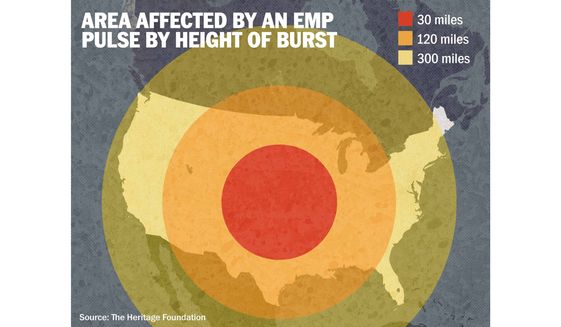
EMP Graphic to accompany Woolsey article of Aug. 19, 2015

EMP Graphic to accompany Woolsey article of Aug. 19, 2015


Watch Video


By James Woolsey and Peter Pry — Tuesday, August 18, 2015

Congress must stop President Obama’s nuclear deal with Iran. The most important reason — Iran can threaten the existence of the United States by making an electromagnetic pulse (EMP) attack using a single nuclear weapon.

It may obtain one, relatively easily, by cheating in the use of the nuclear infrastructure permitted them under the agreement.

U.S. intelligence cannot meet the impossibly high standard of assuring that Iran cannot acquire a single nuclear weapon and, given the regime’s existing nuclear infrastructure, cannot with absolute certainty guarantee that Iran does not already have one.


PHOTOS: Vladimir Putin auditions for role as James Bond villain


Secretary of State John Kerry’s assertions on June 16 that the United States has perfect intelligence on Iran’s nuclear program are not credible: “We know what they did. We have no doubt. We have absolute knowledge … .”

No.

Former CIA Director Michael Hayden is right to correct Mr. Kerry: “He’s pretending we have perfect knowledge about something that was an incredibly tough intelligence target while I was director, and I see nothing that has made it any easier.”

Mr. Kerry’s disregard of the limits of U.S. intelligence is reason enough to reject the deal — since just one nuclear warhead can threaten the existence of the United States.

A single nuclear weapon detonated at high altitude over the United States would generate an EMP that could black out the electric grid and other life-sustaining, critical infrastructures, such as communications, transportation, banking and finance, food and water. The Congressional EMP Commission estimated a nationwide blackout lasting one year could kill anywhere from two of every three Americans by a low estimate up to nine of 10 Americans by starvation and social disruption.

“Death to America” is more than merely an Iranian chant — Tehran’s military is planning to be able to make a nuclear EMP attack.

On July 21 at the annual meeting of the Electric Infrastructure Security Summit in Washington, Rep. Trent Franks quoted from an Iranian military textbook, recently translated by the Defense Intelligence Agency’s National Intelligence University. The textbook, ironically titled “Passive Defense” (2010), describes nuclear EMP effects in detail. It advocates in more than 20 passages an EMP attack to defeat decisively an adversary.

The official Iranian military textbook advocates a revolutionary new way of warfare that combines coordinated attacks by nuclear and non-nuclear EMP weapons, physical and cyber-attacks against electric grids to black out and collapse entire nations. Iranian military doctrine makes no distinction between nuclear EMP weapons, non-nuclear radio-frequency weapons and cyber-operations — it regards nuclear EMP attack as the ultimate cyber-weapon. EMP is most effective at blacking-out critical infrastructures, while it also does not directly damage the environment or harm human life, according to Iran’s “Passive Defense”:

“As a result of not having the other destructive effects that nuclear weapons possess, among them the loss of human life, weapons derived from electromagnetic pulses have attracted attention with regard to their use in future wars … . The superficiality of secondary damage sustained, as well as the avoidance of human casualties, serves as a motivation to transform this technology into an advanced and useful weapon in modern warfare.”

Because EMP destroys electronics directly, but people indirectly, it is regarded by some as Shariah-compliant use of a nuclear weapon. “Passive Defense” and other Iranian military writings are well aware that nuclear EMP attack is the most efficient way of killing people, through secondary effects, over the long run. The rationale appears to be that people starve to death, not because of EMP, but because they live in materialistic societies dependent upon modern technology.

For example, an Iranian article on nuclear EMP attack, “Electronics To Determine Fate Of Future Wars” (1998), concludes hopefully (from the Iranian author’s perspective):

“If the world’s industrial countries fail to devise effective ways to defend themselves against dangerous electronic assaults, then they will disintegrate within a few years … . American soldiers would not be able to find food to eat nor would they be able to fire a single shot.

Written 17 years ago, Iranian military doctrine has assessed nuclear EMP attack against the United States for now nearly two decades.

The Iranians have done more than just think about EMP attack.

The Congressional EMP Commissionfound that Iran has practiced launching missiles and fusing warheads for high-altitude EMP attack, including off a freighter. Iran has apparently practiced surprise EMP attacks, orbiting satellites on south polar trajectories to evade U.S. radars and missile defenses, at altitudes consistent with generating an EMP field covering all 48 contiguous United States. Iran launched its fourth satellite on such a trajectory as recently as February 2015.

A single nuclear weapon would complete the list of requirements.

Finally, because a nuclear EMP attack can be conducted by surprise and anonymously — deterrence may not work against EMP.

Deterrence depends upon knowing who attacked and being able to retaliate. Unlike a nuclear weapon used to blast a city, high-altitude EMP leaves no collectible bomb debris for forensic analysis to identify the aggressor.

EMP attack by missile or balloon launched off a freighter could be from many possible actors. Even Yemen’s Houthis have Scud missiles and know how to use them, having recently killed the chief of Saudi Arabia’s air force with a Scud strike on King Khalid Air Force Base.

Hundreds of satellites are in low earth orbit, unseen when approaching the United States from the south, that could help disguise the origins of an EMP attack. And the EMP could damage the means necessary to identify the attacker and U.S. retaliatory capabilities.

One Iranian nuclear weapon is one too many for an Iran ruled by theocratic totalitarian genocidal imperialists.

No deal.

• R. James Woolsey is a former director of Central Intelligence and is chairman of the Foundation for Defense of Democracies. Peter Vincent Pry is executive director of the EMP Task Force on National and Homeland Security and served in the Congressional EMP Commission, the House Armed Services Committee, and the CIA.
