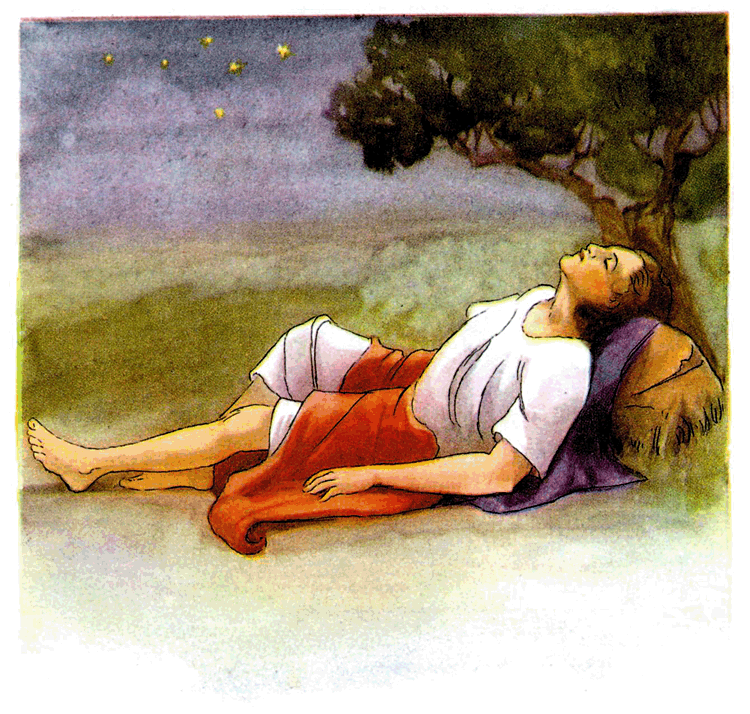
Here’s how to have a “religious” experience

Psalm 63:2, Looked…sanctuary. To see is the Hebrew word chazahi meaning “to see as a seer in an ecstatic state, to perceive with intelligence, to prophesy, to perceive with inner vision, to see a vision (see also Ps 27:4). 

Sanctuary is Hebrew word kavod and refers to the holy of holies in the Tabernacle of Moses where the glory of Elohim abode and was an earthly representation of Elohim’s throne room. 

Glory is the Hebrew word kavod and refers to the manifest, weighty presence of Elohim, which can be experienced by humans. 

With the meaning of these words in mind, this verse is bursting with a full treasure chest of meaning. What can we learn from this verse? Simply this. When we thirstily seek Elohim as if we were trekking through a waterless desert (v. 1), and come into his throne in a spirit of worship and prayerful surrender (v. 4), while recognizing YHVH’s lovingkindness and seeking him first above anything else in life (v. 3), we can expect a divine revelatory and supernatural experience (v. 2).


Take you your cross—the way down is the way up

Mark 8:34, Deny himself.The inordinate love of self is the greatest obstacle to following Yeshua wholeheartedly and to becoming great in his kingdom. The chief characteristic of a life dominated by self is selfishness, pride, self-righteousness, self-centeredness and possessiveness. Such a person, to one degree or another, has forced Elohim out of the center of their life and has crowned themselves as their own king and has given themselves over to the coveting of things and the exaltation of self. 

To a person who has placed themselves at the center of their lives instead of Yeshua and his Word, self-life has become their main focus and fiercest passion. Such a person tends to be extremely self-invovled, self-centered, self-focused and selfish. They tend to always be talking about themselves, always wanting attention, always wanting people’s approval, their feelings are easily offended or hurt, they tend to be possessive, and they want to be in control of people and situations around them, that is, they’re bossy.

Possessiveness can take on several forms. One example is surrounding oneself with many physical possessions, which causes one to feel elevated in that it makes one the ruler of one’s own kingdom—the kingdom of stuff and self. Such people have a hard time giving their physical possessions away, even if they no longer need or use them. Physical things are an extension of themselves, and because they’re self-absorbed, their also selfish in that they have a hard time giving what belong to them to others.

With such a person, the pronouns I and me are constantly heard from their lips, and they have, to one degree or another, become their own god and the leader of their own religious sect—the religion of self. 

In response to the tyranny of self and material possessions that largely dominates and even monopolizes the endeavors of most self-centered and carnally (fleshly) minded people (which to one degree or another includes all of us), Yeshua says “Deny yourself, take up your cross and follow me.” Elsewhere he says, “Blessed are the poor in spirit, for theirs is the kingdom of heaven” (Matt 5:3). Finally, our Master leaves us with these words to ponder.

For whosoever will save his life shall lose it; but whosoever shall lose his life for my sake and the gospel’s, the same shall save it. (Mark 8:35)

In Yeshua’s kingdom, the way down is the way up; to give is the way to riches; to become a servant is the way to greatness. These all involve self-negation, not self-exaltation. How Yeshua lived and what he taught is diametrically opposite to what this world teaches us. Observe, learn from and follow his example.


Blog Scripture Readings for 12-15 Through 12-21-19

Aside

Parashat Vayeshev — Genesis 37:1 – 40:23
Haftarah — Amos 2:6 – 3:8
Prophets — 1 Samuel 11:1 – 17:58
Writings — Psalms 63:1 – 69:36
Testimony — Mark 8:1 – 11:18

Our new annual Scripture Reading Schedule for 2019-2020 with daily readings is available to download and print. If you are still working through 2018-2019’s Scripture Reading Schedule, the link will still be available on the right sidebar under “Helpful Links”. If you are using a mobile device or tablet, the link may be below, meaning you’ll need to scroll down instead.

Most of this week’s blog discussion points will be on these passages. If you have general comments or questions on the weekly Scripture readings not addressed in a blog post, here’s a place for you to post those. Just use the “leave a reply” link or the “share your thoughts” box below.

The full “Read Through The Scriptures In A Year” schedule, broken down by each day, can be found on the right sidebar under “Helpful Links.” There are 4 sections of scripture to read each day: one each from the Torah, the Prophets, the Writings, and from the Testimony of Yeshua. Each week, the Torah and haftarah readings will follow the traditional one-year reading cycle.

Weekly Blog Scripture Readings for 12/15/19 through 12/21/19.


Yeshua a pork eater? Yeah right!

Many Christians misread Mark 7:19 to mean that Yeshua was okaying them to eat pork in direct opposition to the eternal laws of Elohim as spoken from the mouth of Elohim in his Torah. How can people believe such lies? It’s because they don’t know the Word of Elohim, including most pastors, Bible college professors and Bible teachers in the mainstream church. They are willingly ignorantly and foolish and are misleading YHVH’s people. Shame on them all! People need to start reading their Bibles instead of listening to these false teachers. Spiritual power to the people!

Mark 7:19, Thus He declared all foods clean. Many mainstream Christians believe that in this verse Yeshua is sanctioning the eating of all food not matter what. Thus he is categorically rejecting the biblical dietary prohibitions against eating…drumroll please…beloved pork. Is this what Yeshua is really saying here? Before jumping to conclusions, let’s take a step back, demonstrate a modicum of logic and ask ourselves some questions.

First, would a Torah-observant Jew like Yeshua really be advocating the eating of anything the Torah forbids such as pork and shellfish? Second, would Yeshua the Messiah, the one destined to be the sinless Lamb of Elohim Messiah be advocating sinning by going against the biblical dietary laws? Third, what is the biblical definition of food? Does the Creator of the universe even consider something to be food that he forbids people from eating? Fourth, if Yeshua had been advocating the eating of unclean meats, what would have been the reaction of his Torah-touting audience of Pharisees? With the answers to these questions dancing around in the reader’s mind, let’s now discuss this potentially enigmatic passage in depth and in its logical context to see what it’s really saying.

Continue reading
 

Are you looking upward or downward?

Psalm 61:2, Rock that is higher. When our heart affections and spiritual focus is on something that is higher, loftier  and more solid and substantial than ourselves, then our focus will naturally be higher than ourselves and we will be elevated in all areas of our lives as a result. 

Conversely, when our focus is on something that is at the same level or lower than ourselves, then we will sink to that level. 

This is a fundamental difference between following or worshipping Baal (the world, flesh and the devil) versus following or worshipping Elohim: the former is the downward path that leads to spiritual death and separation from Elohim, while the latter is the upward path that leads to Elohim and eternal life in his presence The choice is ours as to which path we will take. Every day we are faced with many small and sometimes large decisions as to which direction we will go. Choose wisely and do the right thing by choosing the path that will bring blessing and life!

Psalm 61:4, Tabernacle…shelter of your wings. Over the mercy seat on the ark of the covenant were the over-shadowing wings of the two cherubim, which is representative of Elohim’s throne and glorious Presence on earth (see Isa 37:16; Ezek 10:1–22; 11:22–23). It was in this place of intimate worship before the “Rock that his higher than me” (verse 2) that David sought shelter or refuge and deliverance from his enemies (verse 3). 

Biblical phrases such as, “under the shadow of your wings” is a Hebraism meaning “before YHVH in the place and state of worship” (see also Pss 17:8; 36:7; 57:1; 63:7; 91:1, 4). 

It was also in this place—between the cherubim—that Moses heard the voice of Elohim (Num 7:89), and that David would see the power or might strength and glory or manifest Presence of Elohim in a prophetic, ecstatic or spiritual vision (Ps 63:2).

As saints of YHV Elohim, we can come into his presence, into this actual throne room (as represented by the holy of holies in the Tabernacle of Moses through our spiritual relationship with Yeshua our Messiah, Master and Savior.

Therefore, brethren, having boldness to enter the Holiest by the blood of Yeshua, by a new and living way which He consecrated for us, through the veil, that is, His flesh, and having a High Priest over the house of Elohim, let us draw near with a true heart in full assurance of faith, having our hearts sprinkled from an evil conscience and our bodies washed with pure water. (Heb 10:29–22)

Let us therefore come boldly to the throne of grace, that we may obtain mercy and find grace to help in time of need. (Heb 4:16)


Are you en route to Beth-El, or still stuck in “Babylon”?

Genesis 35:1–15, Go up to Bethel. Jacob, twenty years earlier, had left Canaan in disgrace fleeing eastward into exile (as his descendants would do generations later), where in captivity to Laban he pays the price for being a deceiver. In captivity, Jacob prospers and finally is able to return to the Promised Land.

En route westward back to Canaan, he goes through a wilderness experience, as the children of his namesake would do several generations later. What type of individuals does YHVH not permit and permit to enter into the Land of Promise?

The answers are in Hebrews 4:1–11 where the writer speaks of doubt and unbelief, faith, hardness of heart versus resting in YHVH and not in the works of our flesh. (Read it.) To come home, like the prodigal son, to the home of his earthly parents and to that of his Heavenly Father (Beth-el or House of El) what was required of Jacob?

He had to manifest brokenness, humility, a new identity, repentance, and make restitution for past sins committed against others (Gen 34). Will YHVH not similarly break our stiff necks, refine and purify us to become suitable use in his spiritual house?

Are you fighting this same process that YHVH is working out in your life to prepare you for your spiritual Bethel—your place of eternal habitation with him? Jacob got hit again and again until his carnal will was finally broken, and his heart was circumcised. He was forced to die to the willfulness of his flesh and his scheming tendencies to bring YHVH’s will to pass in his life. (Have other notable personages of Scripture tried the same things and had their will broken before they were useful to YHVH? Remember Moses when he murdered the Egyptian? What did YHVH do with him for 40 years?)

Remember this. Neither the uncircumcised of the heart nor of the flesh will enter into the temple or spiritual house of Elohim (Ezek 44:9), which is the ultimate Promised Land of the saints’ spiritual inheritance. 

Where are you in this spiritual process? The Promised Land belongs to those (i.e. the seed of Jacob by faith) who pass the wilderness tests of YHVH (Gen 35:12). Who is that seed? You are if  you’re in Yeshua. (Read Rom 4:16; 9:8, 11; Gal 3:7, 9, 14, 28, 29.)

YHVH Elohim is now calling all the modern saints to follow exactly in our father Jacob’s footsteps by leaving our exile and captivity in spiritual Babylon (i.e. false religious systems, which contains a mixture of both good and evil, see Rev 18:4), and returning westward across the river Jordan into the land of Promise, to our spiritual inheritance, to the ancient and good paths of the Torah faith (Jer 6:16, 19), which is defined in terms of YHVH’s covenants with Israel (Eph 2:12–14). Can you see how Jacob’s life is a prophetic road map of the spiritual journey that each individual believer must go through to obtain his spiritual inheritance? Jacob’s journeyings back to Beth-El (literally, the house of El) is a prophetic picture of what all the saints—the Israel of Elohim (Gal 6:16), collectively, must go through as well.

Continue reading
 

Esau: rich and increased with goods, but spiritually destitute

Genesis 33:9, I have enough. Esau’s positive response to Jacob is proof that he cared nothing for his birthright nor for the covenant Elohim had made with his father or grandfather. Esau was a worldly man and materialism and sensual pleasure was the chief aim of his life, not seeking higher spiritual pursuits. 

In the twenty years that the two brothers hadn’t seen each other, Elohim had prospered Esau who was now wealthy; he didn’t need Jacob’s gifts, which were substantial, for he already had enough wealth such that these gifts seemed a small thing to him. This is why he declared that he had enough already and encouraged Jacob to keep the gifts. 

Had Esau grieved over loosing his birthright, he’d still have had a grudge against Jacob. But the fact is that Esau had never cared about his spiritual inheritance in the first place, which is why he sold his birthright for a bowl of food; he cared only about inheriting the substantial wealth of Isaac, his father. In the course of time when substantial wealth accrued to Esau, the birthright was no longer an issue. His dramatic act over losing his birthright was merely pretense that revealed the true motives of his heart, which were purely physical and not spiritual, as evidenced twenty years later by his statement in this verse, “I have enough.” 

In reality, though physically wealthy, Esau was spiritually a destitute man, for he lacked and even spurned the true riches of heaven. As a secular and carnally-oriented man, he preferred the immediate gratification of the material blessings of this life, rather than the delayed gratification of the higher and true riches from heaven—something both his father, grandfather and brother had chosen (Heb 11:10, 16). The beautiful thing is that because the patriarchs had all sought first the kingdom of Elohim and his righteousness, they also received physical blessings here and now (Matt 6:33). Esau, on the other hand, received only physical blessings, but lost out on the greater wealth of spiritual and eternal rewards and blessings.

There is much to learn from this story. One thing is this. Many people put on religious fronts, airs and pretenses for show to impress those around them, but it’s only for selfish, personal gain. With their mouths they may say one thing, while their actions, reveal the true intent of their hearts. That’s why Scripture instructs the saints to be like their Father in heaven and to not judge people and things by their appearance, but by the fruits (Matt 7:15–20). This is called judging righteously (John 7:24; 2 Cor 2:15).

Those who point on fronts are often living a lie. The church is full of such people. Elohim is not fooled. He sees who the Esau’s are that are sitting in the pews playing religious games.

“I know your works, that you are neither cold nor hot. I could wish you were cold or hot. So then, because you are lukewarm, and neither cold nor hot, I will vomit you out of My mouth. Because you say, “I am rich, have become wealthy, and have need of nothing”—and do not know that you are wretched, miserable, poor, blind, and naked— I counsel you to buy from Me gold refined in the fire, that you may be rich; and white garments, that you may be clothed, that the shame of your nakedness may not be revealed; and anoint your eyes with eye salve, that you may see. As many as I love, I rebuke and chasten. Therefore be zealous and repent. Behold, I stand at the door and knock. If anyone hears My voice and opens the door, I will come in to him and dine with him, and he with Me. To him who overcomes I will grant to sit with Me on My throne, as I also overcame and sat down with My Father on His throne.” (Rev 3:15–21)