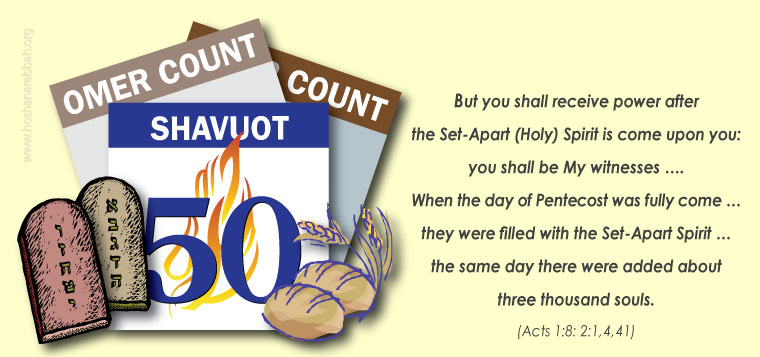
When is Shavuot, the Feast of Weeks or Pentecost?

The short answer to this question is next Sunday, May 31. The long answer to this question and why the biblical feast of Shavuot falls on this day and not some other day is in the article below.


Since Shavuot is the only biblical holiday that involves counting days and weeks (hence its name, the Feast of Weeks), there are different opinions about when to start the count leading up to Shavuot. The Torah tells us to count from the Sabbath associated with the Feast of Unleavened Bread.

And you shall count for yourselves from the day after the Sabbath, from the day that you brought the sheaf of the wave offering: seven Sabbaths shall be completed. Count fifty days to the day after the seventh Sabbath; then you shall offer a new grain offering to the LORD. (Lev 23:15–16, NKJV)

This sounds simple enough. Or is it?

The question and the subject of the debate is which Sabbath do you start counting from? The day after the weekly Sabbath occurring during the Feast of Unleavened Bread or the day after the high holy day Sabbath of the first day of the Feast of Unleavened Bread, which occurs on the fifteenth day of the first month of the biblical year?

In the first century in the time of Yeshua and the apostles, there were two main opinions among the leading Jews on when to start counting the weeks (called “the counting of the omer”) leading up to Shavuot. The religious sect of the Pharisees, whose spiritual descendants are the modern rabbinic Jews started the counting of the omer from the day after first high holy day of the Feast of Unleavened Bread, which is a high holy day Sabbath (John 19:31). On the other hand, the Sadducees, the other main Jewish sects of the first century (along with the Boethusians, which was likely a sub-sect of the Sadducees; see A History of the Jewish People in the Time of Jesus Christ, second division, vol 2, p. 37, by Emil Schurer; Commentary on the NT from the Talmud and Hebraica, vol. 4, p. 23 [commentary on Acts 2:1], by John Lightfoot) counted the omer from the day after the weekly Sabbath that falls within the week of the Feast of Unleavened Bread. Some modern Messianics follow the rabbinic method, while others follow the Sadducean method.

It is generally understood by historical scholars that the Jewish sect of the Pharisees interpreted the written Torah in light of Jewish oral tradition, while the Sadducees rejected oral tradition and adhered strictly to the written Torah (Schurer, pp. 37–38). According to Schurer,

In this rejection of the legal tradition of the Pharisees, the Sadducees represented the older standpoint. They stopped at the written law. For them, the whole subsequent development was without binding power” (ibid. p. 38). To the scribes and Pharisees, in contrast to the Sadducees, oral tradition took precedence over the Written Torah-law. It was intolerable to them that people should “interpret Scripture in opposition to tradition. The traditional interpretation and the traditional law are thus declared absolutely binding. And it is consequently but consistent when deviation from these is declared even more culpable than deviation from the Written Torah. It is more culpable to teach contrary to the precepts of the scribes, than contrary to the Torah itself [according to the B. Talmud, Sanhedrin ix.3]. (ibid. p. 12)

The first century Jewish historian Flavius Josephus (37 AD to 100 AD) confirms this. He writes,

[T]he Pharisees have delivered to the people a great many observances by succession from their fathers, which are not written in the law of Moses; and for that reason it is that the Sadducees reject them, and say that we are to esteem those observances to be obligatory which are in the written word, but are not to observe what are derived from the tradition of our forefathers. (Ant. XIII.10.6)

Commenting on Josephus’ statement, Louis Finkelstein, a noted the twentieth century rabbinic scholar writes,

Continue reading
 

The lost sheep of Israel will be regathered and truth will be restored to them!

Jeremiah 16:15, Children of Israel…from all the lands where [YHVH] had driven them…I will bring them again into their land. This verse corresponds to Leviticus 26:33 of this week’s Torah portion, which states as a result of Israel’s disobedience to YHVH’s Torah-Word: “And I will scatter you among the heathen, and will draw out a sword after you, and your land shall be desolate, and your cities waste.” When did this prophecy come to pass in ancient Israel? To whom did it apply? (On Israel being dispersed among the nations of the world, see Isa 11:12; 56:3, 6–8; Ezek 36:19; Zeph 3:10; John 7:35. On Israel becoming outcasts from its land, see Isa 11:12; 27:12–13; 56:8; Ps 147:2; cp. Deut 30:3–4.)

Jeremiah 16:16, Fishers. Not only this verse, but all of Jeremiah 16:16 is a prophecy about exiled Israel returning from the lands where YHVH had driven them (verse 15). Jeremiah says YHVH would use spiritual fishermen to fish his scattered people out of all the places—even to the ends of the earth (verse 19)—where he had driven them. Some of Yeshua’s disciples were fishermen by trade whom he recruited to become “fishers of men” (John 4:19). Who has that commission now? 

Another way to look at this issue is to compare Israel to lost sheep. How many times does Yeshua liken his mission to that of a shepherd gathering his lost sheep? (Please note Ps 119:176; Isa 53:6; Ezek 34:4, 16; Matt 15:24; cp. Isa 40:11; Matt 18:11; Luke 15:4; 1 Pet 2:25 [cp. 1 Pet 1:1].) When will these lost sheep be regathered? In the end days, YHVH will gather his sheep that have lost their way, been scattered, hurt and wounded by hireling shepherds and self-seeking religionists (Ezek 34:11, 16). YHVH will gather them from the nations where they have been scattered and return them to the land of Israel with David (or Messiah Son of David) as their king (see Ezek chapters 34 and 36–37).

Jeremiah 16:19, The Gentiles…ends of the earth. Who are these “Gentiles” that have been scattered to the ends of the earth? The word gentiles is the Hebrew wordgoyim (Strong’s G1471, Greek: ethnos, Strong’s G1484) This word is translated in the Tanakh (Old Testament) as nation 374 times, as heathen 143 times, as Gentiles 30 times, and people 11 times.

Whenever the word gentile is used in the KJV it is the word gowy or goy. According to Strong’s Concordance, the meaning of goy is “a foreign nation; hence a Gentile; also (fig.) a troop of animals, or a flight of locusts.” According to Gesenius Hebrew-Chaldee Lexicon,the word gowy means “a people, a confluence of men,” and “contextually in holy Scripture it is used to refer to the other nations besides Israel, the foes of Israel, and strangers to the true religion of Israel.”

There are times when goy refers specifically to Israel (e.g., the descendants of Joseph in general: Gen 48:19; of the southern kingdom of Judah when it forsook Elohim and its covenant with him and became like the surrounding heathen nations: Isa 1:4; of the southern kingdom: Isa 9:1; of Israel in general: Isa 26:2; 49:7; Ps 33:12; Gen 12:2; 35:11). There are numerous other instances in Scripture where the words goy or goyim are applied to the descendants of Abraham. Scripture’s use of the term is unbiased and lacks any of the pejorative implications that have been applied to the term subsequently (e.g., Gen 17:4, 5, 6, 16; 18:18; 25:23; 46:3; Exod 19:6; 33:13; Deut 4:6, 7, 8, 34; Ezek 37:22).

As already noted, the word goy simply means “people group.” The Greek word ethnos as found in the Testimony of Yeshua (New Testament) is equivalent in meaning to the Hebrew word goyim. So clearly, in Jeremiah 16:19 gentiles is a reference to lost and scattered Israel who has mixed herself with the heathen (Hos 7:8; 8:8), and who is now returning to YHVH.

Jeremiah 16:19, Our fathers have inherited lies. What are some of the lies (false or pagan religious traditions) that our spiritual (Christian) fathers have inherited and have passed on down to us that we must let go of in order to serve our Heavenly Father in a manner that is pleasing to him and consistent with his Word (including the Torah)? Compare this verse to Revelation 18:4, where YHVH admonishes his people to come out of the Babylonian religious system that would exist on earth in the end times. Keep in mind that many of these religious systems derive from ancient pagan sex and sun worship rituals as we note below under 17:2.

Jeremiah 16:21, They shall know that my name is YHVH. In Hebraic thought, a name is more than just a word. It also refers to one’s reputation, character and authority. But here, it states that Israel will know what Elohim’s name is. Have you found it ironic that our English Bibles, in this verse, translate YHVH as Lord? Lord is not his name! YHVH (pronounced Yehovah, Yehowah, or something similar to this) is his name. It is time the people of YHVH recognize this and start using it!


Blog Scripture Readings for 5-24 Through 5-30-20

Aside

Parasha — No Reading This Week
Haftarah — No Reading This Week
Prophets — Jeremiah 17:1 – 23:40
Writings — Song of Songs 5:1 – 8:14; Ruth 1:1 – 3:18
Testimony — 1 Peter 5:1–14; 2 Peter 1:1 – 3:18; 1 John 1:1 – 3:24

Our new annual Scripture Reading Schedule for 2019-2020 with daily readings is available to download and print. If you are still working through 2018-2019’s Scripture Reading Schedule, the link will still be available on the right sidebar under “Helpful Links”. If you are using a mobile device or tablet, the link may be below, meaning you’ll need to scroll down instead.

Most of this week’s blog discussion points will be on these passages. If you have general comments or questions on the weekly Scripture readings not addressed in a blog post, here’s a place for you to post those. Just use the “leave a reply” link or the “share your thoughts” box below.

The full “Read Through The Scriptures In A Year” schedule, broken down by each day, can be found on the right sidebar under “Helpful Links.” There are 4 sections of scripture to read each day: one each from the Torah, the Prophets, the Writings, and from the Testimony of Yeshua. Each week, the Torah and haftarah readings will follow the traditional one-year reading cycle.

Weekly Blog Scripture Readings for 5/24 through 5/30/2020.


What is the eternal fate of “morally good,” but unsaved people?

1 Peter 4:6, Who are dead. (See also Rom 2:12–16; 1 Cor 5:5; Heb 12:23.) This verse seems to indicate that certain categories of dead and unsaved humans will stand before YHVH’s judgment seat (the white throne judgment of Rev 20:11–15), and will be accepted into his eternal kingdom at some basic level. Perhaps if their hearts showed a willing disposition toward YHVH while they lived, but they hadn’t gone all the way in choosing him for one reason or another, they will be rewarded for the good that they did in their lifetime and will be given an opportunity to accept Yeshua on judgment day. 

It is possible that these are the ones that Yeshua declared who would be least in his kingdom (Matt 5:19). Moreover, was Paul making a reference to these people in Romans 2:12–16 when he talks about those Gentiles who sinned without the law, and who will be judged based on whether they lived up to the basic law of Elohim written in their consciences? Will these people, who lived according to the basic tenets of the Torah (e.g. not stealing, lying, committing adultery, murdering, coveting, honoring parents, living according to the golden rule and, in their own way, and adhered to a concept of a Supreme Being before whom they walked in fear without worshiping idols) be given an opportunity on judgment day to make their faith complete by accepting Yeshua’s sacrifice for their sins? Possibly so. Perhaps this explanation would help us to understand Hebrews 12:23, which speaks of the spirits of just men made perfect, as well as the salvation of the thief on the cross (Luke 23:43).

With regard to the thief on the cross who professed faith in Yeshua (Luke 23:43), let’s go one step further. Next to this thief was another thief whose heart remained obdurate toward Yeshua. It appears that on Golgatha (or Calgary), we have three categories of people, even as Peter describes three categories of people in 1 Peter 4:18: the righteous, the ungodly and sinners. The first category is self-evident. The second category seems to imply those who lived a decent life, but who never professed faith in Yeshua the Messiah, while the latter category were unrepentant and hard-hearted individuals who made no effort to live up to even the most basic standards of right and wrong (called the moral law) that was written in their conscience. This verse seems to describe these three categories of people on earth, which are the same three categories of people who were crucified on Golgatha: Yeshua the righteous, the repentant and ungodly thief, and the unrepentant second sinful thief.

With regard to those who never came to faith in the God of the Bible, different biblical-based religions treat these “morally good” but unsaved folks differently by pronouncing different fates on them. For example…

  • The Roman Catholic Church deals with these folks by consigning them to a non-biblical purgatory where, apparently, they can work out their salvation.
  • Rabbinic Judaism consigns these folks to the so-called Book of the Undecided as opposed to the Book of Life and the Book of the Dead. What happens to those in the middle book, is not clear in my mind, but I assume that they get a second chance.
  • The Protestants consign everyone to everlasting torture in hellfire who never accepted Yeshua while alive physically. There is no second chance for them.
  • Armstrongism (a small side branch of Protestantism) had these folks resurrected at the end of the Millennium where they were given “a hundred year period” to come to faith. 
  • My theory, on the other hand, proposes a middle of the road approach where the wholly wicked will be destroyed in the lake of fire, while those who lived faithfully according to whatever light of spiritual truth they had will eventually be given an opportunity to accept Yeshua. This seems to square with Paul’s statements in Romans 2:12–16 and the view of YHVH’s Elohim as being a more merciful and just Being.
 

Are YOU nosey? “Follow me!”

John 21:22–23, What is that to you…follow me. What Yeshua is telling the inquisitive, dare I say, nosey Peter is that it was none of his business what Elohim was doing in the life of John. Rather, Peter’s chief duty was to care for his own spiritual responsibilities of which the chief aim was to follow Yeshua.

Too many times, we get caught up in the affairs of others—in what YHVH is doing in the lives and ministries of other saints, which takes our eyes off of what we are supposed to be doing ourselves, and, more importantly, we take our eyes off of following and emulating Yeshua our Master, which should be our chief aim and purpose in life at all times. We must continually keep our eyes on Yeshua and be looking neither to the left nor to the right nor in the rear view mirror.

To emphasize this point, in the next verse Yeshua repeats the phrase, “What is that to you?” He is again reiterating to Peter that the purposes he was working out in John’s life was of no concern to Peter.


How do YOU become holy?

How does a person become holy? Does holy water make you holy? Does a robed priest sporting a goofy headdress and wearing a giant charm around his pencil neck while waving his gaunt and delicate hand over you make you holy? Does stepping into a gilded and ornately decorated church and performing some religious mumbo-jumbo exercise make you holy? NO! The Bible declares how a person becomes holy, and it’s NOT what most people think!

For starters, most well-meaning but deceived folks don’t even know what the word holy means. It comes from the Hebrew word kadash, a verb meaning “to be pure, undefiled, unpolluted, set-apart or sanctified.” The Hebrew word kodesh is the biblical adjective to describe Elohim who is totally pure and sinless and without any pollution or defilement. Kodesh also describes those things which YHVH has made holy or declared to be holy such as certain times (such as his Sabbath and feasts), certain places (such as the Tabernacle of Moses), and certain people (such as his priests and saints). No matter how elaborate and convincing the efforts humans cannot make or declare anything holy regardless of the ceremonialism and religious activities. These efforts are merely futile, vain and, quite frankly, laughable! Many unbelieving pagans see this religious charade for what it is and are not  convinced. Some even mock and scorn such efforts. Religiosity is NOT the way to bring people to Elohim—to bring unholy man into the presence of a holy Elohim.

So what is true biblical holiness, and how is it different than the counterfeit that often passes for holiness in religious circles? Let’s discuss this briefly below.


1 Peter 1:16, Be holy, for I am holy. How do we as redeemed believers initially become kadosh or set-apart? This occurs only through the blood of Yeshua, the Lamb of Elohim at the time of our salvation. 

And from Yeshua Messiah, who is the faithful witness, and the first begotten of the dead, and the prince of the kings of the earth. Unto him that loved us, and washed us from our sins in his own blood. (Rev 1:5)

“Come now, and let us reason together,” says YHVH. “Though your sins be as scarlet, they shall be as white as snow; though they be red like crimson, they shall be as wool.” (Isa 1:18)

How does one stay set-apart or sanctified andstay in fellowship with a kadosh Elohim? This is accomplished by staying under the blood of Yeshua the Lamb and by confessing and forsaking sin (i.e. violation of the Torah-law of Elohim—1 John 3:4) on a regular basis:

If we say that we have fellowship with him, and walk in darkness [sin or Torahlessness], we lie, and do not the truth [i.e. Torah/YHVH’s instructions in righteousness], but if we walk in the light, as he is in the light, we have fellowship one with another, and the blood of Messiah Yeshua his Son cleanse us from all sin. If we say that we have no sin, we deceive ourselves, and the truth is not in us. If we confess our sins, he is faithful and just to forgive us our sins, and to cleanse us from all unrighteousness. (1 John 1:6–9)

We also stay set-apart or holy by walking in accordance with YHVH’s Torah commandments. The Scriptures are clear on this: holiness or being set-apart from world cannot be separated from obedience to YHVH’s Torah instructions in righteousness.

Everywhere in Scripture (Exod 22:31; Lev 11:45; 19:2; 20:7, 26;  21:28; 1 Pet 1:16) where YHVH’s saints are commanded to be holy, the command is tied to obedience to his laws be they his dietary laws, the Sabbath, honoring one’s parents, treating one’s neighbor ethically, being a righteous minister, or not succumbing to the pagan practices of the world including sexual immorality, witchcraft, sorcery and witchcraft. To be sure, when we practice holiness by living according to the word of Elohim, it will set us apart and make us different from the world. We cannot be like the world and be holy, set-apart and pleasing to Elohim.

Ye adulterers and adulteresses, know ye not that the friendship of the world is enmity with Elohim? whosoever therefore will be a friend of the world is the enemy of Elohim. (Jas 4:4)

Don’t forget the importance of being holy or set-apart from this world, for the Scriptures tell us that without holiness no one will see Elohim (Heb 12:14). This is pretty cut and dried!

Why is holiness so important? Simply this. Contrary to Scripture, the mainstream Christian church teaches one of two things: either holiness is equivalent to religiosity, or that love is YHVH Elohim’s chief attribute. The first notion is incorrect because the Bible teaches that holiness is about obedience to the word or will of Elohim and is not merely about religious activities. The second notion is incorrect because although the Scriptures teach that Elohim is, indeed, love, this is not his chief attribute. Holiness is. This is why the heavenly beings surrounding the Elohim’s heavenly throne are continuously declaring that he is holy. 

And one cried unto another, and said, Holy, holy, holy, is the YHVH of hosts: the whole earth is full of his glory. (Isa 6:3)

And the four beasts had each of them six wings about him; and they were full of eyes within: and they rest not day and night, saying, Holy, holy, holy, YHVH Elohim Almighty, which was, and is, and is to come. (Rev 4:8)

Elohim created humans with the potential to be holy as he is holy, so that he, a holy Elohim, can spend eternity with holy glorified humans. No unholy or sinful beings can remain in his presence.


Where is the fear of YHVH Elohim?

The Bible declares that the fear of Elohim is both the beginning of knowledge and wisdom (Prov 1:7; 9:10; Ps 111:10. Therefore it can be reverse reasoned that where there is no fear of Elohim, foolishness and ignorance will abound to one degree or another.

Look around yourself and what do you see from the highest level of human institutions (religious including the mainstream Christian church, government, education, science, the arts, the media, entertainment et al) to the lowest level? Point proved! Such ignorance and foolishness not only confounds those people with a modicum of intelligence and common sense, but all the more the saints who walk in the true light and fear of YHVH Elohim.

Let’s now discuss the reverence and fear of Elohim a bit below.


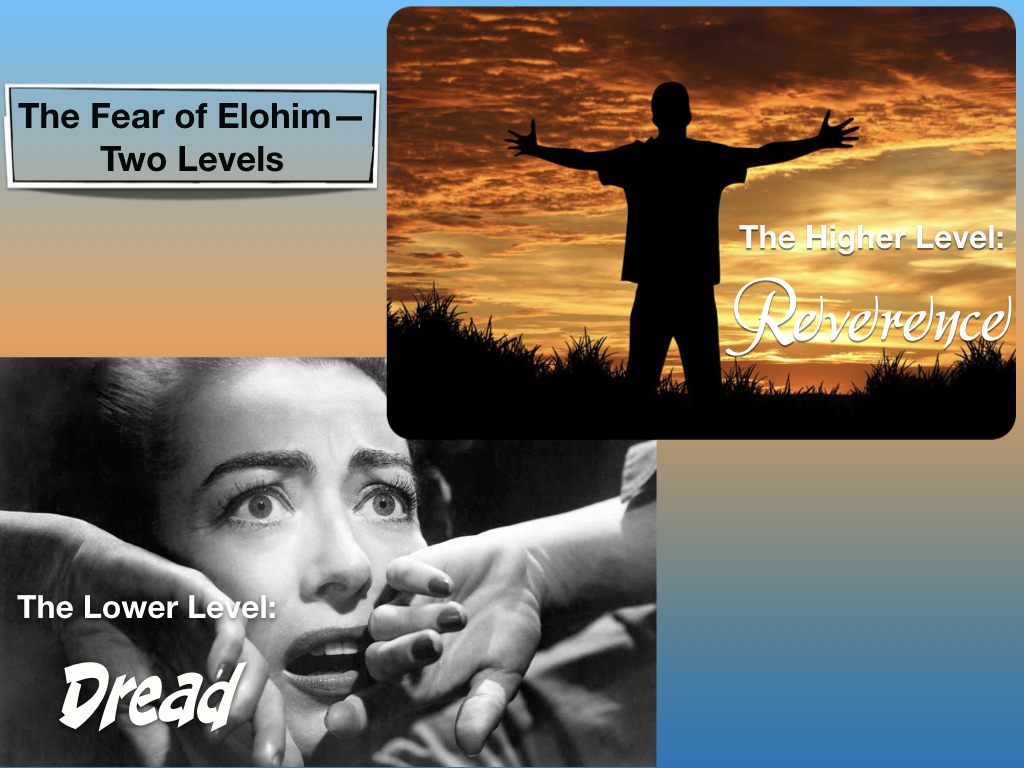
Numbers 3:38, The the outsider who comes near.This verse teaches the principle of the fear and reverence of YHVH when approaching his divine Presence. Other scriptures that teach our need to be careful when approaching him include Psalms 15:1–5; 24:3–5 and Ecclesiastes 5:1–2 (see also Gen 28:16–17; Exod 3:5; Lev 10:3; Josh 5:15; Ps 89:7; Heb 12:28–29). 

As YHVH didn’t permit the Israelites to come near to him except through the intermediary of the Aaronic priests, similarly we can only come to our Father in heaven through the intermediary of Yeshua the Son of Elohim, and our Great High Priest (Heb 4:14), who is the spiritual door and way to the Father (John 14:6). 

Although, YHVH permits his set-apart ones (the saints) to come boldly before him through the agency of Yeshua’s high priesthood and his blood (Rev 5:6–8) to obtain mercy and grace in time of need (Heb 4:16), let’s not forget two things. First, we come to YHVH Elohim in human weakness needing help and grace from him who is greater than us; therefore, we need to maintain a humble disposition (see Isa 66:2). 

Second, our Elohim is a consuming fire (Heb 12:29); therefore, we need to serve him with reverence and godly fear (Heb 12:28), since in his hands he holds the power of life and death (Matt 10:28). Fire is a biblical metaphor for judgment, and YHVH will judge all people including his own people (Heb 10:30–31) for all that they have done while in the flesh whether good or bad to determine levels of rewards and punishment (Matt 5:19; 16:27; 2 Cor 5:10; Rev 20:12; 22:12). In fact, Peter admonishes us to conduct our lives in the fear of Elohim and to be holy as he is holy who will judge each man according to his works (1 Pet 1:17).