Holiness—It’s not what the church has told you it is!

Holiness—The Dominant Theme of Leviticus and the Bible 

Holiness IS NOT what the mainstream Christian church has told you it is. Your pastors and Bible teachers have lied to you! The church has largely stripped holiness of its biblical meaning and imposed on it a man-made religious meaning. A study of the book of Leviticus will reveal the true meaning of the word as defined by YHVH Elohim, our Creator, and teaches us how to become holy as he is holy as we will see below.

The focus of Leviticus is holiness and holy living. Holiness is the chief attribute of Elohim and the most defining aspect of his character. It has to do with the fact that Elohim is entirely good and without evil and moral defect and is sinless. This is why the spiritual beings around his heavenly throne are continually crying, “Holy, holy, holy” in his Presence (Isa 6:3; Rev 4:8). This is why one of his titles is The Kadosh One of Israel,which is used more than thirty times in the Tanakh (e.g. 2 Kgs 19:22; Ps 71:22; Isa 1:4; Jer 50:29). This is why the high priest who ministered in the Tabernacle of Moses and later in the temple wore a golden crown or headplate with the words inscribed on it, SET-APARTNESS TO YHVH. Not only was this pointing upward to YHVH’s set-apartness, but man himself is to become holy or set-apart even as YHVH Elohim is set-apart, for we read in the Epistle to the Hebrews that the attribute of holiness is a prerequisite for a man coming into the Presence of Elohim (Heb 12:14).

The Hebrew word for holy and holiness is kadosh, which is defined as “sacredness, consecrated, set-apartness or separateness.” That which is holy or kadosh relates to that which belongs to the sphere of the sacred, godly or heavenly and is distinct or separate from the sphere of the common, profane, defiled or polluted. Everything about Elohim is holy or set-apart compared to man who is completely polluted and defiled by sin and is thus unholy (Jer 17:9; Rom 3:23; Isa 64:6). 

The Tabernacle of Moses had two rooms: the kadosh place and the most kadosh place. The nomenclature of these rooms relates to the chief attribute of Elohim, which is his set-apartness. The tabernacle is represents heaven where YHVH dwells with the most kadosh place representing his throne room. The understanding of this reality may help us to appreciate the ceremonial rituals that YHVH required of the priest in order to enter and to minister in the tabernacle. It is a picture man coming into the heavenly presence of Elohim.

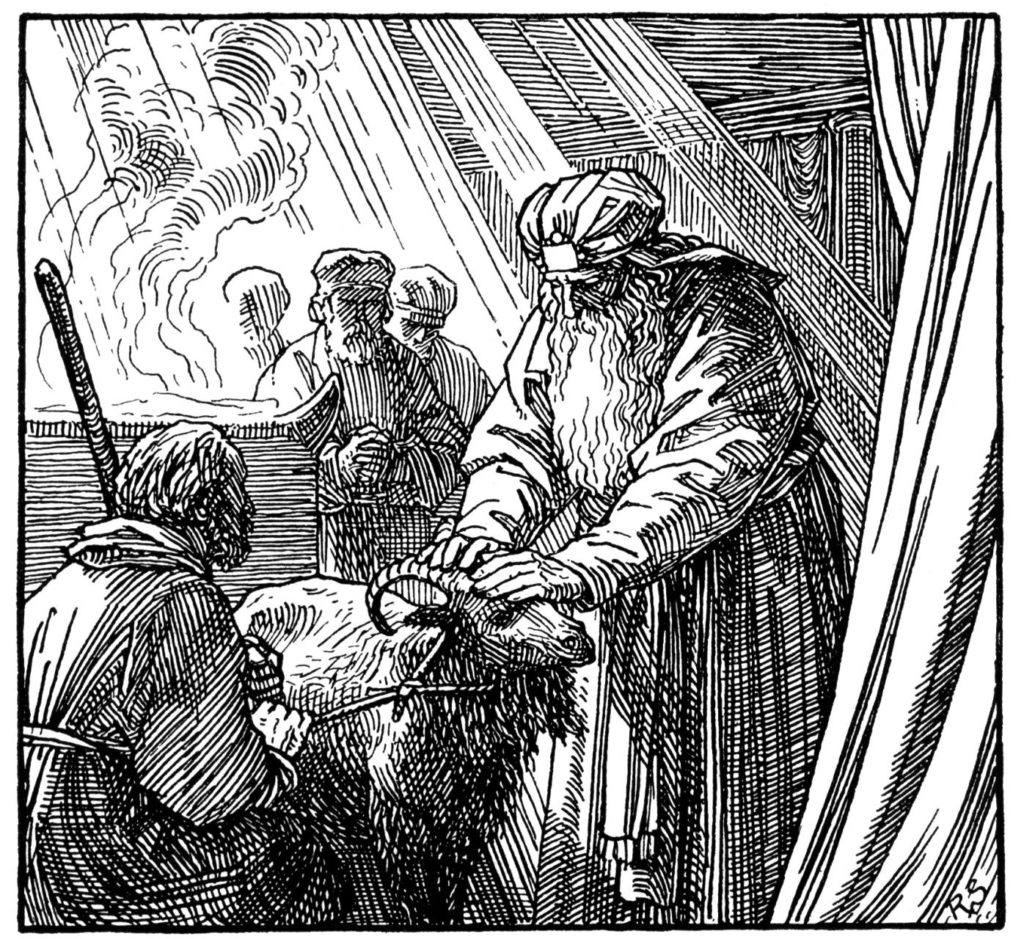
Elohim gave Moses, Aaron, the priests and Levites strict protocols to follow to insure that the tabernacle stay holy and keep from becoming profane, polluted or defiled. This involved caring for and properly handling the building and its furnishings as well as the priestly attire and their bodily, ritualistic and spiritual cleanliness. If these protocols weren’t followed, there were penalties — sometimes involving the death of the violator. If they were followed, the result was a blessed relationship with Elohim.

The requirements for coming into and ministering in the Tabernacle of Moses, the dwelling place of Elohim’s Presence (Exod 25:8) teach us several things. 

First, Elohim is holy and undefiled and is thus transcendent above the earthly and human plane. He is pure, set-apart and undefiled by. 

Second, heaven and the Presence Elohim is a holy and undefiled place. The tabernacle was the earthly dwelling place of Elohim’s Presence (Exod 25:8). It and everything about it was to remain holy or set-apart. Nothing was to defile it. 

Third, maintaining a high standard of holiness with regard to everything pertaining to the tabernacle teaches us that no one can come into the Presence of Elohim without first going through proper protocols to become undefiled. 

Forth, there was a death sentence upon those who refused or neglected to follow these protocols. This teaches man to fear, honor, respect and even to dread Elohim who has the power over life and death. Man cannot come into Elohim’s Presence in a casual, cavalier or arrogant manner in a defiled or polluted state. 

Fifth, the Tabernacle of Moses was a “processing center” to aid man in going from an unholy, polluted and sinful state to progressively becoming more and more holy and sinless. Eventually, man could come to a place — by following YHVH’s protocols of holy living — of intimate fellowship with Elohim. This is pictured by the inner room, or holy of holies, of the tabernacle where the Presence or Kavod of Elohim was dwelt. The holy of holies is representative of Elohim’s heavenly throne room. 

Sixth, man was created in Elohim’s image to have an intimate relation with him and with the capability of reflecting his divine character. When man sinned in the garden, man’s relationship with Elohim was cut off. The Tabernacle of Moses shows man how to deal with the pollution or defilement of sin through blood atonement and the eventual sacrifice of Yeshua on the cross to which all the bloody, sacrificial rituals of the tabernacle pointed. 

Seventh, there is no other way for man to come into the Presence of Elohim except through the protocols that he has established. Man has to recognize his sinfulness, turn away from his state of unholiness or pollution by making the proper sacrifices. He must then turn to and embrace Elohim’s holy or righteous standards for living a sinless life. 

Holiness is the greater message of Leviticus as it relates to the redeemed believer coming into conformity with the exalted and righteous standards of a holy Elohim. This occurs when one recognizes their unholiness or sinfulness, puts their faith in the blood atoning sacrifice of the Lamb of Elohim, Yeshua the Messiah who died on the cross in payment for men’s sins, and then turns from sin by adhering to Elohim’s standards of righteousness as outlined in the Torah and the rest of the Scriptures, and as lived out by Yeshua and his immediate disciples. 

Holiness involves heeding Elohim’s call to become his special and treasured possession by following him and allowing him to separate us from the defilement or pollutions of the heathen nations around us (Lev 20:26; Deut 7:6; 14:2; 26:19).

This message of holiness — and the message of the entire Bible — can be succinctly summed up by Elohim’s loving and longing cry to his people on several occasions to be holy as he is holy (Lev 11:44, 45; 20:7, 26; 1 Pet 1:16). The Torah shows us how to be holy (Lev 20:7–8). The Torah (and the rest of Scripture) shows us that being holy not only involves behavior, but man’s thoughts and attitudes, words and physical cleanliness as well as the observance of holy times (e.g. the Sabbath and biblical festivals), and respect of things that are dedicated to Elohim. Men must learn to make a division or separation between the spheres of the holy and the profane and to keep them separate (Ezek 44:23; 22:26), and to not let the latter pollute the former.

The message of holiness has serious implications for each individual, for as the writer of the Epistle to the Hebrews declares, without holiness, no one will see Elohim (Heb 12:14 cp. Ps 15:2ff).


More Reasons for Celebrating YHVH’s Biblical Feasts

The biblical pilgrimage or aliyot (singular: aliyah) festivals are Passover (Pesach) and Unleavened Bread (Chag haMatzot) and the Feast of Weeks or Pentecost (Shavuot) in the spring and the Feast Tabernacles (Chag haSukkot) in the fall (see Lev 23). At these feasts, the Torah, the Word of Elohim, commands all of YHVH’s his people Israel to come up (or make aliyah) to the place where YHVH has chosen to place his name. There they are to worship and serve him as they fellowship with joy with their Israelite brothers from far and near.

  • What are the reasons and benefits for YHVH’s people to faithfully and obediently celebrate his holy or set-apart feasts as he has commanded in is Set-Apart Word?
  • The biblical feasts are a prophetic shadow-picture of things to come (Col 2:16–17; Heb 10:1). When they were given to ancient Israel they pointed forward to future events that would occur to the nation of Israel including redeemed believers. The spring feast days, for example, point to Yeshua the Messiah’s first coming, while the fall feast days point to his second coming leading into the Messianic Age (Millennium) and into eternity beyond.
  • All the biblical feasts point to Yeshua. Yeshua is the Hebrew name for Jesus and means “salvation.” All the biblical festivals point to the various stages or steps of the path of salvation that believers find themselves on. 
  • All of the feasts point back to and commemorate historical events that occurred in Israel’s history. By studying and celebrating these feasts, we can learn valuable historical spiritual lessons that are, at the same time, representative of our own spiritual journey (1 Cor 10:1–6, 11). The biblical feasts also point to present spiritual realities in the life of the redeemed believer. The feasts—especially the fall feasts—point to prophet events that are yet to happen. As such, they function as a sort of road map that tell us where we’ve come from, where we’re at, and where we’re going in our spiritual journey.
  • YHVH Elohim commands his people to keep what the Scriptures calls his appointed times or biblical festivals. They are times when he makes an appointment to meet with his people (Lev 23:1–2, 4). It is at these festivals or commanded assemblies that YHVH teaches his people about his wonderful plan of salvation or the redemption of the world through Yeshua the ­Messiah.
  • The feasts are in the Bible and the whole Bible is the inspired word of Elohim (2 Tim 3:16). Yeshua commands his saints to live by every word that comes out of the mouth of Elohim (Matt 4:4). The feasts are in the Bible, and believers need to study and obey the whole Bible, which is the inspired word of Elohim (2 Tim 3:16). 
  • The feasts set forth the pattern of heavenly things on earth (Heb 8:1–2, 5; 9:8–9, 23; Exod 25:8–9, 40; 26:30; Num 8:4; Ezek 43:1–6, 10–12), and, therefore, reveal to us spiritual mysteries about things in heaven.
  • As physical human beings, we need physical means and methods to help us understand spiritual mysteries that are above and beyond our intellect. YHVH gives us the natural to help us to understand the supernatural or the spiritual, which would otherwise be beyond our comprehension (1 Cor. 2:9–13). The biblical feasts play an important role in our spiritual growth, development and maturation and bring us higher and closer to Elohim through Yeshua the Messiah. Therefore, Elohim’s feasts act as bridges to help us to transcend the physical and not only to understand the spiritual, but to actually come up to the higher spiritual level. As such, they bring us closer to YHVH Elohim, our Creator and Heavenly Father.
  • Yeshua, the apostles and early believers celebrated the biblical feasts. The apostles walked as Yeshua walked, and instructed us to do the same (1 Cor 11:1; 1 John 2:6).
  • The Bible tells us that YHVH’s feasts will be celebrated during the Millennium, so why shouldn’t we be keeping them now?
  • Yeshua said that if we love him, we will be keeping his commandments (John 14:15). Elsewhere, Yeshua equated the commandments with the Torah (Luke 18:20), of which the biblical feasts are a part.
  • If you want to know YHVH, you will be keeping his Torah-commandments of which the feasts are a part (1 John 2:3–6).
  • YHVH’s Word commands us to appear before him three times each year at the three aliyot or pilgrimage feasts (Passover/Unleavened Bread, the Feast of Weeks/Pentecost, and the Feast of Tabernacles, Exod 23:14–17). If we’re going to be obedient to his instructions in righteousness, we must gather together in the place where he has chosen to place his name (Deut 16:2, 6, 11).
  • The aliyot feasts are a time for all Israel—including the saints of Elohim, who are “the Israel of Elohim” (Gal 6:16)—to gather together to worship YHVH (Lev 23:2, 4).
  • When we obey YHVH’s commands, we are blessed in wonderful and unexpected ways (Deut 28:1–14).
  • When we come together at his appointed times (moedim) and at the place where he has chosen to place his name, we show YHVH that we love him and want to meet with him. As a result, we will experience a special divine joy (Deut 12:5–7, 18).
  • When we come together at his appointed times (moedim) at the place where he has chosen to place his name we show our fellow redeemed Israelites that we love them and want to fellowship with them. This brings unity and one accordness into the spiritual body of Yeshua.
  • At the feasts, there is corporate worship, and when YHVH’s people praise him together, he inhabits the praises of Israel (Ps 22:3).
  • When redeemed Israel comes together, YHVH camps in the midst of his people (Ps 34:7).
  • When the disciples of Yeshua come together, he is in their midsts (Matt 18:20).
  • At the aliyot feasts, people from outside of one’s local congregation ideally gather together for a common purpose: to obey, worship and serve YHVH. This binds all the saints together in a common focus and purpose. In this atmosphere, new and lasting friendships are forged and the kingdom of Elohim is expanded and he is glorified.
  • At the aliyot feasts, one has the opportunity to hear new teachers with fresh manna or teachings.
  • The aliyot feasts give our young people and adult singles an opportunity to meet prospective spouses.
  • The aliyot feasts give one an opportunity to visit new places and provides one with a great (and biblically-based) excuse to take a much needed vacation.
  • The aliyot feasts are a place to not only meet new people, but to exchange ideas and to get your Bible questions answered.
  • At the aliyot feasts, one is provided with extended times of anointed praise and worship, which brings redeemed Israel together, unites heaven and earth, unites the body of Yeshua and causes everyone to grow spiritually.
 

Is it the biblical new year? Yes!

We are going to proclaim that the biblical new year has arrived based on reports of aviv (or abib) barley being found and the new moon sighting in the land of Israel (see https://www.facebook.com/search/top?q=devorah%27s%20date%20tree and https://www.facebook.com/HaleviTeacher). Based on this report, Passover (Pesach) will occur on Sunday, March 28, 2021 with the first high holy day of the Feast of Unleavened Bread occurring on the following day (Monday, March 29, 2021). We will now discuss the reasons for our decision.

To be sure, some people may consider this to a borderline call this year, but the preponderance of evidence, in my opinion, is that this is the month of the aviv barley. (For more info on the biblical calendar and the biblical definition of “the month of the aviv/abib [barley]”, see my articles on the subject at https://www.hoshanarabbah.org/teaching.html#feast). Here are the reasons that we have chosen to call this new biblical month the first month of the new year:

  • As far as we know, Devorah Gordon and her team are the most experienced aviv barley searches currently operating in the land of Israel, and have been at this for some 20 years. We know and trust Devorah (along with her former husband, Nehemia Gordon), and were privileged to be part of their team in 2008. So we have a sense of how the barley search system works as well as the integrity of those involved.
  • Based on my extensive understanding of the Scriptures on the subject of the biblical calendar (see my articles on the subject at the link provided above), for the first month of the biblical calendar to be called the month of the aviv, aviv barley must be found in the land of Israel at the beginning of the month. According to the above referenced reports, aviv barley has been found. True, there is not a lot of it, but it is there. Moreover, by the time Wavesheaf Day occurs in about three weeks, it is highly probable that there will be much more aviv barley.
  • In the past, other people have proclaimed the new month based on the potential of aviv barley being found by Wavesheaf Day. We have rejected this notion for several reasons. First, it is our belief based on our study of the Scripture that for the month to be called “the month of the aviv” (a biblical term), aviv barley must already be present in the land of Israel by the first day of the first month. Second, if there is no aviv barley to be found by the first day of the first month, then there is no guarantee that it will be found in time for the Wavesheaf Day two or three weeks later. Maybe there will be enough aviv barley, may be there will not be. It is anyone’s guess. Why is this? Because the ripening of the barley depends on the weather, and no one can predict what the weather will do. If it is warm, then the barley will ripen; it it is cold, it will not ripen. This is why there needs to be aviv barley by the first day of the first month for it to be the month of the aviv barley. For example, in 2008 when we were in the land of Israel, we did not find aviv barley when we searched for it. Yet, there was a man who proclaimed that month to be the first month of the year based on the notion that the barley might be aviv by the middle of the month and in time for the Wavesheaf Day. As it happened that year, the barley was still not aviv when he thought it would be, and so his proclamation was false. For this reason, it is important that there be aviv barley by the first day of the first month for that month to be proclaimed the month of the aviv and, hence, the first month of the biblical new year.
  • Why is it important for there to be aviv barley by the first day of the first month of the new year? Simply this. In ancient biblical times and according to Scripture, the Israelites were commanded to go up to Jerusalem (or wherever YHVH chose to place his name) to celebrate the Passover and Feast of Unleavened Bread. They had to walk there. Depending on where they were coming from, this journey may have taken anywhere from several days to more than a week to make. If the new month was declared based on potential sighting, and not on the actual occurrence of barley at the beginning of the month, then there was the potential for a major problem for the Israelites. What if they prepared for the journey to Jerusalem, left their farms, made the journey only to find out that the barley still was not aviv? What then? They had to make the trek back home by foot, only to turn around a short time later and make the trip all over again when the barley was finally aviv. Such a situation is not an issue in our day of modern transportation, but in biblical times, this would have been a major economic inconvenience if not a debacle for many people. For this reason, the barley had to be aviv by the beginning of the first month.
  • In ancient Israel, the Mishnah records that there was a whole process that occurred to determine whether the barley was aviv or not. This process was officiated over by the religious and political leaders of Israel. It involved many people and important protocols were followed to insure accurate information. Today, we do not have such resources at our disposal. Most of us are not in the land of Israel. We have to trust those who are there for accurate information. That is my wife and I went to Israel in 2008 to experience this process ourselves and to meet the people involved.

We realize that well-meaning people will have different opinions on some of the points mentioned above. This is where love and respect comes in. There is no need to criticize, slander or libel others who have different opinions. We are all doing the best that we can to live up to the light of truth that has been given to us. Truth is being restored to YHVH’s people in these last days (see Acts 3:21 and Mal 4:4–6) and this is a process that takes time involving one heart and mind at a time. As such, everyone is at a different place on the truth-restoration trajectory. So let us love and respect one another, even if someone has a different opinion than ours. At this point, I am reminded of Paul’s instructions in Romans 14,

Receive one who is weak in the faith, but not to disputes over doubtful things…Who are you to judge another’s servant? To his own master he stands or falls. Indeed, he will be made to stand, for Elohim is able to make him stand.…But why do you judge your brother? Or why do you show contempt for your brother? For we shall all stand before the judgment seat of Messiah.…Therefore let us not judge one another anymore, but rather resolve this, not to put a stumbling block or a cause to fall in our brother’s way.…Therefore do not let your good be spoken of as evil; for the kingdom of Elohim is not eating and drinking, but righteousness and peace and joy in the Holy Spirit. For he who serves Messiah in these things is acceptable to Elohim and approved by men. Therefore let us pursue the things which make for peace and the things by which one may edify another. (Rom 14:1, 4, 10, 13, 16–19)


Blog Scripture Readings for 3-14 Through 3-20-21

Aside

Parashat Vayikra — Leviticus 1:1 – 5:26 (6:7)*
Haftarah — Isaiah 43:21 – 44:23
Prophets — Isaiah 11:1 – 20:6
Writings — Proverbs 18:1 – 24:34
Testimony — John 15:1 – 19:42

Our new annual Scripture Reading Schedule for 2020-2021 with daily readings that began on 10/11/20 is available to download and print. The link to the previous 2019-2020’s Scripture Reading Schedule will still be available on the right sidebar under “Helpful Links” into next year. If you are using a mobile device or tablet, the link may be below, meaning you’ll need to scroll down instead.

Most of this week’s blog discussion points will be on these passages. If you have general comments or questions on the weekly Scripture readings not addressed in a blog post, here’s a place for you to post those. Just use the “leave a reply” link or the “share your thoughts” box below.

The full “Read Through The Scriptures In A Year” schedule, broken down by each day, can be found on the right sidebar under “Helpful Links.” There are 4 sections of scripture to read each day: one each from the Torah, the Prophets, the Writings, and from the Testimony of Yeshua. Each week, the Torah and haftarah readings will follow the traditional one-year reading cycle.

* Verse numbers in parenthesis refer to the verse number in Christian English Bibles when they differ from Hebrew Bibles or the Tanakh.

Weekly Blog Scripture Readings for 3/14 through 3/20/2021.


How to Prepare YOURSELF for Passover

Passover is just around the corner. It is the first step in YHVH Elohim’s plan of salvation or redemption of sinful humans to reconcile fallen man back to him. Did you ever wonder how this process really works?

There is never a better time to begin repenting of sin and getting under the blood of the Lamb of Elohim than just before Passover. As the children of Israel applied the lamb’s blood to the door posts and lintels of their house, so we must apply the sin-cleansing and Satan-defeating blood of Yeshua afresh to our lives (i.e. to our thoughts as represented by the door lintel and to our hands or actions as represented by the door posts). Cleansing of our sin occurs as we repent of our sins, and pray for and receive YHVH’s forgiveness. He will then cover our sins over or wash away our sins by Yeshua’s blood (1 John 1:9; Rev 1:5).

In Egypt at Passover time, YHVH judged all those who had failed to put the lamb’s blood on the door posts of their houses. In other words, they weren’t under the blood of the lamb, but were still under the penalty of sin, which is death (Ezek 18:4; Rom 6:23). Any unrepented of sin in our lives brings the curse of death on us. To the degree that we have sin in our lives is the degree to which the spirit of death has a legal claim on us. Now is the time to repent of sin by confessing it and seeking Elohim’s forgiveness under the blood of Yeshua and then forsaking that sin through YHVH’s grace (1 John 1:9). 

Let us now discover the miraculous process of how to overcome sin in more detail through a spiritual magnifying glass. How do we go from being a lost sinner—the walking damned or the living dead—to becoming the glorified and immortalized children of Elohim?

It works like this: When we confess and repent of our sins, Yeshua will pass over or forgive us of our past sins (Rom 3:25; Ps 103:8–12). From this point forward, it is up to us to embrace a new mindset and a new spiritual identity and reality; that is, we must reckon our old sinful man as having been crucified with Yeshua, in that we are now dead to sin, no longer slaves to sin, freed from the power of sin, and alive to Elohim in Yeshua our Lord (Rom 6:7–11). Yeshua is the one who victoriously defeated the power or sting of sin, which is death, hell and the grave at the cross and through his resurrection (1 Cor 15:56–57; Col 2:13–15). Through our faith in him and our legal identification with his death, burial and resurrection through the symbolic ritual of baptism for the remission of sine, his victory is legally applied to us by the courts of heaven, which is how he has made us more than conquerors over sin and death (Rom 8:37; 6:1–14) such that the power of sin and death will no longer have dominion over us (Rom 6:12–14).  He now gives us strength through his enabling and empowering grace to resist and overcome sin, that is, to not let sin control us any longer (Rom 6:12). He promises to give us a new, circumcised heart as he writes his laws or commandments on our hearts, so that we will be supernaturally inclined to love him by keeping his commandments (Jer 31:33; 24:7; Heb 8:10; 10:16; Ezek 36:25–27; Isa 51:7; Ps 40:8; 37:31; Deut 30:6; John 14:12 cp. Rom 7:22). What is that supernatural power that works in us to help keep us from sinning? It the Spirit of Elohim or the Comforter that Yeshua promised would come along side of us to aid us in the process of overcoming sin (John 14:16–18, 25–26; 15:26–27; 16:7–14). 

To summarize, this whole supernatural and miraculous process of being victorious over sin is activated when we first acknowledge our sin, confess our sin, repent of our sin and then place our faith in Yeshua’s death and burial. This occurs when we appropriate or reckon, by faith, our old sinful man to have been crucified with Yeshua, and then been resurrected in the newness of spiritual life with him. We now embrace the new identity that he has given us—a spiritual reality that he has imparted to us and has been legally recorded in heaven (Col 2:14)—that we are a new creation and are victorious over sin (Gal 2:20; 2 Cor 5:17), and have become Spirit-begotten children of Elohim. This whole process is summarized from beginning to end in Paul’s Epistle to the Romans chapters six through eight. The end result, if we continue in a right spiritual relationship with Yeshua the Messiah for the rest of our lives, is that our names will be recorded in Elohim’s Book of Life, and our physical bodies will be glorified—we will be given immortality—at the resurrection of the righteous dead, which occurs at the second coming of Yeshua. 

This whole process or chain of events that transforms sinful humans into glorified and immortal children of Elohim begins at Passover which symbolizes the first steps a person takes when he comes to faith in Yeshua the Messiah.

Here are some things of which to repent: 

Continue reading
 

Why study and celebrate the biblical feasts?

YHVH’s seven biblical give us a glimpse into past and future…

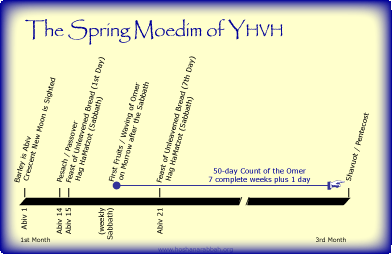
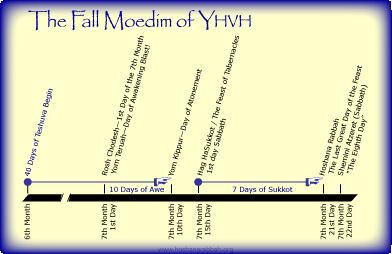
The spring biblical feasts are just around the corner. Passover and the Feast of Unleavened Bread are the first of seven biblical celebrations or festivals that lay out YHVH Elohim’s plan of salvation or redemption for humankind. Not only that, the Creator commands his people to observe them. Moreover, Yeshua and the New Testament disciples did, so why shouldn’t we?

The mainstream church has lied to us in several ways about YHVH’s feasts. First, they ARE NOT the Jewish feasts. The Jews did not invent them. Read your Bible! They came from the Creator, and he commanded all of his people to celebrate them—NOT just the Jews.

Second, they were not done away with at the cross. That is another lie that the church has brainwashed you to believe. The article below clearly proves this from Scripture.

Third, the church has pulled the wool over your eyes about YHVH’s feasts when it replaced them with its own invented Christo-pagan holidays. These are traditions of men that Yeshua warned us against by which YHVH’s Word has been made of none effect.

Folks, when are we going to wake up to the cold hard facts? The article below will help to unveil the hidden truth of the Scriptures and to expose the lies that we have inherited from our forefathers.


An Introduction to the Biblical Feasts

If you had to sum up the entire message of the Bible in one word what would it be? Probably words such as love, hope, salvation, eternal life or heaven are coming to your mind. But I challenge you to find a better word than the following: r-e-c-o-n-c-i-l-i-a-t-i-o-n. The dictionary defines reconciliation as “to restore to friendship or harmony, to settle or resolve a quarrel, to make consistent or congruous.”

When the first humans chose to listen to the lies of the serpent and to rebel against YHVH by giving in to sin at the tree of the knowledge of good and evil at the very beginning, our first parents chose the path of separation from their Heavenly Father. Sin causes man to be separated from our totally holy, righteous, sinless and loving Creator.

Since that time YHVH has been endeavoring to reconcile man to himself. He has laid out the criteria for this to occur—for man to once again have a loving and intimate relationship with his Heavenly Father as did Adam and Eve before they sinned.

The seven biblical feasts of YHVH (please note, the Bible calls them YHVH’s feasts, not men’s feasts, Lev 23:2, 4; Exod 31:13) prophetically represent the steps man must take to be reconciled to his Heavenly Father. They are the complete plan of salvation or redemption rolled up into an easy-to-understand ­seven-step plan. Though a child can understand these steps, the truths contained therein can, at the same time, be expanded and unfolded until one literally has rolled out before oneself the entire message of the Bible from Genesis to Revelation—a message that to the human comprehension is staggering, deep and rich beyond understanding. The biblical feasts are literally the skeletal structure upon which the truths of the entire Bible hang. The message of redemption, sanctification, salvation, the atonement, glorification, end-times eschatology, the history of Israel, the entire gospel message, the covenants, the marriage of the Lamb of Elohim, the truth about the bride of Messiah, and Yeshua the Messiah are all prefigured within the glorious spiritual container of YHVH’s feasts contained in seven steps. Seven is the biblical number of divine perfection and completion, thus revealing to us that his plan of salvation is complete in that it will bring man back into an eternal and spiritual relationship with Elohim.

Quite assuredly, without a deep, walking-it-out comprehension of YHVH’s feasts, no matter how learned one may be in biblical knowledge, one will miss key elemental truths pertaining to YHVH’s plan of salvation. For example, there is no way to correctly or fully understand end-time events such as the second coming of Yeshua, the great tribulation, the wrath of Elohim, the resurrection of the righteous, the marriage of the Lamb, the Millennium, or the New Jerusalem unless one understands the feasts from a deep Hebraic perspective. Spiritual pride may not allow one to handle this fact, but it is the truth none the less! It’s illogical to think that one can throw out the foundation of a building and expect it to stand, or to eliminate the skeleton from a human body and expect a person to stand upright. Similarly, the feasts are both the foundation and the skeletal framework upon which is built or hangs the whole corpus of biblical truth.

What’s more, at Mount Sinai, YHVH gave to his people Israel the Ten Commandments. These words from the mouth of the Creator himself literally formed the foundation and cornerstone to the rest of the Torah’s (the 5 books of Moses) 613 commandments, which YHVH gave to man through Moses. The Jewish sages have understood this for thousands of years. From the Ten Commandments, all the rest of the commandments can be extrapolated. For example, the prohibition against adultery includes not only marital infidelity, but all manner of sexual sin, for the cornerstone of sexual holiness is a righteous and undefiled marital union. The same can be said of all the other commands. Similarly, from the Sabbath command springs forth all the biblical feasts, for they too are sabbaths. From the fourth commandment also comes the land sabbath and jubilee years. These sabbaths were so vital in YHVH’s eyes and so fundamental to his relationship with his people that he said that they would be a token of his wedding agreement with Israel, even as a ring is a symbol of a modern marriage covenant. About the Sabbath, we read the following in Exodus 31:13,

Speak thou also unto the children of Israel, saying, Verily my Sabbaths ye shall keep: for it is a sign between me and you throughout your generations; that ye may know that I am YHVH that doth sanctify you.

Please note that the word Sabbaths is plural. This refers not only to the weekly or seventh day Sabbath, but to all the Sabbaths of YHVH, including the biblical feasts. These days are so important that they would actually form the basis for his reconciliatory relationship with his people throughout their generations, which means ­forever!

Continue reading
 

John Chapters 11 and 12—Natan’s Commentary Notes

John 11

John 11:9, Twelve hours in a day. One possible meaning of Yeshua’s enigmatic response to the disciples’ question about the wisdom and safety of Yeshua’s going anywhere near the Jews who wanted to kill him is this: If we walk in the light of or are led by the Spirit of Elohim, we will not fall prey to the forces of evil and evil doers who want to destroy us, for the Spirit will guide us when or when not to go somewhere or to do something, and will navigate our steps safely through any destructive perils that way await us. This is called walking by faith (in Elohim), not by sight, and walking in or being led by the Spirit. Elsewhere, YHVH promises to order the steps of a good man (Ps 37:23).

John 11:48, The Romans will come. The chief concern of most major religious leaders has always been to preserve the status quo thus preserving their power and wealth. This is largely more important to them than pursuing the Truth or will of Elohim. Because of this spiritual blindness, the Jewish leaders of the day not only failed to appreciate the mighty miracles that Yeshua worked, but they failed to recognize their actual long-awaited Messiah. In our day, when the Messiah comes, how many religious leaders in the mainstream church will recognize Yeshua as the Torah-obedient Jewish Rabbi that he actually is, when they have spent so much time and energy convincing people that the Torah has been done away with? Not only that, the modern church’s message of easy-believism has been very profitable for its proponents, since it tickles the ears of those who receive and often lulls them into a false sense of spiritual security.

John 11:49–52, Caiaphas…prophesied. Here, Caiaphas was giving the Jewish leaders approval to murder Yeshua. At the same time, unbeknownst to him, he was making one of the great prophecies in the Testimony of Yeshua concerning Yeshua the Messiah whose role and mission it was to gather in the twelve tribes of Israel that were scattered throughout the nations. This prophetic word from an unlikely source and the man who was largely responsible for Yeshua’s death sentence shows that Elohim in his sovereignty can use any source—even a wicked one—as a vessel in his hands to speak and to accomplish his purposes. Remember Balaam’s donkey?

John 11:54, Ephraim.This is prophetic of Yeshua’s disciples taking the gospel message to Gentiles or “the children scattered abroad” or “the lost sheep of the house of Israel” because all but a few Jews rejected Yeshua in his day.

John 12

John 12:1, Six days before the Passover. Let’s review the sequence of events that occurred in Yeshua’s life that led up to the Passover. In this way, we will see how Yeshua, the Lamb of Elohim, fulfilled the types and shadows of the Passover lamb in the story of the Exodus.

 Yeshua came to Bethany six days before Passover (verse 1). Then they had a formal dinner (verse 2, the word supper is deipnon meaning a formal meal usually occurring in the evening), which probably was the erev Shabbat meal (verse 2) on Friday night. So Yeshua came to Bethany on Friday, which was six days before Passover (or the ninth of Aviv or Abib). That evening at erev Shabbat was the beginning of the tenth day of Aviv, or five days before the Passover. It was here that Mary anointed Yeshua with the spikenard (verse 3). This is the fulfillment of the Passover lamb being separated, which occurred, according to Torah, on the tenth of Aviv. From Friday erev Shabbat forward five days brings us to the end of the day on Wednesday the fourteenth of Aviv which corresponds to when he was crucified and then laid in the grave before the setting of the sun (or the beginning of the fifteenth). The disciples quickly entombed him before the High Sabbath or first day of Unleavened Bread, which started at sundown on the fifteenth day of the first month, or the month of the Aviv.

For a further discussion on the chronology of the six days before the crucifixion, see The Companion Bible (appendix 156).

John 12:5, Three hundred denarii. This large sum is equal to 300 days’ wages for a common laborer.

To the natural mind, Judas’ objection to the use of this expensive spice (worth between $30,000 and $50,000 in today’s money) to anoint someone’s feet seems illogical and a total waste of money. By contrast, from our perspective today, we can look backwards historically with perfect 20–20 hindsight and realize that for Yeshua, the Messiah and Savior of the world, he was worth every penny of the spikenard and much more. Yet, from the perspective of Yeshua’s followers, Yeshua’s true identity and mission still weren’t clear. This confusion wouldn’t clear up until after his resurrection and glorification (v. 16). So for some of them, Mary’s act of faith in anointing Yeshua’s feet with a year’s wages of spice seemed to be illogical folly. 

This spice, most likely was originally intended for use on Lazarus’ body, whom Yeshua had just resurrected and so was no longer needed for that purpose, at least. It is likely that it was out of gratefulness for resurrecting her brother that Mary performed this act of love and devotion to Yeshua, not realizing that her actions were prophetic in that she was pre-anointing Yeshua’s body for his own burial ten days from that night (v. 7).

Now let us consider the following. We know that YHVH Elohim the Father gave us his greatest love gift by sending Yeshua, his Son, to this earth to live, die and resurrect for our redemption and ultimate glorification (John 3:16). How much do we love Yeshua, and what is the greatest gift we could ever give him, even if those around us may think that we were crazy to do so? It is your heart, devotion and obedience. Have you given him all your heart? Does all that you own belong to him including your life? Would you give away all of your possessions in devotion to him if he asked it of you? Would you literally lay your life down for him as he did for you? How much do you love Yeshua?

John 12:20, Greeks. Referring either to Greek-speaking Jews and God-fearing Gentiles converts who had come to Jerusalem from various areas in the Roman empire to celebrate the feast (cp. Acts 6:1 and 9:29).

John 12:28–29, Voice from heaven…thundered. Some people heard the voice of Elohim in the thunder, while others heard only thunder. Evidently, there was some debate as to what the heavenly sound they heard was. This begs a question. Two people can hear or see the same thing, yet one will see YHVH behind it, while the other will attribute it to natural phenomenon. What determines whether one hears Elohim’s voice or sees a miracle or not? It gets down to the level of a person’s faith and to what degree they’ve exercised their faith. Those who have faith as a little child and are looking for a relationship with their Creator — whose hearts are inclined to serve and obey him will, interesting, be more likely to see his hand in mundane things and hear his voice through the cacophony of this world. This is because their hearts and minds are already open to him. Their “God radar” is up and tuned in. Conversely, those who have their ears and hearts tuned into the world, flesh and the devil will have difficulty see and hearing YHVH because they’re disinclined to doing so. This is why so few people believed Yeshua in followed him in his day…and today.

John 12:34, The law. The Torah does not mention that the Messiah will reign forever. These prophecies are found in the Prophets and the Writings (e.g. Isa 9:6 cp. 2 Sam 7:16). Here we see two things. First, the Jews referred to the entire Tanakh (or Old Testament) colloquially as “the Torah-law,” and, second, there was confusion among the Jews as to the purpose of the Messiah’s mission. Because of Roman domination over the Jews, the Messiah’s role as the Conquering King over that of the Suffering Servant had taken precedence in the thinking of the Jews of Yeshua’s day. Even the disciples were predisposed to this popular notion (e.g. Mark 10:37; Acts 1:6). This is evident in their inability to believe that Yeshua’s mission would end with his death.

John 12:37, The word of Isaiah. Here Yeshua is referencing Isaiah 53, the great Suffering Servant prophecy predicting his death to atone for the sins of men. The unbelief of Yeshua’s followers, including that of his own disciples, about his impending death is the very fulfillment of Isaiah’s prophetic question in this regard: “Who has believed our report?” (Isa 53:1). In any era, a Conquering King figure is more likely to elicit popular support than a Suffering Servant who gives his life for the nation.