Is celebrating the biblical feast of Shavuot (aka the Feast of Weeks or Pentecost) optional for the born-again, redeemed Israelite believer in Yeshua the Messiah in the 21st century?
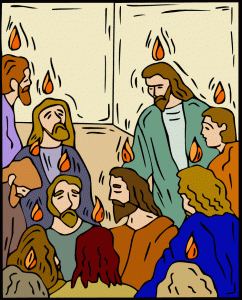
The short answer is, “NO!” unless one considers the clear commands of the Word of Elohim to be merely suggestions and not commands. “NO!” unless one rejects following the examples of Yeshua, the Apostle Paul and the Book of Acts followers of Yeshua. “NO!” unless one has become so conditioned to following the traditions of men that have made of non-effect the Word of Elohim that they have become blind and deaf to the clear truth of the Scriptures.
You see, we live in an age where the majority of so-called “Bible believers” and church people are more concerned about feelings, popularity, majority consensus, what others think, having fun, being entertained, the lust of the flesh and eyes that most either don’t know what the Word of Elohim says, or don’t care. Oh, they will swear otherwise, but their actions speak louder than their words. Amos the prophet describes this spiritual sickness well when he referred to apostate Israel as suffering from a “famine of the hearing of the words of YHVH,” (Amos 8:11). You see, the word “hearing” in Hebrew is shema, which means not just “to hear,” but “to do and to obey” as well. It seems that nowadays, like then, a lot of folks hear, but few obey.
On May 27, 2012, we will be celebrating the biblical feast of Shavuot (Lev 23:15–22, Acts 2:1; 20:16). On this blog, and on our ministry website (hoshanarabbah.org) we have been promoting our congregation’s and our ministry’s Shavuot celebration to those in our local area (the Pacific Northwest U.S. region). Well, what prompted this blog post was an interesting response I received today from someone who thanked us for the announcement, but was sorry they couldn’t make it to Shavuot because they had a birthday party to attend instead.
So, I submit, once again, the question, is celebrating Shavuot optional? Let me list the reasons why it is not — according to the Word of Elohim:
- Shavuot is a miqra kodesh (holy convocation) and sabbath when YHVH commands his people to stop whatever they are doing, gather together, and to meet with him on this day (Lev 23:1,15–21).
- YHVH enacted Shavuot as a statute forever for his people Israel (Lev 23:21).
- If you’re a follower of and believer in Yeshua then that makes you a son of Abraham (Gal 3:29), and an Israelite (Eph 2:11–19), and so the command to observe Shavuot applies to you. Only the heathens are exempted from this celebration, and that exemption isn’t without eternal consequences, for to not obey the Torah-commands of YHVH-Yeshua is sin (1 John 3:4), and the wages of sin is eternal death (Rom 6:23).
- If you call yourself a Christian, Messianic, or a follower of Yeshua, then you’ll not want to risk being a hypocrite (or a sinner), but rather, you’ll want to do what he did and celebrate all of the biblical feasts including Shavuot. You’ll also want to follow the example of Paul who instructed us to imitate Yeshua as he imitated Yeshua by doing what Yeshua did (1 Cor 11:1). To imitate means to do exactly what someone else does. Paul celebrated Shavuot (Acts 20:16).
- If you love Yeshua, you will be keeping his Torah-commandments (John 14:15) of which Shavuot is one.
- Some believers in Yeshua feel that we only need to do what he directly commanded us to do. Well, he commanded his disciples to tarry in Jerusalem until they were endued with power from on high, which occurred on the day of Pentecost (Luke 24:49; Acts 2:1–4). Therefore, he was commanding them to celebrate it, which they continued to do as we see from the example of Paul above.
- Finally, if there is any biblical feast that has precedence to be celebrated in our day, it would be the Feast of Pentecost, since, as many of us have been taught in our churches, the NT church was birthed on this day. So, if it was good enough for them, why not for us? Moreover, it seems to me, that if there is any church group out there that should be leading the way in celebrating the biblical Feast of Shavuot or Pentecost, it should be the Pentecostals, right?
So now what’s your excuse for not celebrating Shavuot as YHVH Elohim in the Scriptures commands?