Noah—A Prophetic Picture of the End Times

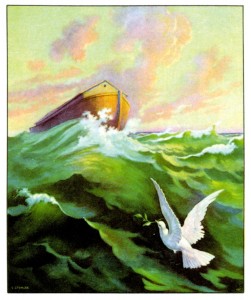
Genesis 6–7, Noah’s flood provides allegorical insights relating to end-times prophecy. In Matthew 24:37, Yeshua compares the end times to the days of Noah. The story of Noah has allegorical implications that give hints about end-times prophecy.

In 1 Peter 3:18, we learn that the story of Noah is also a picture of salvation and baptism. Noah is a type of Yeshua.

Noah building the ark is a prophetic picture of the redeemed believer working out his own salvation all the while following the exact plans or specifications of YHVH.

Noah builds an ark of safety from Elohim’s wrath or judgments against sinful man. The ark is a metaphorical picture of the believer’s salvation; Noah is a spiritual picture of Yeshua. The flood is also a picture of water baptism for the remission of sins, which ceremonially pictures the death of the old sinful man, and the birth the new spiritual man (Rom 6:3–6). The unregenerated sinful or carnal men perished in the floodwaters in Noah’s day, while the new, redeemed man (as pictured by Noah and his family) who had found grace in the sight of Elohim found refuge on the ark. While the flood is a judgment against sinful man who has violated the Torah-laws or divine instructions of YHVH, the ark is a picture of the grace that YHVH offers to those who will repent of their sins (i.e. Torahlessness) and turn to him through Yeshua. As Noah found grace in the eyes of YHVH because he was “perfect in his generations” (Gen 6:8, 9), he was spared from the wages of sin which is death, and YHVH offers the same grace to all men to this day (2 Pet 3:9).

Continue reading →


Blog Scripture Readings for 7/8 through 7/14/12

Aside

Genesis 7–13; Job 7–20; and Psalms 101–107

Most of this week’s blog discussion points will be on these passages. The full year’s Bible Reading Schedule can be found on the right sidebar under “Helpful Links.”

If you have general comments or questions on the weekly Scripture readings not addressed in a blog post, here’s a place for you to post those. Just use the “leave a reply” link below.


Torah Central (this is some deep stuff!)

The Torah Is the Central Theme of the Bible — A Brief Overview

Torah is the dominant theme at the beginning, middle and end of the Scriptures.

In Genesis one, at the beginning of the Bible:

  • Gen 1:1, The Hebrew grammatical marker word consisting of an aleph and tav (the first and last letters of the Hebrew alphabet) are found twice in verse one, just before and after the word heaven. They are the fourth and seventh Hebrew words in this sentence. This is a prophetic reference to Yeshua, who is the Beginning and the End (the Alpha and Omega, Rev 1:8,11; 21:6,22:13), and it testifies to the fact that Yeshua would come from heaven in the fourth millennia and would come back to earth from heaven in the seventh millennia.
  • Gen 1:3, Light was the first creative act of Elohim. Light is a biblical metaphor for Torah/the Word of Elohim (Prov 6:23; Ps 119:105). Light pierced the darkness of evil. Darkness is a biblical metaphor for Torahlessness or all that which is of the world, the flesh and the devil and which is contrary to or in rebellion against the will and Word of Elohim (John 1:5; 3:16–21).
  • Gen 1:3–5, Light is mentioned five times here. This is referred to as the five points of light—a reference to the five books of the Torah (Gen through Deut), and to Yeshua, who was the light of the world before the sun was created on the fourth day in Gen 1:14. Yeshua, that same spiritual Torah-light, will replace the sun in the New Jerusalem (Rev 21:23; 22:5).
  • In Gen 1:3, we find the complete spelling of the word light (aleph, vav, resh), as opposed to a defective spelling minus the vav that the physical sun gives (see Gen 1:14, the first reference to light in that verse is spelled defectively). This points to the supreme and supernal Torah-light from heaven, which is Yeshua, the Torah-Word of Elohim that was made flesh and dwelt among men (John 1:1,14), and who was the spiritual Light of the world (John 1:4–5; 8:12).

Psalm 119 is the middle of the Bible. This is the Bible’s longest chapter and the highest praise of Torah to be found in all of the Scriptures

In the Book of Revelation, the last book of the Bible, we find a number of references to the written Torah, and to Yeshua, the Living Torah.

  • Rev 22:14, Blessed are they who keep his [Torah] commandments.
  • Rev 21:23; 22:5 (also 2 Cor 4:6), The Torah-Sun. Yeshua is the Light of the World (John 1:4–5; 8:12) and the Sun of Righteousness (Mal 4:2) whose face shines like the sun (Rev 1:16).
  • Rev 22:3, There will be no more curse because there will be no more sin or Torahlessness (1 John 3:4, sin is the transgression of the Torah) in the world to come, which brings on the curses of the law (Deut 28:15–68), for the wages of sin is death (Ezek 18:4; Rom 6:23), which is the ultimate curse for violating Torah-laws,which are Elohim’s instructions in righteousness.
  • Rev 22:12, Yeshua is bringing spiritual rewards to his servants based on how faithful they were to obeying and teaching the Torah (cp. Matt 5:19).
  • Rev 22:13, The alpha and omega/aleph and tav—the beginning and end of the Torah-Word of Elohim—is another reference to the written Torah and to Yeshua, the Living Torah.
  • Rev 22:15 (also 21:7), Outside of the New Jerusalem are found sinners or the Torahless ones.
  • Rev 22:17, The Spirit and Bride say come. Who gets to come? Those who have prepared themselves for the marriage supper of the Lamb by putting on the robes of the righteous acts of Torah (see Rev 19:7–9, NIV and NAS). The Scriptures defines righteousness as obedience to the Torah (Ps 119:172).
  • Rev 22:18–19, Don’t add or subtract to or from the book. This echoes the warning Moses wrote at the end of the Torah (Deut 4:2; 12:32).
  • Rev 22:20–21, The Hebrew word amein is found twice in the last two verse of the Bible including the very last word of the Scriptures. Amein is a Hebrew word meaning “verily, truly” and derives from the Hebrew word emet/<nt meaning “truth.” Emet is comprised of aleph, mem and tav, which are the first, middle and last letters of the Hebrew alphabet. Therefore, emet is a word that signifies all that is revealed on the subject from aleph to tav comprising of all that can be written on it and no more can be added to it. This is a one-word picture of Torah which points to the highest head and source of all knowledge (as the paleo-Hebrew word pictures for each individual letter illustrates).
 

66 or 49 Books in the Bible?

The Number of the Books of the Bible and the Symmetry of the Scriptures

The first point in determining the symmetry of the Scriptures is to realize that originally the Tanakh (Old Testament) was subdivided into 22 books, not the 39 in our present Bible. There was no difference in the content between then and now but only in how the books were categorized. The Book of Jubilees, a Jewish pseudepigraphic work dating to the second century B.C., attests to the fact (Jubilees 2:23) of there originally being 22 books in the Tanakh, as does Josephus in his Contra Apion (Book 1.8), and as do many early Church fathers and other early Christian scholars (In Restoring the Original Bible, Ernest L. Martin references 22 such early Christian writers, including Eusebius’ Ecclesiastical History, 4.26.14, Martin, pp. 58–60).

It is believed that Ezra the scribe originally arranged the books of the Old Testament in this manner. Thus, books such as Samuel, Kings and Chronicles were combined into one book each and the 12 Minor Prophets were combined into one book as well. We will discuss the significance of the number 22 in the Scriptures momentarily, but for now, how did the Tanakh get expanded from 22 to 39 books? According to Martin, the Jewish translators of the Greek version of the Tanakh (the Septuagint) in the second and third century b.c. subdivided the books of the Tanakh into the pattern we have today. There were, however, no Hebrew manuscripts that followed the Greek version (Martin, p. 65). Sometime in the last part of the first century or beginning of the second century a.d. Jewish authorities decided to re-divide the Tanakh into 24 books rather than to maintain the 22 (Martin, pp. 67–68). Eventually the Jews adopted the Christian numbering system of the books of the Tanakh found in the modern Protestant Christian Bible.

“There may well have been political and religious reasons why the Jewish authorities made the change when they did. When the New Testament books were being accepted as divine literature by great numbers of people within the Roman world, all could see that the 27 New Testament books added to the original 22 of the Old Testament reached the significant number 49 [7 x 7]. This was a powerful indication that the world now had the complete revelation from God with the inclusion of those New Testament books. Since Jewish officials were powerless to do anything with the New Testament (the Testimony of Yeshua), the only recourse they saw possible was to alter the traditional numbering” (Martin, p. 68).

The Significance of the Number 22 in Hebrew Thought

Martin next draws our attention to the ancient Jewish Book of Jubilees which mentions the significance of the number 22 in Hebraic biblical thought. Annotated to the restored text of Jubilees 2:23 is the remark that Elohim made 22 things on the six days of creation with man being the twenty-second created thing—the crowning achievement of YHVH’s creative activities. These 22 events paralleled the 22 generations from Adam to Jacob (i.e., the Israelite nation being the crowning achievement of YHVH’s work among the nations of the world with Israel being the vehicle through which redemption would occur), the 22 letters of the Hebrew alphabet, and the 22 books of the Holy Scriptures (Martin, p. 57).

The 22 numbering is most interesting and fits in well with the literary and symbolic meaning of “completion” as understood by early Jews. The Book of Jubilees put forth that this number represented the “final” and “complete” creation of Elohim. Adam was the last creation of Elohim (being the 22nd). Jacob, whose name was changed to Israel, was the 22nd generation from Adam; and Jacob was acknowledged as the father of the spiritual nation of Elohim. Also the Hebrew language became the means by which Elohim communicated his divine will to mankind. It had an alphabet of 22 letters. And, finally, when Elohim wished to give his complete Old Testament revelation to humanity, that divine canon was presented in 22 authorized books. The medieval Jewish scholar Sixtus Senensis explained the significance of this matter (Martin, pp. 57–58).
As with the Hebrew there are twenty-two letters, in which all that can be said and written is comprehended, so there are twenty-two books in which are contained all that can be known and uttered of divine things.


 

Blog Scripture Readings for 7/1 through 7/7/12

Aside

Deuteronomy 34; Zechariah 11–14; Malachi 1–4; Job 1–6; and Psalms 94–100

Most of this week’s blog discussion points will be on these passages. The full year’s Bible Reading Schedule can be found on the right sidebar under “Helpful Links.”

If you have general comments or questions on the weekly Scripture readings not addressed in a blog post, here’s a place for you to post those. Just use the “leave a reply” link below.


Paul Equates Torah With Yeshua

Deuteronomy 30:11–14, Does YHVH’s Torah set an impossible standard by which we are to live? If so, we are logically compelled to ask ourselves this question: Would a righteous and just Creator and a loving Heavenly Father give to his chosen people and children a set of standards that were humanly impossible to perform, then curse them for their inability to meet these standards? If so, then we must face the fact that Elohim is an unjust and a wicked tyrant!

If Torah isn’t an impossible standard to follow, then what is the Torah’s purpose in our lives, and why does the Creator impose the Torah upon his people?

We believe that the Torah sets a standard of faith, trusting in Elohim, and that if followed it provides a system of repentance and sacrifice for obtaining forgiveness from Elohim and restoring a condition of being considered righteous in his sight. The Torah also teaches man how to achieve peace on earth and good will toward men by showing humans how to love Elohim with all their heart, soul, mind and strength and their neighbor as themselves.

Paul quotes this same Deuteronomy passage in Romans 10:6–8 where he relates the Written Torah to Yeshua, the Living Torah or Word of Elohim incarnate (in the flesh). (Compare with John 1:1, 14.) He shows that they are one in the same and that Messiah Yeshua, through his life, came to reveal to man the righteousness of the Torah-law. This righteousness is available to us if we will but have a heartfelt faith in him (Rom 10:4, 9–10) and allow him to live out his righteousness in us through the empowering work of the Spirit of Elohim. In verses 11 through 21, Paul goes on to relate this very truth to being the central message of the gospel that Isaiah prophesied (Isa 52:7) would be preached to redeem both houses of Israel to Yeshua their Messiah. Furthermore, in Romans 10:4 Paul reveals that Yeshua is the end goal, target of or the full flowering or embodiment of the Written Torah in human form.


SEE MUSLIM MOB STONE CHRISTIANS – IN U.S.!

Here is a link to the story and live video from Worldnet Daily (wnd.com) of Muslims stoning Christian street preachers in Dearborn, Michigan. And you thought this could never happen in the U.S.A.!

http://www.wnd.com/2012/06/muslim-mob-stones-christians-in-u-s/

I personally know the main individual interviewed in this video and have ministered with him. He’s the same man who unfurls the large John 3:16 banners at major football events on live TV. Please pray for Ruben! Pray for all those who are taking a stand against wickedness and who are calling sinners to repent.

When the police should be defending the rights of Christians to have freedom of speech, they are instead siding with those who are attacking the Christian preachers with bottles, rocks and bags of urine. Freedom of speech on a public street isn’t a crime. Violently assaulting people and causing bodily harm in a public venue is a crime, yet the police side with the aggressors and refuse to protect the Christians. I’m reminded of this passage in Isaiah:

Woe unto them that call evil good, and good evil; that put darkness for light, and light for darkness; that put bitter for sweet, and sweet for bitter! (Isa 5:20)

This is part of the judgment that is coming against America because it has forsaken YHVH Elohim—the God of the Bible—and turned to worshipping the false gods of wood and stone. Moses prophesied this in Deuteronomy 32:15–22,

But Jeshurun [i.e. end-times Israel including America] waxed fat [greed and materialism], and kicked: thou art waxen fat, thou art grown thick, thou art covered with fatness; then he forsook Elohim which made him, and lightly esteemed the Rock of his salvation. They provoked him to jealousy with strange gods, with abominations provoked they him to anger. They sacrificed unto devils [via false and demonic religions such as Islam], not to God; to gods whom they knew not, to new gods that came newly up, whom your fathers feared not. Of the Rock that begat thee thou art unmindful, and hast forgotten Elohim that formed thee. And when YHVH saw it, he abhorred them, because of the provoking of his sons, and of his daughters. And he said, I will hide my face from them, I will see what their end shall be: for they are a very froward generation, children in whom is no faith. They have moved me to jealousy with that which is not Elohim; they have provoked me to anger with their vanities: and I will move them to jealousy with those which are not a people; I will provoke them to anger with a foolish nation [in this case, Islam/Edom]. For a fire is kindled in mine anger, and shall burn unto the lowest hell, and shall consume the earth with her increase, and set on fire the foundations of the mountains.


As Moses prophesied long ago, Elohim’s judgment against his people in America is intensifying because of its sins against him!

In America, it’s all out war against the God of the Bible, against the Bible and against those who believe in and follow the Bible. It seems that any religious or philosophical system that demeans the Bible and Bible believers is given a pass, exhaled and venerated, while at the same time, Bible believers are derided, besmirched, litigated against, condemned and persecuted. What will it take to wake Americans up?

What can each of us do in our own lives to stand for truth even if it costs us something? Being salt and light in the midsts of a perverse generation isn’t easy. Some may lose their lives over it. Read Hebrews 11.