Have You Met Isaac?

WHO WAS ISAAC?—A CHARACTER SKETCH

He was successful and blessed. (Gen 26:12)
He was obedient.

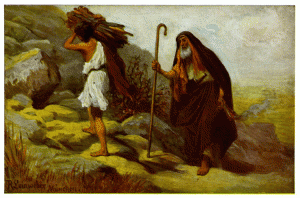
  • At age 37 Abraham bound Isaac to the altar (in Heb. called the akeidah, Gen 22).
  • Isaac was obedient to marry Rebecca, his parents’ choice, unlike Esau. He trusted and had faith in his parents even as he had at the akeida.

He had deep and personal relationship with YHVH.

  • Here we learn that obedience to and faith in and love for parents leads to devotion to YHVH. Honoring one’s parents is the key to honoring YHVH and entering into relationship with him. That is why the fifth commandment to honor one’s parents is placed after the commands to love Elohim. In Genesis 24:63 and 25:21 (see The Stone Tanach rendering of this verse in addition, The ArtScroll Beresheis, p. 1048, which says Isaac prayed abundantly and urgingly, i.e., persistent prayer, a penetrating prayer or request), we see that Isaac had a deep and personal relationship with his Creator.

He had strong faith.

  • Though childless and barren, Isaac and Rebecca kept their faith in the promises of YHVH alive (Gen 25:19–26). In verse 21 we see Isaac seeking YHVH for the answers to life’s dilemmas and tough problems (he had a vibrant and abiding relationship with his Heavenly Father). The same can be said of Rebecca (v. 22).

He was a peacemaker with his neighbors to his own hurt in that he didn’t assert his personal (even legal) rights.

  • Though opposed in the digging of wells, he refused to feud over his legal rights to these wells. He avoided strife and quarreling with his neighbors. After digging the third well, YHVH brought comfort to Isaac’s weary soul (Matthew Henry, p. 38).
  • He was neighborly with his unsaved neighbors. Though Abimelech and his people had wronged Isaac, he did not rebuke them for stealing the first two wells. Was this a sign of Isaac’s meekness or weakness? Matthew says no (p. 38) and Arthur Pink says yes (p. 233).

What are some comparisons between the three patriarchs?

  • Abraham was the man of the altar. He built altars as a form of worship to YHVH. The altar is mentioned more times in connection with Abraham than the other two patriarchs.
  • Isaac was the man of the well. Wells mentioned seven times in connection with Isaac.
  • Jacob was the man of the tent. ­The tent is mentioned more times in connection with Jacob.

What are the spiritual implications of the altar, the well and the tent?

The Abrahamic Covenant is the covenant of salvation (by grace through faith, see Rom 4). The tabernacle (or tent) in the wilderness is a picture of the steps in the salvation process. In one’s spiritual journey toward YHVH Elohim, one must first come to the altar of sacrifice (a picture of the cross), then the one must come to the bronze laver (a picture of baptism or immersion for the remission of sins, spiritual cleansing, the washing of the water by the word, and receipt of the Holy Spirit). Afterwards, one enters the tent or tabernacle to commence a deeper and more intimate relationship with YHVH. Do we not see this progression in the lives of the Patriarchs? They went from the altar to the well, and then into the tent (later the Tabernacle of Moses wherein were the 12 loaves of bread representing the 12 tribes of Israel) from which sprang the 12 sons or tribes of Jacob the tent-dweller?

This shows us how we come into a spiritual relationship with our Father in heaven: We have to start with an encounter with Yeshua at the cross. From there, we must get spiritually cleansed by the washing of the water of Elohim’s Word and be filled with and led by the Holy Spirit. From there, we enter into an intimate relationship with YHVH as we come into his home (the tabernacle is a picture the New Heavens and New Earth with the Holy of Holies picturing the New Jerusalem) and become part of 12 tribes of  redeemed Israel.


What to Do With an Unpayable Debt

Matthew 18:24, 28, Ten thousand talents…a hundred denarii. A talent was a unit of measure for gold and silver and was equivalent to about 75 lbs. One talent of silver at today’s rate of $30 per ounce would be worth $36,000. Ten thousand talents of silver would be worth about $36 million. A denarius was equivalent to a fair day’s wages (Matt 20:2). If one earns $40,000 in a year and works 260 days per year, then 100 denarii would be equivalent to about $15,384.

The lesson of Yeshua’s parable about the unforgiving servant is obvious. If one’s master forgives him of a debt that’s impossible to repay ($36 million), then one should forgive one’s neighbor the small debt of $15,384. Likewise, if Yeshua through his death on the cross forgives a repentant sinner of the wages of sin, which is death (an impossible debt for a sinner to pay), then shouldn’t the same forgiven sinner likewise forgive those who have offended him (Matt 18:6–8) or sinned against him (verse 15–19)?


Nuggets from Genesis 24

Genesis 24:2, 9, Your hand under my thigh. (Heb. yarek; see also 47:29.) Abraham’s servant literally placed his hands on Abraham’s testicles swearing an oath on Abraham’s projected progeny, even as in modern times we place our hands on the Bible. Interestingly, the word testicle or teste derives from the Latin words testis meaning “testimony, testify and testament.” Interestingly, yarek is the same word the KJV translates “hollow of his thigh” in Genesis 32:25 and 32, although, in this case, it seems to be referring to the tendon in the hip.

Genesis 24:6, 8, Beware that you bring not my son there again. Why was Abraham insistent that Isaac not be exposed to Babylon? What was there to beware of (shamar/שמר/shin-mem-resh, Strong’s H8104 meaning “to guard against, protect from, keep watch and ward, preserve, keep oneself from”)? The key is verse seven. What does this teach us about protecting our children and loved ones from corrupting influences? We must be ever vigilant like a soldier on guard duty to preserve and protect our children from those things that could lead to their spiritual ruination. YHVH had led Abraham out of the spiritual filth of Babylon. In no way did he want Isaac to go back to what he had left behind. Are we investing the necessary time and energy into our physical and spiritual children to insure that they do not return to the spiritual Babylon from which we fled prior to our conversion?


Blog Scripture Readings for 11/4 through 11/10/12

Aside

Parashat Chayei Sarah — Genesis 23:1 – 25:18
Haftarah — 1 Kings 1:1–31
Prophets — Judges 9:1 – Judges 16:31
Writings — Psalms 29:1 – 35:28
Testimony — Matthew 19:1 – 22:22

Most of this week’s blog discussion points will be on these passages. If you have general comments or questions on the weekly Scripture readings not addressed in a blog post, here’s a place for you to post those. Just use the “leave a reply” link below.

The full “Read Through The Scriptures In A Year” schedule, broken down by each day, can be found on the right sidebar under “Helpful Links.” There are 4 sections of scripture to read each day. One each from the Torah, the Prophets, the Writings, and from the Testimony of Yeshua. Each week, the Torah and haftarah readings will follow the traditional one-year reading cycle.

Weekly Blog Scripture Readings for 11/4 through 11/10/2012


Are You a “Lot’s Wife?”

Genesis 19, The story of Lot and us. Is Lot a picture of the typical modern born-again believer whether Christian or Messianic Israelite? I believe so. In saying this, as a pastor and having been a watchman on the spiritual wall for many years, I see very little if any differentiation (broadly speaking) between Christians and most Messianics, for the spiritual condition of both groups is fundamentally the same.

Primarily what differentiates the two groups is the nomenclatures each group uses and the outward religious trapping or externals each uses to identify itself. What about Torah, you may ask? Don’t Messianics obey the Torah and Christians do not? My response is that there is not a huge difference between the two—at least not from the Creator’s perspective who looks at hearts, and not merely superficiality of outward appearances and religious trappings.

In reality, both born-again Christians and born-again Messianics follow Torah principles to one degree or another. The only difference is that the former group does not claim to follow Torah, but teaches that it was “done away with,” but in fact, to a certain degree, Christians do follow the “moral” principles of the Torah and tithing. On the other hand, Continue reading →


Binding and Loosing

Matthew 16:17–19, Bind … loose. Yeshua clearly gave the authority of the Sanhedrin (the ruling body of Jewish leaders in Ye­shua’s day) over to his apostolic disciples.

No longer do we need to look to the authority of the religious Jewish leaders for determining how to obey YHVH, nor for making rulings pertaining to religious service. First, there is no Sanhedrin today to tell us these things. Second, in Matthew 16:17–19, Yeshua clearly transferred to his apostles—the church leaders of that time—the authority of the Sanhedrin to make judicial rulings and decisions about spiritual matters pertaining to his kahal (the congregation or church). This authority would include making determinations about the biblical calendars.

No longer, does the kahal of Yeshua have to wait for a Jewish Sanhedrin to form to tell them how to follow the Word of Elohim with regard to the biblical calendar or any other subjects for that matter. Today, the spiritual apostolic leaders of the saints can simply teach and do what the Bible says, and heaven will honor or endorse their decisions (called “binding” and “loosing”)! That’s what Yeshua says in Matthew 16:19, and this is exactly what his apostolic leaders did in Acts 15 at the first apostolic council.


Blog Scripture Readings for 10/28 through 11/3/12

Aside

Parashat Vayera — Genesis 18:1 – 22:24
Haftarah — 2 Kings 4:1–37
Prophets — Judges 1:1 – Judges 8:35
Writings — Psalms 22:1 – 28:9
Testimony — Matthew 14:22 – 18:35

Most of this week’s blog discussion points will be on these passages. If you have general comments or questions on the weekly Scripture readings not addressed in a blog post, here’s a place for you to post those. Just use the “leave a reply” link below.

The full Scripture Reading Schedule broken down by each day can be found on the right sidebar under “Helpful Links.” There are 4 sections of scripture to read each day. One each from the Torah, the Prophets, the Writings, and from the Testimony of Yeshua. Each week, the Torah and haftarah readings will follow the traditional one-year reading cycle. By the end of next Sukkot, you will have read all scriptures from Genesis to Revelation!

Weekly Blog Scripture Readings for 10/28 through 11/3/2012