Do you have full peace or a piece of peace?

Man’s peace versus…

Isaiah 26:3, Peace. Heb. shalom. This word is spelled in its undiminished form (i.e. shin, lamed, vav, mem sofit) here containing the Hebrew letter vav (as opposed to other places in the Hebrew Scriptures where shalom is spelled deffectively [i.e. shin, lamed, mem sofit] without the letter vav denoting an incomplete or human-originated peace). What can we learn from this interesting anomaly that is not visible in our English Bibles?

This verse is referring to that deep and inner soul-quenching peace of Elohim that passes all understanding that comes through a relationship with Yeshua the Messiah (Phil 4:7)—the fruit of the Spirit, as opposed to human or earthly, temporal peace. This peace comes because of our salvation through Yeshua, which is our spiritual bulwark and wall as stated in verse one. This is the same peace that Yeshua talked about when he said, “Peace I leave with you, My peace I give to you; not as the world gives do I give to you. Let not your heart be troubled, neither let it be afraid” (John 14:27).

If you don’t know this peace that calms the storms in your heart and mind, forgives sin, takes away all one’s shame and guilt and replaces it with love, joy, peace, hope and assurance of eternal life after you die, then now is the time to put your faith in Yeshua the Messiah, repent of your sins and love and obey him for the rest of your life. As the saying goes, know Yeshua, know peace; no Yeshua, no peace.

the peace that comes from heaven.
 

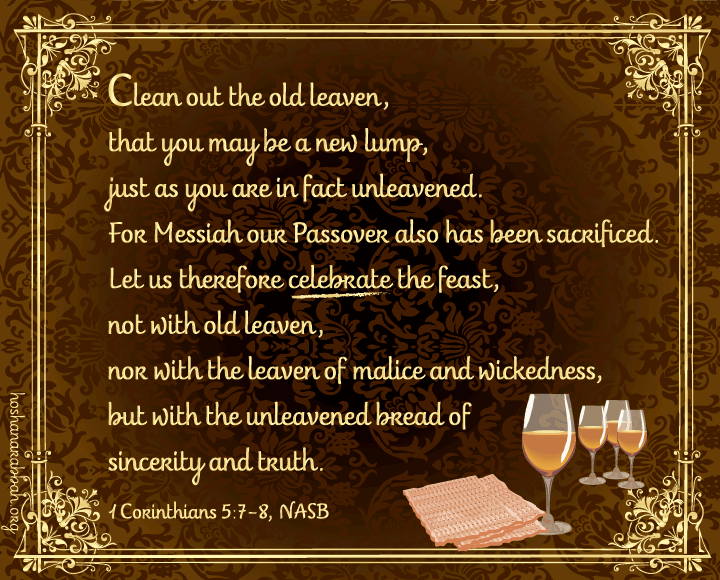
Chag Sameach! Happy First Day of the Feast of Unleavened Bread!

Many of you who are new to this blog may also be new to the biblical festivals, which Yeshua and his disciples, including the book Acts believers, all celebrated in accordance with the Creator’s (that’s Yeshua) life-giving, blessing-producing commandments.

Over the years, Hoshana Rabbah not only through this blog, but through our website and You Tube channel have produced numerous resources to help you to understand as well as to celebrate the Feast of Unleavened Bread in the biblical way. Today is the first of seven days

Below are some free resources that will help you to do just that.

Happy studying, and as you come to understand better the biblical roots of our faith, may you grow in your spiritual walk and your love for the Word of Elohim and Yeshua our Messiah!

https://hoshanarabbah.org/blog/?s=Feast+of+Unleavened+Bread&submit=Search


Blog Scripture Readings for 4-5 Through 4-11-20

Aside

Parashat — (No reading for this week)
Haftarah — (No reading for this week)
Prophets — Isaiah 27:1 – 35:10
Writings — Proverbs 29:1 – 31:31; Job 1:1 – 4:21
Testimony — Acts 3:1 – 7:16

Our new annual Scripture Reading Schedule for 2019-2020 with daily readings is available to download and print. If you are still working through 2018-2019’s Scripture Reading Schedule, the link will still be available on the right sidebar under “Helpful Links”. If you are using a mobile device or tablet, the link may be below, meaning you’ll need to scroll down instead.

Most of this week’s blog discussion points will be on these passages. If you have general comments or questions on the weekly Scripture readings not addressed in a blog post, here’s a place for you to post those. Just use the “leave a reply” link or the “share your thoughts” box below.

The full “Read Through The Scriptures In A Year” schedule, broken down by each day, can be found on the right sidebar under “Helpful Links.” There are 4 sections of scripture to read each day: one each from the Torah, the Prophets, the Writings, and from the Testimony of Yeshua. Each week, the Torah and haftarah readings will follow the traditional one-year reading cycle.

Weekly Blog Scripture Readings for 4/5 through 4/11/2020.


Blog Scripture Readings for 3-29 Through 4-4-20

Aside

Parashat Tzav — Leviticus 6:1 (8)* – 8:36
Haftarah — Jeremiah 7:21 – 8:3; 9:22-23 | Malachi 3:4-24**
Prophets — Isaiah 19:1 – 26:21
Writings — Proverbs 22:1 – 28:28
Testimony — John 19:1 – 21:25; Acts 1:1 – 2:47

Our new annual Scripture Reading Schedule for 2019-2020 with daily readings is available to download and print. If you are still working through 2018-2019’s Scripture Reading Schedule, the link will still be available on the right sidebar under “Helpful Links”. If you are using a mobile device or tablet, the link may be below, meaning you’ll need to scroll down instead.

Most of this week’s blog discussion points will be on these passages. If you have general comments or questions on the weekly Scripture readings not addressed in a blog post, here’s a place for you to post those. Just use the “leave a reply” link or the “share your thoughts” box below.

The full “Read Through The Scriptures In A Year” schedule, broken down by each day, can be found on the right sidebar under “Helpful Links.” There are 4 sections of scripture to read each day: one each from the Torah, the Prophets, the Writings, and from the Testimony of Yeshua. Each week, the Torah and haftarah readings will follow the traditional one-year reading cycle.

** A different Haftarah is read when it is a special sabbath in Jewish tradition. This week it is Shabbat HaGadol on the traditional calendar and Malachi 3:4-24 is read. Otherwise, Jeremiah 7:21 – 8:3; 9:22-23 would be read.

* Verse numbers in parenthesis refer to the verse number in Christian English Bibles when they differ from Hebrew Bibles or the Tanakh.

Weekly Blog Scripture Readings for 3/29 through 4/4/2020.


Blog Scripture Readings for 3-22 Through 3-28-20

Aside

Parashat Vayikra — Leviticus 1:1 – 5:26 (6:7)*
Haftarah — Isaiah 43:21 – 44:23
Prophets — Isaiah 9:1 – 18:7
Writings — Proverbs 15:1 – 21:31
Testimony — John 13:17 – 18:40

Our new annual Scripture Reading Schedule for 2019-2020 with daily readings is available to download and print. If you are still working through 2018-2019’s Scripture Reading Schedule, the link will still be available on the right sidebar under “Helpful Links”. If you are using a mobile device or tablet, the link may be below, meaning you’ll need to scroll down instead.

Most of this week’s blog discussion points will be on these passages. If you have general comments or questions on the weekly Scripture readings not addressed in a blog post, here’s a place for you to post those. Just use the “leave a reply” link or the “share your thoughts” box below.

The full “Read Through The Scriptures In A Year” schedule, broken down by each day, can be found on the right sidebar under “Helpful Links.” There are 4 sections of scripture to read each day: one each from the Torah, the Prophets, the Writings, and from the Testimony of Yeshua. Each week, the Torah and haftarah readings will follow the traditional one-year reading cycle.

* Verse numbers in parenthesis refer to the verse number in Christian English Bibles when they differ from Hebrew Bibles or the Tanakh.

Weekly Blog Scripture Readings for 3/22 through 3/28/2020.


Blog Scripture Readings for 3-15 Through 3-21-20

Aside

Parashat Vayakhel-Pekudei — Exodus 35:1 – 40:38
Haftarah — 1 Kings 7:51 – 8:21 | Exodus 12:1-20; Ezekiel 45:16 – 46:18**
Prophets — Isaiah 1:1 – 8:22
Writings — Proverbs 8:1 – 14:35
Testimony — John 10:1 – 13:16

Our new annual Scripture Reading Schedule for 2019-2020 with daily readings is available to download and print. If you are still working through 2018-2019’s Scripture Reading Schedule, the link will still be available on the right sidebar under “Helpful Links”. If you are using a mobile device or tablet, the link may be below, meaning you’ll need to scroll down instead.

Most of this week’s blog discussion points will be on these passages. If you have general comments or questions on the weekly Scripture readings not addressed in a blog post, here’s a place for you to post those. Just use the “leave a reply” link or the “share your thoughts” box below.

The full “Read Through The Scriptures In A Year” schedule, broken down by each day, can be found on the right sidebar under “Helpful Links.” There are 4 sections of scripture to read each day: one each from the Torah, the Prophets, the Writings, and from the Testimony of Yeshua. Each week, the Torah and haftarah readings will follow the traditional one-year reading cycle.

** A different Haftarah is read when it is a special sabbath in Jewish tradition. This week it is Shabbat HaChodesh on the traditional calendar with a special reading. Otherwise, 1 Kings 7:51–8:21 would be read.

Weekly Blog Scripture Readings for 3/15 through 3/21/2020.