The Two Sticks Prophecy Yet to Be Fulfilled

Ezekiel 37:14–28, The vision of the two sticks (trees). The second vision Ezekiel records in chapter 37 involves YHVH commanding him to take two sticks (or trees) and writing upon one stick “for Judah and for the children of Israel and his companions [i.e., those who have knit themselves together with or joined to the tribe of Judah],” and upon the other stick, write “for Joseph, the stick of Ephraim, and for all the house of Israel and his companions.” Ezekiel was to told to then join the two sticks together, so that they would become one stick (or tree) in his hand (verses 15–17).
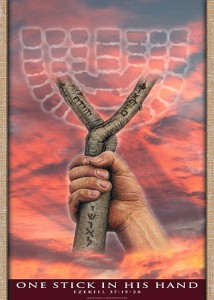
One Stick in His Hand

Image courtesy of messianicisrael.com

How were these two nations, which separated from each other some three thousand years ago, to be rejoined into one nation? That has been the subject of much debate between both Jewish and Christian commentators for years. Some modern historical revisionists view this prophecy as having been fulfilled when the Jews returned to the land of Israel in the time of Ezra and Nehemiah after their Babylonian captivity ended. But this interpretation leaves some unanswered questions. The book of Ezra, which chronicles the return of a remnant of Jews from Babylon to the land of Israel, lists the numbers and tribes of those who returned. All the tribes listed were originally from Jerusalem and Judah and were from the tribes of Judah and Benjamin (Ezra 2:1; 4:1; 10:9), and there is no mention made that any of the ten northern Israelite tribes joined the Jews in resettling the land of Israel. So far as the returning Jews were concerned, it is likely that they considered their northern brothers lost and assimilated among their Assyrian captors and that only they were left of all the twelve tribes to resettle the Promised Land after their captivity. If this were so, Continue reading →


New Video: Islam—YHVH’s Judgment on Christians to Bring Spiritual Revival

This video discusses how the biblical prophets predicted the rise of the demonic religion of Islam in the days before the second coming of Yeshua the Messiah. This would coincide with the end-times spiritual apostasy of Jews and Christians, and would be part of Elohim’s divine plan to lovingly discipline his wayward children and bring them back to him through repentance resulting in spiritual revival and the eventual demise of Islam.


Blog Scripture Readings for 7/7 through 7/13/13

Aside

Parashat D’varim — Deuteronomy 1:1 – 3:22
Haftarah — Isaiah 1:1 – 1:27
Prophets — Ezekiel 36:1 – 42:20
Writings — Ezra 4:1 – Ezra 10:44
Testimony — Galatians 3:1 – 6:18; Ephesians 1:1 – 3:21

Most of this week’s blog discussion points will be on these passages. If you have general comments or questions on the weekly Scripture readings not addressed in a blog post, here’s a place for you to post those. Just use the “leave a reply” link below.

The full “Read Through The Scriptures In A Year” schedule, broken down by each day, can be found on the right sidebar under “Helpful Links.” There are 4 sections of scripture to read each day. One each from the Torah, the Prophets, the Writings, and from the Testimony of Yeshua. Each week, the Torah and haftarah readings will follow the traditional one-year reading cycle.

Weekly Blog Scripture Readings for 7/7 through 7/13/13.


Islam: YHVH’s Judgment to Bring Jews & Christians Back to Him

This is a hard message. Few will be able to receive it. But the watchman must give it anyway (Ezekiel 33:1–11).

The Ancestry of Modern Arabs

In Genesis 32, Esau and his army stood in the way preventing Jacob and his descendants from returning to their homeland — the land YHVH had promised to them. This historical event is prophetic of what will happen in the end times as the Jews and the rest of the Israelites endeavor to receive their promised inheritance and the kingdom of Elohim.

198298

Not only that, YHVH used Esau to test Jacob’s who had grown overly self-confident due to his business acumen and his ability to produce a large family clan. In the ancient world, he had reached the pinnacle of wealth and power. However, what mattered to YHVH more than these things was the character of a man. Would Jacob have faith in his Creator, or would he trust in his own abilities to outwit his adversaries and come out on top as he had done twice previously with his brother Esau and Laban, his uncle? Jacob’s confrontation with his brother at the threshold of the land of Israel and his wrestling with the Messenger from heaven were the two tests that he had to pass. The Bible calls this Jabob’s Trouble and prophesies that something similar will occur in the end times to Jacob’s descendants (Jer 30:7).

According to Genesis 32, Jacob divided his wives and children into two camps (Gen 32:1, 7). This was prophetic of what would eventually occur to the nation of Israel after the death of King Solomon. The one nation of Israel became two houses or kingdoms — the Northern Kingdom of Israel and the Southern Kingdom of Israel. The descendants of these two kingdoms are presently — loosely speaking — the Jews and the Christians. But who are the descendants of Esau historically and, more importantly, today. Why is it important to know?

Many, if not most of the modern Moslems (especially the Arabs) trace their lineage back if not biologically then spiritually to Ishmael, the son of Abraham by Hagar. Islam in its religious book, the Koran, claims that it was Abraham and Ishmael who founded the religion of Islam and built the Kaaba, which is the small building containing a stone that supposedly fell from heaven. This shrine is located in the midst of the great mosque in Mecca, Saudi Arabia. Of Ishmael and his descendents, the Bible prophesies in Genesis 16:11–12,

The Messenger of YHVH said to her further, “Behold, you are with child, and you shall bear a son; and you shall call his name Ishmael, because YHVH has given heed to your affliction. And he will be a wild donkey of a man, his hand will be against everyone, and everyone’s hand will be against him; and he will live to the east of all his brothers.”

The Koran has further twisted the biblical account to declare that the biblical patriarchs were Muslims and that Abraham gave the birthright blessing to Ishamael instead Isaac. Both Israelites and Arabs, therefore, believe that they have a right to the Promised Land of Canaan, and, hence, thus forming the basis for the modern Arab-Israeli conflict. Continue reading →


For Profit Prophets—Like Balaam

Numbers 31:8, Balaam … they slew with the sword. Jude 11 talks about Balaam being greedy for money and indicates that there are those in the end times in the body of Yeshua who will follow after this sin. How is this possible? What will be the ultimate fate of these “tares”? (See Matt 13:40.)

Balaam prophesies 2

Had Balaam believed his own good prophecies concerning Israel and not have sided with Israel’s enemies, would he no doubt would have been spared the sword of YHVH’s justice. What were his motives for siding with them?

Greed and materialism blind one from YHVH’s truth and cause one to side with YHVH’s enemies. What is the end result of this action?

Balaam was a deceiver and a hypocrite. He spoke one thing and did something else. Are we ever guilty of this? How rampant is the sin of duplicity within the body of believers in Yeshua?

There are people who claim to be prophets in the church who, like Balaam, speak soothing and ear-tickling prophetic words in order to profit from the people. How can we know the difference between true and false prophets? A true prophet is not greedy like Balaam. (Read Deut 18:20–22 and Matt 7:15–20.) Can a true prophet of Elohim prophesy out of the flesh something false, and if he repents, when he finds he was in error, be spared from the death penalty? (Read 2 Sam 7:1–17.)


Blog Scripture Readings for 6/30 through 7/6/13

Aside

Parashat Matot-Masei — Numbers 30:2 (1)* – 36:13
Haftarah — Jeremiah 2:4-28; 3:4
Prophets — Ezekiel 29:1 – 35:15
Writings — Daniel 9:1 – 12:13; Ezra 1:1 – Ezra 3:13
Testimony — 2 Corinthians 10:1 – 13:13; Galatians 1:1 – 2:21

Most of this week’s blog discussion points will be on these passages. If you have general comments or questions on the weekly Scripture readings not addressed in a blog post, here’s a place for you to post those. Just use the “leave a reply” link below.

The full “Read Through The Scriptures In A Year” schedule, broken down by each day, can be found on the right sidebar under “Helpful Links.” There are 4 sections of scripture to read each day. One each from the Torah, the Prophets, the Writings, and from the Testimony of Yeshua. Each week, the Torah and haftarah readings will follow the traditional one-year reading cycle.

Weekly Blog Scripture Readings for 6/30 through 7/6/13.

*Verse numbers in parenthesis refer to the verse number in Christian Bibles.


It’s Time to Rise Up Against Evil!

Numbers 25:7, Phinehas…took a javelin. Phinehas, the priest, rose up against evil and took a stand for righteousness and YHVH commended him for it. In this case, the grandson of Aaron the high priest was not acting as a self-appointed vigilante as it may appear. Rather, YHVH had given the priests the authority to act as judges in Israel and to pronounce sentence in criminal matters (Deut 17:9–11). Additionally, Phinehas was doubly justified in his action against the physical and spiritual fornicators, since he was an eyewitness of these sins, and the Torah teaches that the hand of the eyewitness was to be the first to rise up in executing judgment against the criminals (Deut 17:6; Ezek 44:24). So as an eyewitness and as a priest, he was legally justified in his actions. The priests and Levites were to act as Israel’s legal experts (Lev 10:10–11; Deut 24:8; 33:10; 2 Chron 17:9; 30:22; Neh 8:2, 8; Hag 2:11; Ezek 44:23; Mal 2:7) and to make determinations between the holy and the profane (Ezek 22:26; 44:23).

Soldier 33398211

Who are YHVH’s priest on the earth today? According to Peter, and John the saints are those priests (1 Pet 2:7; Rev 1:6; 5:10; 20:6). As such, the saints presently possess the divinely mandated legal authority to fulfill the responsibilities of the priesthood of old when it comes to teaching the laws of Elohim to the nations in which they live. Yeshua, our Great High Priest, has tasked his disciples with the responsibility and authority to judge righteously (i.e., to make judgments according to YHVH’s standards of righteousness, John 7:24), and to be spiritual fruit inspectors (Matt 7:15–20). Today, this responsibility is primarily exercised within the congregation of the righteous. However, besides this, the righteous saints are to act as spiritual salt in this world and to be like a spiritual light on a hill for the world to see (Matt 5:13–16). They are to preach the gospel to the world, to make disciples and to teach those around them all that Yeshua has commanded them (Matt 28:18–20; Mark 16:15–16). This means that the saints have heaven’s authority and commission to act as the spiritual and moral compass and conscience for the nations in which they live. This means that they will be standing against evil whereever and however they can as directed by the Spirit of Elohim, even as Phinehas did.

It is time that the righteous servants of YHVH Elohim begin to stand up in a more vocal and demonstrative way against the evil that is being foisted upon our society Continue reading →