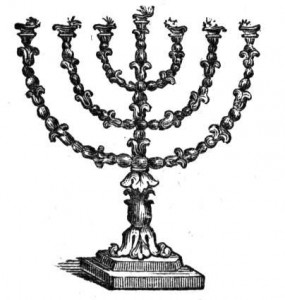
Numbers 8:2, The menorah. The phrase toward the face of the menorah is an interesting one. The Jewish sages teach that the three wicks on the right and the three on the left were all directed toward the menorah’s central stem, thus concentrating light toward the center. The menorah symbolized that YHVH is the Source of all light (The ArtScroll Stone Edition Chumash, p. 775). What are the connotations of this for a believer in Yeshua? How did Yeshua describe himself? (See John 8:12; 9:5.) Moreover, what did he mean when he said that “I am the vine and you are the branches?” (John 15:5) What does this mean and how is this pointing to a type of human menorah? Now relate this to the seven Messianic assemblies of Revelation 2 and 3 being likened to menorahs (Rev 1:13, 20). Is Yeshua the center of all that we do? Do we place all of our focus on him? Can we say, as the Apostle Paul did, that “in him we live and move and have our being” (Acts 17:28)? Does the power of his resurrected life and anointing flow through you even as oil was in the menorah and sap flows through a tree to its branches?
Redeemed Israelites Are That Menorah
The Scriptures plainly states that Yeshua and his body of followers are likened to a tree of which the seven-branched menorah that adorned the mishkan (tabernacle) in the wilderness as well as the sanctuary of Solomon’s Temple is a picture. Furthermore, remember what Yeshua said in John 15:5? “I am the vine and you are the branches …” This is a perfect picture of the menorah, which has a central trunk with six (the number representing man) branches growing out of the trunk. Remember what Yeshua said in Matthew 5:14–15, that his followers were to be lights upon a lampstand on a hill for all the world to see—a clear allusion in the mind of anyone in Yeshua’s audience to the temple’s menorah (which was upon the Temple Mount like a light on a hill).
Additionally, when a redeemed believer in and follower of Yeshua is in a sacred state of worshipping his Master and Savior, he will often lift his arms heavenward. Not only is this the universal sign of surrender (in this case to one’s Heavenly Master), but when we lift our hands our bodies are actually forming a human menorah. By doing this, in worship we are acting out what we are—a lampstand to the world radiating forth the good news of the truth and love of Yeshua.
In fact, The Scriptures shows us that the menorah, and not the cross, is the symbol of Yeshua’s spiritual body of believers. We see this in Revelation 1:12, 20 and 2:1 where the seven congregations are symbolized as a seven-branched menorah! The menorah here is the symbol of the congregation of redeemed believers.
Though the cross is representative of the redemptive work Yeshua accomplished on our behalf, it is not the symbol of the body of believers, commonly called the “church,” but the menorah is! Furthermore, in Jewish thought, the menorah is analogous to an olive tree (the ancient temple menorah was constructed of hollow tubes of solid gold filled with olive oil that burned when lit), to which the Apostle Paul makes reference in Romans 11, as representing the tree of life (which ultimately represents Yeshua) into which all must be grafted if they are to be part the spiritual body of Yeshua and have his eternal life.