Leviticus 16:8, The scapegoat. The Soncino Pentateuch says of the azazel goat of Leviticus 16:10 that the word scapegoat, as used in the KJV, is a poor translation and should be rendered as dismissal. In the Septuagint it is translated as the one to be sent away which agrees with the term used in the Mishnah. Azazel is not a proper name, but a rare Hebrew noun (kZtZG from ZG meaning goat and kZt meaning to go away) meaning dismissal, or entire removal. It is the technical term for the entire removal of sin and guilt of the community, that was symbolized by the sending away of the goat into the wilderness.
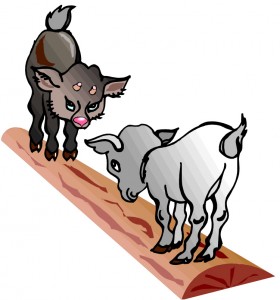
There is some difference of opinion as to the symbolic meaning of the azazel goat. Some say it is a picture of Satan who initially tempted man to sin or to rebel against Elohim, and has been doing so ever since. Since he is the source of sin and since he is responsible for man sinning, he must consequently bear the responsibility for his actions which he will do when he is bound and thrown into the bottomless pit at the beginning of the millennium. The azazel goat being dismissed into the wilderness is a picture of this. On the other side, there are those who teach that the azazel goat is a picture of Yeshua who bore our sins upon himself and died alone in our place. Which view is correct? Well, both. Sort of…
The most important key to determining who this goat represents is found in Lev 16:10,
But the goat, on which the lot fell for Azazel, shall be set alive before YHVH, to make atonement over him, to send him away for azazel into the wilderness.
Note the highlighted portion. Who made atonement for our sins? Satan or Yeshua? Scripture does not reveal the devil as the redeemer of mankind. Of Yeshua being our atonement the Scripture say:
And not only so, but we also joy in Elohim through our Master Yeshua the Messiah, by whom we have now received the atonement. (Rom 5:11)
Who being the brightness of his glory, and the express image of his person, and upholding all things by the word of his power, when he had by himself purged our sins, sat down on the right hand of the Majesty on high. (Heb 1:3)
Who needeth not daily, as those high priests, to offer up sacrifice, first for his own sins, and then for the people’s: for this he did once, when he offered up himself. (Heb 7:27)
For then must he often have suffered since the foundation of the world: but now once in the end of the world hath he appeared to put away sin by the sacrifice of himself. (Heb 9:26)
Furthermore, the act of laying on of hands (Lev 16:21) onto the azazel goat symbolizes the transference of sins from the guilty party (the children of Israel) to the innocent azazel goat. The innocent becomes the sin-bearer. Of course, who can deny that this is a perfect picture of Yeshua, and not Satan!
Spiritually, the azazel goat represents the entire removal of sin’s defilement from the camp of Israel into the wilderness. In Psalms 103:12 Elohim removes our sins from us as far as the east is from the west. YHVH does this, not Satan!
In Lev 16:22 we read, “And the goat shall bear upon him all their iniquities unto a land not inhabited: and he shall let go the goat in the wilderness.” Throughout the Scriptures there are numerous references to Yeshua bearing our sins.
All we like sheep have gone astray; we have turned every one to his own way; and YHVH hath laid on him the iniquity of us all. (Isa 53:6)
Therefore will I divide him a portion with the great, and he shall divide the spoil with the strong; because he hath poured out his soul unto death: and he was numbered with the transgressors; and he bare the sin of many, and made intercession for the transgressors. (Isa 53:12)
So Messiah was once offered to bear the sins of many; and unto them that look for him shall he appear the second time without sin unto salvation. (Heb 9:28)
Who his own self bare our sins in his own body on the tree, that we, being dead to sins, should live unto righteousness: by whose stripes ye were healed. (1 Pet 2:24)
I believe that the azazel goat has a secondary meaning, as well. Though it doesn’t outrightly represent Satan, but Yeshua, we will see that our Savior, blessed be him, while hanging on the cross represented sin in its totality and in its extreme, and so for a brief moment took on the image of the serpent himself. Yeshua said of himself in John 3:14: “And as Moses lifted up the serpent in the wilderness, even so must the Son of man be lifted up.” In Scripture, the serpent is a picture of the Satan, the adversary (Gen 3:1, 2, 4, 13, 14, 15: Rev 12:9; 20:2).
In Lev 16:8 we see that as the two goats stood before the high priest, one on his right hand and one on his left, the lots would be cast and one would become the azazel goat and one would be the goat that would be sacrificed in the tabernacle sanctuary itself. An interesting note that may have a bearing here: Hebraically, the right hand is the hand of strength, power and judgment, while the left land is the hand of mercy and grace.
Both Adam Clarke and Matthew Henry in their commentaries say that both goats refer to a different aspect of Yeshua’s atonement. Henry says, “Thus [Yeshua] was prefigured by the two goats, which both made one offering: the slain goat was a type of [Messiah] dying for our sins, the scapegoat a type of [Messiah] rising again for our justification…[after which] the entrance into heaven which [Messiah] made for us is here typified by the high priest’s entrance into the most holy place (Heb 9:7)” (Matthew Henry’s Commentary On the Whole Bible, vol. 1, p. 509). Henry doesn’t explain just how the goat going into the wilderness typifies Yeshua’s redeeming us, but I should like to offer an alternative idea in this regard. Perhaps, the azazel goat represented Yeshua’s soul descending into hell and there taking the keys of death (1 Pet 3:18–20; Rev 1:18). Some fun speculation to contemplate!