Natan’s Commentary on Judges 17 to 20

Judges 17

Judges 17:3, I had wholly dedicated. Micah’s mother made a foolish and unlawful vow to YHVH, as did Jephthah in chapter 11. Vows to YHVH are a serious thing and should be made in a righteous manner to righteous ends. 

Judges 17:10, Be a father. For ten shekels, a suit of clothes, food and lodging, Michah hired an out of work Levite to be his own personal minister of his own manmade religion. Hireling ministers are a dime a dozen. Religious systems of men produce hirelings. This is a false spiritual paradigm that is self-sustaining and self-perpetuating. 

Judges 17:13, Now I know. Michah cared nothing about serving YHVH and obeying his commandments. His only concern for religion was for self-gratification.

Judges 18

Judges 18:30–31, Manasseh…carved image. The son of Manasseh [Moshe/Moses]. The MT reads ﬣשׁמ/Moshe (Moses) with a hanging nun/נ‭ ‬inserted by the Jewish sages between the mem מ and the shin שׁ to make it read Manashe in an effort to hide the fact that the direct descendants of Moses became idol-worshippers. Jewish scholars readily admit this, and acknowledge the fact that the word Moshe is in the original (The Artscroll Rubin Edition Joshua-Judges Commentary, p. 223). Various versions of the LXX translate it either way. The Targums and the Syriac have Manasseh. (See Keil and Delitzsch, Adam Clarke and Bullinger in his Companion Bible for a more detailed discussion of this. The NIV, NRSV, RSV and ASV have Moses instead of Manasseh, while the NAS and NKJV have the latter, but add a footnote indicating that Moses as an alternate rendering. 

Judges 19

Judges 19:24–25, Here is my virgin daughter…his concubine.This is nothing more than the degradation and abuse of women. This incident speaks volumes about the status of women in the ancient world. Even though the Torah uplifts and upholds the status of women, the neighboring pagan cultures, which the Israelites tended to follow, obviously did not. Islam and the Koran still follow these ancient practices viewing woman as property, chattel and second class citizens. 

Judges 20

Judges 20:1–48, A lesson in warfare.Israel took a stand for righteousness against the sin of homosexuality. They did the right thing by inquiring of YHVH whether to go up against the Benjaminites who were harboring the sexually deviant brothers. 

Twice YHVH told the Israelites to go up against Benjamin and that he would give them victory. Twice Israel was defeated losing thousands of soldiers. Each time afterwards, Israel did the right thing by humbling themselves, weeping and seeking YHVH’s counsel. The third time, Israel was victorious against Benjamin. 

This begs an important question. Why wasn’t Israel victorious the first two times? Perhaps there was sin in the camp as was the case with Achan when the Israelites were defeated at Ai. The Israelites were right in punishing the unrepentant tribe of Benjamin, yet the rest of Israel wasn’t without sin either. After all, the Levite who had a concubine (a type of sex slave) in the first place, and then gave her to the mob of bisexual deviants to abuse and murder was also a guilty party. Not only that, the rest of Israel had failed to hold the Levite accountable for his sin. 

What was the Levite’s sin? First, he should not have had a concubine sex slave. Second, he should have protected her from the mob. Obviously such practices were common among the Israelites—even among the Levitical leaders who YHVH had commissioned to be the guardians and teachers of the Torah—YHVH’s standard of righteous and set-apart living. 

If the leaders of nation are morally and spiritually compromised, what is to become of the rest of the nation? Moreover, how is YHVH to bless such a nation by delivering them from their enemies when they themselves are sin-laden? 

When expecting YHVH’s help and deliverance from our enemies and before engaging our enemies, we must clean our own house spiritually by repenting of sin. If not, we shouldn’t expect victory, or at best, only a partial victory, which is also a partial defeat. When a nation is not serving and obeying YHVH completely, and as a result, there is sin in the nation’s camp, and everyone in that nation is doing what’s right in his own eyes, and there is no strong, righteous central leadership in that nation (Judg 21:25), the fate of that nation will be what Israel experienced in this story. YHVH will be with them, but only up to the level their obedience to him merits it. This is a result of the divine law of cause and effect—the law of reciprocity. One reaps physically and spiritually what one sow.

Judges 20:28, Phinehas the son of Eleazar.Either Phinehas was hundreds of years old, or this story is an anachronism, or out of chronological order. Adam Clarke in his commentary on this verse suggest that this event occurred shortly after the death of Joshua. If this is the case, then the book of Judges is not written in chronological order.


 

Lessons From the Life and Death of Samson

Judges 14

Judges 14:8–9, Honey out of the carcass. Although Samson’s parents followed the Messenger of YHVH’s instructions and dedicated him as a Nazarite (Judg 13:5), Samson was not a totally committed to his divine calling as a Nazarite; he played around the edges of obedience with regard to the Torah’s strictures with regard to the requirements to be a Nazarite (Num 6:1–22). 

An example of Samson’s careless approach to being a Nazarite includes his touching a dead lion carcass, and spending time in the Valley of Sorek (or grapevine), where he fell under the sway of Delilah (Judg 16:4ff). A Nazarite was to get nowhere near either a dead carcass or grape products (Num 6:3, 6). This teaches us two things. Samson’s parents chose his religion for him and dedicated him to YHVH’s service, and he begrudgingly went along with it, but he did not fully own his parents’ vision for his life; it was not his choice. The lesson here is that parents can raise their children correctly, but it is up to each child to embrace and then walk in the path they have set before them. Whether they do or do not, it is up to them to do so, and they will be blessed or cursed accordingly.

The second lesson is that because Samson had not fully embraced his divine calling as a lifelong Nazarite, he played around the edges of sin. Eventually, the sin sucked him into its maw, and we fell spiritually and suffered the resultant consequences of his bad choices. When we know to do right by giving sin and temptation a wide berth, we will be less likely to be drawn away and to fall to it. Samson failed to do this and the consequences for his life were disastrous. James the apostle has something to say about this.

Blessed is the man who endures temptation; for when he has been approved, he will receive the crown of life which the Lord has promised to those who love Him. Let no one say when he is tempted, “I am tempted by Elohim”; for Elohim cannot be tempted by evil, nor does He Himself tempt anyone. But each one is tempted when he is drawn away by his own desires and enticed. Then, when desire has conceived, it gives birth to sin; and sin, when it is full-grown, brings forth death. (Jas 1:12–15)

Sadly, in many respects, Samson was a lover of this world more than a lover of Elohim. Because of his lust for women and giving in to the carnal desires of the flesh, his weakness resulted in his ignominious fall. Again James warns us,

Adulterers and adulteresses! Do you not know that friendship with the world is enmity with Elohim? Whoever therefore wants to be a friend of the world makes himself an enemy of Elohim. Or do you think that the Scripture says in vain, “The Spirit who dwells in us yearns jealously”? But He gives more grace. Therefore He says: “ELOHIM RESISTS THE PROUD, BUT GIVES GRACE TO THE HUMBLE.” Therefore submit to Elohim. Resist the devil and he will flee from you. Draw near to Elohim and He will draw near to you. Cleanse your hands, you sinners; and purify your hearts, you double-minded. (Jas 4:4–8)

Despite Samson’s carnal weaknesses and spiritual failures, he was still given a place of recognition in the Scriptures’ “Hall of Faith” in Hebrews chapter eleven (Heb 11:32). This speaks volumes about YHVH’s mercy and grace for those who act valiantly in service to his kingdom despite their weaknesses. James, again, speaks to us in this regard,

[Elohim’s] mercy triumphs over judgment. (Jas 3:13 cp. Pss 85:10; 89:14)

Judges 15

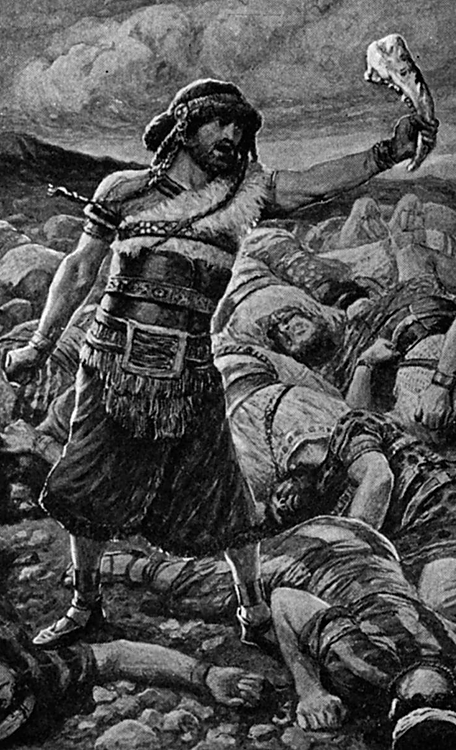
Judges 15:15, Jawbone of a donkey. Samson exercised resourcefulness and ingenuity and used what was at hand to fulfill is divine mission and purpose. In this case, he used the jawbone of a donkey to slay 1,000 Philistines, who were the enemies of Israel and the illegal inhabitants of the land that Elohim had given to the Israelites. We learn from this that if we want to be a profitable servant of Elohim, we can use anything at our disposal to help advance his kingdom. How many times have you heard someone say, I were rich, or if I won the lottery, then I would do such and such for the Lord? Frankly, this is often a cop out to excuse one’s failure in fulfilling one’s Christian duties and responsibilities to help advance the kingdom of Elohim. Such a person is actually burying their talents in the sand and is an unprofitable servant. No! Rather, what can YOU do NOW with the time, resources and abilities that you already available to you to “slay” the enemies of YHVH and to advance his kingdom?

Judges 16

Judges 16:20, YHVH had departed from him. This was a sad day in Samson’s life. How the mighty have fallen! Samson’s departure from YHVH was a slow and gradual process until found himself in a place of total compromise resulting in darkness and sin. YHVH had no choice but to abandon Samson, for he had totally given himself over to the world, flesh and devil. What’s sadder is that Samson was so compromised that he did not even know that YHVH had departed from him. He as that out of tune spiritually with YHVH that he had totally lost touch. This did not happen overnight. You see, people don’t just decide one day to abandon Elohim all at once. They little-by-little fall into sin and one thing leads to another until they are in total darkness. This is where Samson found himself very quickly, literally.

Judges 16:21, Out his eyes. Having fallen away from YHVH because he had given himself over to the love of the world, the flesh and the devil, Samson was now in a place of both physical and spiritual darkness. Long before losing his physical eyesight, he had already lost his spiritual eyesight. His physical condition of blindness was a result of his spiritual blindness. One’s physical state often mirrors one’s spiritual state. Not only that, Samson was now a prisoner and a slave to the false gods of this world to which he had prostrated himself. Anything that we give our lives over to other than Yeshua the Messiah will rise up and capture and then enslave us, and this will lead to our death, as Samson sadly was about to find out.

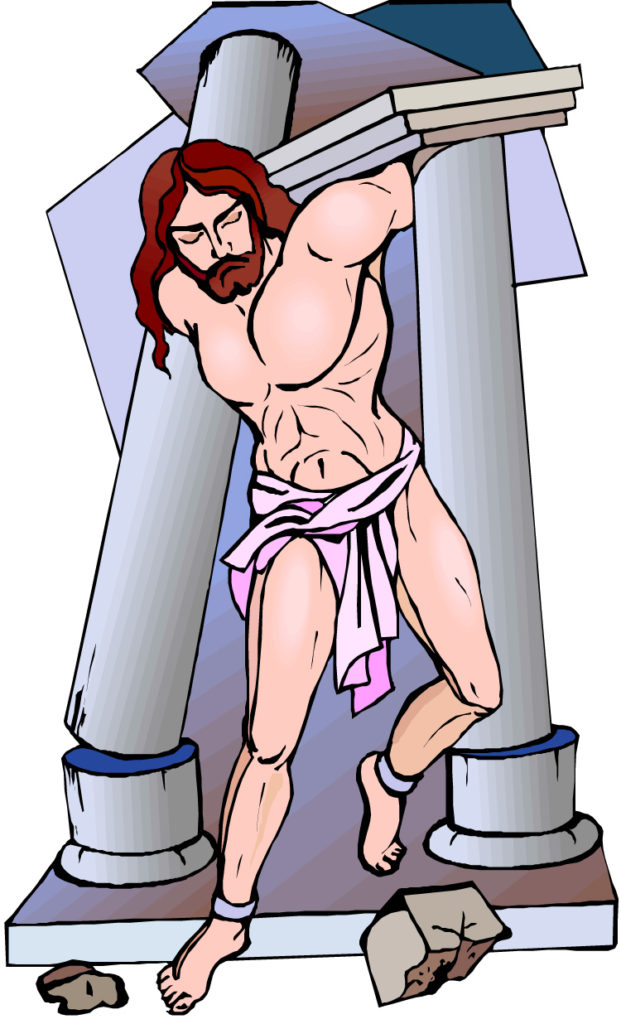
Judges 16:30, Let me die. Self-Murder (Suicide) or Self-Sacrifice Out of Love? Was Samson’s death a suicide, which is self-murder—something the Torah implicitly forbids? Let’s answer this question with a question. Was Yeshua going to certain death on a cross a form of suicide as well, or was it self-sacrifice to serve a greater spiritual purpose, that is, laying one’s life down for his friends (there is no greater love, John 15:13; cp. Rom 5:7)? In battle, if a soldier throws himself upon a grenade to save is comrades, is that suicide or self-sacrifice for a higher purpose? If someone goes into a burning house to save someone and loses his his own life in the process, is this suicide or laying one’s life down for a higher purpose? I suggest that we think of Samson’s “suicide” in the same way.


Natan’s Commentary on Psalms 38 to 45

Psalm 38

Psalm 38:1–40, Trials because of sin, resulting in divine judgment and followed by true repentance. This chapter discusses the nacham or sorrowing, grieving or anguishing side of repentance or teshuvah. Bible teachers seldom discuss this aspect of repentance. Verses 4–8 and 18 exemplify the Hebraic concept of nacham as it relates to repentance from sin.

Psalm 39

Psalm 39:7, Wait. Heb. qavah meaning “to twist, bind or stretch (like a rope) and the tension resulting therefrom, to be strong or robust, the tension of enduring or waiting; to look for with eager expectation, waiting with steadfast endurance., enduring patiently in confident hope.”

Psalm 40

Psalm 40:6, A Messianic prophecy. Verses six to nine are a Messianic prophecy foretelling of Yeshua, the gospel message and the canonization of the Testimony of Yeshua (or New Testament).

The passing of the Levitical sacrificial system is implied (verse 6).

  • The coming of Yeshua the Messiah, and writing of the Testimony of Yeshua Scriptures are foretold (verse 7a).
  • Yeshua is the one who did the will of his Father in heaven (verse 7b).
  • The Torah being written on the hearts one’s heart is prophesied (verse 8). Yeshua promised that the Comforter (the Holy Spirit) would do this for his disciples.
  • The same Messiah would proclaim the good news (or gospel) of righteousness (verse 9).

Psalm 40:6, Mine ears hast thou opened. This phrase in the LXX reads, “a body thou hast prepared for me” and has been quoted thusly by the author of Hebrews (Heb 10:5).

Psalm 40:7–8, Volume/scroll of the book …delight. This verse prophesies the canonization of the Tanakh, and is a messianic prophecy pointing to Yeshua who would “delight to do the will” of Elohim, which this verse equates with the Torah!

Psalm 41

Psalm 41:1–3, Blessed is he who considers the poor. This passage makes it clear that helping the poor is like a spiritual insurance policy that pays off in one’s own time of need. The old adage, “What goes around comes around” applies here. The only difference is that this law of reciprocity isn’t chance driven, but YHVH instituted and orchestrated, for verse one says that YHVH will deliver the one who blesses the poor in one’s own time of trouble.

From verse one to verse three, YHVH promises to care for those who help the poor in the following ways:

  • Protect and preserve one’s life (verse 2).
  • Deliver one from one’s enemies (verse 2).
  • Sustain and restore one who is sick (verse 3).

This is an insurance policy that pays rich dividends in YHVH’s spiritual economy.

Psalm 42

Psalm 42:1–2, As the deer pants. The Bible is full and running over with concrete analogies from everyday life that help us to understand otherwise abstract spiritual concepts. Our soul (i.e., our mind, will and emotions) dying of thirst for Elohim and longing for his refreshing presence like a deer panting for water in the hot desert is another example this. Scripture’s use of beautiful poetic imagery helps to draw us closer to Elohim by showing us what we need to do and how to act in ways that are pleasing to him. 

Psalm 42:2, When shall I appear? The hope of the resurrection and an afterlife spent with Elohim has incentivized the saints to keep seeking him from the earliest times. Other psalms that speak of the saints’ eternal inheritance include Psalms 17:15; 50:4–5; 71:20; 73:24; 90:10. Also see Job 14:14–15; 19:25–27; Prov 14:32; Eccl 3:21. 

Continue reading
 

Psalm 37—A Good Place to Spend Your Life

For many decades, Psalm 37 has been one of the “go-to” psalms that I turn to in my time of personal need along with Psalms 91 and 103. My next favorite “go-to” psalms are Psalms 1, 34, 119, 73, 139 and 145. What are your favorites psalms that encourage and strengthen you when you feel beaten down and overwhelmed by this world? Let’s now explore the main themes of Psalm 37 that I find so uplifting to my soul and spirit when I am down. There are several. 

As our all-knowing Creator, Elohim knows the end from the beginning, for he inhabits all time—past, present and future, therefore he knows what the outcome will be of everything in our lives. Furthermore, as an all-powerful Being, he then has the capability to direct our steps and the circumstances in our lives, so that the outcome will be a good one for those who love and wait on him. This psalm clearly lays this process out step-by-step, and, therefore, should bring great encouragement to the saints no matter the struggles they are encountering in their lives no matter when.

So what then, are the steps that lead to a blessed conclusion, no matter the circumstances in one’s life, for those who love YHVH Elohim? First, this psalm wisely counsels us to keep our eyes on Elohim and not to be overwhelmed by the storms of doubt and fear along with the seemingly answerable conundrums that plague, buffet and batter us along the path of life. The saint who will overcome the world, the flesh and the devil will be continually looking heavenward with his eyes fixed faithfully on Elohim rather than having his focus on a horizontal view with its waves and storms that continuously beat against the ships of our lives as we traverse the ocean of this physical existence (vv. 3–5, 7 cp. 1, 7, 32–34). 

Waiting on YHVH—a subtheme of this psalm—literally involves wrapping oneself up with, around or binding oneself to YHVH Elohim, which is the meaning of the Hebrew word qavah translated in this three verses in this psalm as wait (see vv. 7, 9 and 34). Waiting involves faith in an unseen Elohim. It also involves exercising patience as opposed to acting impulsively or impetuously, which is not easily done when one is experiencing fear and concern and when the innate tendencies of fight or flight are pounding forcefully on the door of one’s mind and emotions. At that moment, we are faced with two options: will we take matters into our own hands and try to “work things out” ourselves, or will we wait patiently on YHVH and let him work out the perplexing difficulties we face in our lives?

Faith and waiting on YHVH do not imply inaction on our part, however. No. This psalm, as counter-intuitive as it may seem, admonishes us to demonstrate what most humans would consider to be bizarre and, perhaps, even a ridiculous behavior. That is to trust in an unseen Being and to do what is good in the face of the actions of evildoers against us (vv. 3, 7, 32–34). This is despite the compelling urge to take matters into one’s hands and going forth to confront one’s enemies and to solve one’s problems oneself. We have all been in this place, so you know what I am talking about.

Furthermore, as crazy as it may seem, not only are the children of Elohim to trust in our invisible Creator, but we are to delight in him and to be sustained by his faithfulness (v. 4), that is, to have faith in a Being that we cannot see or hear in the normal sense. So what is it to delight in YHVH? Most Christian Bibles translate the opening phrase of verse four as “Delight yourself in YHVH” (or something similar). But this fails to capture the meaning of the Hebrew words. By contrast, one orthodox Jewish Bible does a better job by translating the Hebrew as “rely on [YHVH] for your enjoyments” (ASET). Another has “Seek the favor of YHVH” (JPS). The idea here is to find joy in the delicate, soft, exquisite dainties or delights of YHVH (see The TWOT), while waiting on him, and while your heart is desiring a good outcome. To the natural mind, this may seem like a ridiculous reaction when one’s enemies are viciously pounding at the door of one’s life, but such a response is what is required to unlock the resources of heaven to come to one’s aid in the time of urgent need.

In the process of waiting for or relying on YHVH as well delighting on him to work things out, this psalm instructs us to commit or literally “roll over onto him” our cares and concerns and to trust totally in him (v. 5). This is in spite of the fretfulness that evil doers may cause us (v. 1), and the fact that wicked doers may even seek to harm or kill us (vv. 14, 32). Nowhere does this psalm give us the justification to trust in YHVH only when things are going well for us. No. For the child of Elohim, this is a mental-spiritual demeanor, lifestyle and a walk regardless of the circumstances. 

Again, regardless of the outside circumstances of life, the saint is expected to walk counter-intuitively to his natural inclinations when facing crises. Resting and waiting patiently on YHVH to act on one’s behalf (v. 7) is the pathway to ultimate victory and blessing (vv. 9, 11, 22, 29). The word rest in verse seven literally means “to be dumb, to be still or silent or to stand still.” Frankly, this is the opposite response that most of us have when facing a crisis. The natural reaction is to fight or to flee—the old fight or flight syndrome. If not that, we tend, at least, to frantically work overtime mentally to figure out what we can do to defend ourselves from the attack. It is not natural for us to stand still, be silent and look heavenward. James the apostle adds his wisdom to such a situation when he tell us,

My brethren, count it all joy when you fall into various trials, knowing that the testing of your faith produces patience. But let patience have its perfect work, that you may be perfect and complete, lacking nothing. If any of you lacks wisdom, let him ask of Elohim, who gives to all liberally and without reproach, and it will be given to him. But let him ask in faith, with no doubting… (Jas 1:2–6)

This discussion begs an obvious question: Who are our enemies that are causing us the consternation that we are experiencing? The psalmist holds an expansive view as to who or what one’s enemies may be. Not all of our enemies have a human face attached to them. One’s “enemy” may be an evil time in which one is living such as a time of famine (vv. 19, 25). Famine is merely one example and an evil time. This could also include evil circumstances, health issues, demonic attacks, financial crisis as well as emotional and psychological struggles with which one has to deal. Evil can be anything that causes one to stumble along the path of live (v. 24) or to be forsaken or rejected by others (v. 25) 

So in conclusion, what are the ultimate blessed benefits of waiting patiently on YHVH Elohim and resisting the temptation to react impulsively, impatiently and impetuously by taking matters into our own hands? Simply this:

The steps of a good man are ordered by YHVH, and He delights in his way. Though he fall, he shall not be utterly cast down; for YHVH upholds him with His hand. (vv. 23–24).

Moreover,

For those blessed by Him shall inherit the earth, but those cursed by Him shall be cut off. (v. 22)

I have been young, and now am old; yet I have not seen the righteous forsaken, nor his descendants begging bread. (v. 25

And finally,

Mark the blameless man, and observe the upright; for the future of that man is peace. But the transgressors shall be destroyed together; the future of the wicked shall be cut off. But the salvation of the righteous is from YHVH; He is their strength in the time of trouble. And YHVH shall help them and deliver them; He shall deliver them from the wicked, and save them, because they trust in Him. (vv. 37–40)

I don’t know about you, but this sounds like a pretty good deal to me! The fact is that you cannot lose when YHVH Elohim, the all-wise, all-knowing and all-powerful Creator of the universe, is on your side and when you follow his instructions. As for me and my household, we will put our eggs into that spiritual basket, invest in heaven’s bank, and lean our spiritually ladder up against this tree of life and keep climbing higher in our spiritual journey upward.


Blog Scripture Readings for 11-7 Through 11-13-21

Aside

Parashat Vayetzei — Genesis 28:10 – 32:3 (2)*
Haftarah — Hosea 12:13 (12) – 14:10 (9)*
Prophets — Judges 18:1 – 21:25; 1 Samuel 1:1 – 3:21
Writings — Psalms 41:1 – 47:9
Testimony — Matthew 25:31 – 27:31

Most of this week’s blog discussion points will be on these passages. If you have general comments or questions on the weekly Scripture readings not addressed in a blog post, here’s a place for you to post those. Just use the “leave a reply” link or the “share your thoughts” box below.

The full “Read Through The Scriptures In A Year” schedule, broken down by each day, can be found on the right sidebar under “Helpful Links.” There are 4 sections of scripture to read each day: one each from the Torah, the Prophets, the Writings, and from the Testimony of Yeshua. Each week, the Torah and haftarah readings will follow the traditional one-year reading cycle.

* Verse numbers in parenthesis refer to the verse number in Christian English Bibles when they differ from Hebrew Bibles or the Tanakh.

Weekly Blog Scripture Readings for 11/7 through 11/13/2021.


Americans: Know Your Rights Concerning “Mandatory” [0v!D Injections

Many Americans are currently facing firings from their jobs because they are refusing to take the C0v!d-i9 shot. What are the issue here, and what are YOUR legal rights in this regard?

Refusal to take injections because of one’s sincerely held religious beliefs (this is a key phrase to remember) has been viewed by US law as a fundamental, God-given right since time in memorial. After all, who has the right to tell you what you can or cannot put into your body? Your body belongs to you, not to someone else or to some government entity. The basic issue is this: If someone can force you to put something into your body against your consent, then you no longer have God-given right of ownership over your own body. That is, you no longer own yourself, someone else does. When this occurs, you are now, by definition, a slave, who is under the control of a tyrant.

What are sincerely held religious beliefs? It is whatever YOU determine them to be at any moment in time. No other human except you has the right to question or to determine what your sincerely held religious beliefs are. YOUR religious beliefs are personal and are no one else’s business. This is because the US Constitution and other US laws guarantee the right to practice one’s religion freely as a God-given right, which cannot be infringed upon by government or anyone else (unless doing so violates certain other fundamental or basic human rights [such as taking the life of someone, or stealing from someone]).

Furthermore, no one has the right to ask you why you believe what you do, how long you have believed it, or to seek information regarding the tenets of your religious faith. Moreover, you do not need the stamp of approval from any religious “official” or organization confirming your sincerely held religious beliefs. Your faith is yours and yours alone. It is personal and belongs to you and is nobody else’s business. Do not tell those seeking this information anything about what your believe. Make no mistake, any information you give them in this regard can and will be used against you in order to bully you into going against your sincerely held religious beliefs.

Here are some informational resources to help you maintain your personal, Elohim (God)-given rights if you choose not to take any shot or injection:

  • Know your HIPAA (i.e., Health Insurance Portability and Accountability Act of 1996) rights. The HIPAA Act “The Health Insurance Portability and Accountability Act of 1996 (HIPAA) is a federal law that required the creation of national standards to protect sensitive patient health information from being disclosed without the patient’s consent or knowledge. The US Department of Health and Human Services (HHS) issued the HIPAA Privacy Rule to implement the requirements of HIPAA. The HIPAA Security Rule protects a subset of information covered by the Privacy Rule,” (from https://www.cdc.gov/phlp/publications/topic/hipaa.html). For more information on the HIPAA Act rules and regulations including “Covered Entities,” and “Permitted Uses and Disclosures” go to https://www.cdc.gov/phlp/publications/topic/hipaa.html.
  • If your employer is demanding that you get a C0v!d-i9 shot, then your next step will be to file a complaint with the Federal Equal Employment Opportunity Commission. According to https://en.wikipedia.org/wiki/Equal_Employment_Opportunity_Commission,

The U.S. Equal Employment Opportunity Commission (EEOC) is a federal agency that was established via the Civil Rights Act of 1964 to administer and enforce civil rights laws against workplace discrimination.[3]: 12, 21  The EEOC investigates discrimination complaints based on an individual’s race, color, national origin, religion, sex, age, disability, sexual orientation, gender identity, genetic information, and retaliation for reporting, participating in, and/or opposing a discriminatory practice.[4]

The Commission also mediates and settles thousands of discrimination complaints each year prior to their investigation. The EEOC is also empowered to file civil discrimination suits against employers on behalf of alleged victims and to adjudicate claims of discrimination brought against federal agencies.

When confronted with an EEOC complaint and the threat of a lawsuit over YOUR religious rights, no right-minded employer is going to want take this on. Be aware of one thing, however. An employer can fire you for many other reasons that are not religious in nature. He may not like the way you comb your hair or the color of your pants. That is to say, an employer can fire you ostensibly for one reason, while, in reality, he is secretly firing you for another reason. That is why, as a child of Elohim, it behooves you to be the best employee possible, so that your employer will NOT want to fire you, for your loss to him will not be worth his enforcing the shot mandate on you. If your employer is recalcitrant with regard to the shot mandate for their employees, then civil litigation may to an option. At the same time, consider the idea that YHVH Elohim, the one who directs the footsteps of the righteous when they trust in him (see Ps. 37; 1, 3–7, 23–24), may be closing a door behind you, so that he can open the door to a better situation in front of you. Remember, the just shall walk by faith.

To learn more about your religious rights as protected by the EEOC and other government laws and how to claim and ensure these rights are not violated, go to https://www.eeoc.gov. To file a complaint, go to https://www.eeoc.gov/how-file-charge-employment-discrimination.

For more information on the harmful effects of the C0v!d-19 injection from medical experts, go to https://www.drleemerritt.com or https://www.drtenpenny.com/thetenpennyfilestv or https://www.drtenpenny.com/tenpenny-3friday-favorites.


Natan’s Commentary on Jephthah and Samson

Judges 11

Jephthah—A Man of Faith From “the Other Side of the Tracks”

Judges 11:1–2, Was the son of a harlot. YHVH can raise up anyone to accomplish his purposes—even men of low degree. YHVH does not judge a man by his outward appearances, but by the condition of his heart (1 Sam 16:7). In YHVH’s eyes, what was Jephthah? (See verse 1.) Are there specters from your past that still haunt you and hold you back, or have you overcome them by the blood of the Lamb and assumed your new identity as more than a conqueror who is seated in heavenly places with Yeshua? (Read Phil 4:13; Rom 8:37; Rev 12:11; Col 2:12; Eph 2:6; for your inspiration and edification; also read Zec 4:6 and 1 Cor 1:27.) YHVH can take any vessel, no matter how average it may be, and elevate it for his purposes providing the vessel has faith and willingness to be used. In this way, YHVH and not man gets the glory. Will you be such a vessel in YHVH’s hands?

Judges 11:12, Jephthah sent messengers unto the king. Before going to war with the people of Ammon, Jephthah made every effort to diplomatically resolve Israel’s differences with that hostile nation. Armed conflict was still the result, and YHVH gave Israel the victory.

What can we learn from this? Yeshua instructs us to make every attempt to create peace with our enemies before resorting to legal (or in Jephtha’s case, lethal) means (Matt 5:25–26). When all else fails, if one is walking in the paths of righteousness, know that YHVH will back you when, as a last resort, you come to blows with your enemies.

In Scripture, there exists no prohibition against self defense. Some will use Yeshua’s admonition to turn the other cheek (Matt 5:39) as justification not to defend oneself against an aggressor, and that somehow doing so will be a witness to one’s enemy of the love of Yeshua. Not defending oneself may accomplish this noble goal, but more likely the aggressor will view it as a sign of weakness to justify increased aggression against you and your loved ones. 

When Yeshua said to turn the other cheek what did he really mean? Was Yeshua justifying pacifism in place of self defense? According to Hebrew scholars, David Biven and Roy Blizzard, pacifism has never been part of Hebrew thought or culture. It is permissible to kill in order to defend oneself. The authors point out that some of Yeshua’s disciples were armed (Luke 22:38, 50), and that once Yeshua even suggested that his disciples purchase swords (Luke 22:35–37). When instructing his disciples to turn the other cheek, Yeshua was not talking about how to deal with violent aggressors such as rapists, robbers, or murderers, or when facing an enemy in battle. Rather he was talking about the fundamentals of brotherly relationship—how to relate to our neighbors. In other words, if a friend embarrasses us by slapping us in the face, we are not to slap him back, but instead to offer him the other cheek. This has nothing to do with a battlefield situation or when dealing with a violent aggressor. (Understanding the Difficult Words of Jesus, pp. 68–71). In other words, when it comes to offensive words or actions from brother in the faith, we need to let offences simply roll off our back, for love covers a multitude of sin (1 Pet 4:8).

Judges 11:29, Then the Spirit of YHVH came upon Jephthah. There are those who claim that the power and gifts of YHVH’s Spirit were unknown in biblical times prior to the outpouring of the Spirit on the day of Pentecost in Acts chapter two. This is not altogether true when one considers this passage concerning Jephthah. What are some other examples of YHVH’s Spirit coming upon Israelites in the prior to the Pentecost? (See Num 11:26–27; 24:2; Judg 3:10; 6:34; 13:25; 14:6,19; 15:14; 1 Sam 10:11; 11:6; 19:20–24; 1 Chron 12:18; 2 Chron 24:20.)

Judges 11:30–31, For a burnt offering (KJV); or as a burnt offering (NAS, NIV, NKJV); or as an elevation offering (ASET). This doesn’t mean that Jephthah literally made a human sacrifice of his daughter, for this would not only have violated the Torah, but would have been subscribing to the most heinous and vile of heathen practices, that of human sacrifice to their gods. Not only that, the Torah made provisions for one who made a rash and illegal vow. It was considered a sin to so, and atonement could be made for it by making the required sin offering (Lev 5:4–6).

More realistically, Jephthah consecrated his daughter to YHVH for the rest of her life (like a Nazarite) to remain in a virginal state (which is why she bewailed her virginity and Jephthah had no descendants — a terrible price to pay for a rash vow, yet to Jephthah’s credit for keeping his vow to Elohim even to his own hurt —a mark of a righteous man (Ps 15:4; Heb 11:32). Perhaps Yeshua had this incident in mind when he instructed his disciples to not swear an oath at all, but to give one’s word only by saying “yes” and “no” (Matt 5:34–37).

Judges 11:30, Jephthah vowed a vow. Rash words (or vows) spoken may come back to haunt a person. Be careful with the mouth. Proverbs 10:19 says, “In the multitude of words there lacks not sin, but he that refrains his lips is wise.” Not only that, was Jephthah attempting to negotiate with YHVH? If so, was this a wise move? Does YHVH really need or want anything that we could possible give him in order to curry his favor? There is only one thing that he wants from us. What is that? (Read Hos 6:6; 1 Sam 15:22; Mic 6:8; Isa 66:2.) The heart of man is always the issue with YHVH! (See 1 Sam 16:7; 1 Sam 13:14; Acts 13:22.)

Judges 13

The Birth of Samson—A Mighty Man on the Outside, But Weak on the Inside

Ever since the death of Joshua and during the time of the judges the spiritual and moral state of Israel slowly declined until the time of Samson. As The ArtScroll Rubin Edition Joshua/Judges Commentary points out, ­Samson was a new kind of judge. “Up to this point, Israel’s sins would lead to foreign domination, followed by repentance and the emergence of a judge who would lead the people to defeat and expel the enemy. In this new period, the people’s descent was so serious that they did not merit a complete salvation of the sort that had been achieved by such judges as Deborah and Gideon.” Nevertheless, it was not in YHVH’s overall plan to let Israel’s enemies go completely unchecked so that the sublimation and eventual destruction of Israel would be complete. He used Samson to check the Philistines’ quest to totally subjugate the nation of Israel and to punish the former, while at the same time YHVH extended grace to Israel by relieving them of some pressure from their enemies (p. 195).

Continue reading