The Life of Joseph—A Foreshadow of Messiah Ben (Son of) Yosef

The spirit of Antimessiah (Antichrist) is on a dramatic rise in this day and age. It is even alive in the Hebrew Roots or Messianic Israel Movement where some are losing their faith in Yeshua. A few are even converting to Rabbinic Judaism, which denies the messiahship and deity of Yeshua and the divine inspiration of the Testimony of Yeshua. Some of the blame for this can be laid at the feet of a few of the modern-day descendants of the non-believing Pharisees (i.e., the Rabbinic Jews) who use clever arguments to beguile unstable and unlearned souls into humanistic reasoning devoid of a living faith in Yeshua the Savior and Redeemer of man. Because of a spiritual blindness that Scripture prophesied would come upon the Jews producing hardness of heart toward Yeshua the Messiah, unbelieving Jews ignore the numerous prophetic shadow-pictures pointing to Yeshua the Messiah contained in their own Tanakh.
Joseph's coat 2-33397808May the following study strengthen your faith in Yeshua, in his divine origination in the very heart, mind and essence of Elohim, and in the fact that he was foreordained to come to this earth to reconcile sinful man to his Heavenly Father through his self-sacrifice on the cross. All this was prophesied long ago in the Hebrew Scriptures. The ancient Jewish rabbis speak of a messianic figure coming called Messiah ben Yosef, the Suffering Servant, whose life and ministry would parallel that of Joseph, yet these same rabbis fail to see the connection between Joseph’s life and that of Yeshua. Let’s now chronicle the striking and uncanny parallels between Joseph and Messiah, the son of Joseph, the Suffering Servant (Many of these comparisons come from the book, Gleanings in Genesis, by Arthur W. Pink):

  • Joseph had two names: Yoseph (meaning “to add, increase, do again”) and Zaphnath-panaaneah (41:45) (meaning “revealer of secrets”). How do these names point to Yeshua’s mission? Continue reading
 

Yeshua in the War Zone — A Template for Ministry

Mark 1–3

It is interesting to note the order of events as Yeshua was launching his ministry. He was about to enter a war zone!

After John baptized Yeshua and he received his heavenly empowerment, he first went through a spiritual boot camp before stepping onto the battlefield of public ministry. Once in the “war,” it’s worth noting where the battle lines fell.

22065310

  • His spiritual boot camp was the wilderness where he fasted for forty days and nights to get his body, soul and spirit, and his mind, will and emotions in sync with the will of his Father in heaven (Mark 1:12–15).
  • His first battle was an internal one. The devil tested him in three areas: his body, soul and spirit, or, to put it another way, the lust of the flesh, the lust of the eyes and the pride of life (Mark 1:13). After overcoming himself and submitting to the will of his Father, he was now ready to launch into the war zone of public ministry.
  • His mission was to preach the message of the gospel of the kingdom of Elohim and repentance from sin (i.e. Torahlessness, 1 John 3:4; Mark 1:14–15).
  • Next he chose his cadre of spiritual warriors — his “army”— the twelve disciples (Mark 1:16–20).
  • Where better to start proclaiming the gospel message than in the local synagogue on the Sabbath (Mark 1:21)? After all, the religious folks there should be overjoyed to hear this good news, fresh message from heaven. Right? Continue reading
 

Yeshua Eating With Sinners — Will the Real Sinner Stand Up?

Matthew 9:10, Sinners. What is behind the Gospel writers’ use of the word sinner (see also Mark 2:16) to designate a class of people along with tax collectors? To the modern reader, this likely begs the question, aren’t all people sinners? This depends on one’s religious point of view. To understand the term sinners as used by the Gospel writers, we must understand the cultural, religious context of the day. According to David Stern in his Jewish New Testament Commentary, this term was used by the Pharisees (who were present at the time this event occurred, see verse 11) to refer to those of low reputation in society including prostitutes and thieves along with the despised, often greedy and mendacious tax collectors (or publicans), whose sins were blatant and obvious.

20794988

Furthermore, in Hebraic culture, table fellowship indicated intimate relations among those who shared it. As Keener points out (The IVP Bible Background Commentary NT in his notes on Mark 2:16), the Pharisees were especially scrupulous about their special rules on eating, and they didn’t like eating with who were less scrupulous than them — especially those of low reputation.

In this case, Yeshua responded graciously to his accusers (vv. 12–13) by pointing out to them the Father’s heart of mercy in reaching out to lost sinners. At other times, Yeshua, the spiritual activist, turned the tables on the self righteous and sacrosanct Pharisees when he taught that those who considered themselves righteous were, in reality, often worse off spiritually than those they ridiculed (see the Parable of the Pharisee  and the Tax Collector, Luke 18:10–14). From Yeshua’s example in dealing with the Pharisees, we learn that when we are accused there are times to be gracious and to turn the other cheek, and there are times to push back hard. Wisdom and the guidance of the Holy Spirit will help us to determine which response is appropriate at any given time.


Some Thoughts on the Rapture, the Great Tribulation and Wrath of Elohim

Matthew 24:29, 31, Immediately after the tribulation … gather the elect. If no other verse disproves the pre-trib rapture theory, this one does. Here Yeshua clearly states that the gathering of the saints to meet Yeshua as he is coming in the clouds occurs not only after the tribulation, but after the great tribulation (v. 21). The tribulation and great tribulation are separate events from the wrath of Elohim, which John describes as being part of the seven trumpet and seven bowl judgments (Rev 6:17; 11:18; 15:1; 16:1).

730255

Matthew 24:29, 30, Sun will be darkened … sign of the Son of Man. Here Yeshua tells us that certain harbingers of his second coming will occur first. These include phenomenon occurring in the heavens involving the sun, moon and the stars. After this, a miraculous sign in the heavens will occur, and then Yeshua will come. Between the signs of the sun, moon and stars and the final miraculous sign of his coming there’s a gap in time. Yeshua later revealed to John the cosmic disturbances involving the sun, moon and stars would correspond with the sixth seal (as part of the great tribulation that occurs before Elohim pours out his wrath on the earth) of Revelation 6:12–17. After this, Elohim pours out his wrath upon the earth (Rev 6:17; 11:18; 15:1; 16:1), and then the second advent of Yeshua occurs.

Does the sign of the Son of Man coming (Matt 24:30lp) occur before or after the wrath of Elohim? That’s hard to say, but since Yeshua states that between the two events that all men will mourn, perhaps this is a veiled reference to the wrath of Elohim that is to be poured out on unregenerate men during the seven trumpets, seven thunders and seven bowl judgments described in the Book of Revelation. Why else would men be mourning? The intervening time between the cosmic disturbances (the sixth seal of Rev 6:12–17) and Yeshua’s second coming during which Elohim pours out his wrath could be a year or more, since the Scriptures speak of the day (or a period of time) of YHVH’s wrath. The Hebrew word for day (Heb. yom) can mean both a day and a period of time.

The prophet Isaiah speaks in several places about “the day of YHVH’s vengeance” (or words to this effect). This is the time period when YHVH will judge the nations including Babylon the Great, which occurs at Yeshua’s second coming (see Rev 18 and 19). In three places, Isaiah indicates that the day of YHVH will last for one year (Isa 34:8; 61:2 and 63:4). Interestingly, in Isaiah 63:4, the prophet couples the idea of the day of YHVH’s vengeance being a year long with the jubilee year — “the year of my redeemed has come.” This occurs as the Messiah (the subject of Isa 63:1–6) judges the enemies of Israel (notably Edom) as he is at the same time about to redeem (i.e., regather and return scattered Israel to its Promised Land inheritance). It appears that while Yeshua is judging Israel’s enemies at his second coming, he will at the same time be regathering the lost and scattered 12 tribes of Israel. Yeshua seems to allude to this in Matthew 24:31.


What Is the Higher Torah? (part 2)

(Continued from Part 1)

The Letter Kills, But the Spirit Makes Alive

Demoting the Torah to merely a set of do’s and don’ts not only eviscerates, but it misses the heart of our Heavenly Father, the spirit of the Torah — the higher Torah. The letter of the law kills, but the Spirit of the law brings life. The letter by itself brings bondage and legalism. It can even become burdensome and grievous as the pro-Torah apostolic writers inform us.

Torah scroll 3

Who also hath made us able ministers of the new testament; not of the letter, but of the spirit: for the letter killeth, but the spirit giveth life. (2 Cor 3:6)

For this is the love of Elohim, that we keep his commandments: and his commandments are not grievous/heavy or burdensome. (1 John 5:3)

Love, Not Law-Keeping, Is What Attracts

Yeshua gives us a clue about some aspects of the higher Torah when he told his disciples that men would know they were his not because they kept the Torah scrupulously to the letter, but because they walked in love for one another.

By this shall all men know that ye are my disciples, if ye have love one to another. (John 13:35)

Paul also taught that love was the greater thing in 1 Corinthians 13. Love is above all knowledge (including Torah), and all prophecy (inspired teaching of Torah).

The Higher Torah Is About Relationship

The higher Torah is not about bondage; it is about bonding. It is about relationship. Yeshua summed up the Torah as follows:

And one of the scribes came, and having heard them reasoning together, and perceiving that he had answered them well, asked him, Which is the first commandment of all? And Jesus answered him, The first of all the commandments is, Hear, O Israel; YHVH our Elohim is one YHVH: And thou shalt love YHVH thy Elohim with all thy heart, and with all thy soul, and with all thy mind, and with all thy strength: this is the first commandment. And the second is like, namely this, Thou shalt love thy neighbour as thyself. There is none other commandment greater than these. And the scribe said unto him, Well, Master, thou hast said the truth: for there is one Elohim; and there is none other but he: And to love him with all the heart, and with all the understanding, and with all the soul, and with all the strength, and to love his neighbour as himself, is more than all whole burnt offerings and sacrifices. And when Yeshua saw that he answered discreetly, he said unto him, Thou art not far from the kingdom of Elohim. And no man after that durst ask him any question. (Mark 12:28–34)

The higher Torah is about love, mercy, and faith, which are the weightier matters of the law! It is about building relationships and about bonding with your fellow man and Elohim! We can’t be bonding in love if we are constantly walking in offence, maintaining a critical spirit toward others, judging others, are religious exclusivists, or are arrogant toward those who do not believe or act as we do whether they be Christians, or even non-Christians. Rather, we must love everyone, and by actively demonstrating that love, we show those around us the way to a higher walk or relationship Continue reading


What Is the Higher Torah? (part 1)

Matthew 23:23, Weightier matters of the Torah. What are the weightier matters of the Torah? Torah is not an end-all. It is a vehicle that leads us to something. What is that? What really matters to YHVH when all is said and done???? It is the greater Torah or the higher Torah. The Gospel of Matthew (23:23) records that Yeshua rebuked the religious leaders of his day for their not following the higher Torah. What did Yeshua really mean by “the weightier matters of the Torah”?

Torah scroll 3

The Deeper Meaning of the Word “Torah”

Almost every place where you see the word “law” in the Tankah, it is the Hebrew word “Torah.” This word is used 219 times in the Tanakh or Hebrew Scriptures, and in almost every case it is translated in the KJV and in most other English Bibles as “the law.” Is this all the word law (or Torah) means? Is “law” even Torah’s main meaning?

As a test of your understanding (or, perhaps, your preconditioned biases), when you think of the term “the laws” what comes into our mind: good thoughts or bad thoughts? Do you think of a list of dos and don’ts—what you can do and cannot do? Do you think of red and blue lights flashing and a siren? Do you think of a man in a blue uniform with a badge and a gun, or judge in a black robe with a gavel, or a prison? These can be scary thoughts!

Let’s see what the word Torah really means according to the Scriptures.

Let’s start understanding the full scope of this word by first reading Proverbs 13:14. There we read that the Torah is the foundation of life.

Next start reading in Proverbs 1:7 where we read that the fear of YHVH is the beginning of wisdom. In verse 8, Solomon, the wisest man who ever lived, is talking to his son about the Torah. In a sense, he’s talking to all of us. The word law in this verse is Hebrew word Torah. Continue reading what Solomon teaches us about the benefits of YHVH’s instructions and wisdom found in the Torah. Start reading in verse 9 to the end of chapter. Then start reading in chapter three and continue to the end of chapter four. Whenever you see the words “law,” “instruction,” “wisdom,” “instructions” “commandments,” “truth,” “mercy,” “knowledge” or “words” think of Torah, for that is what these words are referring to.

Next let’s read Psalm 119. Perhaps no other passage in Scripture extols the virtues of the Torah more than this psalm of David.

Based on Psalm 119 and Proverbs chapters one through three, what are the blessings and benefits of the Torah? Continue reading


Isaac—A Man of Godly Character

Isaac—A Character Sketch

  • He was successful and blessed. (Gen 26:12)
  • He was obedient to his father.

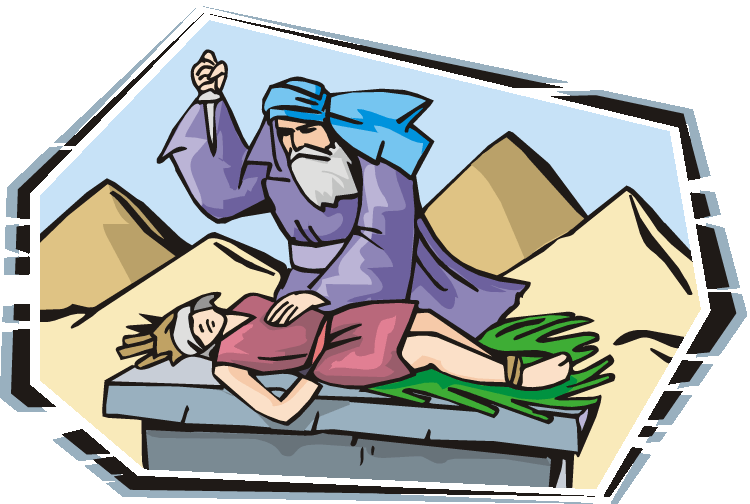
At age 37 Abraham bound Isaac to the altar (in Heb. called the akeidah, Gen 22).

Isaac was obedient to marry Rebekah, his parents’ choice, unlike Esau. He trusted and had faith in his parents even as he trusted his life with his father at the akeida.

Akeidah

  • He had a deep and personal relationship with YHVH.

Here we learn that obedience to and faith in and love for parents leads to devotion to YHVH. Honoring one’s parents is the key to honoring YHVH and entering into relationship with him. That is why the fifth commandment to honor one’s parents is placed after the commands to love Elohim. In Genesis 24:63 and 25:21, (see The Stone Tanach rendering of this verse in addition, The ArtScroll Beresheis, p. 1048, which says Isaac prayed abundantly and urgingly, i.e., persistent prayer, a penetrating prayer or request), we see that Isaac had a deep and personal relationship with his Creator. Continue reading