

Genesis 32
Genesis 32:10, I am not worthy/I have been diminished [Heb. kato-n’tey]. “In some Bible versions, in the word kato-n’tey ,the letter tet is written smaller or diminished to show the utter humility and sense of unworthiness Jacob felt toward YHVH as he prayed for mercy and protection from Esau (The Wisdom in the Hebrew Alphabet, p. 123 by Michael Munk).
Genesis 32:13–15, Present for Esau his brother. This was a generous gift of great value. Possibly, Jacob out of righteousness, felt the need to make restitution to his brother for having “stolen” the birthright. This demonstrates the need for saintly people to right their wrongs in order to maintain a good witness to their unsaved or heathen neighbors. Of course, Jacob’s motives were not totally based on making restitution for past wrong. He was also trying “to save his skin,” so to speak, by appeasing his brother who wanted to murder him (v. 20).
Genesis 32:28, Israel.
The Meaning of the Name “Israel”
According to the top Hebrew lexicons, the words making up the name Israel can have several meanings:
- He rule (as) El (God).
- He contends with El.
- El persists, perseveres.
- Let El persist or contend
- To prevail or have power with El.
- The name Israel is comprised of two Hebrew words: sarah and el.
- Sarah (is a primitive verb root meaning “to prevail.”
- El means “God” and is the short form of the word Elohim (God).
Interestingly, the name Israel contains a couple of other Hebrew words although the lexicons do not indicate any lexical connection between them and the name Israel. These words are:
- Yashar meaning “straight or upright.
- Sar meaning “a head person, captain, ruler, chief, master or prince.” Sar is used in the famous Prince of Peace passage in Isaiah 9:6—a notable prophetic reference to Yeshua the Messiah.
Because of the similarities between the Hebrew words Israel and yashar and sar, some Bible students have taken the liberty to see within the name Israel some other meanings that the lexicons do not recognize. It is interesting to note these similarities, but whether there is a lexical connection between these words or not, we let the Hebrew language experts debate this issue.
Genesis 32:24–32, Jacob wrestling with the Messenger of YHVH.
Who Did Jacob Wrestle With? An Angel or the Pre-Incarnate Yeshua?
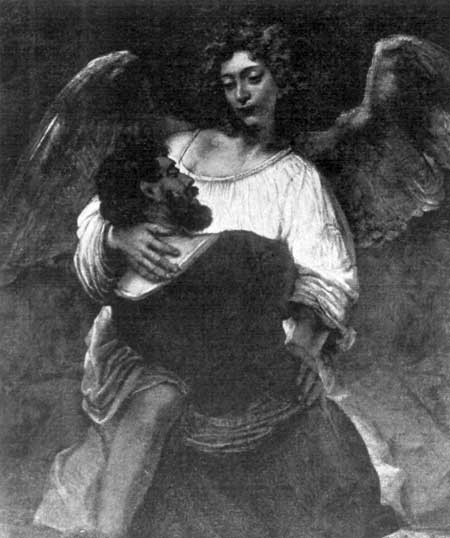
It is one of the classic Old Testament Bible stories. Along with Noah’s ark, David and Goliath, Jonah and the big fish, every Sunday school student has heard of the story of the patriarch Jacob wrestling all night with an “angel.” But who was this heavenly being? Was he actually a stereotypical angel as the text in Genesis 32 suggests, are is there more to this story? This is where Christians and Jews differ in their conclusions. Let’s explore this classic Old Testament story a little deeper. The truth may astound you and will likely help to deepen your faith!
And Jacob was left alone; and there wrestled with a man [Heb. iysh] or heavenly messenger [i.e., Heb. malak]. (KJV; cp. Hos 12:4)
In the following passages, we see that this man was Elohim.
You have power with Elohim and with men, and have prevailed. (verse 28, based on the KJV)
…for you have striven with the Divine [lit. Elohim] and with man and have overcome. (verse 28, The ArtScroll Stone Edition Tanach and Chumash)
Then Jacob says that he has “seen [Elohim] face to face” (KJV, CJB and The Soncino Edition Pentateuch, second edition). The two standard Orthodox Jewish versions of the Torah, The ArtScroll Stone Edition Tanach and The ArtScroll Stone Edition Chumash, and Samson Raphael Hirsch’s Torah commentary The Pentateuch (by Judaica Press)all read, “For I have seen the Divine face to face.” Here they have incorrectly translated the Hebrew word Elohim as “the Divine”(OHBP OHVKT/Elohim panim).
Which translation of the word Elohim is the correct one? Before resorting to human sources to solve this dilemma, let’s allow the Word of Elohim itself to interpret this passage, thus giving us clarity as to its exact meaning. Hosea 12:2–5 is the Bible passage that sheds light on this issue.
[YHVH] hath also a controversy with Judah, and will punish Jacob according to his ways; according to his doings will he reward him. He took his brother by the heel in the womb, and by his strength he had strove with [Elohim]. He strove with an angel [Heb. malak or heavenly messenger in many instances referring to YHVH himself, as noted elsewhere in this work] and prevailed: he wept, and made supplication to him; he found him in Beth-El, and there he spoke with us; and [YHVH Elohim] of hosts; [YHVH] is his name. (based on the KJV)
The Stone Edition Tanach renders this passage as follows (starting in verse four):
In the womb he seized his brother’s heal, and with his strength he struggled with [an angel of] God; he struggled with an angel and prevailed; [the angel] wept and beseeched him: ‘In Beth-el He will find us and there He will speak with us.’ HASHEM is the God of Legions; HASHEM is His remembrance. (bracketed supplied word are in the original)
So which translation is correct? The first one indicates Jacob was wrestling with a Heavenly Messenger, who was none other than YHVH Elohim, while the second translation is cast in such a light as to imply that Jacob was wrestling merely with an angel.
The Hebrew word Elohim does not mean “the Divine.” Rather it means “God.” It is interesting to note that in the Authorised Version (or KJV) the word Elohim appears 2606 times in the Tanakh. It is translated as God 2346 times, god 244 times and as several other words less than five times each (e.g., judge, goddess, great, mighty, angels). As in all cases with a word which can have several meanings, the context of the Scripture passage will determine a word’s meaning and its subsequent translation from the original language into English. The word divine was not employed in the 1611 (KJV) Authorized Version in reference to Elohim anywhere in the Tanakh, since the word had a pejorative connotation (as in divination or one who divines the future). This is not the case in our modern parlance as the modern Webster’s New Collegiate Dictionary defines divine in its primary definition as “relating to, or proceeding directly from God, being a deity, directed to deity.” All standard English (Christian ) versions (e.g., NKJV, NAS, NIV, NRSV) translate this passage as “God face to face” and none use the term “the Divine face.” The New Brown-Driver-Briggs-Gesinius Hebrew-English Lexicon defines Elohim (in those Scripture passages where it is a clear reference to deity, as opposed to a goddess or a human judge) as “the true God, Yahweh is (the) God.” Never does this Hebrew lexicon define Elohim as “the Divine.” Similarly, nowhere does the The TWOT in defining the word Elohim suggest that the Divine could be an appropriate substitute for the title of YHVH. So we must ask, why do the two Jewish translations of this passage (noted above) run cross grain to a plethora of other translations, both Jewish and Christian, as well as to noted lexicographers to translate it as they do? This likely a case of translation bias, where translating Elohim panim as Elohim face to face as so many other translators do would be a tacit admission that Elohim can appear as a man, hence giving credence to the Christian assertion that Yeshua was Elohim in the flesh. But before jumping to conclusions, let us examine other passages in the Tanakh where Elohim and man come face to face. Let’s see how the non-Yeshua believing Jewish translators treat these passages, and discover how their commentaries explain these difficult passages.
The following are what some leading rabbinic Jewish commentaries say about these passages where Elohim appears in humanesque form.
The Stone Edition Chumash (pages 176–177): This commentary states that the man with whom Jacob wrestled was an angel (no doubt based on the passage found in Hosea 12:4), yet the fact that the malak was an angel in the common meaning of the word, is an assumption, since, as we have already noted, malak literally means “messenger,”and in this context heavenly messenger meaning “angel”is but one type of heavenly messenger. Furthermore, the Chumash defines the word malak as “Divine.” What is the terminology here supposed to imply, based on the meaning of the word divine? Was the angel deity or not? At the very least, the reasons given for explaining away the idea that Jacob was wrestling with Elohim are ambiguous if not totally misleading or even deceptive.
The Soncino Edition Pentateuch (p. 124) commenting on Genesis 32:29 and Hosea 12:4 states, “We have here another instance of ‘God’ interchanging with ‘angel of God’, as in [Genesis] 16:7 [and] 31:11.” On verse 31 other Jewish commentators states, The Targum (the Aramaic translation of the Pentateuch made in the second-century) “was in response to the spread of Christianity, when proponents of the new religion began to interpret certain passages to accord with their own doctrines” (The Encyclopedia of the Jewish Religion, p. 376). This then supposedly gives justification to why the modern Jewish scholars understand these verses to mean “I have seen angels of God face to face” (The Soncino Edition Pentateuch, p. 124). One can only wonder if the Targum’s translation of this passage and the subsequent rabbinic interpretations of the same is not an example of these translators and commentators redacting these Bible passage in an attempt to steer their readers away from the fact that YHVH appeared to Jacob in the form of a man (as a plain reading of the text indicates)—a conclusion that could then pave the way for the Christian belief that Yeshua the Messiah was YHVH incarnate (in the flesh) as per John 1:1 and 14 (and other both Old and New Testament passages).
The ArtScroll Bereishis/Genesis commentary postulates a total different explanation as to who Jacob wrestled with. Was it Elohim, an angel or something else. These commentators state, “The ‘man’ who struggled with Jacob was not a human being, nor was he an ordinary angel. As Rashi comments, the ‘man’ was Samael, the guardian angel of Esau” (p. 1397) who was the angel of evil (ibid.p. 1437). The commentary goes on to say that not all Jewish sages agreed with Rashi’s assertion. Tanchuma suggests that this was the angel Michael, while R. Bachya “perceives this as symbolizing the righteous person’s inner struggle against the forces of evil.” Rambam “regards this incident as a prophetic vision (just as he regards Abraham’s vision of the three angels in [Genesis] 18:2f). Ramban…challenges this vigorously, posing many questions (for example: If Jacob’s wrestling was only a vision, why did he limp when he awoke? Abarbanel cites Ralbag who in defense of Rambam, holds that Jacob’s hip injury might have been caused by autosuggestion, an aftermath of the prophetic vision” (ibid.). And the debate between the rabbinic Jewish scholars continues on and on without any resolution as to the nature of the angel with whom Jacob wrestled, when the plain meaning of the literal words of the text clear state that Jacob wrestled with Elohim!
As these quotes have been provided (and there are more to come) to show the reader that there are some things that the Jewish sages, for all their learning, brilliance, respectability and passion for Torah, simply cannot figure out. Some will even contrive fantastical scenarios and explanations in an attempt to explain a passage in a certain way, while leaving out some of the more obvious conclusions.

To the sages’ credit, they have in mind the passage in Exodus 33:20, which states that, “You cannot see my face, for no man shall see me and live.” This, the reader will recall, is the occasion where Moses requested to see the glory (or splendor) of YHVH Elohim (verse 18). Indeed, it is obvious that no man can look into the glorious face of the One who made the Sun, which is the smallest of billions of stars, and expect to live. Yet is it possible for the same YHVH to place all his glory “on the proverbial shelf,” so to speak, and to appear to man without his full glory? Obviously, YHVH being all powerful, can do anything he pleases. If this is possible, then can Jacob have seen the face of Elohim temporarily without his glory and Exodus 33:20 still be valid? After all, the sages have numerous reasons, and some very creative ones, to explain why Elohim is actually an angel in Genesis 32, when a simple explanation, based on the literal meaning of the text, could easily suffice to explain why the Being Jacob encountered really was Elohim, as the Scriptures so plainly states.
Rashi (Shelomoh Yitzhaki, 1040–1105), considered by some to be the most notable Orthodox Jewish Torah commentary of the modern era, should have some notable comments on verses 28 and 30 (The Sapirstein Edition Rashi, The Torah) regarding Jacob’s the nature of the being with whom Jacob was wrestling. Was it Elohim, an angel, or something else? In fact, he has no comments at all in his venerable commentary (pp. 371–372). It must be noted at this point that not only can one learn much from what the Jewish sages say, but one can learn as much by what they do not say—especially when they comment voluminously on the Biblical passages preceding and proceeding a certain troublesome verse, but say little or nothing on a particular, especially controversial, passage.
As noted above, Rashi does cite certain rabbinic traditions equating the man Jacob wrestled with to the ministering angel of Esau (p. 370). He also notes, as further discussed below, that the phrase in verse 24, “a man wrestled” can mean, “and a man became dusted” because, according to the meaning of the Hebrew words, this phrase can literally mean, “because they raised dust with their feet through their movement” as they wrestled (p. 370).
Let us now turn our attention to the comments of noted nineteenth-century German rabbinic scholar and founder of neo-Orthodoxy, Samson Raphael Hirsch (1808–1888). On verse 30, Hirsch admits that “Jacob recognized in his opponent, something divine, something justified, appointed by God.” Then Hirsch pens a fictional conversation that Jacob and the Heavenly Messenger might have had where the Messenger states that he is a Messenger of God, created of Elohim, yet neither an ordinary angel nor deity (The Pentateuch—Genesis, vol. 1,p. 507). This idea is similar to that expressed by other rabbinic writers that this was Samael, the guardian angel of Esau, “a man who climaxed the Patriarchal tradition” (The ArtScroll Bereishis/Genesis commentary, p. 1397)
What does another eminent Jewish Torah scholar state in his commentary regarding who Jacob wrestled with in Genesis 32? Let us now analyze what Jacob ben Asher (c. 1270–c. 1343), who is known as Baal HaTurim (The Davis Edition Baal HaTurim Chumash—Bereishis), says in his commentary. Virtually nothing! He simply refers to the man with whom Jacob wrestled as “the angel” and fails to comment on the fact as stated in verses 28 and 30 that this individual was Elohim in human form (p. 307). Again, we can learn much from the silence of the rabbinic Jewish sages.
Baal HaTurim does have some interesting comments on verse 24 which says, “And Jacob was left alone; and there wrestled a man with him until the breaking of the day.” Here Baal HaTurim says that the gematria (the letter-number valuation of the Hebrew letters) of the phrase, “a man wrestled” is 118, which equals that of the phrase, “the throne of glory” (The Talmud, Challin 91a). The phrase “a man wrestled” can also mean “he covered with dust” or “he raised dust” in reference to the fact that during the wrestling match the two men stirred the dust of the ground as they entangled. Baal HaTurim gives a fanciful explanation of this wording. He states that as they wrestled they raised dust heavenward to the throne of glory (ibid., p. 305). This must have been quite the dual!
So regarding the rabbinic Jewish commentary regarding the identity of the individual with whom Jacob wrestled, what is the bottom line? Simply this. They refuse to admit that Jacob was wrestling with Elohim, even though the Torah clear states otherwise. Moreover, and even worse is that these Jewish scholars are prone to concoct fanciful, non-biblical explanations as to why this being was not Elohim. They state that he was an angel, some divine being, no ordinary angel, or Samael, the demon-guardian angel of Esau. They debate and argue and sometimes contradict each other and themselves as to who this Being was. There is much confusion and uncertainty. But one thing about which they can all agree: he was not Elohim in human form. On this point the honest inquirer is compelled to ask, “Why?” Is it because the sages refuse to admit what the Christians have been saying all along, that the Being with whom Jacob wrestled was a preincarante appearance of Yeshua the Messiah?
Now consider this. As noted above from the Jewish sages’ own writings, the meaning of the Hebrew text, “a man wrestled” (verse 24) can signify “a man covered with dust” or “raised dust to the throne of glory.” If Jacob saw the “face of Elohim” as verse 30 states, and Yeshua in the Gospels clearly declares that no one has seen the face of the Father (John 1:18), then how do we reconcile these two passages without breaking the Scriptures (John 10:35)? Was Jacob indeed wrestling with Yeshua in his preincarnate state? Is this preposterous? The sages have no clear answers to this difficult passage—only numerous reasons why it cannot be so, when all they lack is one good reason why it could be so, especially when confronted with the plain meaning of the Scriptures, which states that Jacob was wrestling with Elohim.
If this was Yeshua in his preincarnate state, could the rabbinical “covered-in-dust” actually be a cryptic metaphor for Elohim being clothed in humanity—a concept that confirms the New Testament’s claims about the incarnation of Yeshua, as well as the Christian belief that the pre-incarnate Yeshua appeared on a number of occasions in the Tanakh in human form (called theophanies or christophanies)? Could this not be a picture of Elohim condescending himself to come to earth in human form from the throne of glory covered in the clay dust of human flesh (see Phil 2:5–8) wrestling with the carnal, prideful and devious nature (of which Jacob, the heel snatcher or supplanter, was a type), breaking the stubborn will of man, wounding the flesh (Jacob left the dual wounded in the hip), and left with a new name and identity (Israel meaning “prince, power, strength and prevailer of El”)? We believe so.
In the end, Jacob left this spiritual encounter with YHVH a new, changed, humbled and wounded-in-the-flesh man ready to encounter Edom (representing the spiritual enemies that the saint will face as he treks through the wilderness of life before entering the “Promised Land” of YHVH’s kingdom) and overcome his enemies no longer in his own human strength, but with the spiritual power and blessing of YHVH at work in his life. Jacob was now ready to enter Beth-el (House of El) of the Promised Land as a spiritually resurrected new man in Yeshua the resurrected God-man.
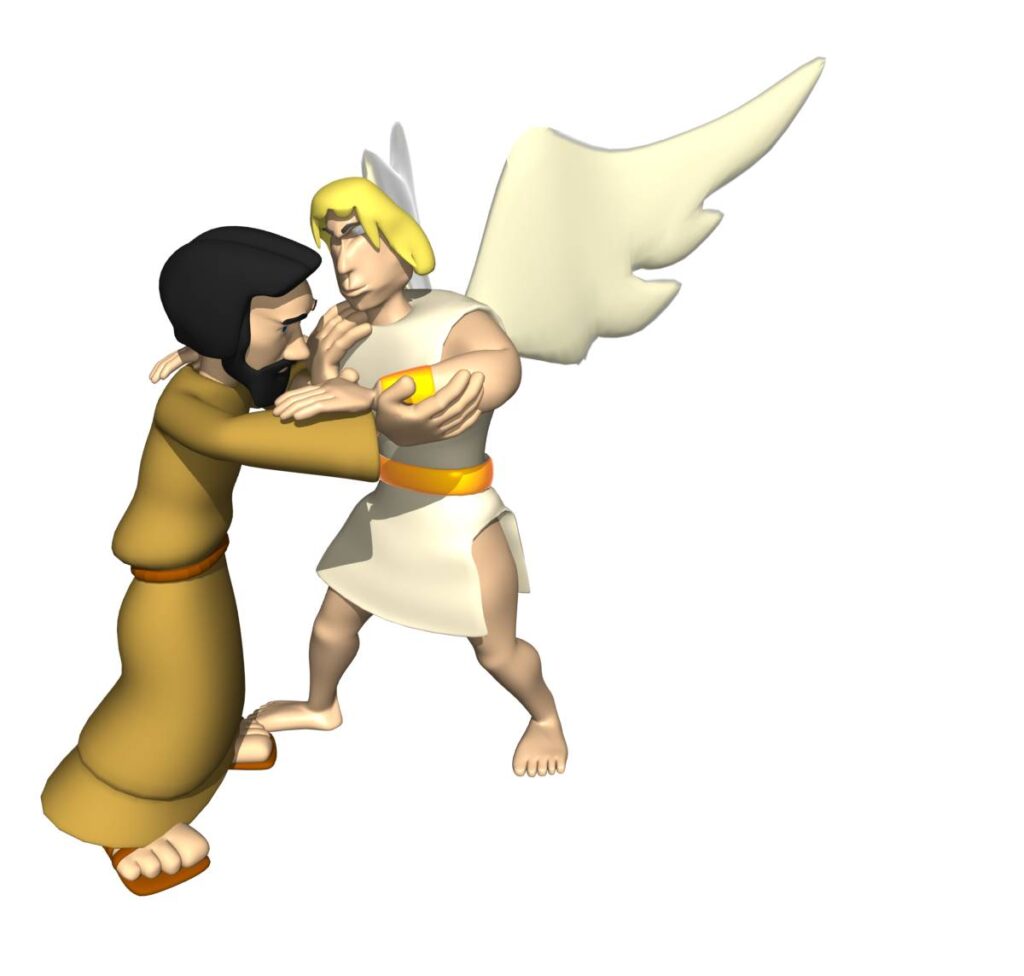
Genesis 32:24–32, A Man. This is the account of Jacob wrestling with someone, but who? In verse 24, who does it say Jacob wrestled with? Let’s read Hosea 12:3–4 for a fuller comprehension of who this divine individual was. Hosea the prophet informs us that the “angel” with whom Jacob strove was none other than Elohim himself. The Hebrew word for angel is malak, which means “messenger” whether human, angelic or divine. Thus by definition, an “angel” in the Bible can be the stereotypical angel, a human messenger or a member of the actual Godhead acting as a divine messenger to humans. In Genesis 32:30, Jacob names the spot where he wrestled with the “angel” Beth-El or House of El. Obviously, in Jacob’s mind, he had encountered Eohim, not your stereotypical angel.
So why does Scripture use a term for the Being with whom Jacob wrestled that can mean “a man, a messenger and Elohim”? Isn’t this ambiguous or confusing? Or, on the other hand, is there Someone that the Bible reveals who fits all three of these definitions, or stated otherwise, Who is the only One in all of Scripture that fits all three of these descriptions? So with whom did Jacob really wrestle? Who is the One who blessed Jacob and made covenants with him and with his father and grandfather? We find the answer turn in Isaiah chapter 53, which is the chapter that speaks about the Suffering Servant Messiah who would come to redeem man from his sins through his atoning death. Of the Messiah, in verse one we read,
Who hath given credence to that which we heard? And the arm of Jehovah, On whom hath it been revealed?
Who is the “arm of YHVH” that now sits at the right hand of YHVH in heaven (1 Pet 3:22)? If you are still not sure, read the rest of Isaiah 53 for the answer. It is none other than Yeshua the Messiah! He is the same One who led the children of Israel through the wilderness (for further proof see Acts 7:37–38 and 1 Cor 10:4 cp. John 8:58).
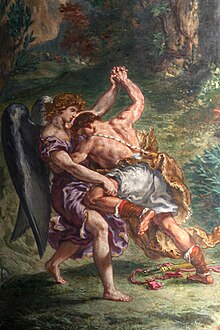
Genesis 32:24, Wrestled with him. Why did Elohim wrestle all night with Jacob? Why not just wound him early on and save the time and trouble? This teach us much about the long-suffering nature of Elohim, who will continue to strive with us and our carnal weaknesses and self-reliances, until we finally submit to him and recognize that only through him can we have real strength and victory, though we might end up physically lame in the process. Why the wrestling all night“till the breaking of the day”? Biblically night and breaking of day can metaphorically represent the struggles, trials and difficulties that humans often experience in their lives. Jacob’s night-long struggle teaches us much about faith, the struggles of this life and about not giving up until the very end when the blessings and dawning of a new day are about to break forth. Jacob’s struggle is an inspiring example about prevailing faith in Elohim and not giving up despite the spiritual darkness that surrounds us and the struggles that we face in life.
At the end of his struggle, Jacob received the new name of Israel (verse 28). Through this struggle, he took a quantum leap spiritually and became a new man with a new identity. Has this ever happened to you? Don’t we progress spiritually only out of crisis? “There is no gain where there is no pain,” as the saying goes.
What were the positive results of Jacob’s struggle? Verse 32 says of Jacob, “as he passed over Penuel the sun rose upon him, and he limped upon his thigh.” The Hebrew word penuel means “faces of El.” Taking a little poetic license (at the drash, allegorical or third level of Hebraic biblical interpretation) here, we could paraphrase this verse as follows: “As Jacob emerged out of the darkness of self-reliance, the face of Elohim shined favorably upon him as he no longer relied on the flesh.” Pause to reflect on this for a moment and take quick stock of your own spiritual walk in the light of these words.
Who are some other notable Biblical characters besides Jacob who struggled with trying to achieve their divine mission through human means? The most notable example is the patriarch Abraham who tried to fulfill YHVH’s will through his sexual relations with his mistress Hagar. Moses attempted to deliver his fellow Israelites from the hands of their enslavers when he murdered the Egyptian. Peter when he cut off the ear of the high priest’s servant in an attempt to deliver Yeshua from the hands of his captors. What did these biblical figures learn from their mistakes about walking in the Spirit versus walking in the flesh?

Now consider your own life. Have you ever struggled between doing your will versus submitting to the will and ways of Elohim? How did it go? What lessons did you learn?
Sadly most people clueless about the spiritual battle that is occurring in their lives; they just live their lives reacting impulsively to life’s situations without considering the consequences of their actions or critiquing themselves with an eye on self improvement. This is because they are unaware that there is a higher way to walk instead of simply following the natural impulses of their human nature, which is a downward spiraling slippery slope.
The only way to know that there is higher way is to walk in the Spirit of Elohim through a spiritual relationship with Yeshua the Messiah, and to learn about the heart, mind and will of the Creator. How do we accomplish this? Like Jacob, by acknowledging the fact that our ways haven’t worked out so well for us and that we need help from above. This involves repenting of our sin (i.e., going against the ways of Elohim), receiving Yeshua as our Lord and Savior, and then studying the words, ways and will of Elohim in the Bible, and by studying the lives and examples, both the failure and successes, of the people written about therein, and then by conforming our lives to the truth of the Bible. In this manner, we will begin to emerge from the darkness of sin and carnality and will become a child of the light (1 Thess 5:1–5) of YHVH’s Truth with a new awareness, a new identity as an overcomer, a conqueror, and child or prince of El, like Jacob becoming Israel.
Genesis 32:28, Jacob but Israel. Jacob/Ya’acov means “heel snatcher/holder or supplanter,”while Israel/Yisra’el means “Prince of El or El Prevails/Prevailer with El.” What can we learn about the change of Jacob’s character as reflected in the changing of his name? Who is the focal point of the name and the initiator of the action in the first name…in the second name? Now apply these principles to your own life as you learn from the lessons of Jacob’s life

Genesis 32:32, The muscle that shrank. Please notice that the sinew, representing the strength of Jacob’s, flesh only shrank. It was not removed. What does this signify spiritually with regard to the redeemed man’s old sin nature? Simply this. At the point in one’s spiritual journey when one is regenerated by the Spirit of Elohim, a person doesn’t lose their identity, personality or soul (i.e., his mind, will and emotions). Rather, they become a new man with a new spiritual identity and a new upward orientation.
In the process of dying to oneself, what then happens to a person’s soul? It must be transformed and renewed by the Spirit of Elohim to be conformed to YHVH’s perfect will (Rom 12:2). One’s soul (their mind, will and emotions or personality) will still try to assert dominance over their personal spirit that resides inside of them, but one must learn to submit their soul and spirit to the Spirit of Elohim, that is, to the mind, will, ways and Word of Elohim, their Creator.
Paul discusses the struggle between the soul and the spirit in Romans 7:14–25. This is the same struggle that Jacob faced in his dark night of the soul when wrestled not only with his own carnal limitations, but with the preincarnate Yeshua the Messiah. There he died to his own will and finally submitted totally to that of his Heavenly King. There Yeshua not only became his Savior but also his Lord and Master. Jacob’s struggle is the same struggle that each of us faces. Will we overcome and become a new person with a new spiritual identity and receive heaven’s blessing, or will we hang on to our old ways and keep beating our heads aimlessly and pointlessly against the wall of our own limitations? The choice is ours.
Genesis 33
Genesis 33:9, I have enough.
Esau—A Picture of Materialistic, Carnal and Laodicean Christian
Continue reading