

Exodus13
Exodus 13:18, 21, But Elohim led the people…and YHVH went before them…to lead the way. The Bible records that YHVH speaks to his people in various ways, and still does to this day. He communicates with his people…
- Through his written word (Ps 119:105).
- By his Holy Spirit who leads YHVH’s people to into all truth (John 16:12).
- Through his divinely appointed leaders (Eph 4:11–16).
- By directing the steps (through life’s circumstances) of a righteous man (Ps 37:23–24; Prov 16:9).
- By directing the hearts of men (Prov 21:1).
- Through prophetic words (Num 12:6).
- Through dreams and visions (Num 12:6).
- Through wise counselors (Prov 24:6).
- Through Divine Messengers from heaven (e.g., Judg 6:11–14; 13:3).
Exodus 14
Exodus 14:13–15, And Moses said. The first four statements that Moses makes in these two verses presupposes the four fear responses that the Israelites would naturally have had when trapped between the Egyptian army and the Red Sea. What were the Israelites’ reactions? Maybe we can learn something about our own responses when faced with dire situations.
To those who felt hopeless and depressed and essentially wanted to commit suicide by fleeing, which meant certain death since there was nowhere to go: fleeing meant certain death either by drowning in the sea or by Pharaoh’s army, Moses said, “Do not be afraid. Stand still and see the salvation [Heb. Yeshua] of YHVH.”
To who longed for the good old days of their past lives back in Egypt, Moses said, “The Egyptians whom you see today, you shall see no more.”
To those who wanted to fight, Moses said, “YHVH will fight for you.”
To those who wanted to just complain to Moses and YHVH about their plight, Moses said, “Hold your peace.”
When faced with similar impossible situations, we typically have the same responses as that of the children of Israel, when all we have to do is to stand still in faith and wait on YHVH to supernaturally deliver us. But there’s more. Faith isn’t passive. It’s active. This is where the fifth statement—this one made by YHVH—comes into play.
YHVH command the Israelites to “Go forward” in faith! YHVH expected Moses, the leader, to lead the way. YHVH told the Israelites to confront their fears including the fear of death and to step into the Red Sea. Only when the people’s leader stepped forward in faith and placed his foot into the Red Sea did the sea part and the deliverance of YHVH became evident.
Note what Moses told Israelites in this first statement: “Stand still and see the salvation [Heb. Yeshua] of YHVH.” As already noted previously, the pre-incarnate Yeshua the Messiah was the Messenger of YHVH who was with the children of Israel in the fire cloud positioned between the Israelites and the Egyptians. When Yeshua the Messiah is in your camp, there is nothing to fear! This was a lesson in faith that the Israelites had to learn—and one we have to learn as well. Let’s not forget the words of the apostle:
I can do all things through Messiah which strengthens me. (Phil 4:13)
Nay, in all these things we are more than conquerors through [Messiah] that loved us. (Rom 8:37)
What shall we then say to these things? If Elohim be for us, who can be against us? (Rom 8:31)
Exodus 14:13, Salvation. The word salvation here is the Hebrew word Yeshua. Think about this for a moment in light of the context in which this word appears in this story, and the implications for your own life when you are confronted with difficult situations.
Exodus 14:19, Angel [or Messenger] of YHVH. This is divine entity was none other than the preincarnate Yeshua—the Messenger or Word of Elohim before he was made flesh (John 1:1, 14).
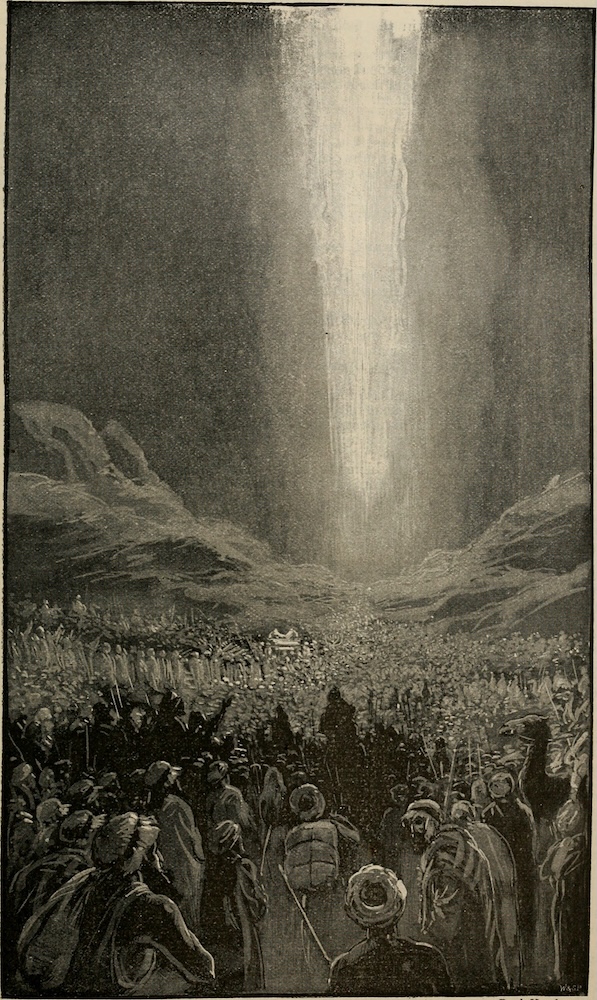
Went behind them. Fire does two things. It both destroys and purifies substances depending on the durability of their composition. It consumes that which is flammable (e.g., wood, hay and stubble) and refines or purifies that which is inflammable (e.g., gold, silver and precious stones; see 1 Cor 3:12–15). To those people whose lives are characterized by wood, hay and stubble (spiritually speaking, this refers to sin and the works off the flesh), fire is a threat and terror. On the other hand, to those whose lives are like gold, silver and precious stones (spiritually speaking, this refers to works of righteousness and the fruit of the Spirit of Elohim), fire is welcomed, since they have nothing to fear. This is because fire will only refine, not destroy them spiritually.
Moreover, fire creates light. To those whose lives are characterized by light (i.e., truth and righteousness), fire is a positive thing, since it exposes sin and gives them light by which to go forward spiritually. To those people who live in spiritual darkness (i.e., the world, the flesh and the devil), as was the case with Pharaoh and Egypt (a symbolic picture of Satan and the world), and those who love sin and hate Elohim and his righteousness (John 3:19–20), fire and light are feared because it will not only expose their evil deeds, but will consume them through divine judgment (see Rev 20:15).
Therefore, the fiery flame that separated the Israelites from the Egyptians was a good thing and a blessing for the former and a horrific thing, a curse and a terror for the latter. In fact, in Exodus 15:7, in poetic terms, the Egyptians (a biblical metaphor for rebellious and unrepentant sinners) are likened to stubble that YHVH destroys in his wrathful judgment. This same thing will occur again on a global scale when the earth is burned with fire and the wicked become ashes under the sole’s of the feet (Mal 4:1–3) of the righteous after the white throne judgment (Rev 20:11–15).
What is your life comprised of? Wood, hay and stubble, or gold, silver and precious stones:
For no other foundation can anyone lay than that which is laid, which is Yeshua the Messiah. Now if anyone builds on this foundation with gold, silver, precious stones, wood, hay, straw, each one’s work will become clear; for the Day will declare it, because it will be revealed by fire; and the fire will test each one’s work, of what sort it is. If anyone’s work which he has built on it endures, he will receive a reward. If anyone’s work is burned, he will suffer loss; but he himself will be saved, yet so as through fire. (1 Cor 3:11–15)
Exodus 14:22, The children of Israel went. According to Jewish tradition (e.g., see The ArtScroll Stone Edition Chumash commentary on verse eight), the Red Sea crossing occurred on Nisan 21 (or the month of the Abib, which is the first month of the biblical calendar occurring in the early spring, Exod 13:4), which is the last day of the Feast of Unleavened Bread, even though the Scriptures does not explicitly state this. The Jewish sages deduce this from the chronology of events leading up to the crossing. On the fifteenth day of the first month, they reason, Israel left Egypt and traveled from Rameses to Succoth. On the sixteenth day, they traveled from Succoth to Etham, and on the seventeenth from Etham to Pi-hahiroth. Then on the eighteenth it was reported to Pharaoh that Israel had been gone for three days. On the 19th and 20th Pharaoh mustered his army and pursued Israel, and on the twenty-first day of the first month Israel crossed the Red Sea, which was the last day of the Feast of Unleavened Bread.
The [Red] Sea. The Israelites went through the midst of the Red Sea. Like the killing of the Passover lamb and the painting of his blood on the door posts, the crossing of the Red Sea prophetically pointed forward to the message of the gospel and the steps a disciple of Yeshua must take in his spiritual journey. Paul states in his letter to the believers in Corinth,
Moreover, brethren, I would not that ye should be ignorant, how that all our fathers were under the cloud, and all passed through the sea; and were all baptized unto Moses in the cloud and in the sea; and did all eat the same spiritual meat; and did all drink the same spiritual drink: for they drank of that spiritual Rock that followed them: and that Rock was Messiah. (1 Cor 10:1–4)
The Israelites going through the Red Sea is a prophetic picture of baptism for the remission of sins of the new believer. Red reminds us of the blood of Yeshua that cleanses sinners of sin. Moreover, sea water is salty and salt is a biblical symbol representing cleansing, purification, preservation and eternity and all of which point to the efficaciousness of Yeshua’s atoning blood on behalf of the redeemed saint.
Now let’s look at Israel’s Red Sea passage in light of its larger gospel message context. While back in Egypt, YHVH sent Moses the evangelist to the Israelites with the message of redemption from their Egyptian slave masters. To be spared from Eloim’s judgments against sin, all the Israelites had to do was to believe the evangelist (i.e., the preacher of the gospel message), when he instructed them to kill a lamb and to put its blood on the doorposts of their houses (i.e., have faith in the shed blood of Yeshua the Messiah who died on the cross to set us free from the penalty of our sins). Those who obeyed these instructions were spared Elohim’s judgment against sin.
Next, the Israelites were told to put leaven (i.e., a picture of sin) out of their houses (a symbol of their lives), eat unleavened bread (i.e., a picture of accepting Yeshua unconditionally and living a sin-free life from that point forward) and to leave Egypt (i.e., a picture of leaving behind the world’s ways and lifestyles).
After that they went through the Red Sea (i.e., a picture of baptism for the remission of sins).
These were merely the initial steps that the Israelites had to take on their journey to the “Promised Land.”
After that, they came to Marah, then to the desert oasis of Elim, then they received manna from heaven and water from the rock.
Through these steps, the Israelites learned about sin, redemption, the Messiah, how to have faith in Elohim, and how to overcome the triple headed enemy of the world, the flesh and the devil.
For those readers who can discern the code, the gospel message is encrypted in the steps that the Israelites took while traversing the wilderness (a biblical metaphor for our physical life on earth) en route to our own promised land as immortalized and glorified children of Elohim in his eternal kingdom. What the Israelites went through, how they reacted and the consequences of their actions can act as a sort of spiritual road map to aid modern saints in guiding them forward in their own spiritual journey toward inclusion in the kingdom of Elohim as his glorified children. The wise saint will learn from both the mistakes and triumphs of the Israelites. So may we all study the Bible to show ourselves approved, and may YHVH help us to learn our lessons well, so that we may overcome the world, the flesh and devil and be included in YHVH’s everlasting kingdom. Amein!
Chapter 15
Continue reading