Blog Scripture Readings for 10/6 through 10/12/13

Aside

Parashat Lekh L’kha — Genesis 12:1 – 17:27
Haftarah — Isaiah 40:27 – 41:16
Prophets — Joshua 15:1 – 21:45
Writings — Psalm 15:1 – 20:9
Testimony — Matthew 10:27 – 13:58

Most of this week’s blog discussion points will be on these passages. If you have general comments or questions on the weekly Scripture readings not addressed in a blog post, here’s a place for you to post those. Just use the “leave a reply” link below.

The full “Read Through The Scriptures In A Year” schedule, broken down by each day, can be found on the right sidebar under “Helpful Links.” There are 4 sections of scripture to read each day. One each from the Torah, the Prophets, the Writings, and from the Testimony of Yeshua. Each week, the Torah and haftarah readings will follow the traditional one-year reading cycle.

Weekly Blog Scripture Readings for 10/6 through 10/12/13.


A New Spiritual Identity and a New Name

Genesis 11:29, Iscah. According to rabbinical commentary, Iscah is another name for Sarah, Abraham’s wife. It was not uncommon in ancient and Hebraic culture to have more than one name. We find this to be the case in the Scriptures in many instances.

20474058For example, Jethro (Yitro, Exod 3:1), the father-in-law of Moses, was known by two other names: Hobab (Num 10:29; Judg 4:11) and Reuel (Exod 2:18). Sometimes a person’s name would reflect exploits or achievements accomplished in that person’s life, one’s character traits or one’s destiny. Often when one was given a new mission or calling in life a new name was given to that person to reflect their new destiny. Examples of this would be Abram (“exalted father”) becoming Abraham (“father of a multitude”), Sarai (princess) becoming Sarah (“noblewoman, queen”), Jacob (“prevailer, heelcatcher”) becoming Israel (“El prevails, prince of El”), or Hoshea (“savior, deliverer”) becoming Joshua/Yehoshua (“Yah saves/delivers”). It is not uncommon for redeemed believers returning to the Hebrew roots of the Christian faith to take a new name to reflect their new spiritual journey, mission, destiny or identity. Some may think this a strange thing to do, but in Hebraic culture this was a very acceptable practice. Often Elohim did the renaming as in all the examples given above.

Interestingly, YHVH promises a new name as part of their spiritual inheritance to those saints who overcome the world, the flesh and the devil (Rev 2:17; 3:12). Do you have your new name yet?


Yeshua’s Commissioning the Twelve…and YOU?

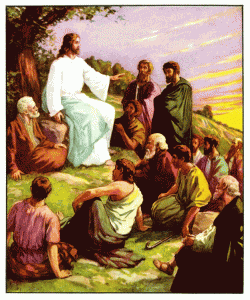
Matthew 10:5ff, Yeshua sent out. The Commissioning of the Twelve Disciples.

  • There are several notable aspects to consider when Yeshua commissioned his disciples. As modern-day disciples of Yeshua, we need to take these into consideration when assuming a ministry role. These are the requirements of his laborers who will work in his harvest field (see Matt 9:37 for context).
  • Yeshua calls one into the ministry (Matt 10:1). Some go into the ministry as a career like any other job. This is unbiblical. Involvement in Yeshua’s ministry is by his invitation only.
  • 25479441After calling one into the ministry, there is a time of training. This is the biblical norm. For some, it was five years (e.g., the Levites), or forty years (Moses and Joshua). David had a period of training before becoming king, as did Paul the apostle and Elisha. For Yeshua’s disciples, it was three-and-one-half years. The Matthew ten account is part of the disciples’ training program.
  • After calling them, Yeshua gives his disciples their marching orders by telling them where to go and not to go (Matt 10:5–6). They were to go to the lost sheep of the house of Israel and to bypass the Gentiles (for now).
  • Yeshua then instructs them what their ministry was to be (Matt 10:7–8). They were to do exactly as Yeshua himself did: preach the gospel of repentance and the kingdom of Elohim, and to heal the sick.
  • He then gives them instructions pertaining to travel arrangements — what they were to take on their journey, where they were to stay, and how to act when encountering resistance (Matt 10:9–15). This includes lodging, food and financial remuneration. On the latter point, today many itinerant  evangelists flagrantly violate Yeshua’s strictures in this regard and have become nothing more than travelling salesmen and peddlers.
  • Next, Yeshua warns his disciples against persecution (Matt 10:16–26). He assumes that persecution will be a natural result of preaching the gospel. Conversely, it could be assumed that something is out of spiritual order when one preaches the gospel and persecution doesn’t occur.
  • Yeshua then instructs his disciples about fear — who to fear and not to fear. They are to fear YHVH, not men (Matt 10:27–31). This is an important point, since preaching the gospel to the lost can be intimidating, which is why so few do it. Yeshua promises divine protection for his disciples who preach the gospel as he has instructed (Matt 10:29–30).
  • The workman is worthy of his hire. Yeshua promises spiritual rewards to those who preach the gospel (Matt 10:32–33).
  • For those who are called into Yeshua’s ministry, he demands total commitment. One must put Yeshua first above all other human relationships. For this, expect rejection from family and friends (Matt 10:34–39).
  • Again, Yeshua holds out the promise of spiritual rewards for those who heed his call to become a disciple who works in his spiritual harvest field (Matt 10:39 cp. Matt 9:37).
 

Prophetic Pictures in the Story of Noah

Genesis 6–8, Noah’s flood provides allegorical insights relating to end-times prophecy. 

In Matthew 24:37, Yeshua compares the end times to the days of Noah. The story of Noah has allegorical implications that give hints about end-times prophecy.
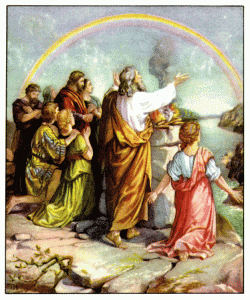
Noah and rainbow

In 1 Peter 3:18, we learn that the story of Noah is also a picture of salvation and water baptism. Noah is a prophetic type of Yeshua.

To start with, Noah building the ark is a prophetic picture of the redeemed believer working out his own salvation (Phil 2:12), yet while doing so according to YHVH’s exact plans or specifications (e.g., repentance from sin, faith in Yeshua, baptism for the remission of sins, and faithful obedience to YHVH’s commandments).

Noah builds an ark of safety from Elohim’s wrath or judgments against sinful man. The ark is a metaphorical picture of the believer’s salvation, and Noah is a spiritual picture of Yeshua. The flood is also a picture of water baptism for the remission of sins, which ceremonially pictures the death of the old sinful man, and the birth of the new spiritual man (Rom 6:3–6). Unregenerated sinful or carnal men perished in the floodwaters in Noah’s day, while the new, redeemed man (as pictured by Noah and his family) who had found grace in the sight of Elohim (Gen 6:8) found refuge on the ark. While the flood is a judgment against sinful man who has violated the Torah-laws or divine instructions of YHVH, the ark is a picture of the grace that YHVH offers to those who will repent of their sins (i.e. Torahlessness, see 1 John 3:4) and will turn to him through Yeshua. Since Noah found grace in the eyes of YHVH because he was “perfect in his generations” (Gen 6:8, 9), he was spared from YHVH’s judgments against sin (the wages of sin which is death, Rom 6:23). YHVH offers the same gift of grace to all men today (2 Pet 3:9).

The ark had three levels indicating the three levels of salvation rewards that YHVH offers to saints, which is analogous to the three sections in the Tabernacle of Moses. The highest level where Noah lived is the part closest to heaven, where YHVH abides, and is a picture of the kadosh hakadoshim (the holy of holies, also known as the d’veer meaning “oracle”), which was the place in the tabernacle from which Elohim spoke to the Moses and the Israelites. It is in that highest place that one hears Elohim’s instructions directly from him.

The unclean animals are a picture of lost and scattered Israelites returning to YHVH in the end times from the beast or heathen nations to where they have been scattered and where they have become like beasts of the field. In Peter’s vision of the sheet in Acts 10, the Gentiles are likened to unclean animals that YHVH has redeemed (e.g., the great and innumerable multitude or Rev 7, the lukewarm believers of Laodicea in Rev 3, the thief on the cross and the foolish virgins in Yeshua’s parable in Matt 25). The clean animals may represent the 144,000 of Revelation 7 and 14, and who are those saints who have remained faithful in keeping YHVH’s Torah commandments, while at the same time maintaining faith in Yeshua the Messiah (Rev 12:17; 14:12).

Noah escaping the wrath of Elohim may be a type of the second exodus of end-times Israelites from the nations of the world. As a mixed multitude joined Israel in the exodus from Egypt, so even within Noah’s family there was a mixed multitude containing a spiritual tare; namely, Ham who later fell into sin (Gen 9:22–27) and become the father of the evil Nimrod (Gen 10). Even Yeshua had Judas, a tare, among his select group, and Yeshua teaches that the tares would coexist with the wheat up until the end times (Matt 13:24–30).

The waters that flooded the world both came up from out of the bowels of the earth and down from heaven (Gen 7:11). Water is a biblical metaphor for the spoken word; namely, and it represents both the Word of Elohim from above, and the word (philosophies, thoughts, ideas, religions) of man that are counter to the Word of Elohim that have their source from below. In the last days, knowledge shall be increased, the devil shall spew out his mouth words or philosophies like a flood in an effort to spiritually drown the world and even the saints (Rev 12:15; Matt 24:14). Water can also be a judgment against men. YHVH will judge men for their words, philosophies and religions. Those who followed YHVH’s Word from heaven will be spared his wrath, while those who have subscribed to the words or philosophies of men from below will perish or be judged in a sea of men’s words that are often founded on doctrines of demons. Those who feed spiritually from the tree of knowledge (i.e., secular humanism and all the false religions and ideologies that have spawned from it) will die, while those who spiritually feed from the tree of life or the word of Noah (i.e. a prophetic picture Yeshua), the preacher of righteousness (i.e., the Torah, see Ps 119:172) will live. In the last days, the Word of YHVH will judge men, for when Yeshua returns to the earth on a white war stallion, the sword of the word of Elohim will be coming out of his mouth with which he will judge the nations (Rev 19:11–15).

It rained 40 days. This is another picture of judgment, since biblically, forty is the number of trials, testing or spiritual refinement.

The ark came to “rest” (Heb. nuach meaning “repose, settle down, be quiet”) on the mountains Ararat (Gen 8:4). From there, Noah built an altar and begin to rule the earth. This is a picture of Yeshua, at his second advent, coming to Zion or the Temple Mount where he will have his temple and will establish his kingdom on earth.

The word Ararat means “the curse is reversed.” The ark came to rest on Ararat during the Feast of Tabernacles or Sukkot. This is a picture of the saints coming to a place of rest at the beginning of the Millennium after the judgments of Elohim have been poured out on this earth against sin and wickedness.

The dove is a picture of the bride of Yeshua who follows the Spirit of Elohim. The dove coming from the top window of the ark is a picture of the bride of Yeshua coming back to earth from the first heaven to rule with Yeshua on earth. The dove left and came back on the seventh day — the Shabbat. This is a picture of the Millennium or the seventh millennia of man’s existence on earth. Several times in the story of Noah, it is mentioned about the dove finding rest or not finding rest. This is another picture of the Millennium — a time of rest for the saints or the bride of Yeshua.

The raven is a picture of the devil who feeds off of dead meat. He is also actively trying to kill, steal and destroy (John 10:10). Satan will be active at the end of the Millennium, as well, when he will be loosed and will incite Gog and Magog to come against Jerusalem (Rev 20:7–10).

Noah’s altar may well be a picture of the third temple (or Ezekiel’s temple).

According to Christian commentator Matthew Henry, the ark was an early Christian metaphor for salvation and YHVH’s delivering his people form evil and judgment against wickedness. We see this allusion in 1 Peter 3:20–22 where the flood is a picture of salvation, deliverance by baptism and the resurrection of Yeshua.

The ark was covered with pitch, which is a picture of the redeemed believer being covered by the blood of Yeshua to keep his spiritual ark from sinking under the judgment of Elohim against men’s sin. The blood of Yeshua keeps man from coming under (the penalty of ) the law even as the pitch smeared on the ark’s exterior kept it from sinking.

The name Noah means “rest.” Yeshua bids all who are heavy laden and need rest to come to him (Matt 11:28–30).

Noah was 600 years old when he went into the ark and the flood came. YHVH’s final judgment against wicked men will be at the end of the 6000 years of men’s rebellious tenure on this earth.

Noah didn’t leave the ark and set foot on the earth until YHVH bade him to do so (Gen 8:15). Likewise, Yeshua won’t return to the earth from heaven until the Father permits it.

The Noachic Covenant that Elohim made with all humanity (Gen 9:1) is a picture of the New Covenant being ratified in the Millennium with “all Israel.” No non-Israelites (i.e., no sinners) will be permitted to live, but will be burned up in the lake of fire at the end of the Millennium (Rev 20:11–15).

 

Build Your House on the Rock (of Torah)

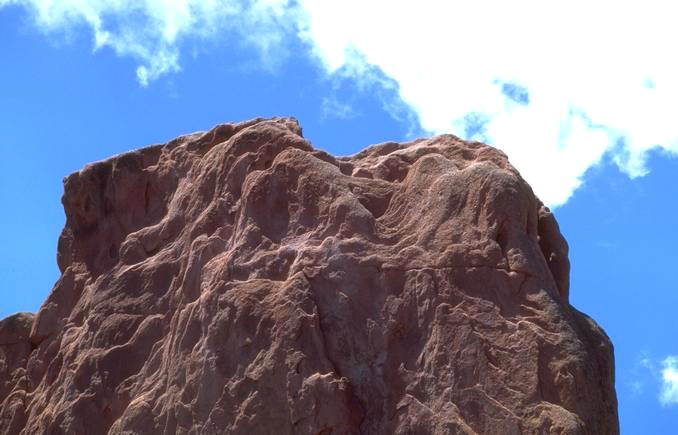
Matthew 7:24–27, House on the Rock. What is Yeshua saying here? The Bible equates Torah with wisdom (e.g., Deut 4:5–6; Ps 111:10; Prov 2:6). Therefore, a wise man is one who walks in the Torah. The same man will be called “greatest in the kingdom of heaven” (5:19), referring to one who keeps the Torah-commandments of Elohim and teaches men to do them, whereas the one who rejects Torah the Messiah Yeshua will reject him (verse 23).

Rock1- 1750660

A “house” in Hebrew thought is a reference to the temple of Elohim (1 Chr 6:48; 9:13, 26, 27; 22:2; 23:28; 28:21; 2 Chr 4:19; 5:1; Ezr 4:24; Is. 2:3; Matt 12:4; Mark 2:26) that was built upon Mount Moriah (originating from the Hebrew word moreh meaning “to teach”) from which the Torah-law (the righteous teachings or instructions) of Elohim was to go forth to the nations (Isa 2:3; Mic 2:4). We know from the Testimony of Yeshua that the saints are called the spiritual temple (or house) of Elohim (1 Tim 3:15; Heb 10:21; 1 Pet 4:17; 1 Cor 3:16; 6:19; 2 Cor 6:16; Eph 2:21). What we see here is that the “teachings” or “instructions in righteousness” (i.e., the Torah) of YHVH go forth from the temple or house of Elohim located on Mount Moriah for the benefit of the spiritual house or temple of the saints. Clearly stated, Yeshua is saying that the Torah-law of Elohim is for redeemed believers today during the “Church Age.” Continue reading →


Will the Saints Go Through the Great Tribulation?

Genesis 7:9, After seven days. Noah was a preacher of righteousness for 120 years prior to the flood (Gen 6:3). He no doubt endured the mockery and persecution of those who did not believe his message about a coming flood, and the need for an ark of safety when that generation had never experienced rain or floods (Heb 11:7; 2 Pet 2:5).

Rain 20107088

In Genesis 7:4 YHVH allows Noah to experience seven more days of persecution before the rains of judgment come upon the earth after which YHVH shut Noah and his family up in the ark of safety (Gen 7:16) after which the ark “was lifted above the earth” (Gen 7:17).

Yeshua likens the end times just prior to his return to the days of Noah (Matt 24:37–39). Yeshua further teaches that his saints will not only go through tribulation on this earth (Matt 24:3–22), but that his people will even go through “great tribulation” (Greek: megathlipsis, v. 21).

After this, Yeshua teaches that the saints will be lifted up above the earth to meet him in the air after the great tribulation (Matt 24:29–31). The Scriptures reveal that Noah endured another seven days of tribulation before the wrath of Elohim was poured out upon the wicked inhabitants of the earth. This may be a prophetic picture of a seven-year tribulation period the saints will have to go through before the wrath of Elohim (which is different than the tribulation period) is poured out upon this earth (See Rev 11:15–18 [compare with 1 Cor 15:51–53] and chapters 15 and 16 where the seven last plagues are called the wrath of Elohim).

The Scriptures clearly teach that YHVH’s people will not have to endure his wrath (1 Thess 1:10; 5:9), but conversely teaches that all will go through tribulation (John 16:33; Acts 14:22; Rev 7:14). Scripturally, tribulation and wrath are two different words and concepts.


New Video: The Feast of Tabernacles

The fall biblical festival called the Feast of Tabernacles (in Hebrew, Sukkot) is a prophetic picture of the millennium when Yeshua the Messiah, along with the saints, will be reigning over this earth. In this video, Dr. Joseph Dombek explains the past, present and future implication of this festival and how it relates to the redeemed believer.

We invite you to watch this video at: