Beware of False Prophets and Biblical Gurus—Accountability of “Prophets”

1 Corinthians 14:29, Let…prophets speak…let the others Judge.

How many YouTube, internet and podcast “prophets” are out there claiming to hear form Elohim, and are making all sorts of prophetic proclamations as they build their empires of fame and fortune supposedly in the name of Elohim? Caveat emptor! Let the buyer beware!

Many people who claim to be prophets have a hard time being accountable to anyone. After all, they’re sure that they have heard from Elohim, so who is anyone to question them? In their mind, to question them is to question Elohim. Lack of accountability of prophets to other prophets or spiritual elders is contrary to what the Bible teaches (1 Cor 14:29). Yet such accountability is a rare occurrence in most churches where the gifts of prophecy operate.

Such a demeanor of self-delusion among “prophets” who refuse to be unaccountable to anyone can become a major stronghold of pride on the part of these individuals

If they claim to be speaking for Elohim when they are not, they are running the risk of blaspheming Elohim by speaking lies in his name. In this case, in reality, they’re speaking from the dictates of their own evil hearts, and not by the Spirit of Elohim, which is something that Elohim hates and condemns (Jer 23:16–22; Ezek 13:2–7).

Such “prophets” are under the influencing control of their carnal nature instead of the Spirit of Elohim lack, and they lack self-control, humility and meekness. Moreover, those who are driven by their own passions of impetuosity, pride, anger and accusativeness are especially vulnerable to false prophetic proclamations. They are operating not from a sound (or moderate and self-controlled) mind that is under the control of the Spirit of Elohim, but from an unsound mind (2 Tim 1:7). Such people are even open to demonic spirits because they are controlled by a spirit of pride and hypocrisy. They hate accountability from other people because the light of truth shining through others onto them might expose them for who they really are and not who they suppose themselves to be—prophets speaking the oracles of Elohim.

Furthermore, when these “prophets” have psychological disorders (e.g. they are “bi-polar,” manic-depressive, or have an obsessive-compulsive disorder) or they are under the influence of either medically prescribed psychotropic drugs or non-prescribed “legal” pyscho active drugs (like cannabis) and this is combined with some knowledge of the Scriptures and a passion for the Bible great delusion can come forth all ostensibly in the name of YHVH Elohim. In reality, these “prophets” proclaiming a toxic mix of truth error. Beware!

Add to this the alluring opportunities modern technology presents these “prophets” for stardom due to easy access to social and digital media platforms and outlets like Facebook and YouTube, the possibilities for spreading their false prophetic delusion far and wide to others is great. Anyone—literally anyone—can look good on a digital platform, and can gain sycophantic and fawning followers (just look at the sins that have been uncovered on many of the current and past crop of televangelists), but do we really know their true character or who they really? That’s why the Bible admonishes us to know those who labor among us (1 Thess 5:12), and why YHVH has given us the gift of the discernment of spirits (1 Cor 12:10).


Is the Torah just the books of Moses or the whole Bible?

1 Corinthians 14:21, In the law. Usually the word law (in Gr. nomos and in Heb. torah meaning “teachings, instructions or precepts) in the Scriptures refers to the first five books of Moses, but here Paul uses the term to apply to the writings of Isaiah the prophet. Obviously, Paul had a more expansive view of the law than just to the five books of Moses, for here he applies it to the prophets sections of the Tanakh or Old Testament. 

Similarly, in the Gospel of John, Yeshua refers to the Psalms (which were contained in the Writings part of the Tanakh) as the law (John 10:34), and Jewish people, like Paul, regarded Isaiah as part of the law as well (John 12:34). 

What all this means is that Yeshua, Paul and the Jewish people in a general sense viewed the entire Tanakh as the law, or more correctly, the instructions or teaching of YHVH, since the Hebrew word for law (i.e. torah) means exactly this. What this means to us is that Elohim’s entire word should be viewed as his legal code or instructions to men on how to act. As such, no parts of it can be eliminated, relegated to the past or “done away with.” It is thus important to view the entire Word of Elohim as equally binding and relevant to all people at all times.


Phinehas: Who will rise up against evil?

Who will rise up for me against the evildoers? Who will stand up for me against the workers of iniquity? (Psalm 94:16)

Numbers 25:7, Phinehas…took a javelin. Phinehas, the priest, rose up against evil—in this case, sexual immorality—and took a stand for righteousness, and YHVH commended him for it. Who are the Phinehases of today?

In standing against sin, Phinehas, the grandson of Aaron the high priest, was not acting as a self-appointed vigilante as it may appear. Rather, YHVH had given the priests, of which Phinehas was one, the authority to act as judges in Israel and to pronounce sentence in criminal matters (Deut 17:9–11). Additionally, Phinehas was doubly justified in his action against the fornicators, since he was an eyewitness of these sexual crimes, and the Torah teaches that the hand of the eyewitness was to be the first to rise up in executing judgment against the criminals (Deut 17:6; Ezek 44:24). So as an eyewitness and as a priest, he was legally justified in his actions. The priests and Levites were to act as Israel’s legal experts (Lev 10:10–11; Deut 24:8; 33:10; 2 Chron 17:9; 30:22; Neh 8:2, 8; Hag 2:11; Ezek 44:23; Mal 2:7) and to make determinations between the holy and the profane (Ezek 22:26; 44:23).

Who are YHVH’s priest on the earth today? According to Peter, and John the saints are those priests (1 Pet 2:7; Rev 1:6; 5:10; 20:6). As such, the saints presently possess the divinely mandated legal authority to fulfill the responsibilities of the priesthood of old when it comes to teaching the laws of Elohim to the nations in which they live (Lev 10:10–11). Moreover, Yeshua, our Great High Priest, has tasked his disciples with the responsibility and authority to judge righteously (i.e. to make judgments according to YHVH’s standards of righteousness, John 7:24), and to be spiritual fruit inspectors (Matt 7:15–20). Today, this responsibility is primarily exercised within the congregation of the righteous (1 Cor 5:12; 6:1–6). However, besides this, the righteous saints are to act as spiritual salt in this world and to be like a spiritual light on a hill for the world to see (Matt 5:13–16). This means that they are to preach the gospel to the world, to make disciples and to teach those around them all that Yeshua has commanded them (Matt 28:18–20; Mark 16:15–16). This means that the saints have heaven’s authority and commission to act as the spiritual and moral compass and conscience for the nations in which they live. This means that they will be standing against evil wherever and however they can as directed by the Spirit of Elohim, even as Phinehas did.

It is time that the righteous servants of YHVH Elohim begin to stand up in a more vocal and demonstrative way against the evil that is being foisted upon our society by those who are bent upon destroying the family, morality, and any vestiges of biblical standards of righteousness that may still exist around us. In Psalm 94:16, YHVH asks the question of his servants, “Who will rise up for me against the evildoers or who will stand up for me against the workers of iniquity?” With this in mind, the question we need to ask ourselves is this: If not me, who; if not now, when? If you have something worth living for, then do you have something worth giving your life for? If those who are caught up in demonically inspired religious systems are willing to die for their faith calling it “a holy war” and “martyrdom for their [demon] god,” can the saints of YHVH at least not take a verbal stand against the tide of evil that is sweeping our society?

The Bible is full of examples of YHVH’s servants standing against unrighteousness in their day and their receiving YHVH’s blessing for it. Several examples include the Hebrew midwives disobeying the edict of Pharaoh to commit infanticide (Exod 1:15–22), Phinehas executing judgment against the fornicators (Num 25:7–8), the three Hebrew children refusing to worship the golden image (Dan 3:8–18), Daniel violating the king’s edicts by praying to YHVH (Dan 6:10–12), John the Baptist criticizing Herod for his adultery (Mark 6:18), Yeshua turning over the money changers’ tables in the temple (Matt 21:12), and Peter and John for disobeying the Jewish leaders’ command to not preach the gospel (Acts 4:18–20). Many more examples could be given. Remember all the biblical prophets? 

Numbers 25:11, Has turned back my wrath…because he was zealous. Read Psalm 94:16. What are some other examples of righteous men and women in the Bible who stood up against evil in their day whom YHVH praised for doing so? Did Phinehas rise up against evil in his own carnally-minded, emotionally-based zeal? If not, then whose zeal was he full of? (Read verse 11 again.) When we take a stand against evil as led by the Word and Spirit of the YHVH Elohim, can it ever be wrong to do so, even though the world may not agree with us and may even criticize or persecute us for doing so? Not only that, Phinehas placed his life on the line between the righteous judgment of Elohim and those who were sinning. Many times, the servants of YHVH actually have to leave their comfort zones and place themselves in harm’s way on the ragged edge between good and evil to take a stand for YHVH Elohim. (Note Aaron’s actions in Num 16:46–50.) The examples of such actions from the pages of the Scriptures are too numerous to list. Some notable examples include: 

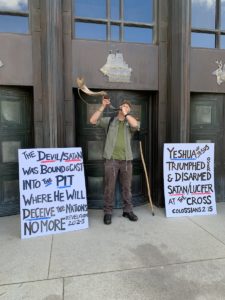
Natan recently standing on the steps of the Oregon state capital building preaching and blowing the shofar against a Satantist/Luciferian rally and march that was supposed to have occurred there that day, but, amazingly, the devil worshippers never showed up.
  • Noah preaching righteousness against the utterly corrupt generation of his day.
  • David versus Goliath (1 Sam 17)
  • Elijah confronting the prophets of Baal (1 Kgs 18:20ff)
  • John the Baptist confronting King Herod (Matt 14)
  • Yeshua confronting the religious leaders of his day on numerous occasions (e.g. Matt 23)
  • Peter and John versus the Jewish leaders (Acts 4)
  • Stephen confronting the Jewish leaders (Acts 7)
  • Paul and Silas preaching against false religion in Philippi (Acts 16) and preaching the gospel on the streets in Thessolonica (Acts 17), in Corinth (Acts 18) and again in Ephesus (Acts 19)

At times, YHVH tried to find such a person who would stand for his truth, but was unable to do so (see Jer 5:1; Ezek 22:30).

Numbers 25:11, In my jealousy.YHVH is a jealous Elohim. The word jealous is the Hebrew word qanna/TBBE(Strong’s H7067) meaning “to envy, be jealous, be envious, be zealous.” The ArtScroll Stone Edition Chumash states, “Jealousy is a person’s reaction when he finds that another is taking something that is rightly his. [Elohim] is jealous when Jews serve idols, because they transfer their allegiance from Him to something else.” p. 876). Torah expresses this same idea elsewhere:

Continue reading →
 

Blog Scripture Readings for 7-5 Through 7-11-20

Aside

Parashat Pinchas — Numbers 25:10 – 30:1 (29:40)*
Haftarah — 1 Kings 18:46 – 19:21 | Jeremiah 1:1 – 2:3**
Prophets — Ezekiel 7:1 – 15:8
Writings — Daniel 7:1 – 12:13
Testimony — 1 Corinthians 14:1 – 16:24; 2 Corinthians 1:1-24

Our new annual Scripture Reading Schedule for 2019-2020 with daily readings is available to download and print. If you are still working through 2018-2019’s Scripture Reading Schedule, the link will still be available on the right sidebar under “Helpful Links”. If you are using a mobile device or tablet, the link may be below, meaning you’ll need to scroll down instead.

Most of this week’s blog discussion points will be on these passages. If you have general comments or questions on the weekly Scripture readings not addressed in a blog post, here’s a place for you to post those. Just use the “leave a reply” link or the “share your thoughts” box below.

The full “Read Through The Scriptures In A Year” schedule, broken down by each day, can be found on the right sidebar under “Helpful Links.” There are 4 sections of scripture to read each day: one each from the Torah, the Prophets, the Writings, and from the Testimony of Yeshua. Each week, the Torah and haftarah readings will follow the traditional one-year reading cycle.

* Verse numbers in parenthesis refer to the verse number in Christian English Bibles when they differ from Hebrew Bibles or the Tanakh.

** A different Haftarah is read when it is a special sabbath in Jewish tradition. This week it is Parashat Pinchas occurring after a minor fast on the traditional calendar, so Jeremiah 1:1 – 2:3 is read. Otherwise, 1 Kings 18:46 – 19:21 would be read.

Weekly Blog Scripture Readings for 7/5 through 7/11/2020.


Celebrate Shabbat!

Natan’s gardening rejoicing on the seventh day Sabbath—the only day of the week that YHVH Elohim sanctified!


Spiritual Gifts from Heaven—For YOU (if you want them)!

How do we bring glory to Elohim, live in his river of life and help to advance his kingdom initiatives on earth? By receiving his spiritual gifts and then learning to exercise them.

The spiritual gifts Elohim gives to his children are essential in all aspect of our lives from the time we receive the gift of salvation, but beyond that as well. They establish us in him as a fully functioning and important part of his kingdom being advanced on earth. They help us to be his hands, feet and mouth to reach many people for him.

We must know what our spiritual gifts are so that instead of being a side-lined pew warmer, we are a fully functioning member of the body of Yeshua. Knowing our gift and then functioning in most importantly brings glory to Elohim, and as a by-product gives our life meaning, purpose and direction.

The Gifts (Gr. Charismahtohn) of the Spirit

Having then gifts differing according to the grace that is given to us, whether prophecy, let us prophesy according to the proportion of faith. (Rom 12:6) 

So that ye come behind in no gift (charisma); waiting for the coming of our Lord Yeshua Messiah. (1 Cor 1:7)

For I would that all men were even as I myself. But every man hath his proper gift (charisma) of Elohim, one after this manner, and another after that. (1 Cor 7:7)

There are diversities of gifts, but the same Spirit. (1 Cor 12:4)

But covet earnestly the best gifts [charisma]: and yet shew I unto you a more excellent way. (1 Cor 12:31)

Follow after charity, and desire spiritual gifts (lit. spirituals), but rather that ye may prophesy. (1 Cor 14:1)

Neglect not the gift (charisma) that is in thee, which was given thee by prophecy, with the laying on of the hands of the presbytery.(1 Tim 4:14)

Wherefore I put thee in remembrance that thou stir up the gift (charisma) of Elohim, which is in thee by the putting on of my hands. (2 Tim 1:6)

As every man hath received the gift, even so minister the same one to another, as good stewards of the manifold grace of Elohim. (1 Pet 4:10)

Spiritual Gifts (Charisma) in a General Sense

For the wages of sin is death; but the gift (charisma) of Elohim is eternal life through Yeshua Messiah our Lord. (Rom 6:23)

But the free gift is not like the transgression. For if by the transgression of the one the many died, much more did the grace of Elohim and the gift by the grace of the one Man, Yeshua the Messiah, abound to the many. The gift is not like that which came through the one who sinned; for on the one hand the judgment arose from one transgression resulting in condemnation, but on the other hand the free gift arose from many transgressions resulting in justification. (Rom 5:15–16 NAS)

Salvation Is Elohim’s Greatest Gift to Man

For I long to see you, that I may impart unto you some spiritual gift[Gr. charisma], to the end ye may be established. (Rom 1:11)

The Purpose of Spiritual Gifts 

Spiritual gifts help to establish, make firm, make stable, place firmly a person in the body of Yeshua or kingdom of Elohim. They give one a purpose and function. If you know what your gift is, you’ll better understanding your spiritual call and purpose. This will give your life meaning and direction. This glorifies Elohim, helps to advance his kingdom and keep you in his perfect will and in his river of life for you.

I thank my Elohim always concerning you for the grace of Elohim which was given to you by Messiah Yeshua, that you were enriched in everything by Him in all utterance and all knowle.g. even as the testimony of Messiah was confirmed in you, so that you come short in no gift, eagerly waiting for the revelation of our Master Yeshua the Messiah. (1 Cor 1:4–7)

Spiritual gifts from Elohim enrich our lives in all that we say and think.

Misc. Spiritual Gifts (Charisma)

For the gifts and calling of Elohim are without repentance. (Rom 11:29)

Israel was YHVH’s chosen and gifted people.

Do not neglect the gift that is in you, which was given to you by prophecy with the laying on of the hands of the eldership. (1 Tim 4:14)

Ministry gifts come by prophecy and the laying on of hands by the elders. 

Word Definitions

The Greek word for gifts (as in spiritual gifts, see Rom 6:23; 2 Cor 12:4, 9, 28, 30, 31; 14:1; 1 Pet 4:10) is charisma and means the following:

  • a favour with which one receives without any merit of his own
  • the gift of divine grace
  • the gift of faith, knowle.g. holiness, virtue
  • the economy of divine grace, by which the pardon of sin and eternal salvation is appointed to sinners in consideration of the merits of Messiah laid hold of by faith
  • grace or gifts denoting extraordinary powers, distinguishing certain redeemed believers and enabling them to serve the church of Messiah, the reception of which is due to the power of divine grace operating on their souls by the Spirit of Elohim.

From the study notes found in The Spirit Filled Life Bible in an article entitled“The Holy Spirit and Power,” (by Paul Walker), we learn the following things about spiritual gifts from heaven:

Romans 12:3–8 Lists Seven Gifts from the Father

All born again or redeemed believers should have one or more of these gifts. Often they are innate character traits a person already possesses naturally, but once they are born again by the Spirit of Elohim, these traits will often be employed for ministry purposes. These gifts are basic life purpose or residential motivational gifts that a person is gifted with for the benefit of others.

  • Prophecy
  • Ministry
  • Teaching
  • Exhortation
  • Giving
  • Leadership
  • Mercy

1 Corinthians 12:8–10, 28 Lists Nine Gifts from the Spirit of Elohim

Continue reading →
 

Paul was “under the law to Messiah”—Are you?

1 Corinthians 9:20

And unto the Jews I became as a Jew, that I might gain the Jews; to them that are under the law, as under the law, that I might gain them that are under the law; to them that are without law, as without law, (being not without law to Elohim, but under the law to Messiah,) that I might gain them that are without law. To the weak became I as weak, that I might gain the weak: I am made all things to all men, that I might by all means save some.

What does Paul mean when he says “under the law to Messiah”? The answer should turn the theology of the whole mainstream Christian church with regard to its view of the Torah-law totally on its head! It is evident that when Paul uses the phrase, “under the law” in his writings, he at times infuses different connotations into this phrase. Only by studying the context of the surrounding passages in which this phrase is imbedded can we understand the exact connotation that Paul is attaching to the term “under the law.”

In this passage, the phrase “under the law” is found four times, and doesn’t connote “under the penalty of the law,” (as is the case with Paul’s usage of the term in Romans). The first three times this phrase is found here it means “in subjection to a legalistic perversion of the Torah” (as David Stern translates it in his Complete Jewish Bible and then explains reasons behind this translation in his Jewish New Testament Commentary). Here Paul identifies several groups of people, each of which had its own view of the Torah. These groups were (a) ethnic Jews, (b) those (ethnic Jews or otherwise) who had come under a legalistic view of the Torah in that they believed, for example, that circumcision was a precondition for salvation (certain Pharisees believed this [see Acts 15:1], and Paul was dealing with this doctrinal perversion in the first several chapters of Romans), (c) those (presumably Gentiles) who had no knowledge of the Torah, and (d) those new believers who were still weak and unstable in their faith.

In Paul’s final usage of this phrase in this passage he adds to the phrase under the law” [Gr. ennomos meaning “in the law”] the two words “in Christ.” This changes the whole meaning of the term under the law. As we have noted above, “under the law,” as Paul uses it can mean “under the [penalty of] the Torah,” or “under a legalistic perversion of the Torah,” but here Paul is referring to Torah obedience in the context of a faith in Yeshua. Is Paul referring here to Christians who keep the Torah? Yes! This is what the first century redeemed believers were, and what Paul confesses here about himself (1 Cor 9:21). Paul’s pro-Torah stance is totally consistent with other apologetic statements he makes concerning the Torah along with his confession to being totally Torah-obedient himself (e.g. Rom 3:31; 7:12, 22, 25; 1 Cor 7:19; Acts 21:24; 24:14; 25:8). Torah obedience was also to be a normative attribute of the life of the redeemed believer then and now (e.g. Acts 21:20; 22:12; Rev 12:17; 14:12; 22:14).

So what specifically does the phrase “not being without the Torah toward Elohim, but “under or in the law toward Messiah” mean? Simply this. There is a keeping of the Torah that is done through men’s legalistic efforts that is devoid of trusting faith toward Elohim, whereby one hopes to earn Elohim’s grace or merciful kindness through human effort. This approach Paul proves in Romans 3 and 4 was never how Elohim intended men to come into a spiritual relationship with him, since it is impossible for men to keep the righteous requirements of the Torah perfectly without sinning. Thankfully, salvation is by the grace of Elohim through faith in Yeshua (Eph 2:8–10). It is through Elohim working through his Holy Spirit through our relationship with Yeshua that we can do the good works (Eph 2:10) of loving Yeshua by keeping his Torah commandments (John 14:15; 1 John 2:3–6; 3:24; 5:2–3). When Yeshua and his apostles use the term commandments in their writings, how do we know that they’re referring to the Torah-commandments? In Luke 18:19–20, Yeshua answers this question when he connects the word commandments (Gr. entole) with the laws of Torah (in this case, the Ten Commandments, which is the cornerstone of or the basis for all the other 600 plus commandments in the Torah).

Therefore, when Paul says “not being without the Torah toward Elohim, but under [or, in] the law toward Messiah,” he is referring to Torah obedience within the paradigmatic context of Elohim’s grace toward us (which covers our past sins and delivers us from the penalty for violating the law, which is death), and to Yeshua living in the redeemed believer’s life through his Set-Apart Spirit, which enables one to love Yeshua by obeying his Torah (John 14:15).