Elohim used the boy Samuel to change a nation’s destiny and to bring spiritual revival. Maybe he can use you to do the same. Watch this video, and let it inspire you to do so.


Elohim used the boy Samuel to change a nation’s destiny and to bring spiritual revival. Maybe he can use you to do the same. Watch this video, and let it inspire you to do so.
Parashat Vayeshev — Genesis 37:1 – 40:23
Haftarah — Amos 2:6 – 3:8
Prophets — 1 Samuel 11:1 – 17:58
Writings — Psalms 55:1 – 61:8
Testimony — Mark 3:20 – 6:55
Most of this week’s blog discussion points will be on these passages. If you have general comments or questions on the weekly Scripture readings not addressed in a blog post, here’s a place for you to post those. Just use the “leave a reply” link below.
The full “Read Through The Scriptures In A Year” schedule, broken down by each day, can be found on the right sidebar under “Helpful Links.” There are 4 sections of scripture to read each day. One each from the Torah, the Prophets, the Writings, and from the Testimony of Yeshua. Each week, the Torah and haftarah readings will follow the traditional one-year reading cycle.
Weekly Blog Scripture Readings for 11/17 through 11/23/13.
Mark 1–3
It is interesting to note the order of events as Yeshua was launching his ministry. He was about to enter a war zone!
After John baptized Yeshua and he received his heavenly empowerment, he first went through a spiritual boot camp before stepping onto the battlefield of public ministry. Once in the “war,” it’s worth noting where the battle lines fell.

Matthew 9:10, Sinners. What is behind the Gospel writers’ use of the word sinner (see also Mark 2:16) to designate a class of people along with tax collectors? To the modern reader, this likely begs the question, aren’t all people sinners? This depends on one’s religious point of view. To understand the term sinners as used by the Gospel writers, we must understand the cultural, religious context of the day. According to David Stern in his Jewish New Testament Commentary, this term was used by the Pharisees (who were present at the time this event occurred, see verse 11) to refer to those of low reputation in society including prostitutes and thieves along with the despised, often greedy and mendacious tax collectors (or publicans), whose sins were blatant and obvious.
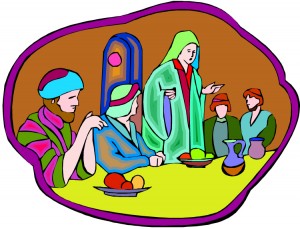
Furthermore, in Hebraic culture, table fellowship indicated intimate relations among those who shared it. As Keener points out (The IVP Bible Background Commentary NT in his notes on Mark 2:16), the Pharisees were especially scrupulous about their special rules on eating, and they didn’t like eating with who were less scrupulous than them — especially those of low reputation.
In this case, Yeshua responded graciously to his accusers (vv. 12–13) by pointing out to them the Father’s heart of mercy in reaching out to lost sinners. At other times, Yeshua, the spiritual activist, turned the tables on the self righteous and sacrosanct Pharisees when he taught that those who considered themselves righteous were, in reality, often worse off spiritually than those they ridiculed (see the Parable of the Pharisee and the Tax Collector, Luke 18:10–14). From Yeshua’s example in dealing with the Pharisees, we learn that when we are accused there are times to be gracious and to turn the other cheek, and there are times to push back hard. Wisdom and the guidance of the Holy Spirit will help us to determine which response is appropriate at any given time.
Genesis 35:1, 6–7, 9–10, 15 (cp. 32:23–31), Elohim said unto Jacob. This account of the encounter between Elohim and Jacob is so matter-of-fact and is written in such a manner as to be familial, if not almost casual. There are no embellishments or hyperbole, just statement of literal fact. Again, the plain (peshat) meaning of the text seems clear: Elohim spoke with man face-to-face. This was not the only time Jacob had experienced such a divine encounter as we have previously noted in is encounter with Elohim in Genesis 32.
It could be said that Elohim spoke to Jacob in some sort of a vision form, until we come to verse 13 and 14, which states that “Elohim went up from [Jacob] where he talked with him. And Jacob set up a pillar in the place where he talked with him.” These verses indicate that Elohim was literally there at that place and when finished “went up from [Jacob].” The word place in verse 13 is the Hebrew word maqowm, which is a “performative noun [which] represents the physical location where something is or ought to be … so it is translated place, home, room …” (TWOT, vol 2, p. 794). The well-respected Brown, Driver and Briggs lexicon, like TWOT, defines maqowm as a literally physical place, spot or locality (p. 879). The word maqowm is used 402 times in the Tanakh and only four times does it refer to YHVH’s heavenly dwelling place (1 Kgs 8:30; 2 Chr 6:21; Hos 5:15 and Mic 1:3); all other scriptural passages where the word is used is referring to literal or figurative place on earth including Genesis 35:13. The evidence is clear: YHVH Elohim was on this earth, speaking to Jacob in some form of diminished glory that man could see him and live.
Matthew 28:19, Baptizing. Let’s define some terms first. Mikveh (or mikvah) in Hebrew means “a gathering of waters.” Tevilah means “immersion/baptism in water.” So technically, we do tevilah at a mikvah.
Tevilah is an ancient custom that goes back to the levitical priesthood when YHVH required the priests to be cleaned in water (the bronze laver in the tabernacle) before they could even serve him. In fact, when consecrating the priests for service, Elohim instructed Moses to wash the priests (Aaron and his sons) before they could even begin to serve him. In fact, it was the third of seven steps in their consecration process (Exod 29:4). After that, they confessed their sins over a bull which was then sacrificed (Exod 29:10–11, the fifth step), then Moses anointed them with oil (the sixth step, Exod 29:21). These seven steps are a prophetic picture showing how one is “born again,” or spiritually regenerated when one comes into a relationship with Elohim through faith in Yeshua.
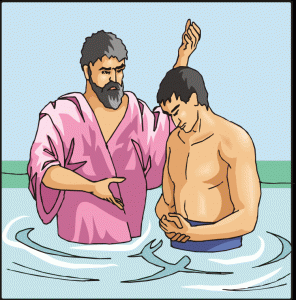
What the priests went through is a picture of what we as believers must go through. This is elucidated in various places in the Testimony of Yeshua.
The Bible contains prophetic shadows of baptism even before the consecrating of the priests. Paul talks about the children of Israel being baptized into Moses when they went through the Red Sea (1 Cor 10:2). In a sense, the whole nation was consecrated to YHVH’s service through faith in the lamb’s blood on the doorposts at Passover, through baptism in the Red Sea so that they could become YHVH’s peculiar treasure, a kingdom of priests and his set-apart nation (Exod 19:5–6). They also washed their garments (another picture of ritual immersion) before coming into the presence of YHVH to receive the 10 Words at Mount Sinai (Exod 19:10). Additionally, throughout the Torah, there are numerous ritual washings for both the priests and the people of Israel associated with various sin-cleansing rites.
Now we come down to John the Baptist who came in the spirit of Elijah to prepare the Continue reading
Parashat Vayishlach — Genesis 32:4(3)* – 36:43
Haftarah — Obadiah 1:1 – 1:21
Prophets — 1 Samuel 4:1 – 10:27
Writings — Psalms 48:1 – 54:7
Testimony — Matthew 27:32 – 28:20; Mark 1:1 – 3:19
Most of this week’s blog discussion points will be on these passages. If you have general comments or questions on the weekly Scripture readings not addressed in a blog post, here’s a place for you to post those. Just use the “leave a reply” link below.
The full “Read Through The Scriptures In A Year” schedule, broken down by each day, can be found on the right sidebar under “Helpful Links.” There are 4 sections of scripture to read each day. One each from the Torah, the Prophets, the Writings, and from the Testimony of Yeshua. Each week, the Torah and haftarah readings will follow the traditional one-year reading cycle.
* Verse numbers in parenthesis refer to the verse number in Christian Bibles.
Weekly Blog Scripture Readings for 11/10 through 11/16/13.