Apostles Then … and NOW?

Ephesians 4:11, He gave  some to be apostles. Did the so-called five-fold ministry offices cease after the New Testament era, or do they continue function in the body of Yeshua to this day? In our day, most people agree that the ministries of the evangelist, teacher and pastor are still in operation today, but many say that the offices of apostles and prophet have ceased to operate. Yet in verse 13, we read that these offices would operate “till we all come to the unity of the faith and of the knowledge of the Son of Elohim, to a perfect man, to the measure of the stature of the fullness of Messiah…,” which hasn’t happened yet. Therefore, it would stand to reason, that all these ministry offices are still needed today.

It must be kept in mind that Yeshua is the epitome of and over all (authoritatively) ministry offices that follow in this verse. When we ascended to heaven, he spread his own abilities out, as it were, among those he called to be leaders over his spiritual flock below (see Eph 4:8). Collectively, these ministry offices should be doing the work that Yeshua himself would be doing were he here on this earth presently.

In addition to the twelve original apostles (including Matthias who replaced Judas Iscariot, Acts 1:26), here is a list of the other apostles, which might be called Yeshua’s ascension-gift apostles (Eph 4:8):

  • James, the half brother of Jesus and leader of the Jerusalem church (Gal 1:19)
  • Barnabas (Acts 14:14)
  • Paul (e.g., Acts 14:14)
  • Apollos (1 Cor 4:6–9)
  • Timothy and Silvanus (1 Thess 1:1 and 2:6)
  • Epaphroditus (Phil 2:25)
  • Titus, and other un-named apostles—at least two (2 Cor 8:23)
  • Andronicus and Junia (Rom 16:7)
  • Yeshua is the Apostle and High Priest of our confession (Heb 3:1)

Including Judas Iscariot, this makes a total of at least 26 apostles who are mentioned in the Testimony of Yeshua.

With this list in mind, it now becomes logical to divide the apostles into at least three categories or level. Yeshua is the Chief Apostle. The original 12 that Yeshua appointed (minus Judas Iscariot) and possibly Paul would be the next tier. They are the foundational apostles. Yeshua mentions that the 12 apostles will rule over the 12 tribes of Israel and that the 12 foundations of the New Jerusalem are named after the 12 apostles (Rev 21:14). It seems that Yeshua commissioned these foundational apostles in direct, face-to-face encounters. After this come the lowest tier or ascension-gift apostles (Eph 4:8), which are all the other apostles.

Apostle Defined

The Greek word apostolos means “a delegate, messenger, one sent forth with orders.” According to the Theological Dictionary of the New Testament, apostolos originally was a military or naval term relating to an expeditionary force that was sent out or dispatched. It came to be applied to a band of soldiers, or colonists and their settlement as well as to the commander of the expedition or an admiral. A common feature of all the definitions of the word was its passive character. In none of the definitions is there any suggestion of initiative on the part of the apostle. The word denotes the quality of being sent. In the New Testament, apostolos always denotes a man who is sent with full authority and is synonymous with the Hebrew word shaliach as is evidenced in John 13:16. Here is a legal term relating to one who is lawfully charged to represent the person and cause of another. This meaning is confirmed by the juxtaposition in this verse of the Greek words doulos/kurios and apostolos/pemptsas. Here the servant (doulos) stands under full jurisdiction of his master (kurios) and derives from him all that he is. Apostolos also denotes the “commissioned representative of a congregation” (Acts 13:2ff). Finally, the term signifies the “bearers  or proclaimers of the NT message.” The latter meaning applied to not only the original twelve apostles that Yeshua commissioned and sent out, but to the first Christian missionaries or their most prominent representatives (Acts 14:4, 14). According to Paul, the apostles (1 Cor 12:28f) aren’t officials of the congregation, nor the chief of such officials, but are officers of Yeshua by whom the church is built (Ibid. vol 1, p. 407ff).

Attributes of an Apostolic Ministry 

  • Elohim sets or appoints (puts in place, establishes) a apostles (as he also does prophets, teachers, etc., 1 Cor 12:28).
  • An apostle is called by God, not men (Gal 1:1).
  • They minister in the power of God, not the wisdom of men (Mark 16:20 cp. 1 Cor 2:1–5).
  • Elohim appoints apostles by the revelation of the Holy Spirit and as confirmed by other established elders ( Acts 9:15; Acts 13:2-4; Acts 22:21).
  • An apostle is given a specific mission to a specific group of people (Gal 2:8–9; Acts 13:2–4).
  • They are spiritual pillars (Gal 2:9).
  • They form part of the spiritual foundation of the church (along with prophets, Eph 2:20).
  • They lay spiritual foundations for others to build on (1 Cor 3:10).
  • They facilitate unity (along with the other five-fold ministries) within the body of Yeshua (Eph 4:11–13).
  • They help the body of Yeshua to mature, to grow up, and to be built up (Eph 4:11–13).
  • Apostles bring revelation to the church (Eph 3:5; Gal 1:11–12).
  • Apostles establish, set, and correct doctrine (Acts 2:42; 15:19–30).
  • They raise up new ministries and ordain elders (Rom 15:20; Acts 14:23).
  • They impart spiritual gifts (Rom 1:11).
  • They defend the gospel­—are defenders of the faith (Phil 1:17).
  • The apostles in the NT were persecuted and rejected or even killed for their service to the body of Yeshua (e.g. 1 Cor 4:11–13; Luke 11:49; Acts 5:18, 40). This is because they’re on the forefront of YHVH’s spiritual battle to advance his kingdom into the enemy’s territory.
  • One has to grow into becoming a fully function and a spiritually powerful apostle. Yeshua’s 12 apostles asked him to increase their faith (Luke 17:5; Mark 16:15 cp. John 21:3 and Acts 2:14).
  • An apostle may initially not be baptized in the Spirit, but once having received this spiritual empowerment will be released into the full authority of the office, as was the case with the original 12 apostles.
  • Apostles take their marching orders directly from Yeshua (Acts 1:2).
  • Apostles have authority to pronounce judgment on sinners within the body of Yeshua (Acts 5:3–10; 1 Cor 5:1–5).
  • Apostles work many signs and wonders (Acts 5:12).
  • Apostles lay down the doctrinal foundation within the body of Yeshua (Acts 2:42; 2 Pet 3:2).
  • Apostles are often called to testify before secular and religious leaders (Acts 5:29).
  • Often apostles have to stay in the thick of the spiritual battle while the rest of the saints escape from harm’s way (Acts 8:1).
  • After the gospel is preached in an area, apostles are sent in to establish spiritual order and to plant congregations (Acts 8:14).
  • Apostles go into new areas to preach the gospel (Acts 13:1–14:7).
  • Apostles along with elders are called to help resolve conflicts within the body of Yeshua (Acts 15:2, 6).
  • There are false apostles (2 Cor 11:13; Rev 2:2).
 

Covenants of Promise: What and For Whom?

Ephesians 2:12, Covenants. The Apostle Paul makes a very interesting and often overlooked statement in Ephesians 2:12. For ­context we will quote the surrounding verses:

Wherefore remember, that you being in time past Gentiles in the flesh, who are called Uncircumcision by that which is called the Circumcision in the flesh made by hands; that at that time ye were without Messiah, being aliens from the commonwealth [citizenship] of Israel, and strangers from the covenants of promise, having no hope, and without Elohim in the world: but now in Messiah Yeshua ye who sometimes were far off are made nigh by the blood of Messiah. (emphasis added)

Paul, talking to the redeemed believers in Ephesus, states that they had been (past tense) Gentiles (comprised of various ethnic or people groups) without Elohim and without hope, but now, through the work of Yeshua at the cross, provision had been made for these alienated people-groups to become citizens of the nation of Israel. Elsewhere Paul refers to these (former) Gentiles as now being Israelites and defines them as heirs to the promises YHVH made to Abraham and calls them “seed” or descendants of Abraham (Rom 4:15; 9:8, 11; Gal 3:7, 14, 29).

Paul further says that these same people had been aliens from YHVH’s “covenants of promise” and relates this to the “Gentile” believers at Ephesus. We know that the principles laid out in this teaching apply to all the redeemed believers down through the ages. So what covenants of promise were these redeemed believers strangers to in times past prior to their conversion? Most in the church have been taught that the New Covenant is the only covenant that pertains to them, yet Paul spoke of covenants (plural) of promise. To what was he referring? The two main covenants of the Tanakh (the Old Testament) affecting the nation of Israel were the Abrahamic Covenant and the Mosaic or Sinaitic Covenant. Additionally, Jeremiah prophetically speaks of a New (Renewed) Covenant that YHVH would make with the two houses of Israel (Jer 31:31–33); that is, a refreshed version of a former (marital) covenantal agreement which Israel broke with YHVH (verse 32). These are the three principal covenants that the Scriptures reveals affect YHVH’s people. Clearly, Paul is referencing these three covenants in Ephesians 2:12 (see the Jewish New Testament Commentary, by David Stern, p. 583).

Which of the three covenants forms the bedrock upon which the others are based, and upon which Elohim predicated his glorious plan of redemption for mankind? In Romans four, Paul references the Abrahamic Covenant in discussing the means by which one is saved. In his discussion of the Abrahamic Covenant, Paul gives us no indications that the provisions of the Abrahamic Covenant are passé or invalid as pertaining to believers in Yeshua as relating to the New Covenant. He clearly shows us that this covenant forms the basis for man’s redemption (salvation) and subsequent relationship with his Creator.


Outline and Intro to Deuteronomy

Outline of Sefer Devarim—The Book of Deuteronomy: Moses’ Farewell Address

Chapter 1:1–5, Introduction

Chapters 1:6–4:40, First Discourse
Moses gives a veiled rebuke for sin and disobedience, and gives a review of the journey from Mount Sinai to Kadesh with exhortations to obedience.

65289264

Chapters 4:44–11, Second Discourse, Part 1
The religious foundations of the covenant, the spirit in which it is to be kept and the motives to right obedience are discussed. Moses shows how the covenant defines the relationship between YHVH and Israel and emphasizes the basic spiritual demands that such a relationship imposes upon Israel.

Chapters 12–26, Second Discourse, Part 2
The code of law dealing with:

  • Worship, Chapters 12:1–16:17
  • Government, Chapters 16:18–18
  • Criminal Law, Chapters 19:1–21:9
  • Domestic Life, Chapters 21:10–25
  • Rituals and the Sanctuary, Chapter 26

Chapters 27-30, Third Discourse

The enforcement of the Torah-law with its blessings and cursings; establishment of a fresh covenant between YHVH and Israel (i.e., the younger generation).

Chapters 31-34, The Last Days of Moses
Chapter 31, Committal of the law to the keeping of the priests.
Chapter 32, The Song of Moses (a prophecy about Israel’s future).
Chapter 33, Moses’ patriarchal blessing over the tribes of Israel.
Chapter 34, The death of Moses.

Overview of the Book of Deuteronomy/Devarim from Various Commentators
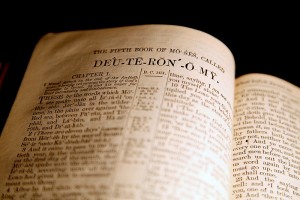
This last book of the Torah starts out with “These are the words which Moses spoke ….” The Hebrew name for Deuteronomy is Devarim meaning “words,” which is the plural form of devar meaning “word, speech, a matter or thing, a commandment, a report, a message, promise.” Note the similarity between the Hebrew word devar and the Greek word logos from John 1:1 (“In the beginning was the Word, and the Word was with Elohim, and the Word was Elohim.”). From this connection, we see that Yeshua was the Word of both the OT and the NT. He is the message of the entire Bible (Spirit Filled Life Bible, from the “Word Wealth” at Deut 1:1).

Deuteronomy is written similarly to the vassal-treaties formulated between captor and captive nations prior to 1000 B.C. It contains historical information, enumerates laws, and concludes with threats and promises (Hebrew Greek Key Study Bible, from the Continue reading →


Blog Scripture Readings for 7-27 through 8-2-14

Aside

THIS WEEK’S SCRIPTURE READINGS FOR STUDY AND DISCUSSION:

Parashat D’varim — Deuteronomy 1:1 – 3:22 
Haftarah — Isaiah 1:1–27
Prophets —Ezekiel 39:1 – 45:25
Writings —Nehemiah 5:1 – 11:36
Testimony — Galatians 6:1–18; Ephesians 1:1 – 5:33

Most of this week’s blog discussion points will be on these passages. If you have general comments or questions on the weekly Scripture readings not addressed in a blog post, here’s a place for you to post those. Just use the “leave a reply” link below.

The full “Read Through The Scriptures In A Year” schedule, broken down by each day, can be found on the right sidebar under “Helpful Links.” There are 4 sections of scripture to read each day. One each from the Torah, the Prophets, the Writings, and from the Testimony of Yeshua. Each week, the Torah and haftarah readings will follow the traditional one-year reading cycle.

Weekly Blog Scripture Readings for 7/27 through 8/2/14.


The Promised Land is YOUR land too!

Numbers 34:2, This is the land. The land of Canaan as described in this passage is but a small portion of Israel’s total land inheritance from the Creator.

In the Abrahamic Covenant YHVH made to Abraham and to his descendants, this promise has yet to be fulfilled (review Gen 17:8 cp. 15:18). 20091268 Never in Israel’s long history as a nation has it possessed and inhabited the land from Egypt to Iraq.

If YHVH’s promise hasn’t been fulfilled yet, unless he lied to Abraham and the Word of Elohim can’t be trusted, this promise is yet to be fulfilled.

In Ephesians 2:12, Paul mentions “covenants of promise” (plural). Most redeemed believers have heard of the New Covenant and know that it somehow relates to them, but Paul speaks of covenants (plural) with regard to the one-new man believer in Yeshua (read the next few verses for context). Other than the New Covenant (singular), what other covenants (plural) that YHVH made with the nation Israel might Paul be referring to?

Do you see yourself as a son of Abraham and an inheritor of these promises? (See Rom 4:16; 9:8–11; Gal 3:7, 9; 14, 28–29.) Paul did. What was Paul thinking, how does this affect you and your future, and how does this square with what the church typically teaches is the future inheritance of the saints?


Galatians Overview in Five Minutes

Below is a quick overview of the book of Galatians. My explanatory comments are in brackets.

The main theme of the book of Galatians is that one is saved by the grace of Elohim through faith in Yeshua the Messiah, not by the works of the Torah-law. Here, it’s not Paul’s point to discuss the validity of the Torah in a believer’s life. This he does, for example, in the book of Romans. Rather, in Galatians, he discusses how one is saved: Is it by works (i.e., obedience to the Torah and men’s non-biblical religious doctrines), or by the grace of Elohim?

In chapter one, Paul warns against accepting a “different gospel” and shares his personal testimony.

Chapter two describes Paul’s confrontation with Peter about not having to adhere to Jewish (non-Torah) traditions. He then begins to define what the gospel is by asserting that men are justified (made righteous) before Elohim not by the works of the law, but by faith in Yeshua. [This is because a man can never keep the laws of Elohim well enough to measure up to his high standard of righteousness or perfection. This in no way gives man a pass to violate the laws of Elohim — only that man can’t be saved by the good works of Torah-obedience.] Once a man is saved, Yeshua now lives his righteousness through the man [through the help of the Holy Spirit].

In chapter three, Paul further explains the concept of justification by faith stating that this method of salvation goes back to Abraham who trusted Elohim, and because of that faith YHVH accounted him as righteous. At the same time, if one attempts to be justified by the works of the law, because he can’t keep the whole law perfectly, he will fall under the curse or penalty of the law [which is death. Elsewhere we learn the that sin is the violation of the law (1 John 3:4) and the wages or penalty of sin is death (Gal 3:22; Rom 6:23).] Paul  goes on to explain that all believers in Yeshua [both Jews and non-Jews] are children of Abraham (v. 28, 29), and so the same salvation model applies to them that YHVH established at the time of Abraham. What then is the purpose of the Torah, Paul asks? It is to bring sinners to the cross of Yeshua [who died in our place to take on himself the penalty for our sins]. [This isn’t the only purpose of the Torah, as Paul teaches us elsewhere. This is the only purpose he mentions in Galatians for the sake of this discussion. The Torah’s other purpose — once we are brought to Messiah because of our sin, which the violation of the Torah — is that it shows us how to walk without sinning; namely how to love Elohim and our fellow man.] Paul concludes this chapter by saying that once the Torah has brought us to Yeshua, we’re no longer under penalty phase of the Torah, and this applies to all people, not just the Jews.

Next in chapter four, Paul explains in more detail the glorious gospel message of salvation by grace. Messiah came to redeem us (set us free) from slavery to sin and the world and to give us a spiritual inheritance as sons of Elohim. He then asks a question. After having received the glorious message of salvation by grace, how can one turn to a works-based salvation and to other non-biblical religious doctrines of men? He then answers the question by using an illustration to make his point. He compares the old or former covenant that YHVH made with the Israelites at Mount Sinai with the new covenant through Yeshua. This was prefigured in Abraham’s two sons: Ishmael and Isaac. The first son (Ishmael) was a result of human effort and brought bondage, while the second son (Isaac) was a result of YHVH’s grace and brought freedom. [Similarly, if one seeks to do Elohim’s will through one’s own effort, it will result in spiritual bondage. On the other hand, if one seeks to do Elohim’s will through his grace and the divine empowerment of the Holy Spirit, it will bring freedom from sin (i.e., Torahlessness) and it’s death penalty.]

In chapter five, Paul exposes the false teachers who were bringing “another gospel.” They were teaching that one can’t be saved, born again, justified or redeemed unless one is physically circumcised. [Although this doctrine is nowhere to be found in the Scriptures, it had become a belief in first-century Judaism. This was hindering the spread of the gospel message among uncircumcised non-Jewish peoples to whom Paul had been commissioned.] Again, Paul restates the idea that salvation is by grace through faith in Yeshua, and that if one seeks to be saved by one’s good works including circumcision, then one must keep the entire law [perfectly without sinning, which is an impossibility]. Evidently, this false teaching was causing much division and strife within the church at Galatia, and Paul urges the believers there to fulfill the Torah-law by loving one another. [Yeshua sums up the entire Torah as loving YHVH with everything and one’s neighbor as oneself (Mark 12:29–31).] Paul admonishes believers to walk according to the Spirit of Elohim that is living in them, which will lead them away from sin (Torahlessness) and towards righteousness (Torah-obedience). Walking in accordance to the leading of the Holy Spirit leads us away from Torahlessness (the works of the flesh including murder, lying, stealing, fornication, uncleanness, witchcraft, idolatry, worldliness and other fleshly passions and desires) and towards righteousness (the fruit of the Spirit).

Paul concludes this letter in chapter six by giving further instructions about living as a follower of Yeshua.


Slip, Slippin Away…

Numbers 33:55, If you do not drive out. In his instructions to his children, YHVH is serious: he doesn’t want his saints to countenance the ungodly around them in any way.

19845304 One only has to read in the pages of the Scriptures the long and sad history of Israel’s numerous involvements with the societies around them resulting in their fall into apostasy again and again.

The reason for this tendency toward spiritual declension is simple. The answer is found in 1 Corinthians 15:33. What does YHVH require his people to do in the face of evil? (See Ps 94:16.)

The problem is that an unsuspecting saint begins to toy with sin and sinners, and slowly and imperceptibly the slide down the proverbial spiritual slippery slope begins.

This is what happened to Lot when he left Abraham and moved toward Sodom (review Gen 13:10–12 cp. 19:1–26). Next, we see that Lot is married with children, has a home in Sodom and is a leader there. Even though the Scriptures consider Lot to be a righteous man, it was nevertheless difficult for him to leave that wicked city. Though Lot’s wife left Sodom physically, she couldn’t leave it emotionally. (Remember Yeshua’s warning to us in Luke 17:32 as pertaining to the last days. Let us also not forget Yeshua’s warning to the church of Laodicea in (see Rev 3:14–22).