Does YHVH want us to freeze in the dark on the Sabbath?

Exodus 35:2, The seventh day … shall be … a set-apart day. In our journey through the Torah, the subject of the seventh day Sabbath keeps popping up. When YHVH said in Exodus 20:8 to “Remember the Sabbath day to keep it set-apart (Heb. kadosh),” he keeps reminding them of it so that they won’t forget it! What does this tell us about the importance YHVH places on the weekly Sabbath? With each reminder, he gives additional instructions about how to keep the Sabbath (see Gen 2:2–3; Exod 16:23–30; 20:8–11).

20720832

Exodus 35:3, Kindle no fire…on the Sabbath day. There are several prevailing viewpoints as to the exact meaning of this passage. Let’s explore them.

The Orthodox Jews take literally the Torah’s prohibition to kindle no fire on the Sabbath. As such, many do not even turn on a light switch or start their cars (i.e., fire in the spark plugs) on the Sabbath for fear of violating this command. To counter balance this viewpoint, the Torah does indicate that the priest lit the menorah in the tabernacle each morning, the Sabbath not excluded (Exod 27:21–21; 30:7). So, for ministry purposes, lighting a fire seems not to be prohibited.

There is also the viewpoint that since the next verse (Exod 34:4) begins YHVH’s instructions to build the tabernacle, the immediate context of the Sabbath-fire passage has to do with not starting fires that pertain only to one’s trade or job—in Israel’s case, their job was the building of the mishkan. Fires would have been needed for tanning hides, working with metal, and possibly bending wood and dying cloth along with other activities.

This we know for certain. On the Sabbath, YHVH’s people are not to bake, cook or prepare food from scratch (Exod 16:23), but reheating food seems not to be Continue reading


 

Blog Scripture Readings for 2-28 Through 3-5-16

Aside

THIS WEEK’S SCRIPTURE READINGS FOR STUDY AND DISCUSSION:

Parashat Vayakhel — Exodus 35:1 – 38:20
Haftarah — Exodus 30:11-16 | 2 Kings 12:1-17**
Prophets — 2 Kings 24:1 – 25:30; Isaiah 1:1 – 5:30
Writings — Psalms 131:1 – 137:9
Testimony — John 5:1 – 7:24

Most of this week’s blog discussion points will be on these passages. If you have general comments or questions on the weekly Scripture readings not addressed in a blog post, here’s a place for you to post those. Just use the “leave a reply” link below.

The full “Read Through The Scriptures In A Year” schedule, broken down by each day, can be found on the right sidebar under “Helpful Links.” There are 4 sections of scripture to read each day. One each from the Torah, the Prophets, the Writings, and from the Testimony of Yeshua. Each week, the Torah and haftarah readings will follow the traditional one-year reading cycle.

** A different Haftarah is read when it is a special sabbath in Jewish tradition. This week it is Shabbat Shekalim on the traditional calendar.

Weekly Blog Scripture Readings for 2/28 through 3/5/16.


The concept of grace rooted in the Torah, not the NT

Exodus 33:12–13, Grace. (Heb. chen meaning “favor, grace, charm, acceptance”). The Hebrew word chen (found 69 times in the Tanakh), which is translated as grace, in this verse is equivalent to the Greek word charis, which is found 156 times in the Testimony of Yeshua and is translated as grace 130 times in the KJV.

The equivalency of these two words is confirmed by the translators of the Septuagint (the Greek Tanakh) who used charis in place of chen when translating the Hebrew Tanakh into Greek beginning in the third century B.C. According to the TWOT, in the vast majority of occurrences of chen in the Tanakh, the focus of attention is not on the giver, but on the recipient. The emphasis is on the relationship of the superior to an inferior (e.g., a king to his subjects). What this teaches us is that despite sin and rebellion against him, YHVH (the king) is gracious (to humans, his subjects).

Contrary to what many in the church have been led to believe, the grace of Elohim is a very prominent theme in the Tanakh. Examples of this include Noah who found grace in YHVH’s eyes (Gen 6:8), or the children of Israel although dead in their sins in Egypt and deserving of YHVH’s wrath, they were saved by the blood of the lamb. There are a number of other references to the grace of Elohim in the Tanakh as well (Gen 18:3; Exod 3:21; 33:16,17; 34:9; Ps 84:11; Zech 12:10).


How are you saved?

John 3:16–18,

For Elohim so loved the world that He gave His only begotten Son, that whoever believes in Him should not perish but have everlasting life. For Elohim did not send His Son into the world to condemn the world, but that the world through Him might be saved. He who believes in Him is not condemned; but he who does not believe is condemned already, because he has not believed in the name of the only begotten Son of Elohim.

Victory 21030574

So How Then Are We Saved?

The Christian church has come up with various formulas to “get a person saved” such as altar calls and saying the sinners prayer. There are no examples these kinds of things in the Bible. Instead, the Scriptures give us general guidelines and examples to follow. There are no formulas. What follows is a list of examples from the apostolic writers of how people were saved in early church era.

For example, in Acts 2:14–37 we read that Peter preached the gospel and that the hearers were pricked in their hearts (verse 37). This resulted in a spontaneous, Holy Spirit-led response on the part of the hearers of the gospel or good news message of salvation. After this, the people were baptized for the remission of sins in the name of Yeshua and subsequently received the Holy Spirit (verse 38). All this happened on the same day (verse 41). When directed by the Holy Spirit, spiritual transformations can happen quickly!

A little later in Acts chapter three (verses 11 to 26), Peter preached another short sermon and then invited the people to “repent and be converted that your sins may be blotted out.” This resulted in about 5000 people coming to faith in Yeshua (Acts 4:4).

Next in Acts 8:4–17, we find that the gospel was preached (in Samaria) and people believed it and were baptized. There were no altar calls; only a spontaneous reaction to the preaching of the good news of the message of salvation through Continue reading


What happens when you die?

John 3:13, No one has ascended to heaven. Most Christians believe that when they die, they immediately go to heaven in spite of Yeshua’s clear statement in this verse. Many believers see this verse as referring to saints who died before his resurrection, but not true of those who died afterwards, even though Yeshua doesn’t say this. Therefore, they reason, this is why, according to Peter, David, who was born before Yeshua, is still resting in his grave awaiting the last days resurrection (Acts 2:29).

Gravestone 36154314

If what the majority Christians believe on this subject is true, then the saints of old are second class citizens and YHVH is a respecter persons (which he is not, see Acts 10:34; Rom 2:11) in that they have to wait for resurrection day and for their ultimate reward of eternal life, while saints born since Yeshua receive their glorified bodies immediately upon death.

Laying aside all the church traditions and doctrines of men, what does the Bible in the simplest and clearest terms say about the timing of the saints receiving immortality? Paul states that the resurrection of all the dead saints and their receiving immortality occurs not at the time of their physical death, but at the second coming of Yeshua at the last trumpet (1 Cor 15:51–54; 1 Thess 4:13–18 cp. Rev 11:15, 18).

In reality, men’s eternal inheritance isn’t heaven, but the New Jerusalem, which is coming down from heaven to the new earth (Rev 21:2).


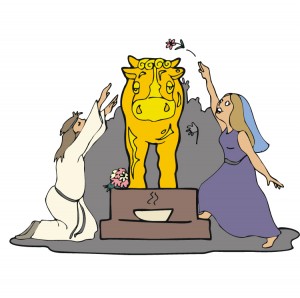
Golden Calf Worship Among YHVH’s People Today

Let’s look at the series of events that occurred as the children of Israel were leaving Egypt, which have major relevance to what is occurring in mainstream Christianity in our day. If we fail to learn the lessons of history, we’ll likely repeat the mistakes of history. It has to do with golden calf worship.

Golden Calf 6 21409020

YHVH redeemed the children of Israel out of Egypt and set the slaves free. He blessed them not only by giving them their freedom, but by giving them the wealth (gold and silver) of Egypt as well. We read that the Israelites exited of Egypt with a high hand. They were victorious, free and wealthy.

YHVH led them into the wilderness en route to the Promised Land — normally an eleven day journey. They had some difficulties: Pharaoh tried to kill them at the Red Sea, they lacked clean drinking water, and they had food issues, but YHVH provided them deliverance from Pharaoh, gave them clean water, manna and meat, and they overcame these trials.

Next, YHVH led the Israelites to the foot of Mount Sinai, and on Shavuot he made a covenantal agreement with them and gave them his Torah as their national constitution. They agreed to obey him and to keep his commandments. He promised to bless them if they remained faithful to him.

Moses went up to Mount Sinai to receive the Torah-covenant on two tablets of stone. While he was gone for 40 days, the people grew worried and anxious and become weary Continue reading


The Christians are almost right about who Yeshua is!

Please note: When I first posted this article, I titled it, “The Christians are right about who Yeshua is!” Then I had a second thought, and changed the title to “The Christians are ALMOST right about who Yeshua is!” Here’s why I added the word “almost”:

The Christians are right about the deity, incarnation, virgin birth and his atonement death on the cross. They aren’t right, however, in recognizing him to the the “God” of the Old Testament who gave the Torah-law to the Israelites. Most believe that this was the Father.

When I wrote the first title, I was thinking about the first part of what I say above. When I changed the title adding the word “almost” I was thinking about the second part of what I say above.   Natan

John 1:1, The Word was Elohim. Is Yeshua or the Father the God (Elohim) of the Old Testament (Tanakh)? For many believers in Yeshua, there is confusion as to who it was in the Godhead who interacted with the Israelites in the Tankah. Was it the Father or the Son? In the minds of the apostolic writers, there was no confusion about this. Yeshua, in his preincarnate state, was the One that YHVH Elohim the Father used to both create (John 1:3; Col 1:16; Heb 11:3), and then to interact with mankind. He was the Word of YHVH Elohim, the Father, who become flesh and dwelt among men (verse 14). This truth is easily confirmed in several passages in the Testimony of Yeshua (New Testament).

Powerful Healing Vortex

First, Yeshua himself claims to be YHVH or the I Am of the burning bush (see John 8:58 cp. Exod 3:14). The Jews viewed Yeshua’s claim to be deity as blasphemous, which is why they picked up stones to kill him (John 8:59). Next, Yeshua in declaring to the Jewish religious leaders that “I send you prophets, wise men and scribes: some you will kill…” (Matt 23:34), he is claiming the rights and prerogatives of YHVH — a right and role that Continue reading