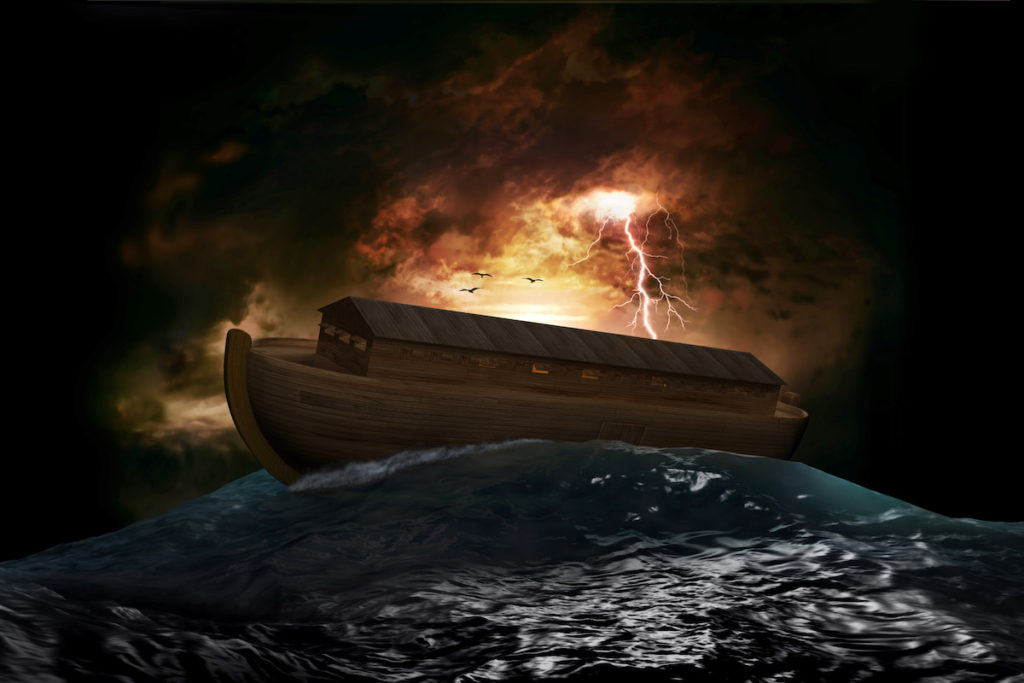
“As it was in the days of Noah…”

Genesis 7:4, Forty days. For 40 days it rained upon the earth. Forty is the biblical number for trial, testing, spiritual refinement and judgment. For example, YHVH refined Moses in the wilderness for 40 years. YHVH made the Israelites wander in the wilderness 40 years as a judgment against their sin. Yeshua fasted for 40 days in the wilderness in preparation for his earthly ministry. Similarly, the 40 days it rained on the earth is a prophetic antetype of YHVH’s final wrath being poured out upon this earth (Rev 15–16). 

Similarly, YHVH’s saints will go through a time of spiritual testing and refinement prior to YHVH pouring out his wrath upon wicked mankind. This we see in the context of Revelation 11:18, which is the resurrection of the saints to meet Yeshua in the air and occurs after the seventh trump has sounded. 

Moreover, according to Yeshua’s Matthew 24 prophecy, YHVH’s saints will still be on the earth during the tribulation and great tribulation period at the end of the age (Matt 24:29–31).

Genesis 7:4, 10, After seven days. Noah was a preacher of righteousness for 120 years prior to the flood (Gen 6:3; 2 Pet 2:5). He no doubt endured the mockery and persecution of those who did not believe his message about a coming flood, and the need for an ark of safety when that generation had never experienced rain or floods (Heb 11:7; 2 Pet 2:5). 

In Genesis 7:4 and 10, YHVH allows Noah to experience seven more days of persecution before the rains of judgment come upon the earth after which YHVH shut Noah and his family up in the ark of safety (Gen 7:16) after which the ark “was lifted above the earth” (Gen 7:17). Yeshua likens the end times just prior to his second to the days of Noah (Matt 24:37–39). Yeshua further teaches that his saints will not only go through tribulation on this earth (Matt 24:3–22), but that his people will even go through “great tribulation” (Gr. megathlipsis, v. 21). 

After this, Yeshua teaches that the saints will be lifted up above the earth to meet him in the air after the great tribulation (Matt 24:29–31), and not before it as some in the church erroneously teach and believe. 

The Scriptures reveal that Noah endured another seven days of tribulation before the wrath of Elohim was poured out upon the wicked inhabitants of the earth. This may be a prophetic picture of a seven-year tribulation period the saints will have to go through before the wrath of Elohim (which is different than the tribulation period) is poured out upon this earth (See Rev 11:15–18 [compare with 1 Cor 15:51–53] and chapters 15 and 16 where the seven last plagues are called the wrath of Elohim). 

The Scriptures clearly teach that YHVH’s people will not have to endure his wrath (1 Thess 1:10; 5:9), but conversely teaches that all will go through tribulation (John 16:33; Acts 14:22; Rev 7:14). Scripturally, tribulation and wrath are two different words and concepts.

Genesis 7:23–24, Only Noah. As Noah was saved in an ark of safety of YHVH’s design from his wrath against wicked man, so the righteous of today have a similar ark of safety. Yeshua is that spiritual “ark of safety” that once inside (or in spiritual relationship with) we will be spared from the judgments of Elohim (John 5:24–29 cp. Rev 11:15–18; 14:4–5 cp. 14:14–20).

 

Who are “workers of iniquity” and what is their fate?

Matthew 7:21–23, What is the will of the Father? In verse 21, Yeshua makes reference to “the will of the Father.” In Hebraic thought, to what is he referring here? What is “the will of the Father”? Keep in mind that when Yeshua gave this teaching the only Scriptures in existence were the writings of the Tanakh, and the first five books of Moses in the Bible, were the central teaching document for the Jewish people—the nation of Israel. Therefore, we would be expected to find “the will of the Father” to be revealed in the Word (or Oracles) of Elohim originating from heaven and delivered to man. The will of the Father was revealed at Mount Sinai and was the reference point of all the Hebrew prophets who were constantly charging the people of Israel to return to the ancient paths of YHVH’s Torah (Jer 6:16, 19; 18:15). As we see in Psalm 40:8, the will of Elohim is nothing more than delighting in obeying the Torah from one’s heart—something this psalm prophesies the coming Messiah would do. 

Yeshua, the Living Word or Torah (instruction, precepts, teachings) of Elohim, came to set Torah on a firm foundation (the whole point of the Sermon on the Mount, as we have seen) by rescuing it from the hands of the hypocritical, greedy, arrogant and self-righteous religionists of his day. Yeshua said in John 7:16 that his doctrine or teaching was not his own, but that of his Father in heaven and that those who do the will of the Father will recognize that his doctrine or teaching is from the Father (verse 17).

In John 7:19, Yeshua asks the Pharisees: “Did not Moses give you the Torah, and yet none of you keep [do, perform] the Torah?” What is the summation of what Yeshua is saying here? He is telling the people that he came to do the will of his Father, to bring to them the oracles or doctrine of the Father as given at Mount Sinai (called the Mosaic Covenant), and that these words are not his and that, basically, he is simply a messenger transmitting his Father’s words to the people—the very words of Moses, which he accuses the people of not keeping or obeying.

This was the message of Yeshua to the people in his day. Is this not a relevant message to the Christian church of our day, which teaches that the Torah-law of Moses is of little nor no relevance to Believers? The idea that Yeshua came to abrogate the Torah-law of Moses is difficult to comprehend in light of such Scriptures as John 14:15, a direct quote from Exodus 20:6, where Yeshua equates himself with YHVH who spoke at Mount Sinai. (See also 1 Cor 10:4.) Do you comprehend the full impact of this? Yeshua, whom the Christians call Jesus Christ, is the very one who spoke out from Mount Sinai and the one who gave the Torah-law and led the Children of Israel through the Wilderness. It is this Torah-law that Yeshua came to uphold and restore as we have seen by our study on the Sermon on the Mount.

We see that many religionists will claim to be followers of Yeshua, but what separates the true followers from the counterfeit ones is whether they are doing the will of YHVH or not. Many will be prophesying in Yeshua’s name, casting out devils and doing many miraculous works in his name, but this is not the proof that they are his. What is the proof? He says in verse 23, “And then will I profess unto them, I never knew you: depart from me, you that work iniquity.”

Continue reading
 

Elohim hates…??? If so, what?

Psalm 5:5, You hate.The idea of Elohim hating is anathema to the sensibilities of most Christians. After all, doesn’t the Bible declare that “Elohim is love” (1 John 4:8,16)? How could he also hate anything, much less people? Yet this is what this verse says, “[YHVH] hates all workers of iniquity.” Let’s explore this concept and try to understand how this could be so.

But first, let’s define the word hate. According to Webster’s New World Dictionary, hate means “to have a strong dislike or ill will for; to wish to avoid.” According to Strong’s Exhaustive Concordance, the word hate in the Tanakh (or Old Testament) means “to hate as an enemy or foe, to be utterly odious.” As used in the Testimony of Yeshua, hate means “to detest.”

Here are some examples of certain things that Elohim hates, and of Elohim commanding his people to hate certain things as well.

Your throne, O Elohim, is for ever and ever…. You love righteousness, and hate wickedness… (Ps 45:6–7) 

Here we see that Elohim loves what is good and detests that which is evil or sinful (or Torahless).

The foolish shall not stand in your sight; you hate all workers of iniquity. (Ps 5:5) 

Workers of iniquity is a biblical expression referring to “those who walk contrary to Torah.”

YHVH tries the righteous, but the wicked and him that loves violence his soul hates. (Ps 11:5) 

These six things does YHVH hate, yes, seven are an abomination unto him: a proud look, a lying tongue, and hands that shed innocent blood, an heart that devises wicked imaginations, feet that be swift in running to mischief, a false witness that speaks lies, and he that sows discord among brethren. (Prov 6:16–19) 

Elohim strongly dislikes or detests those things that are sinful (Torahless) or wicked—those things which hurt people and which cause pain and suffering. Even his hatred is out of a heart of love for the lost and a desire for them to repent and return to Torah.

Continue reading
 

“Yeshua came to fulfill the law”—what does this really mean?

Matthew 5:17, The law and the prophets. Yeshua mentions two of the three subdivisions of the Hebrew Scriptures in this passage: the Law or Torah and the Prophets or Neviim. The Jews have traditionally subdivided the Hebrew Scriptures into three sections: the Torah, Prophets and the Writings. We see Yeshua referring to this threefold subdivision in Luke 24:44. In fact, the Jews of today do not refer to their Hebrew Scriptures by the Christian term of “Old Testament,” but rather by the Hebrew word TaNaKh, which is an acronym representing this threefold division. The T in Tanakh stands for the Torah or the first five books of the Bible, the N stands for Neviim or the prophetic writings in the Hebrew Scriptures, while the K stands for the Hebrew word Ketuvim, which means Writings and includes the book Psalms, Proverbs, Job and others.

I came to…fulfill [the law]. Yeshua came to fulfill the law so that the law might be fulfilled in us, not so that we can continue breaking it without suffering the consequences. He came to save us from the consequences of breaking the law, not from the law itself. He came to set us an example of how to fulfill not only the letter, but the spirit of the law and to empower us through his Spirit to live in up to the law’s standards of righteousness.

How many times have you heard someone say, “Jesus came to fulfill the law [in our place], so that we don’t have to keep the law ourselves.” Many people just repeat this church-system mantra without really stopping and thinking about it. But what do they really mean when they say this? Do they even know? Have they thought about the implications of simply repeating this oft-quoted religious cliche?

Let’s think about this for a moment. If Yeshua’s fulfilling Elohim’s law (also known as the law of Moses)means that he did it so that we don’t have to, does this mean that since Yeshua didn’t murder, commit adultery, lie, steal, worship other gods, dishonor his parents, take God’s name in vain or covet it’s now all right for us to do so, since he did it in our place? When a Sunday Christian is presented with this line of reasoning, he’s usually hard-pressed to come up with a logical response, since his initial assertion has been proven to be illogical. The basic tenets of Christianity assert that such behavior is sin.

Now if you ask a clergyman the same question, he’ll often answer you in one of two ways. He’ll either tell you that we only have to do the laws that Jesus or the New Testament authors specifically enumerated. Or he’ll tell you that Christians are obligated to keep the moral law, but not the ceremonial laws of which the Sabbath, biblical feasts and dietary laws are a part.

To start with, let’s deal with the first answer. If Christians only have to follow the laws that Yeshua and the New Testament writers specifically mention, then is it all right to have sex with animals, since this law is specifically stated in the Old Testament Torah, but not in the New Testament? What’s more, why do many churches teach the tithing principle, which is a law found in the Torah, but not in the New Testament if we only have to follow the New Testament laws? Do you now see the speciousness of the argument that we only have to keep the Old Testament laws that are specifically mentioned in the New Testament?

The next argument involves dividing Elohim’s Torah-laws into two categories: the moral and the ceremonial laws. The problem with this argument is that neither the Old Testament nor the New Testament make such delineations. The law of Elohim is law of Elohim. It all stands or falls together. James, for example, speaks about the whole law and says that when one violates one of Elohim’s laws, one violates them all (Jas 2:10). He calls the same law “the royal law” in a singular sense with no artificial subdivisions (verse 8). Similarly, Paul sums up the law of Elohim by one word: love (Rom 13:8). Yeshua and the apostolic writers in numerous places speaks about the law (e.g. Matt 5:17–19; Mark 12:28–31; Rom 3:31; 7:12, 14; 8:7) and makes no distinctions between moral and ceremonial. 

Continue reading
 

The Torah Is the Elephant in the Room of the Testimony of Yeshua

Though the primary theme of the Testimony of Yeshua (the name John gives to the New Testament in the Book of Revelation—e.g. Rev 1:2; 6:9; 12:17; 20:4) is the testimony of Yeshua the Messiah, the Torah is, nevertheless, the elephant in the room. 

Though not mentioned outrightly as often as one would think in the Testimony of Yeshua, the Torah is implied, assumed, or referred to in on countless occasions using coded Hebraisms. Why, one might ask, is this the case with the apostolic writers? The answer is simple: They were writing to Jews as well as to non-Jewish people who either already operated within a Torah-centric religious paradigm or were being brought into it. The obvious didn’t have to be mentioned over and over again, for Torah was not a strange or foreign thing to the first century believers as it is to most in the church today. The Torah was their way of life and frame of reference for all that they thought and did! 

The word law as used in the Testimony of Yeshua is the first aspect of this “elephant” we need to examine. It is the Greek word nomos which in the Septuagint (the third century B.C. Greek translation of the Tanakh [Old Testament Scriptures]) is used in place of the Hebrew word Torah. Therefore, we know that the Jewish scholars who translated the Tanakh into the Greek language considered the words Nomos and Torah to be equivalent. Also, contextually, in the Testimony of Yeshua, we can see that the word law means Torah. To the Messianic Jews who wrote the entire Testimony of Yeshua, when the Greek word nomos is used this is not a reference to Roman, Greek or Babylonian law, but to the biblical Hebrew law or the Torah, or Torah-law of Moses. 

Continue reading
 

Blog Scripture Readings for 10-27 Through 11-2-19

Aside

Parashat Noach — Genesis 6:9 – 11:32
Haftarah — Isaiah 54:1 – 55:5
Prophets — Joshua 8:1 – 14:15
Writings — Psalms 11:1 – 18:24
Testimony — Matthew 7:1 – 11:30

Our new annual Scripture Reading Schedule for 2019-2020 with daily readings is available to download and print. If you are still working through 2018-2019’s Scripture Reading Schedule, the link will still be available on the right sidebar under “Helpful Links”. If you are using a mobile device or tablet, the link may be below so you’ll need to scroll down instead.

Most of this week’s blog discussion points will be on these passages. If you have general comments or questions on the weekly Scripture readings not addressed in a blog post, here’s a place for you to post those. Just use the “leave a reply” link or the “share your thoughts” box below.

The full “Read Through The Scriptures In A Year” schedule, broken down by each day, can be found on the right sidebar under “Helpful Links.” There are 4 sections of scripture to read each day: one each from the Torah, the Prophets, the Writings, and from the Testimony of Yeshua. Each week, the Torah and haftarah readings will follow the traditional one-year reading cycle.

Weekly Blog Scripture Readings for 10/27/19 through 11/2/19.


Reasons to Believe in Yeshua the Messiah

Have you ever heard someone say, “I’ll believe it when I see it”? Is seeing really believing? Many people saw Yeshua when he was on this earth, but most didn’t believe him.

It has been 2000 years since Yeshua walked this earth, and since we’ve never seen him, nor even talked to those who saw him, what is the basis of our faith? Is faith in Yeshua blind? Or are there logical reasons to believe in him?

For those of us who have had a faith in Yeshua for a while, for us there are a myriad reasons that have come together to form the basis of our faith. However, for those who are new in their faith walk and don’t have a lifetime of “spiritual experiences” that corroborate that faith, initially finding a basis for that faith can be difficult.

Some people come to Yeshua because that’s their last hope. They’ve hit rock bottom in their lives and there’s no where else to go. They hear and believe the gospel message of hope and end up experiencing the power of the Yeshua and his Holy Spirit in their lives.

Others take a more reasoned approach to establishing a faith in Yeshua. Perhaps their lives haven’t hit rock bottom, but they know they’re missing something — there’s still a void in their life. They sense that there must be more to life — a higher purpose — than simply existing and then dying. 

Others come to faith in Yeshua because they look around and see intelligent design behind everything in existence, which speaks of a Creator, which leads them to want to know more about him. 

Some people come to Yeshua as a way of dealing with their on mortality. In their quest to answer the question of whether there’s life after death, they come to faith in Yeshua. 

Perhaps some come to faith in Yeshua due to the pang of a guilty conscience because of their sin and the need for redemption. 

Some people have studied the world’s religions and find that only the gospel message as presented in the Bible addresses the deeper issues of life. 

These are all valid and logical reasons for coming to faith in Yeshua.

Whatever the reason for believing what the Bible says about Yeshua, there are good reasons to believe in him based on both the claims of the Bible and logic.

Yeshua — A Historical Figure

Whatever we think about Yeshua pro or con, he was a historical figure. More has been written about him than anyone else, and he has impacted the world more than anyone. There must be something to all this, and thus we have to deal with this reality. Twenty-seven different first-century New Testament documents attest to the reality of his existence and to his impact on humanity. Additionally, numerous Christian, Jewish and Roman historians from the first and second centuries attest to his existence and his positive impact on the lives of thousands, if not millions of people.

Continue reading