Leviticus 25—The Biblical social welfare system.
Leviticus 25, in part, lays out Israel’s social welfare and economic system. Basically, it was a free market capitalistic economic system where private individuals owned property and small businesses and controlled the means and productions of goods and services, and the central government’s involvement in the lives of people was minimal. This is not the case in a purely socialistic (a Marxist or communistic) economic system where the government owns much or most of the property and controls, to one degree or another, the means and distribution of goods and services, and where government regulation of people’s lives is tremendous. The capitalistic system that YHVH gave to Israel, however, contained some quasi-socialistic checks and balances in that greedy or even exceptionally gifted and ambitious individuals couldn’t become excessively rich at the expense of the poor.
Socialistic economic philosophy demands that the wealth of the nation be equally distributed among everyone including the poor. This may sound good in theory, but it doesn’t work. In reality, socialism stifles individual initiative by punishing (often through taxation and other means of wealth confiscation and redistribution by the government) those who, through hard work, sacrifice, initiative, and inventiveness have become wealthy. So, it stands to reason, why should the wealthy work hard if the fruits of their labors will only be confiscated and be given to the poor or the “have nots, ” or to those who refuse to work?
At the same time, capitalism is also a flawed system, since in time, the wealthy often end up owning much of the land and control most of the wealth. Human nature being what it is, the greedy wealthy will turn a capitalistic system into oligarchic capitalism where only a few rich capitalists control nearly everything including the economic and political systems. This is the end times system that is described in Revelation 13 and 18 and is called Babylon the Great. Such a system ends up enslaving people through economic and political means, thus creating a veritable feudalistic-type serfdom where rich and powerful business oligarchs who control the government are the new nobility (see Rev 18:13, 23).
With these things in mind, as you are reading through chapter 25, notice how YHVH instructed the poor to be cared for. There was no government welfare system based on taxing the producers and giving to the non-producers. Everyone worked for their living. In fact, the Torah commands everyone to work for six days, and then to rest on the seventh day (Exod 20:9). Sloth and laziness weren’t optons. Even the extremely impoverished were expected to harvest food from the agricultural fields. At the same time, those who owned the fields were to leave the corners of their fields unharvested and not to glean their fields, so the poor would have something to harvest (Lev 23:22; the Book of Ruth). In the Testimony of Yeshua, fathers were expected to provide for their households. Those who didn’t were considered worse than heathens (1 Tim 5:8). Similarly, widows under the age of 60 were expected to support themselves through their own work, while those over the age of 60 could be supported by the local church, but they had to recompense the church through acts of service (1 Tim 5:9–14). Once again, the Bible in no way allows for or promotes a system of government handouts. Except in rare situations, everyone was expected to work.
In this chapter, we also see how the Bible handles the issue of debt, and how it requires people to work to pay off their debts. Bankruptcy wasn’t an option. The Torah allows those in debt to sell themselves into servitude to their debtors through a system called bond service. The debtor would work for the lender until the debts were paid and at the end of seven years all remaining unpaid debts had to be forgiven. This system taught fiscal responsibility to debtors, yet at the same time, it required lenders to show mercy and grace to the poor. Again, the Bible in no way promotes a system of government welfare handouts. Everyone had to work. If you didn’t work, you didn’t eat (2 Thess 3:10). Only the extremely poor who were unable to make a living (e.g. widows and orphans) were cared from the public coffers (Deut 14:28–29; 26:12–13). The Levites were care for publicly as remuneration for caring for and teaching the people spiritually. They also worked as farmers and tradesmen.
Notice how the jubilee year prevented the wealthy from acquiring all the land, and how every 50 years there was a redistribution of land, so that those who through sloth, mismanagement of their resources, or through unfortunate circumstances lost their land could get their land back. Such individuals were mercifully given a second chance to start over again and to learn from their past mistakes. Lending to the poor was encouraged, and the charging of interest to them was prohibited.
As you read through this chapter, consider how YHVH deals with the perennial social and economic ills that have plagued the world from time immemorial compared to how men currently deal with these same problems, and usually end up making matters worse.
Though it would be difficult to implement such a system in our highly collectivized and industrialized society of today, it is likely that in the future, during the Millennium, when the Torah will be the rule of the earth and an agrarian society will likely be the dominant economic paradigm, that such a Torah-based system will once again be put in place.
Leviticus 25:2, When you come into the land. The Stone Edition Chumash, translates Leviticus 25:2(b) as follows, “When you come into the land that I give you the land shall observe a Sabbath rest for [YHVH].” Note the emphasized portion. Though the Jewish sages say this does not imply that YHVH rests, it acknowledges the fact that as YHVH “rested” after his creation of the world, so too Israel was to rest in the seventh year from its agricultural work (an activity that allows the created [i.e. humans] to share with the Creator in the act of creation) to commemorate Elohim’s act of creation (The ArtScroll Rashi Leviticus, p. 318). The Jewish sages also note that the comparison between the jubilee and the Sabbath is that both bear testimony to Elohim’s creation of the universe in six days and his rest on the seventh. They further note that the seven years of the shemittah (sabbath year) cycle allude to the six thousand years of history that will be climaxed by the seventh millennium, which will be a period of peace and tranquility (The ArtScroll Stone Edition Chumash, p. 697).
Note how everything ancient Israel did in their day-to-day life brought them into worshipful relationship with their Creator by causing them to recall both what he had done for them (past tense) and what he would do for them prophetically (future tense).
Leviticus 25:4, A sabbath of rest unto the land.The land sabbath teaches us that our means of producing an income belong entirely to YHVH. He gives us life, breath, land, health, eyesight, physical and mental abilities and everything else that we need to survive. Now imagine losing, say, your health or your eyesight? Or due to an illness, suppose through a stroke or an injury to the head, you became mentally impaired. Where would you be financially? We belong to YHVH and he gives us everything we need with which to work our land, do our job, raise our family, educate ourselves, and to exist. Are we as grateful to him as we should be?
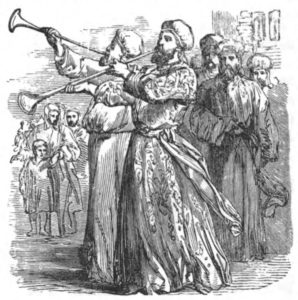
Leviticus 25:9, Jubilee. The word jubilee is the Hebrew word yovel (KcUh) meaning “ram’s horn trumpet.” The ram’s horn would be sounded at special events as a proclamation of great joy and jubilation such as would be the case at the commencement of the Jubilee Year when all debts were forgiven, all indentured servants were set free, all land was returned to its original owners, and all agricultural activity ceased for a year of rest. The arrival of the Jubilee Year was announced on Yom Kippur (Day of Atonement) with the blast of a shofar called the shofar hagadol or the great or final shofar blast (to be distinguished from the first and second shofar blasts that occur on the feasts of Shavuot (Pentecost) and Yom Teruah (Day of Trumpets or Shofar Blowing or Shouting) respectively. This same event prophetically corresponds with the return of the exiles (the “lost ten tribes”) to the land of Israel (which is an aspect of what the Jewish sages call the “final redemption”) and the return of Yeshua the Messiah.
Continue reading