Prophetic Shadows in the Life of Joseph (pt 3)

Joseph: Antitype of Yeshua the Savior (Gen 42)

Joseph acted as a savior to his brothers and family to save them from death in a time of famine. Prophetically, Christians (who are, at least in part, descendants of Joseph) present Yeshua son of Joseph as the Savior to the world (including to the Jews) to save people from spiritual death.
Viewing Joseph’s role as a savior to the Israelite people in their time of need as a prophetic picture of ­Yeshua’s similar role as Savior should not seem strange to the reader. In pre-Christian Jewish literature, the Jewish sages identified two Messiahs that were to come: one whose life would resemble Joseph and was referred to as the suffering servant or “Messiah Son of Joseph” (Mashiach ben Yoseph), and a second Messiah whose life and ministry would resemble that of David, and who they referred to as the warrior king or “Messiah Son of David” (Mashiach ben David). This messianic title was prevalent even in Yeshua’s day, for on several occasions, he was asked if he was the [Messiah] Son of David (e.g., Matt 9:27; 12:23; 15:22; 20:30–31; 21:9, 15; 22:42). The Jewish sages came to the conclusion that there were two Messiahs because while reading the messianic prophecies in the Tanakh (OT) they saw two different, even conflicting Messiahs whose roles were very different from each other. What was not known by the ancient Jewish sages, which was a subject of much debate, was which Messiah would come first, when he would come, would he be the same person or two different individuals, and how much time would separate their two comings.

For believers in Yeshua, this is not a dilemma, because we can look back in time and clearly see that Yeshua fulfilled the Suffering Servant role at his first coming, and will fulfill the Conquering King role at his second coming. But two thousand years ago, without the benefit of historical perspective, this was not an easy matter to figure out. Even the disciples were at times in a quandary as to which mission Yeshua was to fulfill as evidenced by their last question to him before his final ascension, “Will you at this time restore again the kingdom to Israel?” (Acts 1:6).

Allusions to Yeshua the Messiah’s role as the Son of Joseph can be found in the following biblical passages:

  • The Suffering Servant will die a martyrs death for the sins of his people (Isa 52:13–53:12).
  • In the end of times, the Jews will look upon him whom they pierced and mourn for him as one mourns for his only son (Zech 12:9–10).
  • In verse one of Psalm 22 are some of the last words to come out of Yeshua’s mouth while he hung dying on the cross. This psalm predicts certain aspects of the Suffering Servant Messiah’s ministry.
  • John 1:45 may be a double entendre allusion to Yeshua as being not only the (adopted) son of Joseph, the husband of Mary, but to his being Messiah Son of Joseph, as well.

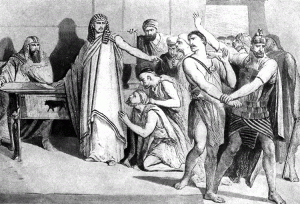
In Genesis 45:1–15 when Joseph finally reveals himself to his brothers, we see that Joseph, as an antitype of ­Yeshua, had mercy on his brothers who were now penitent for their sins against him. Joseph wept for joy and embraced his brothers (verse 14) when being reconciled to them. Past hurts and wrongs were forgiven. Prophetically, this points to Yeshua, our Savior and Redeemer, who lovingly accepts the repentant sinner and warmly embraces and welcomes him into Elohim’s spiritual family and kingdom (Ezek 18:27–32 and Ps 103:10–18).

Continuing with our comparison between Joseph and Yeshua, we see that during the remaining years of the famine, all of the Egyptians became indebted to Joseph as he judiciously doled out the stored wheat to those in need. In order to save their lives, the inhabitants of the famine-ravished land gave their lives and land to be servants of Joseph (who was a type of Yeshua) in exchange for food (Gen 45:13–26, 47:23). Yeshua, likewise, has bought us with the price of his blood (1 Cor 6:20; 1 Pet 1:18–19; Rev 5:9). Similarly, in the Apostolic Scriptures, the disciples of Yeshua are called to be his bondservants—a term the apostles apply to themselves numerous times.


Prophetic Types and Shadows in the Life of Joseph (pt 2)

Joseph Resembles an Egyptian (Gentile)

Joseph lived in Egypt, became Egyptian, resembled an Egyptian in appearance and even married an Egyptian. When his brothers saw him, they didn’t suspect that he was their Hebrew brother.

Prophetically, Joseph’s physical descendants (the house of Israel and later, Christians) would be carried captive into heathen Gentile nations where they would live as Gentiles in a sort of spiritual Egypt. There they would be all but cut off from the Hebraic roots of their faith and would be indistinguishable from the heathen nations in which they were mixed (Hos 7:8; 8:8; also note Yeshua’s Parable of the Prodigal Son, Luke 15:11–32). Some see the prodigal son in Yeshua’s parable as a picture of the modern Christian who was cut off from the Hebrew roots of his faith (or his father’s house), but who will eventually return to the faith of his fathers as prophesied in Malachi 4:4–6).

Joseph Meets His Brothers (Gen 42)

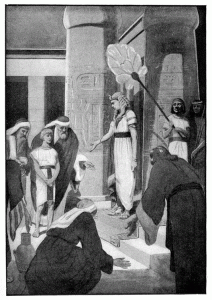
While in Egypt, Joseph became aware that his brothers (and father) were still alive. He recognized who they were, but they didn’t recognize him, since he resembled an Egyptian (a Gentile).

In the end times, Christians, who many of Joseph’s descendants would become according to Genesis 48:14 and 16, have begun to recognize Judah as their brother. Until this time, most of Christianity had either persecuted the Jews, believed that Christians had spiritually replaced the Jews, or were ambivalent toward the Jewish people. This attitude of many Christians toward Jews, however, began to change in the 1960s with the beginning of the “Jews for Jesus” movement which helped Christians to become aware of the need to evangelize the Jews. The result was that many Christians themselves began to become interested in the Hebrew roots of the Christian faith. Beginning in the 1960s, many Messianic Jewish congregations began forming for Jewish believers in Yeshua, but surprisingly often seventy-five percent of the members of those congregations were actually non-Jewish “Gentile” Christians who were seeking to understand and even practice the Jewish roots of their faith!

From the Jews for Jesus or Messianic Jewish Movement of the 1960s came two unexpected results:

  • As Messianic Jewish congregations formed, a large percentage were “gentiles” and not Jewish.
  • In the early 1980s, the Messianic Israel or “Two-House” Movement was birthed through Angus and Batya Wootten.

In this latter movement, which is occurring in the 21st century church, Christians are beginning to open their eyes not only to the fact that the Jews are their brothers, but that they themselves are Israelites and are descendants from the ancient tribes of Israel (Gen 48:14, 16; Rom 9:24–27). As this is occurring, very few Jews (as was the case with Judah of old) recognize that these “Gentile” Christians (like Joseph) are their long lost kinsman who are returning after they were long ago dispersed throughout the world as Jacob, Moses (Deut 30:3; 32:26), and the other prophets predicted would happen. Yeshua clearly stated that it was his ministry and that of his followers to regather these lost Israelites (Matt 10:6; 15:24).

Many Christians are now seeing the relevance and fulfilment of many biblical prophecies concerning the regathering of the ancient lost tribes of Israel to the land of Israel (Deut 30:4; Isa 56:8; Ezek 34:13; 36:24), and their reunification with their brother Judah/the Jews (Ezek 37:15–28). They understand this reunification will occur just prior to the return of Yeshua the Messiah (Ezek 37:24–28).

They have also begun to read and understand the mission of Yeshua and his disciples to regather the “lost sheep” of the house of Israel (Matt 15:24; 10:6), and Paul’s clear statements that all those who come to faith in Yeshua are now Israel and are the literal seed or descendants of Abraham (Eph 2:11–19; Gal 3:7, 8, 14, 28, 29).

Furthermore, they have become aware of the fact that it is Israelites who will have a part in the kingdom of Elohim as exemplified by the New Jerusalem, which has only twelve gates that are named after the twelve tribes of Israel. There is no Gentile gate (Rev 21:12)!

Stay tuned for the next installment in this study!


Prophetic Types and Shadows in the Life of Joseph (Pt 1)

Joseph and Judah (the Two Houses of Israel)

In what follows, we will see types and shadows that point to the end-time reunification of the two houses of Israel (Joseph/Ephraim and Judah/the Jews), and to Yeshua the Messiah whose role it would be to regather and reunite the two houses of Israel by laying his life down as a ransom or substitute for his brothers. In this study, we will discuss the following themes:

  • reuniting lost family members
  • reconciliation and healing of wounds and offenses between families
  • forgiveness of past wrongs, offenses and misunderstandings
  • prophetic shadows of Yeshua the Messiah

Let’s now analyze the events in the life of Joseph (and to a lesser degree, Judah) as they occurred chronologically to see how they pointed forward to events that would occur in the future including the end times.

Joseph Taken as Captive to a Gentile Nation (Gen 37)

Joseph was sold into slavery and taken as a captive to Egypt. Similarly and prophetically, Joseph’s descendants (Ephraim and Manasseh), along with their fellow tribesmen of the northern kingdom of Israel (or house of Israel), were taken as captives into Assyria (ca. 723 B.C.). From there they were scattered around the world (into spiritual “Egypt,” ) where the  biblical prophets predicted they would remain until the final regathering at the end of the age (just prior to and at the coming of Messiah). We will understand this more as we proceed.

Joseph: From Slave to Ruler (Gen 37, 41)

At first, Joseph was a slave and a prisoner in Egypt, but then he prospered and was elevated to a position of leadership there. Likewise, in the future, Joseph’s descendants (Ephraim, Manasseh, and the rest of the house of Israel) would start out as slaves and captives in Assyria (in the eighth century b.c.), but would later become leaders and rulers in their captive nations and would actually have their own nations just as Jacob prophesied would occur to Ephraim and Manasseh (that they would become a multitude of nations, Gen 48:19). We believe that these nations have become the primary Christian nations (of which America is the leader). As we shall see below, the ancient Jewish sages, based on their understanding of the Scriptures, foresaw that the nations of the ten tribes would spread the truth of Messiah Son of Joseph, the Suffering Servant (Yeshua the Messiah at his first coming) around the world. This would help to prepare the way for the Messiah Son of David (Yeshua the Messiah at his second coming).

How do we know that many people in the major Christian nations would be the descendants of Ephraim and Manasseh? The answer is found in understanding the prophecy that Jacob made on his death bed over Joseph’s two sons. Continue reading


Let Joseph’s Example Encourage You

Genesis 41:16, After all Joseph had endured—multiple false accusations, murder attempts, enslavement and imprisonment—a man of lesser spiritual stature than Joseph might have lost his faith in Elohim along the way.

In this verse, what is evidence that he hadn’t given up hope in his Heavenly Father and that he had not lost sight of the dreams and promises that YHVH had made to him many years earlier?

As a form of witnessing, do you give honor to YHVH whenever you can—even to strangers? Doesn’t the fact that Joseph was able to do so in front of one of the most powerful monarchs of his day show evidence of his strong and abiding faith in and fear of YHVH even in spite of years of mistreatment and false accusations?

Joseph is a powerful and encouraging example to the down-trodden of the world who have been persecuted for their faith. It is possible to maintain faith in YHVH even in spite of dire circumstances.


Joseph—An Inspiring Example

Genesis 45:5,7,8, Elohim sent me. Joseph was sold into slavery at age 17, was freed from prison and made ruler of Egypt at age 30, then seven years of plenty followed, and two years of famine had passed by the time he was reunited with is brothers.

Only after 22 years in Egypt did Joseph finally figure out Elohim’s grand and wonderful plan for his life, and how it involved the saving of his family. Had Joseph lost faith along the way, become embittered over his misfortunes, and turned from Elohim, the nation of Israel may have never been preserved.

Keeping one’s eyes on Elohim, and refusing to lose faith during the dark times can yield some amazingly triumphant outcomes, as we learn from the life of Joseph.


Out of the Fog and into the Light of Your Destiny—An Example from the Life of Joseph

Genesis 45:5, 7, 8 — Elohim sent me. This illustrates the remarkable, persevering faith of Joseph who, by this time, had been in Egypt for 22 years.

Joseph was sold into slavery at age 17, was freed from prison and made ruler of Egypt at age 30, then seven years of plenty followed, and two years of famine had passed by the time he was reunited with is brothers.

Only after 22 years in Egypt did Joseph finally figure out Elohim’s grand and wonderful plan for his life, and how it involved the saving of his family.

Had Joseph lost faith along the way, become embittered over his misfortunes, and turned from Elohim, the nation of Israel may have never been preserved.

Keeping one’s eyes on Elohim, and refusing to lose faith during the dark times can yield some amazingly triumphant outcomes, as we learn from the life of Joseph.

What is an example from your life where only after years of endless struggle, while refusing to lose faith in Elohim, did you finally realize that through it all he was working out a glorious plan, bringing you into your destiny, and that he had been preparing you for some assignment or mission all along?