Weekly Blog Scripture Readings for 8/26 through 9/1/2012

Aside

Exodus 6–13; Nehemiah 3–13; 1 Chronicles 1–4; and Psalms 143–149

Most of this week’s blog discussion points will be on these passages. The full year’s Bible Reading Schedule can be found on the right sidebar under “Helpful Links.”

If you have general comments or questions on the weekly Scripture readings not addressed in a blog post, here’s a place for you to post those. Just use the “leave a reply” link below.

Weekly Blog Scripture Readings for 8/26 through 9/1/2012


The Timing and Purpose of Israel’s Exile in Egypt

What Is the Timing of the Exile?

Christian teaching says that Israel was in exile in Egypt for 400 years (Gen 15:13; Acts 7:6) or for 430 years (Gal 3:17). Some see a contradiction in these two numbers, which to nonbelievers “proves” that Scripture is not inspired by Elohim, but rather is the work of men.

The Jewish Sages, on the contrary, say that the 430-year count started when Abraham left Ur, and that the 400-year count started when Isaac was born and that the Egyptian exile lasted for four generations only, or about one-third of the 400 years. The accounting of this is found in Genesis 15:13–16,

And [YHVH] said unto Abram, “Know of a surety that your seed shall be a stranger in a land [eretz] that is not theirs [the land of Canaan and Egypt], and shall serve them [the last half of their bondage in Egypt]; and they shall afflict them four hundred years; and also that nation [goy], whom they shall serve, will I judge, and afterward shall they come out with great substance. And you shalt go to your fathers in peace; you shalt be buried in a good old age. But in the fourth generation [after having been exiled into Egypt] they shall return again [return to the land of Canaan], for the iniquity of the Amorites is not yet full.”

Another point of interest in this regard is Jochebed, the mother of Moses. She was the daughter of Levi (Exod 2:1; Num 26:59) and was married to Amram the father of Moses and the grandson of Levi. Jochebed was the aunt of Amram (Exod 6:16–20). If the Egyptian exile were 400 years, as many believe, then Jochebed would have been around 320-340 years of age at the birth of Moses. This is an unlikely scenario since the biblical record shows us that the lifespan of humans was between about 110 to 150 years at this time. However, if the time of the exile were four generation as noted above (Gen 15:16) then she could have been between 80 to 120 years of age at Moses’ birth, which is in the more likely realm of possibility. The ArtScroll Stone Edition Chumash confirms this math. It says Jochebed was 130 when Moses was born (p. 297) and that at the time Moses returned to Egypt Israel had been living there for 210 years, 116 since the servitude began and 86 since the beginning of the backbreaking oppression (p. 300).

Why the Exile?

The purpose of the exile was to prepare Israel for its inheritance. Egypt was the “boot camp” to prepare them for the rigors of the wilderness journey so that they could then take the land of Canaan. Egypt was an incubator where Israel grew from 70 to more than two to four million people. Israel literally became a hardened army ready to go in and dispossess the Canaanites of their land and in turn repossess it.

Furthermore, YHVH could not allow Israel to dispossess the inhabitants of the Promised Land until the time was right. Scriptures says that the sins of the Amorites had to come to the full (Gen 15:16). YHVH is just and gives nations ample time to repent before judging them.


Overview of the Books of the Torah (Main Themes)

Genesis (Beresheit) is the book dealing with beginnings and eventually its overarching theme is divine election. YHVH is choosing certain people (according to his divine will and sovereignty) to accomplish his purposes.

Exodus (Shemot) is the book whose principle theme is redemption—Israel’s deliverance from Egypt (Mitzraim). Here we learn how YHVH saves his people and we are shown that his people are redeemed in order to worship him.

Redemption is perhaps the main theme in Exodus. It is best delineated in the following passage,

Say, therefore, to the sons of Israel, “I am YHVH, and I will bring you out from under the burdens of the Egyptians, and I will deliver you from their bondage. I will also redeem you with an outstretched arm and with great judgments. Then I will take you for My people, and I will be your Elohim; and you shall know that I am YHVH your Elohim, who brought you out from under the burdens of the Egyptians. I will bring you to the land which I swore to give to Abraham, Isaac, and Jacob, and I will give it to you for a possession; I am YHVH.” (Exod 6:6-8, emphasis added)

Obedience to and worship of YHVH is another major theme in Exodus.

And he said, “Certainly I will be with you, and this shall be a token unto you, that I have sent you, when you have brought forth the people out of Egypt, you shall serve Elohim upon this mountain.” (Exod 3:12, emphasis added)

And I say unto you, “Let my son go, that he may serve [Hebr. awvawd, Strong’s H5647] me, and if you refuse to let him go, behold, I will slay your son, even your firstborn.” (Exod 4:23, emphasis added)

And you shall say unto him, “YHVH Elohim of the Hebrews has sent me to you, saying, ‘Let my people go, that they may serve [Hebr. awvawd, Strong’s H5647] me in the wilderness, and, behold, until now you would not hear.’” (Exod 7:16, emphasis added)

The Basic Outline of Exodus

  • Chapters 1–6 show us the need for redemption.
  • Chapters 7–11 show us the power or might of the Redeemer as the ten plagues are poured out upon Egypt.
  • Chapters 12–18 show us the character of redemption; purchased by blood and emancipated by power.
  • Chapters 19–24 we are taught the duty of the redeemed.
  • Chapters 25–40 we see the restoration of the redeemed—provisions are made for the failures of the redeemed.

Leviticus (Vayikra) gives instructions on how to worship YHVH.

Numbers (B’midbar) gives us instructions pertaining to our spiritual walk and warfare in the “wilderness” of life.

Deuteronomy (D’varim) gives instructions to the younger generation preparing them to enter the Promised Land. Contained within is a recapitulation of the main tenets of the Torah, as well as the addition of some new laws, heart and prophetic issues pertaining to Torah obedience.

 

Weekly Blog Scripture Readings for 8/19 through 8/25/2012

Aside

Genesis 49–50; Exodus 1–5; Daniel 11–12; Ezra 1–10; Nehemiah 1–2 and Psalms 130–142

Most of this week’s blog discussion points will be on these passages. The full year’s Bible Reading Schedule can be found on the right sidebar under “Helpful Links.”

If you have general comments or questions on the weekly Scripture readings not addressed in a blog post, here’s a place for you to post those. Just use the “leave a reply” link below.

Weekly Blog Scripture Readings for 8/19 through 8/25/2012


Jacob’s Prophecy to the Christians (pt 3)

48:18, Multitude of nations. What do the Jewish sages say about this prophetic verse pertaining to the descendants of Ephraim and Manasseh?

Ibn Ezra: Many nations will descend from him (i.e., the word TKN/mem-lamed-aleph [melo], fullness, connotes abundance, the phrase meaning: And his seed will become the abundance of the nation [Neter; Karnei Or].) (The ArtScroll Bereishis/Genesis Commentary p. 2121)

R[abbi] Avraham b. HaRambam somewhat similarly: The expression denotes abundant profligacy to a point that they will have to inhabit lands of other nations it is an allusion to Ephraim’s expansive territory (Ibid.).

Radak: This refers to the Exile when the lands of others will be filled with his scattered descendants … See also Hos 7:8: “Ephraim shall be mingled among the nations. (Ibid.)

What kind of blessing was this prediction that one day his descendants—the Ten Tribes—would be scattered among the nations?

R. Munk explains: while it is true that the dispersion was caused by the unfaithfulness and sinfulness of Ephraim’s descendants (Hos 7:8ff), Jacob’s blessing was not in vain for “they will return to God” and will have their share in the world to come (Sanhedrin 110b). And R. Eliezer adds: “Even the darkness in which the Ten Tribes were lost will one day become as radiant as the day’ (according to the version of Avos d’Rabbi Nosson 36). And in the perspective of history, did not these exiled children of the Patriarchs enlighten the nations among whom they were scattered? They did so by teaching their conquerors the fundamental ideas of the knowledge and love of God, ideals they had never forsaken. Hence they too have a messianic vocation and their Messiah the. … Messiah son of Joseph (Succah 52a), also called Messiah son of Ephraim (Targum Yonasan on Exod 40:11), will play an essential role in humanity’s redemption, for he will be the precursor of the … Messiah Son of David …” (Ibid., pp. 2121–2122).

Can you better see in Jacob’s prophecies over the sons of Joseph and the resulting rabbinic interpretations of those prophecies foretelling the Messianic/Hebrew roots movement (within the Christian church) of the final days? Can you see how this movement would (will) be instrumental in bringing the Christians (many of whom are descendants of Joseph’s sons) back to their Hebrew and Jewish (Book of Acts) roots as part of the restitution/restoration of all things before Messiah Yeshua, the Son of David, returns (Acts 3:21)?

Does not the Book of Revelation prophesy the last days Hebrew roots movement? Read Revelation 12:17 and 14:12 that states that the end-time saints will be those who have the message of the gospel or the faith and testimony of Yeshua the Messiah and who keep YHVH’s Torah-commandments (the Torah or instructions of YHVH given to Moses and Israel at Mount Sinai).


Jacob’s Prophecy to the Christians (pt 2)

48:16, Multitude in the midst of the earth. The ArtsScroll Stone Edition Tanakh translates this verse as follows:

“‘May the angel who redeems me from all evil bless the lads, and may my name be declared upon them, and the names of my forefathers Abraham and Isaac, and may they [Ephraim and Manasseh] proliferate abundantly like fish within the land.’

Onkelos renders this verse as follows:

‘And like the fish of the sea may they multiply among the children of men on earth’ … The literal translation of VDS/dalet-gimel-hey [dagah] refers to procreation … [and] the word essentially denotes fish (The ArtScroll Bereishis/Genesis Commentary p. 2117, emphasis added).

What religious group on earth today has spread out across the face of the earth into all nations and has proliferated a message of Redemption pertaining to a Messenger of YHVH involving a cross-symbol resembling the ancient paleo-Hebrew letter tav and a fish symbol?


Jacob’s Prophecy to the Christians (pt 1)

Genesis 46:14 and 16, Jacob’s Prophecy Over Ephraim and Manasseh

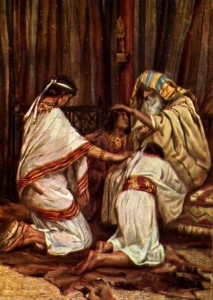
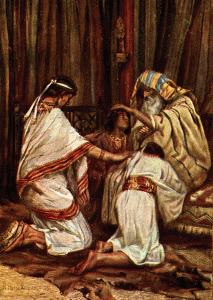
While prophesying over Joseph’s sons, Ephraim and Manasseh, Jacob crossed his hands over their heads making the symbol of the paleo-Hebrew letter tav  (like the letter t or x in the alphabet), which resembles a cross and in that ancient Hebraic script and pictographically means “sign of the covenant.” Jacob then spoke of the Heavenly Messenger (the Hebrew word malak mistranslated as “angel” in most Bibles) of YHVH (i.e., the preincarnate Yeshua) who had redeemed him from all evil (see Gen 31:11–13). Jacob then prophesied that the descendants of Ephraim and Manasseh would become like “fish in the midst of the land” (literal translation of Gen 48:14–16; see The ArtScroll Stone Edition Tanach).

In light of this prophetic symbolism, which present day religious group would qualify as having fulfilled Jacob’s prophecy as to who the descendents of Ephraim and Manasseh would be? Which religion on earth uses the fish as their symbol, speaks of a Messenger from YHVH as their Redeemer, and has the sign of the paleo-Hebrew letter tav, which looks like a cross? The Buddhists? The Moslems? The Hindus? Even the Jews? No! Only Christianity fits this enigmatic criteria.

Many Christians are without a doubt the literal descendants of Ephraim and Manasseh. Those who are not, according to the Apostle Paul, once they come to saving faith in Yeshua in some unique sense become the descendants of Abraham (e.g., Gal 3:7,29). Many of these unsaved descendants of Abraham will recognize Yeshua their Messiah on the day that he returns to Jerusalem (e.g., Zech 12:10).