Blog Scripture Readings For 12/2 through 12/8/12

Aside

Parashat Vayeshev — Genesis 37:1 – 40:23
Haftarah — Amos 2:6 – 3:8
Prophets — 1 Samuel 20:1 – 27:12
Writings — Psalms 57:1 – 63:11
Testimony — Mark 6:1 – 9:37

Most of this week’s blog discussion points will be on these passages. If you have general comments or questions on the weekly Scripture readings not addressed in a blog post, here’s a place for you to post those. Just use the “leave a reply” link below.

The full “Read Through The Scriptures In A Year” schedule, broken down by each day, can be found on the right sidebar under “Helpful Links.” There are 4 sections of scripture to read each day. One each from the Torah, the Prophets, the Writings, and from the Testimony of Yeshua. Each week, the Torah and haftarah readings will follow the traditional one-year reading cycle.

Weekly Blog Scripture Readings for 12/2 through 12/8/2012


The Front Cover of the National Geographic Is Here!

Remember when body piercings, nose rings, ear discs and other forms of bodily mutilations including mass tattooing were something you saw only on half-naked indigenous peoples sporting on the front cover of the National Geographic?

How is it that these practices, once considered ridiculous, or even barbaric, savage and heathen, are now considered fashionable by many in our society?

Is this yet another bellwether of our society’s turning away from biblical values and a continued spiritual declension into godless heathenism and demonism?

Why would someone so mutilate their body and call it fashionable? What is mental-emotional status of a person given to expressing themselves in this manner?

Are those who engage in such practices simply evidencing their spiritual confusion about who they are? Is it an expression of self-dissatisfaction, self-rejection? Is it a cry-out for spiritual help, guidance—an expression of a need for love and acceptance? Or is it simply a “fashion statement” and an effort to be different from the societal norm only for difference’s sake?

Do you know any individuals who are “well-adjusted,”  have a healthy self-esteem, or are even biblically-grounded who mutilate their bodies for fashions’ sake?

What are your thoughts on this matter? Is this growing trend in our society a cause for alarm, or simply a current fad that has no further ramifications than that?

By the way, you might want to take a look at the following blog post I wrote a few months ago—

Genesis 35:4, Strange gods …earrings. For a discussion on the biblical view of men wearing earrings, see an earlier post I wrote on the subject at http://hoshanarabbah.org/blog/?s=earrings&submit=Search.


Symptoms of Demon Possession

Mark 5:1–20, The Gadarene demoniac. This encounter between Yeshua and this  demon-possessed individual teaches us about the characteristics of one who is tormented or even possessed by an evil spirit.

  • One with an unclean spirit is “unclean in thought and life” (Mark 5:2).
  • Such an individual may have a pre-occupation with things relating to death and dying (Mark 5:3)
  • They may possess superhuman strength (thanks to the aid of the demon in him, Mark 5:4).
  • They may act wild, unable to be restrained (Mark 5:4).
  • They may be given to fits of shouting loudly (Mark 5:5), shrieking or making a shrill cry (Mark 9:18).
  • They may cut oneself, or resort to other acts of self-mutilation (Mark 5:5) or self destruction (e.g., burning oneself by fire, Matt 17:15; Mark 9:22), drowning (Mark 9:22).
  • The demoniac may possess supernatural knowledge (Mark 5:7).
  • The demon can speak through the demonized person (Mark 5:7), or cry out (Mark 9:26).
  • A demonic spirit wants to possess or inhabit something; if not a human, then an animal (Mark 5:12), or to homes, to objects like idols or books (Acts 19:19).
  • They may be clothed improperly or scantily (Mark 5:15).
  • They will not a possess a “right [sound, self-controlled, sober]” mind (Mark 5:15).
  • A demonic or an unclean spirit may cause convulsions or spasmodic contractions, bodily contortions within a person, or cause a person to be hurled to the ground (Mark 1:25; 9:18, 20), wallowing or rolling around on the ground (Mark 9:20).
  • Epileptic-type seizures/madness can be symptoms of demon possession (Matt 17:15)
  • A demoniac may foam at the mouth (Mark 9:18, 20)
  • A demoniac may grind or gnash of the teeth (Mark 9:18)
  • A demonic spirit can cause one’s body to waste away, dry up or become rigid (Mark 9:18).
  • Demonic spirits can accompany people as they come into the congregation of YHVH (Mark 1:23; Luke 4:33).
  • A demonic spirit can make one to be mute or unable to speak (Mark 9:17).

But thanks be to YHVH Elohim, our Father, who has given the saints of Yeshua the power over demonic spirits through the blood, the Word and the name of Yeshua the Messiah!

Luke 9:1, Then he called his twelve disciples together, and gave them power and authority over all devils, and to cure diseases.

Luke 10:18–19, And he said unto them, I beheld Satan as lightning fall from heaven. Behold, I give unto you power to tread on serpents and scorpions, and over all the power of the enemy: and nothing shall by any means hurt you.

See also James 4:6–10; 1 John 4:4; Revelation 12:11.


Nuggets from Genesis 32 — Jacob’s Dark Night of the Soul

Genesis 32:24, Wrestled with him. Why did Elohim wrestle all night with Jacob? Why not just wound him early on and save the time and trouble? What does this teach us about the long-suffering nature of Elohim who will continue to strive with us and our fleshy tendencies and self-reliances until we finally submit to him and recognize that only through him can we have real strength and victory, though we might end up physically lame in the process?
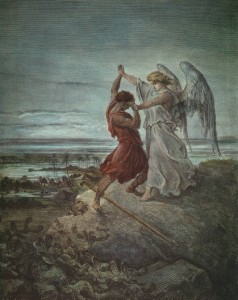
Let’s break this story down.

Why the wrestling all night “till the breaking of the day”? What does night and breaking of day represent metaphorically with regard to our spiritual walk?

What does this teach us about faith, the struggles of this life and about not giving up until the very end when the blessings and dawning of a new day are about to break forth?

Jacob received the new name of Israel during this time (verse 28). Through this struggle, he took a quantum leap spiritually and became a new man with a new identity. Has this ever happened to you? Don’t we progress spiritually only out of crisis? “There is no gain where there is no gain,” as the saying goes.

What were the results of Jacob’s struggle? Verse 32 says of Jacob, “as he passed over Penuel the sun rose upon him, and he limped upon his thigh.” Penuel means “faces of El.” Taking a little poetic license (at the drash/allegorical or third level of Jewish biblical interpretation) here, we could paraphrase this verse as follows:

“As Jacob emerged out of the darkness of self-reliance, the face of Elohim shined favorably upon him as he no longer relied on the flesh.”

Pause to reflect on this for a moment and take quick stock of your spiritual walk in the light of these words.

Who are some other notable Biblical characters besides Jacob who struggled with trying to achieve their divine mission through human means? How about Abraham with Hagar, Moses when he murdered the Egyptian, Samson, or Peter when he cut off the ear of the high priest’s servant? Can you think of some others? What did these men learn about walking in the Spirit versus walking in the flesh?

Genesis 32:28, Jacob but Israel. Jacob/Ya’acov means “heel snatcher/holder or supplanter,” while Israel/Yisra’el means “Prince of El or El Prevails/Prevailer with El.” What can we learn about the change of Jacob’s character as reflected in the changing of his name? Who is the focal point of the name and the initiator of the action in the first name … in the second name? What can we learn from this for our own faith walk?

Genesis 32:32, The muscle that shrank. Please notice that the sinew, representing the strength of the flesh, only shrank. It was not removed. What does this signify spiritually with regard to the redeemed man’s old sin nature?

At the point in one’s spiritual journey when one is regenerated by the Spirit of Elohim, a man doesn’t lose his identity, personality or soul (i.e., his mind, will and emotions). What then happens to a person’s soul? It must be transformed and renewed by the Spirit of Elohim to be conformed to YHVH’s perfect will (Rom 12:2). The soul-man will still try to assert dominance over the spirit-man, but man must learn to submit to the Spirit of Elohim.

Paul discusses the struggle between the soul and the spirit in ­Romans  7:14–25. This is the same struggle that Jacob faced in his dark night of the soul. There he died to his own will and finally submitted totally to that of his Heavenly King.

 

Come out of Babylon, My People!

Genesis 31, Laban and Balaam. It is quite possible that the false prophet Balaam, who heard from YHVH and had a sense of righteousness, though was still steeped in paganism, was a descendant of Laban. Both were from Aram (part of greater Babylon) and only 280 years separated them. One of the Aramaic Targums (Targum Jonathan) equates Balaam with Laban, while other scholars view Balaam as Laban’s grandson.

Whatever the case, both Laban and Balaam were involved in a mixed-religious system—some truth and some error, some good and some evil.

This is the nature of religious Babylon (meaning “mixture” or “confusion”). A mixture of what? Of good and evil.

Remember the tree by that name in the Garden of Eden? Who was the one who enticed man to indulge in that fruit in rebellion to YHVH’s commands? Is not religious Babylon of today, out of which YHVH is calling his people (Rev 18:4), just that—a mixture of truth and pagan lies? How else, for example, do we account for the name of the Christian festival called Easter or Ishtar named after the Babylonian sex goddess of fertility? Or how else do we account for the Christmas tree phallus symbol that also originated from Babylonian sex worship? Or how about the Easter egg (an ancient Babylonian fertility or sex symbol) or the egg on the Jewish Passover Seder plate? All these are symbols of pagan sex worship.

As YHVH called Jacob away from Babylon back to Beth-el (the House of El), and as YHVH turned Jacob’s heart back to the ways of his fathers, is not the same YHVH likewise now calling his people to come out of religious Babylon (Rev 18:4), to separate themselves from that which is unclean or not kosher (2 Cor 6:17)? Yes, YHVH is now calling the modern descendants of Jacob (redeemed Israelites) to remember the Torah of Moses his servant and to listen to the spirit of Elijah as the children’s hearts turn back to the fathers (Mal 4:4–6).


Blog Scripture Readings for 11/25 through 12/1/12

Aside

Parashat Vayishlach — Genesis 32:4 – 36:43
Haftarah — Obadiah 1:1-21
Prophets — 1 Samuel 12:1 – 19:24
Writings — Psalms 50:1 – 56:13
Testimony — Mark 2:1 – 5:43

Most of this week’s blog discussion points will be on these passages. If you have general comments or questions on the weekly Scripture readings not addressed in a blog post, here’s a place for you to post those. Just use the “leave a reply” link below.

The full “Read Through The Scriptures In A Year” schedule, broken down by each day, can be found on the right sidebar under “Helpful Links.” There are 4 sections of scripture to read each day. One each from the Torah, the Prophets, the Writings, and from the Testimony of Yeshua. Each week, the Torah and haftarah readings will follow the traditional one-year reading cycle.

Weekly Blog Scripture Readings for 11/25 through 12/1/2012


Are You Really Free?

Genesis 31:43, These daughters are my daughters. Laban claims that Jacob’s wives belonged to him. He was also steeped in the idolatry of Babylon having in his possession idols or images called teraphim (Gen 31:19, 34–35).

Is there a modern counterpart to this? Does modern Babylon want to control and possess wives and children of redeemed Israel, indoctrinate them in its pagan religious system, and keep Jacob’s modern descendants from returning to their spiritual and physical homeland and birthright inheritance, and from returning to the Torah-faith of their fathers?

Are modern governments (e.g., public education and Child Protective Services, welfare programs, various government regulations that have greatly diminished or eliminated many of our freedoms) and socio-political organizations (e.g. ACLU, UN) modern-day Labans? Revelation 18:13 says that Babylon the Great traffics in the souls of men. This speaks at some level of the modern day enslavement of men—of their religious expression, freedom of thought and action.