Blog Scripture Readings for 7/14 through 7/20/13

Aside

Parashat Va’etchanan — Deuteronomy 3:23 – 7:11
Haftarah — Isaiah 40:1 – 40:26
Prophets — Ezekiel 43:1 – 48:35; Hosea 1:1 – 1:11
Writings — Nehemiah 1:1 – 7:73
Testimony — Ephesians 4:1 – 6:24; Philippians 1:1 – 4:23

Most of this week’s blog discussion points will be on these passages. If you have general comments or questions on the weekly Scripture readings not addressed in a blog post, here’s a place for you to post those. Just use the “leave a reply” link below.

The full “Read Through The Scriptures In A Year” schedule, broken down by each day, can be found on the right sidebar under “Helpful Links.” There are 4 sections of scripture to read each day. One each from the Torah, the Prophets, the Writings, and from the Testimony of Yeshua. Each week, the Torah and haftarah readings will follow the traditional one-year reading cycle.

Weekly Blog Scripture Readings for 7/14 through 7/20/13.


Know Yeshua, No (Longer) Gentile

Ephesians 2:11, Gentiles. Paul says in a number of places that those who come to Yeshua are no longer Gentiles but are the children or seed (literally “sperm,” which is the meaning of the Greek word) of Abraham (Eph 2:11–19; Rom 4:16; 9:8–11; Gal 3:7,9,14,28–29). The word Gentiles as used in the Scriptures (both in the Hebrew and the Greek languages) simply means “ethnic groups or nations.” There are many places in the Scriptures where Jews and Israelites are referred to as “Gentiles.” There is no class of people called Gentiles in the spiritual body of Yeshua. Scripture uses the following terms for the redeemed of YHVH: the saints, the called out ones (or church), the body of Yeshua (1 Cor 10:16; 12:27; Eph 4:12) the one new man (Eph 2:15), sons of Elohim (Rom 8:14, 19; Phil 2:15; 1 John 3:1, 2), children of Elohim (Rom 8:16, 21; Gal 3:26; 1 John 3:10), or Abraham’s offspring (Gal 3:29), the bride (Rev 18:23; 21:2, 9; 22:17) for example.

Cross at St. Augustine

Any attempt by anyone to keep the Jew—Gentile division alive within the body of Yeshua is in effect keeping up the middle wall of partition that the Apostle Paul gave his ministry life and eventually his physical life to tearing down (see Eph 2:11–19). It is also going against the clear teaching of the Scriptures, which say that within the spiritual body of Yeshua, there is no longer Jew or Gentile/Greek (Rom 10:12; Gal 3:28; Col 3:11). 

The Scriptures reveal that there are only two classifications of people: Israelites and non-Israelites or Gentiles. The former has eternal life because of their relationship with the Elohim of Israel through the Messiah of Israel. The latter group, unless they repent of their sin (i.e., lawlessness or Torahlessness, see 1 John 3:4), will burn in the lake of fire because their names weren’t written in the book of life (Rev 20:11–15).

Whenever Paul uses the term Gentiles, he is either referring to ethnicity, and not using the Continue reading →


Family: Can’t Live With or Without Them

Deuteronomy 2:2–9, Edom (another name for Esau, brother of Jacob) and Moab and Ammon (sons of Lot) were blood relatives of the Israelites. Often those of our own family will stand in our way as we go in to possess our ­spiritual, Elohim-given inheritance and destiny. What is the lesson from this passage of scripture on how to deal with less-than-cooperative family members who fail to recognize the calling on your life? Are we to make war with them? Are we in any way to be beholden to or dependent on them for our physical needs? If we became dependent upon them could this help or hinder our chances of entering our own spiritual destiny or “Promised Land”? Does YHVH desire our families to be saved? (See Acts 16:31; 2 Pet 3:9.) How can we be a light to our families if we are fighting and attempting to destroy those who would spiritually stand in our way?

20116916

This passage also teaches us to avoid conflicts with family members at all costs. No good can come from such confrontations. How does verse 5 start out? Now go on to read verse 6. YHVH instructed the Israelites to treat their cousins with respect and civility—almost in a business-like manner. Nowhere does Scripture tell us that we have to like our heathen family members. But neither are we to act offensively toward them. Like the Israelites when forced to encounter long lost relatives, sometimes it is best to smile, be nice, but keep moving on!

Another lesson to be learned from these verses is this: choose your battles carefully. Avoid conflicts with others at all costs. Only go to battle when YHVH tells you to. Only then will you come out victoriously, for then he will be fighting on your side and not against you. Latter in this chapter, we see that YHVH instructed the Israelites to engage certain nations and defeat them. When Israel obeyed him and fought only his battles, what was the outcome? (Read 2:24–3:11 cp. 3:22.)


The Two Sticks Prophecy Yet to Be Fulfilled

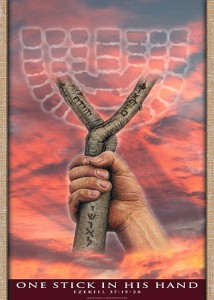
Ezekiel 37:14–28, The vision of the two sticks (trees). The second vision Ezekiel records in chapter 37 involves YHVH commanding him to take two sticks (or trees) and writing upon one stick “for Judah and for the children of Israel and his companions [i.e., those who have knit themselves together with or joined to the tribe of Judah],” and upon the other stick, write “for Joseph, the stick of Ephraim, and for all the house of Israel and his companions.” Ezekiel was to told to then join the two sticks together, so that they would become one stick (or tree) in his hand (verses 15–17).

One Stick in His Hand

Image courtesy of messianicisrael.com

How were these two nations, which separated from each other some three thousand years ago, to be rejoined into one nation? That has been the subject of much debate between both Jewish and Christian commentators for years. Some modern historical revisionists view this prophecy as having been fulfilled when the Jews returned to the land of Israel in the time of Ezra and Nehemiah after their Babylonian captivity ended. But this interpretation leaves some unanswered questions. The book of Ezra, which chronicles the return of a remnant of Jews from Babylon to the land of Israel, lists the numbers and tribes of those who returned. All the tribes listed were originally from Jerusalem and Judah and were from the tribes of Judah and Benjamin (Ezra 2:1; 4:1; 10:9), and there is no mention made that any of the ten northern Israelite tribes joined the Jews in resettling the land of Israel. So far as the returning Jews were concerned, it is likely that they considered their northern brothers lost and assimilated among their Assyrian captors and that only they were left of all the twelve tribes to resettle the Promised Land after their captivity. If this were so, Continue reading →


Blog Scripture Readings for 7/7 through 7/13/13

Aside

Parashat D’varim — Deuteronomy 1:1 – 3:22
Haftarah — Isaiah 1:1 – 1:27
Prophets — Ezekiel 36:1 – 42:20
Writings — Ezra 4:1 – Ezra 10:44
Testimony — Galatians 3:1 – 6:18; Ephesians 1:1 – 3:21

Most of this week’s blog discussion points will be on these passages. If you have general comments or questions on the weekly Scripture readings not addressed in a blog post, here’s a place for you to post those. Just use the “leave a reply” link below.

The full “Read Through The Scriptures In A Year” schedule, broken down by each day, can be found on the right sidebar under “Helpful Links.” There are 4 sections of scripture to read each day. One each from the Torah, the Prophets, the Writings, and from the Testimony of Yeshua. Each week, the Torah and haftarah readings will follow the traditional one-year reading cycle.

Weekly Blog Scripture Readings for 7/7 through 7/13/13.


Islam: YHVH’s Judgment to Bring Jews & Christians Back to Him

This is a hard message. Few will be able to receive it. But the watchman must give it anyway (Ezekiel 33:1–11).

The Ancestry of Modern Arabs

In Genesis 32, Esau and his army stood in the way preventing Jacob and his descendants from returning to their homeland — the land YHVH had promised to them. This historical event is prophetic of what will happen in the end times as the Jews and the rest of the Israelites endeavor to receive their promised inheritance and the kingdom of Elohim.
198298

Not only that, YHVH used Esau to test Jacob’s who had grown overly self-confident due to his business acumen and his ability to produce a large family clan. In the ancient world, he had reached the pinnacle of wealth and power. However, what mattered to YHVH more than these things was the character of a man. Would Jacob have faith in his Creator, or would he trust in his own abilities to outwit his adversaries and come out on top as he had done twice previously with his brother Esau and Laban, his uncle? Jacob’s confrontation with his brother at the threshold of the land of Israel and his wrestling with the Messenger from heaven were the two tests that he had to pass. The Bible calls this Jabob’s Trouble and prophesies that something similar will occur in the end times to Jacob’s descendants (Jer 30:7).

According to Genesis 32, Jacob divided his wives and children into two camps (Gen 32:1, 7). This was prophetic of what would eventually occur to the nation of Israel after the death of King Solomon. The one nation of Israel became two houses or kingdoms — the Northern Kingdom of Israel and the Southern Kingdom of Israel. The descendants of these two kingdoms are presently — loosely speaking — the Jews and the Christians. But who are the descendants of Esau historically and, more importantly, today. Why is it important to know?

Many, if not most of the modern Moslems (especially the Arabs) trace their lineage back if not biologically then spiritually to Ishmael, the son of Abraham by Hagar. Islam in its religious book, the Koran, claims that it was Abraham and Ishmael who founded the religion of Islam and built the Kaaba, which is the small building containing a stone that supposedly fell from heaven. This shrine is located in the midst of the great mosque in Mecca, Saudi Arabia. Of Ishmael and his descendents, the Bible prophesies in Genesis 16:11–12,

The Messenger of YHVH said to her further, “Behold, you are with child, and you shall bear a son; and you shall call his name Ishmael, because YHVH has given heed to your affliction. And he will be a wild donkey of a man, his hand will be against everyone, and everyone’s hand will be against him; and he will live to the east of all his brothers.”

The Koran has further twisted the biblical account to declare that the biblical patriarchs were Muslims and that Abraham gave the birthright blessing to Ishamael instead Isaac. Both Israelites and Arabs, therefore, believe that they have a right to the Promised Land of Canaan, and, hence, thus forming the basis for the modern Arab-Israeli conflict. Continue reading →

 

For Profit Prophets—Like Balaam

Numbers 31:8, Balaam … they slew with the sword. Jude 11 talks about Balaam being greedy for money and indicates that there are those in the end times in the body of Yeshua who will follow after this sin. How is this possible? What will be the ultimate fate of these “tares”? (See Matt 13:40.)

Balaam prophesies 2

Had Balaam believed his own good prophecies concerning Israel and not have sided with Israel’s enemies, would he no doubt would have been spared the sword of YHVH’s justice. What were his motives for siding with them?

Greed and materialism blind one from YHVH’s truth and cause one to side with YHVH’s enemies. What is the end result of this action?

Balaam was a deceiver and a hypocrite. He spoke one thing and did something else. Are we ever guilty of this? How rampant is the sin of duplicity within the body of believers in Yeshua?

There are people who claim to be prophets in the church who, like Balaam, speak soothing and ear-tickling prophetic words in order to profit from the people. How can we know the difference between true and false prophets? A true prophet is not greedy like Balaam. (Read Deut 18:20–22 and Matt 7:15–20.) Can a true prophet of Elohim prophesy out of the flesh something false, and if he repents, when he finds he was in error, be spared from the death penalty? (Read 2 Sam 7:1–17.)