Matthew 26:28, New testament.(Also see notes at Heb 8:8 and notes at Ps 50:5.)
Did you ever wonder where the terms New Testament or New Covenant came from? Yes, you will find these phrases used in the Testimony of Yeshua portion of your English Bible in exactly nine places (Matt 26:28; Mark 14:24; Luke 22:20; 1 Cor 11:25; 2 Cor 3:6; Heb 8:8, 13; 9:15; 12:24), but does the English translation do justice to the Hebrew and Greek words behind them and to the biblical concept of the “New Covenant” as it is commonly called?
Let’s begin to answer this question by first asking a question. When you think of the word new, what comes to your mind? A brand new car? A new house? A new pair of shoes?
You see, in English there is one common word for new, while Greek and Hebrew have more than one word for new. While English speakers are limited to one word, they nuance the meaning of new by adding qualifiers to the word new (e.g. brand new as opposed to used but it’s new to me) to differentiate between brand new versus new to me, or refurbished or repaired new.
In the Testimony of Yeshua, there are two Greek words for new: neos and kainos, and each one has a different connotation. Neos more often means “brand new or numerically new,” while kainos means “renewed, refreshed or repaired or qualitatively new.” When you see the term New Covenant or New Testament used, in eight of nine time the authors use kainos. Only in Hebrews 12:24 is neos used in reference to the new covenant.
The Testimony of Yeshua’s preference over using the Greek word for renewed over the word (brand) new is exactly consistent with the author of the Epistle to the Hebrew’s usage of the word in Hebrews 8:8,
Obedient and truth-seeking disciples of Yeshua will want to love him by keeping his commandments (John 14:12), and by teaching and doing everything he commanded (Matt 28:20). They will be following Paul’s example to imitate Yeshua (1 Cor 11:1) as well heeding John’s admonition “to walk just as [Yeshua] walked” (1 John 2:6). The Passover communion service is an example of doing what Yeshua and his disciples did. How and when did he do it, so that we can follow his example? Let’s now explore this subject from a whole-Bible, Hebraic perspective.
With regard to obeying YHVH’s commands, symbols and memorials figure prominently in YHVH Elohim’s spiritual economy. Why is this? They are teaching aids. Physical humans need physical things to help them to comprehend spiritual truths and ideals. Using symbols, commemorations and memorials is a method of teaching and relates to pedagogy, which is “the method and practice of teaching, especially as an academic subject or theoretical concept.” A effective teacher endeavors to build bridges of understanding between what the student knows and what the teacher wants to teach the student— between the known and the unknown, between what the student understands now and what the teacher wants his students to learn. A successful teacher learns the skill of building bridges of understanding with his students to bring them to a higher level of understanding. The same is true of YHVH Elohim as we works with humans to teach them about spiritual things.
On a spiritual level, YHVH Elohim, our Heavenly Teacher, employes similar pedagogic or teaching techniques as he endeavors to bring men to a higher level of understanding heaven’s spiritual truths and realities. The use of symbols and memorials as teaching tools is essential to this process of teaching and learning.
When did the disciples keep the Passover or the last super?Since Yeshua had to be hanging on the cross during the time that the Jews were offering the Passover lamb in the Temple, which was the same time that ancient Israel was killing their Passover lamb, it seems impossible that Yeshua could keep Passover with his disciples at this exact time. Yet Scripture mandates that Passover be kept on the fourteenth day of the first month. How do we resolve this difficulty?
Let’s look at some scriptures relating to this subject:
Matthew 26:17 reads, “Now the first of the unleavened bread the disciples came to Yeshua, saying unto him, Where do you want us to prepare for you to eat the Passover?” (italicized supplied words not in the original Greek have been removed). Mark 14:12 reads the same.
Luke’s account says, “Then came the day of Unleavened Bread, when the Passover must be killed” (22:7).
The Scripture shows us that in the Gospel narrative the terms “Unleavened Bread” and “Passover” are synonymous and interchangeable (Luke 22:1). Furthermore, we see that the “Passover [lamb] was killed on the Day of Unleavened Bread” (Luke 22:7). In a strict letter-of-law Torah sense, this is impossible since Passover and Unleavened Bread were two separate appointed times falling on two separate days, though the days were adjoining each other. In the Gospel accounts, however, the writers use the colloquial term Passover to designate both appointed times—a common practice in the first century.
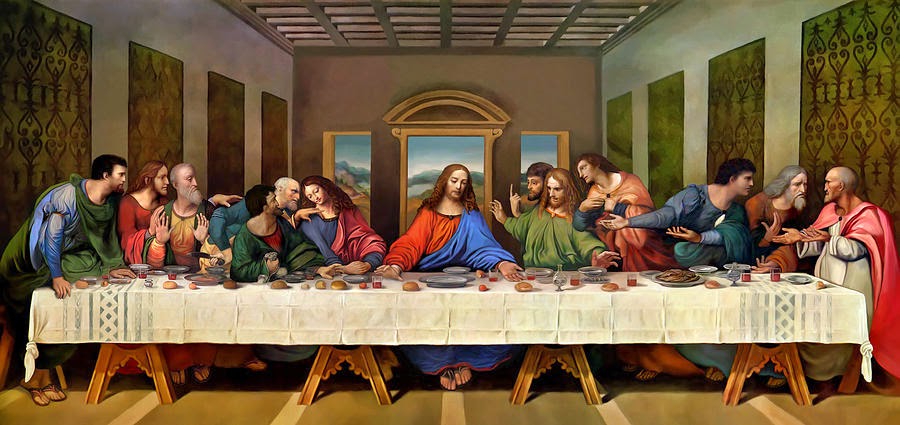
The Gospels further tell us that Yeshua commanded his disciples to go and prepare a place to keep Passover (Luke 22:8). The disciples asked Yeshua where to go to prepare for it (Luke 22:9). Yeshua reiterates that he will be eating the Passover meal with them (Luke 22:11). The disciples make the room ready for the Passover meal (Luke 22:13). And finally, Yeshua calls this meal the Passover. He tells his disciples in Luke 22:15, “With desire I have desired to eat this Passover with you before I suffer.” (Mark and Matthew’s accounts of these events corroborate this.) The word Passover (pascha, Strong’s G3957) in the Greek can refer to the Passover day, Passover meal or the Passover lamb. The context in which the word is used has to determine which one of its several meanings is applicable here. It seems that the context here would point to a meal.
John 13:2–30 offers further proof that the Passover meal that Yeshua was doing was not at the end of the fourteenth and the beginning of the fifteenth, which would have made it the evening of the Sabbath (Heb. erev Shabbat)—in this case, the high Sabbath or the first day of the Feast of Unleavened Bread. When Judas left the supper (verse 27), the disciples figured that he was departing to purchase more supplies for the Passover meal, which was yet to come (verse 29). Furthermore, for them to think this means that they knew that the shops were open from which to buy supplies (and therefore it was not the Sabbath or Shabbat). This would not have been the case had the last supper been at the end of the Passover as it was approaching the beginning of the fifteenth, which was still 24 hours off.
Since Yeshua could not partake of the Passover meal on the afternoon of the fourteenth, and since the Gospels tells us that it was evening when he celebrated Passover with his disciples, and since we know it occurred on the fourteenth of the month of the abib, when was the Lord’s supper or last supper? It had to have been at the end of the thirteenth and at the beginning of the fourteenth after sundown. They simply kept it earlier on the same day (at the beginning of the fourteenth rather than at the end). At the end of that same day, he was hanging on the cross as the Passover Lamb. After the Lord’s supper Yeshua and his disciples went to the Garden of Gethsemane where he was arrested by the Jewish leaders later that night. During the evening and into the morning he was put on trial before the Jewish leaders and afterwards he stood before Pilate, after which he was nailed to the cross sometime between the third and sixth hour (according to the Gospel accounts). At 3 p.m. (Luke 23:44-46), he proclaimed the famous words: “Eloi, Eloi …” and shortly after that exclaimed, “Father receive my spirit …” whereupon he died.
Did Yeshua celebrate an actual Passover service or was it simply a memorial dinner, or a fellowship meal often referred to as the Lord’s supper? There are valid arguments on each side of this issue. Perhaps it doesn’t really matter. For us now, the big question is how could Yeshua keep the Passover (as he said he did) with his disciples on the fourteenth of Abib as Torah commands and still be hanging on the cross on the same day as the spiritual fulfillment of the Passover Lamb?
The Gospel accounts are clear about the fact that Yeshua was keeping a “Passover” meal, for he says so, yet we have seen that it had to have been an early meal on the same day. It was not the main meal that was to be held later at the end of the fourteenth into the fifteenth of Abib as the Torah instructs in Exodus chapter 12.
Alternative “Passovers”
What was the precedence for such a meal? Does Torah make allowances for another Passover celebration at another time? The answer is yes.
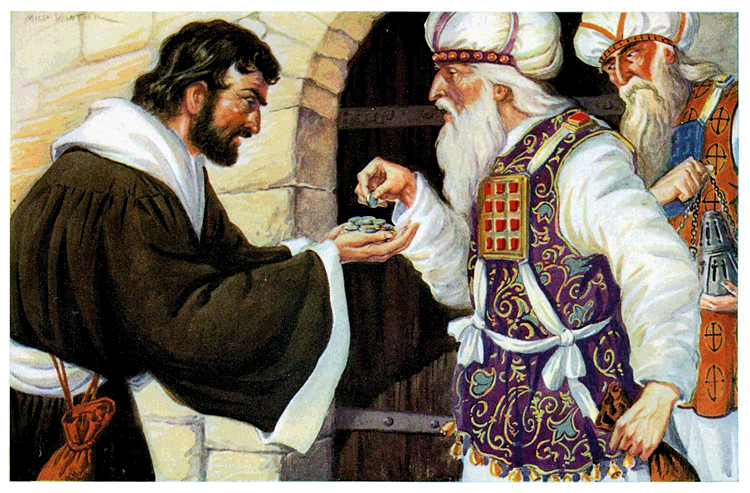
Matthew 26:14–15,Then Judas.When Yeshua plainly stated that he’d be crucified soon, Judas evidently became disillusioned, since he was expecting Yeshua to be the Conquering King Messiah, not a Suffering Servant Messiah. As the conquering king, it would have been Judas’ expectation that Yeshua would have given the Roman overlords the boot, established himself as the king over the Jews, and thus Judas could have expected a prominent position in Yeshua’s new government.
Because of these false and presumptive expectations about Yeshua’s role as the Messiah, Judas wasn’t following Yeshua for who the Master was, but for how Judas could benefit personally out of his relationship with Yeshua. Judas was a false convert, and a spiritual tare. The church is full of such people including pastors and leaders, and Scripture warns us against them.
The lust for money and power were likely the motives behind Judas’ following Yeshua (after all, Judas carried the money bag for Yeshua’s ministry). When Yeshua predicted his crucifixion, Judas’ incentives for following him suddenly vanished. Judas figured he’d salvage what he could of his unfulfilled expectations and enrich himself, even if it meant betraying Yeshua for money. Judas had come to the conclusion that Yeshua was a false Messiah faker and that he had wasted several years of his life following him, so, in his mind, giving Yeshua over to the Jewish authorities wasn’t an act of betrayal at all, but was an act of civil service to expose Yeshua as a trouble-making fraud. This goes to show that the wicked and a carnal person in his own twisted thinking can justify just about any evil deed and delude himself into thinking he is doing good.
In Judas’ mind, the Jewish leaders had been right after all to reject Yeshua as the Messiah. To them, he was merely a pretender, a deceiver, an agitator and a troubler, and now Judas had come to the same conclusion. When Judas came to this realization, he now found it advantageous to his personal well-being to cast his lot in with the Jewish religious establishment and to make some money from it as well.
In our day, there many Judas-type people who turn away from following Yeshua. Many reasons can be given for this, but it boils down to three things: the lusts of the flesh, the lust of the eyes and the pride of life. Selah!
Genesis 26:1–29,There was a famine in the land. At the well of Lachai-roi (or “the well of the Living One seeing me,” Gen 24:62), Isaac was fruitful. There he met his wife while in communion with YHVH (Gen 24:62–64). Isaac also dwelt there for 20 years, and there he entreated YHVH because of Rebekah’s barrenness (Gen 25:21), and YHVH answered Isaac’s prayer and Rebekah gave birth to twins (Gen 25:22).
But because of famine in the land, Isaac felt compelled to leave Canaan to seek relief in Egypt following the earlier footsteps of his father, Abraham. At this point, we must ask ourselves whether it is wise for the saint to rely on “Egypt” (a metaphor for the world) for their physical sustenance instead of trusting YHVH and believing that where he has planted us and blessed us is where we should stay?
Evidently, YHVH didn’t want Isaac to go down to Egpty, for while en route to that land, he gracefully redirected Isaac stay in Canaan and to sojourn in Gerar (temporarily), where he would continue to bless him and his posterity (Gen 26:2–4).
Isaac obeyed YHVH—more or less. Isaac ended up in Gerar located on the border between Canaan and Egypt and dwelt there a long time and not temporarily as YHVH had instructed him (Gen 26:6, 8). Instead of fully obeying YHVH, it was as if Isaac was hedging his bet between faith and fear, between Canaan, the land of promise, and Egypt, the land of comfort for the flesh man. How often do we halt between two opinions and compromise between YHVH’s will and our own in matters where he has given us clear direction?
This place of spiritual indecision and weakness put Isaac in a compromising situation (Gen 26:7). He felt compelled to lie about his wife, thus repeating the sin of his father (Gen 20:1–2). Compromised obedience puts us in compromising situations where in order to “save our skin” we often have to compromise our values.
Though Isaac was out of YHVH’s will, YHVH was still faithful to keep his promises that he had made to Isaac earlier (Gen 26:3–4). Isaac was blessed one hundred fold in his wealth (Gen 26:12–14).
Despite YHVH’s blessings, Isaac’s labors were not without difficulty and opposition from an enemy who was intent upon stealing the water wells that were rightfully his (Gen 26:12–15).
In the arid regions of the Holy Land, wells are essential for survival and prosperity. Wells are a spiritual metaphor for salvation, life, abundance and truth—things the enemy is intent on taking from us (in this light, consider Isa 12:3; 55:1–3; Ps 36:9; John 4:7–14; 7:37–39; 10:10). Don’t let the enemy steal from you that which YHVH has given to you.
Psalm 41:1, Blessed is he who considers the poor. This passage makes it clear that helping the poor is like a spiritual insurance policy that pays off in one’s own time of need. The old adage, “What goes around comes around” applies here. The only difference is that this law of reciprocity isn’t chance driven, but YHVH instituted and orchestrated, for verse one says that YHVH will deliver the who blesses the poor in his own time of trouble.
From verse one to verse three, YHVH promises to care for those who help the poor in the following ways:
Protect and preserve his life (verse 2).
Deliver him from his enemies (verse 2).
Sustain and restore one who is sick (verse 3).
This is an insurance policy pays rich dividends in YHVH’s spiritual economy.
The Bible on Giving to the Poor
Multiple times, the Scriptures enjoins those who have been blessed materially to help those who are poor. In fact, YHVH even has a special place in his heart for a certain class of individuals who have fallen into poverty, namely, the widows and the fatherless (Deut 14:29; 16:11, 14; 24:19; 26:12–13; 1 Tim 5:3). Moreover, Yeshua declared that the poor would always be among us (Matt 26:11), so there will never be a lack of opportunity for the so-called haves to help the have-nots. Furthermore, YHVH promises to bless us when we give to the poor (Ps 41:1–3) as well as to those who have dedicated their lives to serving YHVH’s people through the ministry (Deut 14:29; 16:14; 26:12–13).
In Deuteronomy 15:7, we discover that there should be levels of priorities in our giving to the poor. Our first responsibility is to help a poor person who is a brother, that is, who is a member of our immediate family, or someone who is like a brother to us. Second, we are to help those in need who reside in our gates, or are a member of our immediate community. Finally, and last, our charitable is to go toward those who are in need in our own land or country. The idea here is that our charitable giving is to go first to those who live the closest to us, and then go out from there geographically as we are able to do so financially.
Genesis 25:30,Esau…Edom. Many, if not most of the modern Moslems (especially the Arabs) trace their lineage back if not biologically then spiritually to Ishmael, the son of Abraham by Hagar. Islam in its religious book, the Koran, claims that it was Abraham and Ishmael who built the Kaaba, which is the small building containing a stone that supposedly fell from heaven. This shrine is located in the midst of great mosque in Mecca, Saudi Arabia.
In Genesis 16:11–12 YHVH prophesied the following concerning Ishmael and his descendants:
The angel of YHVH said to her further, “Behold, you are with child, And you shall bear a son; and you shall call his name Ishmael, because YHVH has given heed to your affliction. And he will be a wild donkey of a man, his hand will be against everyone, and everyone’s hand will be against him; and he will live to the east of all his brothers.”
The modern Moslems have twisted the biblical account of Abraham’s giving the birthright blessing to Isaac and believe instead that Ishmael was the promised son of blessing. Both Israelites and Arabs, therefore, believe that they have a right to the Promised Land of Canaan, and, hence, this disagreement is at the roots of the modern Arab-Israeli conflict.
Scripture further records that Esau, the disinherited son of Isaac, also had a jealous anger against his brother Jacob, who received the birthright promise instead of him. Scripture further records that Esau married the daughter of Ishmael (Gen 28:9). Thus in some of Esau’s descendants (he had more than one wife), the lineage of Esau and Ishmael were combined and both men had a jealous feud with the sons of Jacob, which has been passed down generationally to this day.
The Bible has more to say prophetically about the descendants of Edom than about those of Ishmael. Edom is portrayed as an aggressive and bloodthirsty people who are opposed to Israel at every step. We will discover what Scripture has to say about this below.
In the mean time, let’s take a closer look at Edom.