I found another terse comment from the so-called “Rabbi’s” daughter. Here is what she said followed by my comments:
The messiah is not Hashem the Father
Here is my comment:
You are correct. Yeshua is NOT HaShem because HaShem is a non-existent entity and a silly made up name by the rabbinic Jews as a result of a false, pagan doctrine they plagiarized from the Babylonians called the ineffable name doctrine. Scripture reveals nearly 7,000 times in the Tanakh that the name of the Elohim the Father is YHVH or Yehovah. Scripture also reveals that the name of Elohim the Son or Yeshua the Messiah is also YHVH. This is Bible 101.
Moreover, Scripture reveals that the Father is Elohim and that Yeshua is also Elohim. Elohim is a compound unity (the Hebrew word for this, in case you didn’t learn this in schul is echad) comprised of the Father, the Son and Holy Spirit.
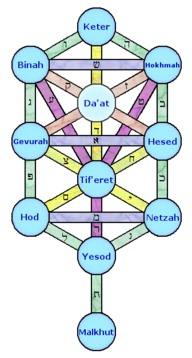
The sephirotic “tree of life” in rabinic Jewish mysticism.
Doesn’t the sephirotic tree as your own “rabbis” teach define Elohim not just as being three entities but as being, what, ten entities of which the Father, Son and Ruach are only three? Do you deign to toy with me thinking that I don’t know these things that you rabbinic Jewish folks keep so well hidden from the Christians? The Trinity doctrine has nothing on you guys! You teach that the Godhead is ten!!!
Yes, Yeshua is not the Father, yet he and the Father are one. He said if you’ve seen him, you’ve seen the Father. Make of this what you will. Neither your brain nor mine is capable of comprehending the exact nature of the “Godhead,” so let us leave it there before we get into water that’s way over both of our collective heads.
Besides why to you care who Yeshua is? You don’t believe that he’s the Messiah anyway, so take a hike and stop trolling this blog. The gate here is now shut to you unless you show a genuine change of heart. Be blessed…
The following comment came into this blog’s comment section today. I permitted it to be posted as an opportunity to comment. The writer purports to be the daughter of a “rabbi” whatever this is supposed to mean. By her comments, she is not a believer in Yeshua the Messiah, but proffers arguments against Yeshua’s Messiahship from the Orthodox Rabbinic Jewish perspective. Her arguments, though seemingly convincing on the surface, are actually quite shallow and easily refuted. Her knowledge of Scripture is superficial and of Jewish history is lacking, I point out in my rebuttal.
The reason I post this is for your education, so that you can help any fellow believers you know who are being swayed by the Antimissionary arguments of the rabbinic Jews.
Elsewhere, I have written extensively on some of the subjects she brings up. At the end of this post, I will post some links for those who care to go further.
Now here is the comment from the “rabbi’s” daughter:
Most people dont realize the role of Messiah, who have come o/o christianty and into a melting pot of teachings of which most only hold partial truth. Take into account the original language in which the Scriptures were written i.e. Hebrew, Aramaic… There are some words that were not translated but transliterated. The world “Messiah” is one of those words, from the Hebrew Mashiach. In Greek it is Christos. I know I’m preaching to the choir on this but let me explain to help you understand. So what does Messiah or Christ mean? It means someone who was anointed or SELECTED by YHVH ELohim, the Father, as ruler, king (1Kings 2:10-12). Hence, in the bible there are many Messiah’s. Examples: The temple priest Lev. 4:3, 6, 16, 6:22; The patriarchs Ps. 105:15; 1 Chron. 16:22; King Saul 1 Sam. 12:3, 5; 24:6, 10; 26:9, 11, 16, 23; 2 Sam. 1:14, 16, 21; King David 2Sam. 19:21; 22:51; 23:1 Ps. 18:50, 20:6, 28:8; King Solomon once in 2 Chron. 6:42, the pagan king Cyrus Isa. 45:1, the future messianic figure 1 Sam. 2:10, 35, Ps. 2:2, 89:51; 132:10, 17; Dan, 9:25-26; Hab. 3:13. AS you can see there are many “christs/messiahs” who preceded Y’shua. The title Messiah can not mean Hashem ELohim Himself, because Messiah or Christ (anointed) is the AGENT of the One True God (John 17:3) As messiah Y’shua/jesus, who is prophet, priest and king. That’s because The Father anointed him above all predecessors i.e. his companions Heb. 1;9. It is for this reason that Y’shua taught men to pray each day for the coming Kingdom of his ELohim, YHVH, and Father (Matt. 6:10) The role of the Messiah(s) throughout all of the ages was to point mankind BACK to the FAther and to His Torah.
None of the prophecies of Daniel nor any other biblical prophet relate to Yeshua/Jesus nor to the Christian writings.
Allow me to be more clear: Jesus never reigned as King of Israel. Messiah will. Jesus never ruled as judge of Israel. Messiah will. Jesus did not rebuild the Temple. Messiah will. Jesus did not bring all Jews Home to Israel. Messiah will. Jesus did not establish world peace. Messiah will. Jesus did not end warfare. Messiah will. Jesus did not oversee the Torah being written on the consciousness of the world. Messiah will. Jesus’ followers increased antisemitism, he did not destroy it. Messiah will end it.
Jesus did not end world hunger. Messiah will. Jesus did not bring idolatry to an end. Messiah will. Jesus not bring global justice. Messiah will. Jesus not restore the Ten Houses. Messiah will. Jesus did not end all diseases. Messiah will. Jesus never sat on the throne of David. Messiah will. David was not his paternal father/anscetor as required of Messiah, Messiah will will be a paternal descendant of David haMelech. Jesus did not lead all Jewish into becoming Torah observant. Without a Jewish father Jesus had no Land Rights in Israel. Messiah will. Jesus was not accepted by our sages and rabbis. Messiah will be.
There are SOOO many prophecies and conditions Jesus did not meet! Several people have come much closer than he. David Ben-Gurion came MUCH closer and he was not even religious! This is why the Christian apologists had to draw on the baseless claim of a “second advent.” Nothing in Scripture supports that. Messiah, when he comes, will establish Israel and meet all of the requirements and be accepted by our people as foretold. The you guys of the other nations will come to us as Noahidim (Zechariah 8:23). I do not care if people choose to worship a god-man our father’s did not (read Deuteronomy 13) but as me, my household and this group, we worship HaShem alone. Missionary activities are not permitted here. Y’shua may or may not be the returning Messiah, we will have to see, only Hashem knows. Y’shua even said that himself.
Natan’s response:
Let me be blunt, which you will probably not like. A serious disease requires a strong medicine. In this case, we are talking about the disease spiritual blindness based on bigotry and ignorance of the Truth of the full counsel of the Bible, the Word of Elohim and aquiescence and submission to the traditions of men by which the Word of Elohim is made of none-effect. Moreover, this is my blog, and I am duty-bound to point out many things that you have said that are not true biblically. Your comments, though containing some truths, are also full of a number of egregious and unbiblical errors, and are evidence of the fact that spiritual blindness has come upon (some of) Israel and the Jews as Paul the apostle, the Jewish Torah scholar par excellence, who was discipled by Gamaliel the First, the grandson of Hillel the Great, stated in his epistle to the Romans (Rom 11:25).
On this blog, we take a strong and firm stand against those who deny the Messiahship of Yeshua the Messiah—against the so-called Jewish “anitmissionaries.” Frankly, the only reason I have not deleted your anti-biblical, Antimessiah spiel is because your comments give me an excuse and an opportunity to address some important fallacies in what you say. So thank you. From now on, however, you will not be able to make posts to my blog quite so freely no that I know your heretical biblical position.
Exodus 20:2, I am YHVH your Elohim.In Jewish reckoning, the first “commandment” (better translated: “word”) is found in 20:2 with verses 3 through 6 forming the second word and verse 7 the third and so on. YHVH wrote the first five words on the right side of the two tablets of stone and the last five words on the left side. The Jewish sages teach that the first word (commandment) corresponds with the fifth, the second with the sixth and so on—the first set of words governing our relationship with YHVH and the second parallel set of words governing our civil relationships. The two are related and linked. One can’t be fulfilled without the other. (Discuss this.) Relate this to what the Apostle John wrote in 1 John 2:3–7,9–11; 4:7–11, 19–21; 5:1–3. Also look at Mark 12:30 and John 14:15 in this regard. Love for Elohim must always be our primary motivation for keeping his commandments!
The Jews (as do I) view Exod 20:2 as the first command. Actually, the term “ten commandments” is a man-made term and misnomer. Look at it, and there are closer to 14 commandments if you look at all the imperative commands. Actually, Exod 20:1 calls these “the words” of Elohim. Hebrew for “words” is “devarim” meaning “words or statements.” This has led the Jews to refer to these as the ten statements, not the ten commandments. This is a more accurate way of describing them.
Exodus 20:3–4, No other gods…carved image.Cp.Deuteronomy 7:25 and 12:3 (also Ps 97:7; Isa 21:9; 42:17), Carved images of their gods. Carved imageis the Hebrew word pehsel in all the listed scriptures. The Deuteronomy verses shows the link between the two commands in Exod 20:3–4 relating to idolatry. The prohibition against the worshipping of false gods and making graven or carved images is actually one command with two parts. Men tend to worship idolize what they can see or make and if they can’t see it, they construct something that conceptualizes or represents their idol. Not every carved image is necessarily an idolatrous image, but it can become so.
Exodus 20:3, Before me.Lit. “before my presence” or “in my face.” When anything in our lives (a belief, a person, something we do, something we own) becomes more important to us than Elohim and his word, we are creating a false god, and are literally throwing that false god into the face of the Living Creator of the universe. Is YHVH Elohim a part of everything we do, say and think? Is the love of Elohim the chief aim of every aspect of our life? Or do we have some dark closet in our heart or mind from which we have excluded him? It is there that we need to begin our search for idols!
Those who love me. Read the last part of this verse, then compare it with what Yeshua said in John 14:15. In Yeshua’s statement, he is claiming to be the deity who gave the Torah to the Israelites at Mount Sinai.
The Ram’s Horn Shofar and Its Spiritual Significance
In Jewish thought, the Scriptures speak of three great shofar blasts that have historical and prophetic significance: the first, last and great or final shofar blasts.
The First Trump (or shofar blast) occurred on Shavuot at the giving of the Torah (Matan Torah) at Mount Sinai (Exod 19:16, 19). This shofar blast was of heavenly origin and is the first time the Bible records the sound of the shofar being heard.
The Last Trump (or shofar blast) occurs on Yom Teruah (the Day of Trumpets/Shofar Blasts, commonly called Rosh Hoshana) is the day of the awakening blast calling the saints to prepare their spiritual garments in preparation for the coming Messiah or Bridegroom. This shofar blast corresponds to the last trumpet blast of Revelation 11:15 after which the resurrection of the righteous occurs (1 Cor 15:51–53).
The Great Trumpet or Final Trumpet (or shofar blast called the Shofar HaGadol) is blown on Yom Kippur (Day of Atonement) signifying the Elohim’s day of judgment and the return of Messiah Yeshua as the King and Judge of the earth. At this time, it seems likely that he will destroy Babylon the Great with its new world order religious, political and economic system (Rev 19:1–21 cp. Rev 18) just before the establishment of his millennial kingdom (Rev 20:1–10). Historically on the Day of Atonement, the jubilee trumpet sounded in Israel on the fiftieth year. At this time, the captives were set free, debts were forgiven and all land was returned to its original owners. Matthew says that Yeshua the Messiah will return with a great sound of a shofar (trumpet, Matt 24:30–31; 1 Thess 4:16). Perhaps this is a reference to the shofar ha-gadol when Yeshua returns to earth, will set the spiritual captives free from enslavement to the enslaving economic, religious and political tentacles of end time Babylon the Great.
What’s So Special About the Sound of the Shofar?
The Shofar
The ram’s horn shofar is a uniquely biblical instrument. Although the enemies of Elohim’s truth have misappropriated, counterfeited or perverted much of what is found in the Bible, so far as this author knows, the shofar is one thing that Satan, the adversary of all that is good, and his followers have left alone. Amazingly, the shofar is like the proverbial “hot potato” that it too hot for the devil and his followers to touch. Why is this? What is it about the shofar that causes Elohim’s enemies to leave well it alone? Let’s explore the mystical qualities of this biblical instrument of divine origination that has the ability to stir the human heart at its deepest level, to pierce the heavens, to bring man back to Elohim and vice versa, and to send spiritual shock waves through the devil’s camp.
The Word Shofar Defined
The Hebrew word shofar (pl. shafarot) occurs 72 times in the Tanakh (Old Testament) and is usually translated into English as trumpet and simply means “ram’s horn.” What could possibly be so special about a ram’s horn? The answer possibly lies in root word from which shofar derives—shapar meaning “to be pleasing.” Derivatives of this word include sheper, which is translated as beauty in Genesis 49:21, and shipra meaning “fairness or clearness (of sky)” (Job 26:13). The root shapar is found only once in the Scriptures in Psalm 16:6 where David, filled with praise to Elohim, describes the blessings from above that have fallen on him as most beautiful or pleasant.
Our new annual Scripture Reading Schedule for 2020-2021 with daily readings that began on 10/11/20 is now available to download and print. The link to the previous 2019-2020’s Scripture Reading Schedule will still be available on the right sidebar under “Helpful Links” into next year. If you are using a mobile device or tablet, the link may be below, meaning you’ll need to scroll down instead.
Most of this week’s blog discussion points will be on these passages. If you have general comments or questions on the weekly Scripture readings not addressed in a blog post, here’s a place for you to post those. Just use the “leave a reply” link or the “share your thoughts” box below.
The full “Read Through The Scriptures In A Year” schedule, broken down by each day, can be found on the right sidebar under “Helpful Links.” There are 4 sections of scripture to read each day: one each from the Torah, the Prophets, the Writings, and from the Testimony of Yeshua. Each week, the Torah and haftarah readings will follow the traditional one-year reading cycle.
* Verse numbers in parenthesis refer to the verse number in Christian English Bibles when they differ from Hebrew Bibles or the Tanakh.
Weekly Blog Scripture Readings for 1/31 through 2/6/2021.
Please pray for Darlene Betsill’s husband, Gary, 67, who just suffered a massive stroke. He is currently in a comma. The outcome is still uncertain.
Darlene has been a faithful reader, commenter and contributor to this blog and the Hoshana Rabbah ministry for many years.
Also pray for Darlene and their family.
While you are at it, please pray for my own mother, Emmylu, 84. She has been in a steady decline health-wise for several months and unless a major miracle occurs, it is unlikely that she will be with us much longer. My parents have been married for 62 years. Thankfully, both are redeemed believers.
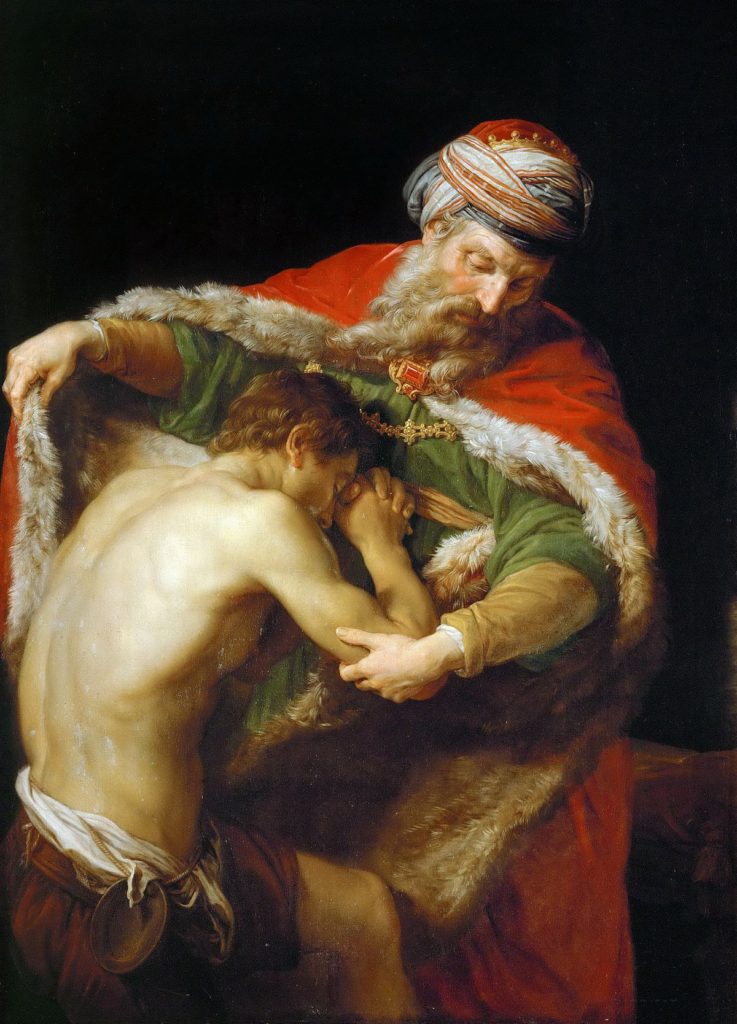
In this parable, a certain man had two sons the youngest of which requested his share of the inheritance of his father’s estate. The young man took his inheritance from his father and left home to journey into a far country where he wasted it on riotous living. A famine broke out and the penniless and hungry son joined (literally, glued, joined tightly) himself to a citizen of that country as a servant. His new master then sent him into the fields to feed husks to the swine. Conditions were so bad for the son and his hunger so acute that he desired to eat the swine’s food. Out of desperation and in realization of his sinful condition, the young man determined to return to his father’s house, willing no longer worthy to be received as a son, but to be received only a hired servant. His father spotted him a great way off, had compassion on him, ran to greet him and fell on his neck and kissed him where upon the son confessed to his father that he had sinned against heaven and that he was no longer worthy to be called a son. The father, out of joy, dressed his son in the finest robe, put a ring on his finger and shoes on his feet. The father had the fatted calf killed and merriment was made over the return of the prodigal. To the father, the son was dead, but was now alive, was lost and was now found. Feasting ensued with music and dancing. When the elder brother heard the feasting and found out about the return of his younger brother, he was angry and refused to participate in the celebration. The father pleaded with him to join the feast. The jealous older brother stated that he had faithfully served the father during the intervening years and that a feast had never been made for him, but that the younger son who had wasted his inheritance on harlots and riotous living was now receiving royal treatment. The father replied that the elder son had no reason to be angry since he had always been with the father enjoying the rights and privileges of that position and that it was only proper to celebrate the return of the prodigal brother who had been “dead” and was “alive” again, had been lost and was now found.
Prophetic Points to Analyze:
verse 11— two sons
verse 13— far country
verse 13— riotous living
verse 15— joined himself to a citizen of that country
verse 15— feed husks to the swine
verse 16— desired to fill his belly with the husks that the swine did eat
verse 18— return to my father
verse 22— best robe
verse 24— he was lost, and is found
verse 25— elder son
verse 27— your younger brother
verse 30— wasted his inheritance with harlots
verse 32— was dead and is alive again
verse 32— was lost and is found
This parable, in a nutshell, outlines much of the history of Israel up to the end time final redemption. This is a parable that is a genre of ancient Jewish literature called aggadah. The purpose of aggadic literature was not to establish line-by-line dogma, doctrine or theological truth, but was a means to teach general moral principles in story form. We will discuss this at greater length latter in our treatment of the Parable of Lazarus and the Rich Man in Luke 16.